
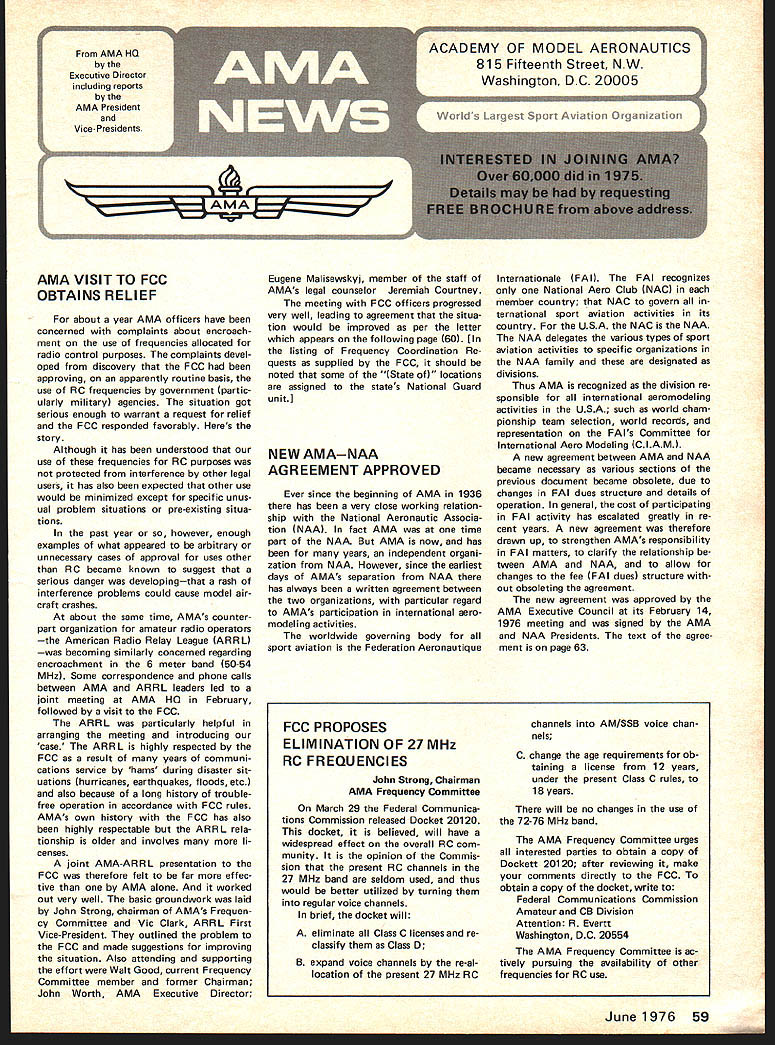
AMA VISIT TO FCC OBTAINS RELIEF
For about a year AMA officers have been concerned with complaints about encroachment on the use of frequencies allocated for radio control purposes. The complaints developed from discovery that the FCC had been approving, on an apparently routine basis, the use of RC frequencies by government (particularly military) agencies. The situation got serious enough to warrant a request for relief and the FCC responded favorably. Here's the story.
Although it has been understood that our use of these free frequencies for RC purposes was not protected from interference by other legal users, it has also been expected that other use would be minimized except for specific unusual problem situations or pre-existing situations. In the past year or so, however, enough examples of what appeared to be arbitrary or unnecessary cases of approval for uses other than RC became known to suggest that a serious danger was developing—that a rash of interference problems could cause model aircraft crashes.
At about the same time, AMA's counterpart organization for amateur radio operators—the American Radio Relay League (ARRL)—was becoming similarly concerned regarding encroachment in the 6 meter band (50–54 MHz). Some correspondence and phone calls between AMA and ARRL leaders led to a joint meeting at AMA HQ in February, followed by a visit to the FCC.
The ARRL was particularly helpful in arranging the meeting and introducing our case. The ARRL is highly respected by the FCC as a result of many years of communications service by "hams" during disaster situations (hurricanes, earthquakes, floods, etc.), and also because of a long history of trouble-free operation in accordance with FCC rules. AMA's own history with the FCC has also been highly respectable but the ARRL relationship is older and involves many more licenses.
A joint AMA–ARRL presentation to the FCC was therefore felt to be far more effective than one by AMA alone. And it worked out very well. The basic groundwork was laid by John Strong, chairman of AMA's Frequency Committee and Vic Clark, ARRL First Vice-President. They outlined the problem to the FCC and made suggestions for improving the situation. Also attending and supporting the effort were Walt Good, current Frequency Committee member and former Chairman; John Worth, AMA Executive Director; Eugene Malisewskyj, member of the staff of AMA's legal counselor Jeremiah Courtney.
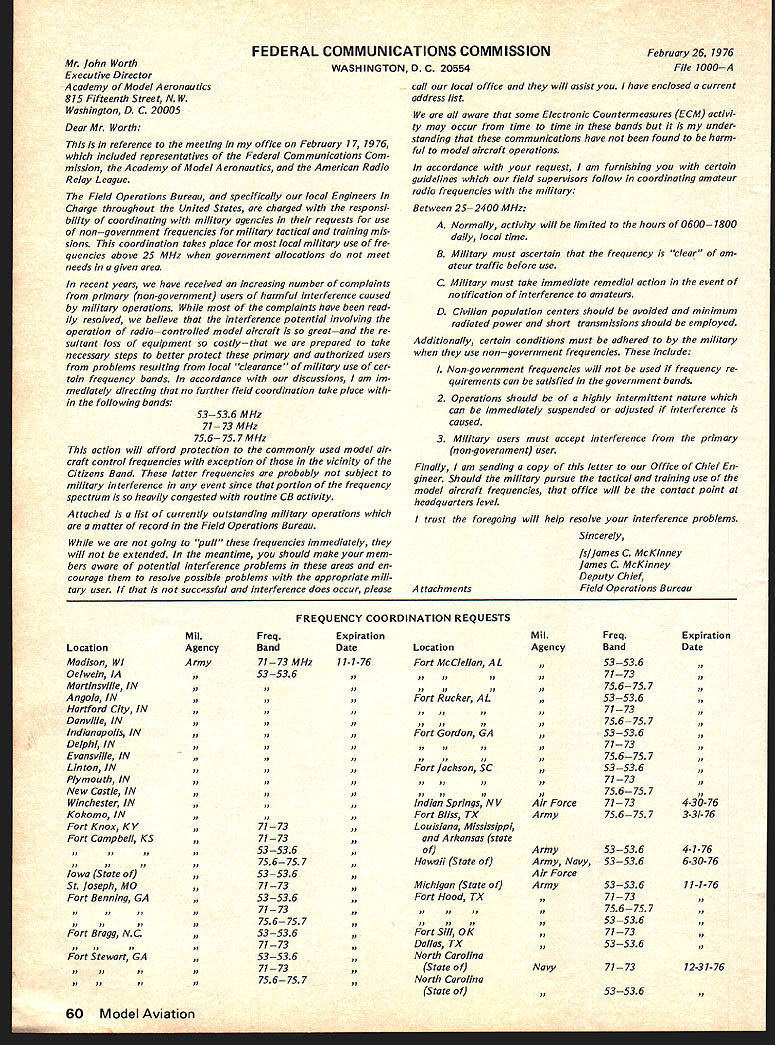
The meeting with FCC officers progressed very well, leading to agreement that the situation would be improved as per the letter which appears on the following page (60). [In the listing of Frequency Coordination Requests supplied by the FCC, it should be noted that some of the "State of" locations are assigned to the state's National Guard unit.] FEDERAL COMMUNICATIONS COMMISSION WASHINGTON, D. C. 20554 February 26, 1976 File 1000–A
Mr. John Worth Executive Director Academy of Model Aeronautics 815 Fifteenth Street, N.W. Washington, D. C. 20005
Dear Mr. Worth:
This is in reference to the meeting in my office on February 17, 1976, which included representatives of the Federal Communications Commission, the Academy of Model Aeronautics, and the American Radio Relay League.
The Field Operations Bureau, and specifically our local Engineers In Charge throughout the United States, are charged with the responsibility of coordinating with military agencies in their requests for use of non-government frequencies for military tactical and training missions. This coordination takes place for most local military use of frequencies above 25 MHz when government allocations do not meet needs in a given area.
In recent years, we have received an increasing number of complaints from primary (non-government) users of harmful interference caused by military operations. While most of the complaints have been readily resolved, we believe that the interference potential involving the operation of radio-controlled model aircraft is so great — and the resultant loss of equipment so costly — that we are prepared to take necessary steps to better protect these primary and authorized users from problems resulting from local "clearance" of military use of certain frequency bands. In accordance with our discussions, I am immediately directing that no further field coordination take place within the following bands:
53–53.6 MHz 71–73 MHz 75.6–75.7 MHz
This action will afford protection to the commonly used model aircraft control frequencies with exception of those in the vicinity of the Citizens Band. These latter frequencies are probably not subject to military interference in any event since that portion of the frequency spectrum is so heavily congested with routine CB activity.
Attached is a list of currently outstanding military operations which are a matter of record in the Field Operations Bureau.
While we are not going to "pull" these frequencies immediately, they will not be extended. In the meantime, you should make your members aware of the potential interference problems in these areas and encourage them to resolve possible problems with the appropriate military user. If that is not successful and interference does occur, please call our local office and they will assist you. I have enclosed a current address list.
We are all aware that some Electronic Countermeasures (ECM) activity may occur from time to time in these bands but it is my understanding that these countermeasures have not been found to be harmful to model aircraft operations.
In accordance with your request, I am furnishing you with certain guidelines which our field supervisors follow in coordinating amateur radio frequencies with the military:
Between 25–2400 MHz:
A. Normally, activity will be limited to the hours of 0600–1800 daily, local time.
B. Military must ascertain that the frequency is "clear" of amateur traffic before use.
C. Military must take immediate remedial action in the event of notification of interference to amateurs.
D. Civilian population centers should be avoided and minimum radiated power and short transmissions should be employed.
Additionally, certain conditions must be adhered to by the military when they use non-government frequencies. These include:
- Non-government frequencies will not be used if frequency requirements can be satisfied in the government bands.
- Operations should be of a highly intermittent nature which can be immediately suspended or adjusted if interference is caused.
- Military users must accept interference from the primary (non-government) user.
Finally, I am sending a copy of this letter to our Office of Chief Engineer. Should the military pursue the tactical and training use of the model aircraft frequencies, that office will be the contact point at Headquarters level.
I trust the foregoing will help resolve your interference problems.
(s) James C. McKinney James C. McKinney Deputy Chief, Field Operations Bureau
Attachments
AMA VISIT TO FCC OBTAINS RELIEF
About a year ago AMA officers became concerned over complaints about encroachment in the use of frequencies allocated to radio control purposes. Complaints developed on discovery of the FCC approving, apparently on a routine basis, use of RC frequencies by government, particularly military, agencies. The situation got serious enough to warrant a request for relief. The FCC responded favorably. Here's the story.
Although it has been understood the use of frequencies for RC purposes is protected from interference by other legal users, it has also been expected other use would be minimized except in specific unusual problem situations pre-existing. During the past year, however, enough examples of what appeared arbitrary, unnecessary cases of approval of uses on other RC frequencies became known to suggest a serious danger developing—that rash interference problems could cause model aircraft crashes. About the same time AMA's counterpart organization, amateur radio operators, the American Radio Relay League (ARRL), became similarly concerned regarding encroachment on the 6-meter band, 50–54 MHz. Some correspondence and phone calls between AMA and ARRL leaders led to a joint meeting at AMA headquarters in February, followed by a visit to the FCC. ARRL, particularly helpful in arranging the meeting and introducing the case, is highly respected by the FCC as a result of years of communications service by hams during disaster situations—hurricanes, earthquakes, floods, etc.—and also because of a long history of trouble-free operation in accordance with FCC rules. AMA's own history with the FCC has also developed a highly respectable relationship. Because a joint AMA–ARRL presentation to the FCC would therefore be far more effective than AMA alone, the basic groundwork was laid by John Strong, chairman of AMA's Frequency Committee, and Vic Clark, ARRL First Vice‑President, who outlined the problem and discussed suggestions for improving the situation. Also attending and supporting the effort were Walt Good, current Frequency Committee member and former chairman; John Worth, AMA Executive Director; Eugene Malisewskyj, member of the staff; and AMA's legal counselor Jeremiah Courtney. The meeting with FCC officers progressed very well, leading to agreement the situation would be improved per the letter appearing on the following page.
(In listing Frequency Coordination Requests supplied to the FCC it should be noted some State locations are assigned to states' National Guard units.)
NEW AMA–NAA AGREEMENT APPROVED
Ever since the beginning of AMA in 1936, AMA has had a very close working relationship with the National Aeronautic Association (NAA). In fact, at one time AMA was part of NAA. AMA is now an independent organization apart from NAA. However, since the earliest days of AMA's separation from NAA there has always been a written agreement between the two organizations, particularly regarding AMA's participation in international aeromodeling activities. The worldwide governing body for sport aviation is the Fédération Aéronautique Internationale (FAI). FAI recognizes the National Aero Club (NAC) of each member country. The NAC governs international sport aviation activities in its country. In the USA the NAC is the NAA. NAA delegates various types of sport aviation activities to specific organizations. In the NAA family of divisions, AMA is recognized as the division responsible for international aeromodeling activities in the USA—such as world championship team selection, world records, and representation on FAI's Committee International Aero Modeling (CIAM). The new agreement between AMA and NAA became necessary because various sections of the previous document became obsolete due to changes in the FAI dues structure and because details of operation and the general cost of participating in FAI activity have escalated greatly in recent years. The new agreement was therefore drawn up to strengthen AMA's responsibility for FAI matters and to clarify the relationship between AMA and NAA and to allow changes in the fee/FAI dues structure without obsoleting the agreement. The new agreement was approved by the AMA Executive Council at its February 14, 1976 meeting and signed AMA N
AMA VISIT TO FCC OBTAINS RELIEF
For about a year AMA officers have been concerned over complaints about encroachment on the use of frequencies allocated for radio control purposes. Complaints developed by discovery of the FCC approving, on an apparently routine basis, use of RC frequencies by government, particularly military agencies. The situation got serious enough to warrant a request for relief. The FCC responded favorably. Here's the story.
Although it has been understood that use of frequencies for RC purposes is protected from interference by other legal users, it has also been expected that other uses would be minimized except in specific unusual problem situations. Pre-existing situations in the past year, however, and enough examples of what appeared to be arbitrary unnecessary cases of approval of uses other than RC became known to suggest a serious danger developing—that rash interference problems could cause model aircraft crashes. About the same time AMA's counterpart organization, the amateur radio operators' American Radio Relay League (ARRL), became similarly concerned regarding encroachment of the 6-meter band (50-54 MHz). Some correspondence and phone calls between AMA and ARRL leaders led to a joint meeting at AMA Headquarters in February followed by a visit to the FCC. ARRL was particularly helpful in arranging the meeting and in introducing the case. ARRL is highly respected by the FCC because of years of communications service by hams during disaster situations (hurricanes, earthquakes, floods, etc.), and because of their long history of trouble-free operation in accordance with FCC rules. AMA's own history with the FCC is also highly respectable. The ARRL relationship is older and involves licensed operators. The joint AMA-ARRL presentation to the FCC therefore felt far more effective than if AMA had worked alone. The basic groundwork was laid by John Strong, chairman of AMA's Frequency Committee; Vic Clark, ARRL First Vice-President, outlined the problem and the FCC made suggestions for improving the situation. Also attending and supporting the effort were Walt Good, current Frequency Committee member and former chairman; John Worth, AMA Executive Director; Eugene Malisewskyj, member of staff; and AMA's legal counselor Jeremiah Courtney. The meeting with FCC officers progressed very well, leading to agreement that the situation would be improved, per a letter which appears on the following page.
[In listing Frequency Coordination Requests supplied to the FCC, it should be noted some State locations are assigned to their State National Guard unit.]
FCC PROPOSES ELIMINATION OF 27 MHz RC FREQUENCIES
John Strong, Chairman, AMA Frequency Committee
On March 29 the Federal Communications Commission released Docket 20120, a docket believed will have widespread effect on the overall RC community. In the Commission's view the present RC channels in the 27 MHz band are seldom used and would be better utilized by turning them into regular voice channels. The brief docket will:
A. eliminate Class C licenses and reclassify Class D;
B. expand voice channels and re-allocation of present 27 MHz RC channels.
NEW AMA-NAA AGREEMENT APPROVED
Ever since the beginning of the AMA in 1936 there has been a very close working relationship with the National Aeronautic Association (NAA). In fact, at one time the AMA was part of the NAA. AMA now functions as an independent organization. However, since the earliest days following AMA's separation from the NAA there has always been a written agreement between the two organizations with particular regard to the AMA's participation in international aeromodeling activities and the worldwide governing body for sport aviation, the Federation Aeronautique Internationale (FAI).
The FAI recognizes a National Aero Club (NAC) for each member country. The NAC governs international sport aviation activities in its country. In the USA the NAC is the NAA. The NAA delegates responsibility for various types of sport aviation activities to specific organizations in the NAA family; thus the AMA is the recognized division responsible for international aeromodeling activities for the USA — such as world championship team selection, world records, and representation to the FAI's Commission Internationale d'Aeromodelisme (CIAM).
A new agreement between the AMA and the NAA became necessary as various sections of the previous document became obsolete due to changes in FAI dues structure and details of operation. The general cost of participating in FAI activity has escalated greatly in recent years. The new agreement therefore was drawn up to strengthen the AMA's responsibility for FAI matters and to clarify the relationship between the AMA and the NAA and to allow changes in fees and the FAI dues structure without obsoleting the agreement. The new agreement was approved by the AMA Executive Council at its February 14, 1976 meeting and signed by the AMA.
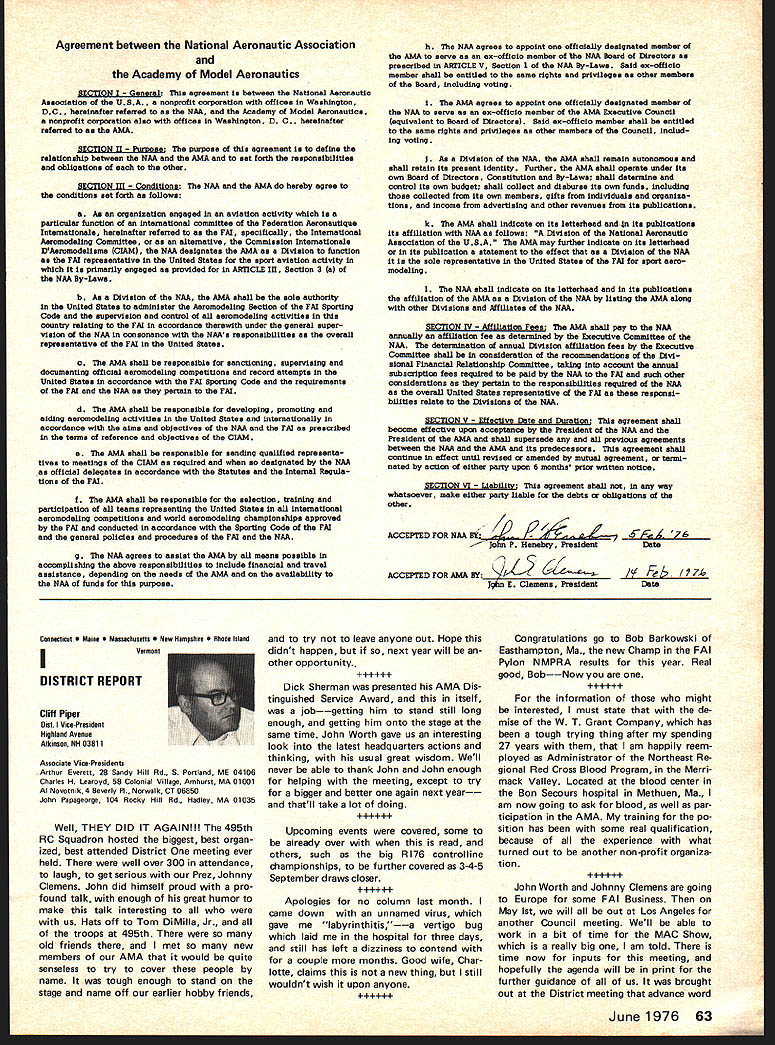
Agreement between the National Aeronautic Association and the Academy of Model Aeronautics
SECTION I - General: This agreement is between the National Aeronautic Association of the U.S.A., a nonprofit corporation with offices in Washington, D.C., hereinafter referred to as the NAA, and the Academy of Model Aeronautics, a nonprofit corporation with offices in Washington, D.C., hereinafter referred to as the AMA.
SECTION II - Purpose: The purpose of this agreement is to define the relationship between the NAA and the AMA and to set forth the responsibilities and obligations of each to the other.
SECTION III - Conditions: The NAA and the AMA do hereby agree to the conditions set forth as follows:
a. As an organization engaged in an aviation activity which is a particular function of an international committee of the Federation Aeronautique Internationale, hereinafter referred to as the FAI, specifically, the International Aeromodeling Committee, or as an alternative, the Commission Internationale d'Aeromodelisme (CIAM), the AMA designates the AMA Division to function as the FAI representative in the United States for the sport aviation activity in which it is primarily engaged as provided for in ARTICLE III, Section 3(a) of the NAA By-Laws.
b. As a Division of the NAA, the AMA shall be the sole authority in the United States to administer the Aeromodeling Section of the FAI Sporting Code and the supervision and control of all aeromodeling activities in this country relating to the FAI in accordance therewith under the general supervision of the NAA in accordance with the NAA's responsibilities as the overall representative of the NAA in the United States.
c. The AMA shall be responsible for sanctioning, supervising and documenting official aeromodeling competitions and record attempts in the United States in accordance with the FAI Sporting Code and the requirements of the FAI and the NAA as they pertain to the FAI.
d. The AMA shall be responsible for developing, promoting and aiding aeromodeling activities in the United States and internationally in accordance with the aims and objectives of the NAA and the FAI as prescribed in the terms of reference and objectives of the CIAM.
e. The AMA shall be responsible for sending qualified representatives to meetings of the CIAM as required and when so delegated by the NAA and shall provide officials and delegates in accordance with the Statutes and the Internal Regulations of the FAI.
f. The NAA shall be responsible for the selection, training and participation of all teams representing the United States in all international aeromodeling competitions and world aeromodeling championships approved by the FAI and conducted in accordance with the Sporting Code of the FAI and the general policies and procedures of the FAI and the NAA.
g. The NAA agrees to assist the AMA by all means possible in accomplishing the above responsibilities including financial and travel assistance depending on the resources of the NAA and the availability to the NAA of funds for this purpose.
h. The NAA agrees to appoint one officially designated member of the AMA to serve as an ex-officio member of the NAA Board of Directors as prescribed in ARTICLE V, Section 1 of the NAA By-Laws. Said ex-officio member shall be entitled to the same rights and privileges as other members of the Board, including voting.
i. The AMA agrees to appoint one officially designated member of the AMA to serve as an ex-officio member of the AMA Executive Council (equivalent to Board of Directors). Said ex-officio member shall be entitled to the same rights and privileges as other members of the Council, including voting.
j. A Division of the NAA, the AMA shall remain subject to and shall retain its present identity. Further, the AMA shall operate under its own Board of Directors, Constitution and By-Laws; shall determine and control its own budget; shall collect and disburse its own funds, including those collected from its own members, gifts from individuals and organizations, and income from advertising and other revenues from its publications.
k. The AMA shall indicate on its letterhead and in its publications its affiliation with the NAA as follows: "A Division of the National Aeronautic Association of the U.S.A." The AMA may further indicate on its letterhead or in its publications a statement to the effect that as a Division of the NAA it is the sole representative in the United States of the FAI for sport aeromodeling.
l. The NAA shall indicate on its letterhead and in its publications the affiliation of the AMA as a Division of the NAA by listing the AMA along with other Divisions and Affiliates of the NAA.
SECTION IV - Affiliation Fees: The AMA shall pay to the NAA annually an affiliation fee as determined by the Executive Committee of the NAA. The determination of annual affiliation fees by the Executive Committee shall be in consideration of the recommendations of the Divisional Financial Relationship Committee, taking into account the annual subscription fees required to be paid by the NAA to the FAI, the FAI's budgetary requirements as they pertain to the responsibilities assigned to the NAA as the overall United States representative of the FAI, as these responsibilities relate to the Divisions of the NAA.
SECTION V - Effective Date and Duration: This agreement shall become effective upon acceptance by the President of the NAA and the President of the AMA and shall supersede and replace any and all previous agreements between the NAA and the AMA and of its predecessors. This agreement shall continue in effect until revised or amended by mutual agreement, or terminated by action of either party upon six months' prior written notice.
SECTION VI - Liability: This agreement shall not, in any way whatsoever, make either party liable for the debts or obligations of the other.
ACCEPTED FOR NAA BY: J. F. Henecky, President Date 5 Feb 76
ACCEPTED FOR AMA BY: John E. Clemens, President Date 14 Feb 1976
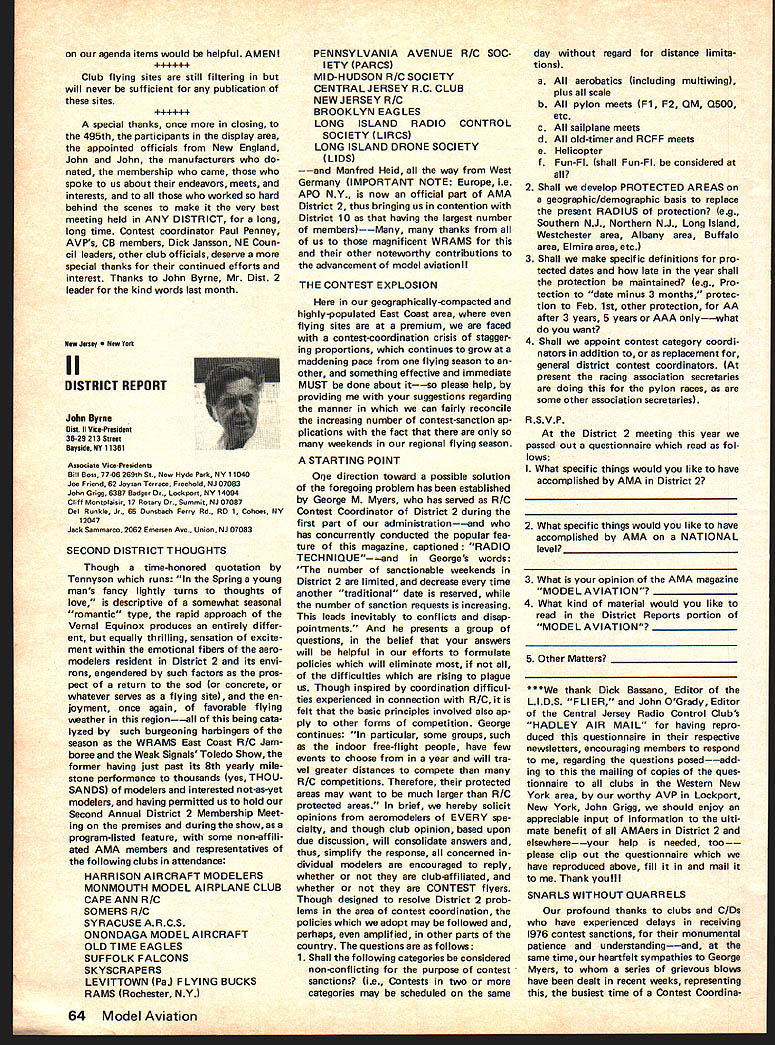
II DISTRICT REPORT
John Byrne Dist. II Vice-President 36-29 213 Street Bayside, NY 11361
Associate Vice-Presidents Bill Ross, 77-06 263rd St., New Hyde Park, NY 11040 Joe Friend, 62 Jaynor Terrace, Freehold, NJ 07728 John Griggs, 687 Broadview Dr., Lockport, NY 14094 Cliff McAnshy, 117 Beaty Dr., Summit, NJ 07089 R. Franklyn, Sr., 65 Dundas Farm Rd., RD 1, Cobleskill, NY 12043 Jack Sanmarco, 2062 E. 16th Ave., Union, NJ 07083
SECOND DISTRICT THOUGHTS
Though a time-honored quotation by Tennyson which runs: "In the Spring a young man's fancy lightly turns to thoughts of love," is descriptive of a somewhat seasonal "romantic" type, the rapid approach of the Vernal Equinox produces an entirely different but equally thrilling sensation of excitement within the emotional fibers of the aeromodelers resident in District 2 and its environs, engendered by such factors as the prospect of a return to the sod (or concrete, or whatever serves as a flying site), and the enjoyment, once again, of favorable flying weather in this region — all of this being catalyzed by such burgeoning harbingers of the season as the WRAMS East Coast R/C Jamboree and the Waga Signals' Toledo Show, the former having just past its 8th yearly milestone performance to thousands (yes, THOUSANDS) of modelers and interested not-as-yet modelers, and having permitted us to hold our Second Annual District 2 Membership Meeting on the premises and during the show, as a program-listed feature, with some non-affiliated AMA members and representatives of the following clubs in attendance:
- HARRISON AIRCRAFT MODELERS
- MONMOUTH MODEL AIRPLANE CLUB
- CAPE ANN R/C
- SOMERS R/C
- SYRACUSE A.R.C.S.
- ONONDAGA MODEL AIRCRAFT
- OLD TIME EAGLES
- SUFFOLK FALCONS
- SKYSCRAPERS
- LEVITTOWN (Pa) FLYING BUCKS
- RAMS (Rochester, N.Y.)
PENNSYLVANIA AVENUE R/C SOCIETY (PARCS) MID-HUDSON R/C SOCIETY CENTRAL JERSEY R.C. CLUB NEW JERSEY R/C BROOKLYN EAGLES LONG ISLAND RADIO CONTROL SOCIETY (LIRCS) LONG ISLAND DRONE SOCIETY (LIDS)
—and Manfred Heidl, all the way from West Germany (IMPORTANT NOTE: Europe, i.e., APO N.Y., is now an official part of AMA District 2, thus bringing us in contention with District 10 as that having the largest number of members!)—Many, many thanks from all of us to those magnificent WRAMS from FL and their other noteworthy contributions to the advancement of model aviation!!
THE CONTEST EXPLOSION
Here in our geographically-compacted and highly-populated East Coast area, where even flying sites are at a premium, we are faced with a contest-coordination crisis of staggering proportions, which continues to grow at a maddening pace from one flying season to another, and something effective and immediate MUST be done about it—so please help, by providing me with your suggestions regarding the manner in which we can fairly reconcile the increasing number of contest-sanction applications with the fact that there are only so many weekends in our regional flying season.
A STARTING POINT
One direction toward a possible solution of the foregoing problem has been established by George M. Myers, who has served as R/C Contest Coordinator of District 2 during the first part of our administration—and who has concurrently conducted the popular feature of this magazine, captioned: "RADIO TECHNIQUE"—and in George's words: "The number of sanctionable weekends in District 2 are limited, and decrease every time another 'traditional' date is reserved, while the number of sanction requests is increasing. This leads inevitably to conflicts and disappointments." And he presents a group of questions, in the belief that your answers will be helpful in our efforts to formulate policies which will eliminate most, if not all, of the difficulties which are rising to plague us. Though inspired by coordination difficulties experienced in connection with R/C, it is felt that the basic principles involved also apply to other forms of competition. George continues: "In particular, some groups, such as the indoor free-flight people, have few events to choose from in a year and will travel greater distances to compete than many R/C competitors. Therefore, their protected areas may want to be much larger than R/C protected areas." In brief, we hereby solicit opinions from aeromodelers of EVERY specialty, and though club opinion, based upon due discussion, will consolidate answers and, thus, simplify the response, all concerned individual modelers are encouraged to reply, whether or not they are club-affiliated, and whether or not they are CONTEST flyers. Though designed to resolve District 2 problems in the area of contest coordination, the policies which we adopt may be followed and, perhaps, even amplified, in other parts of the country. The questions are as follows:
- Shall the following categories be considered non-conflicting for the purpose of contest sanctions? (i.e., Contests in two or more categories may be scheduled on the same day without regard for distance limitations.)
a. All aerobatics (including multiwing), plus all scale b. All pylon meets (F1, F2, Q/M, O500, etc.) c. All sailplane meets d. All old-timer and RCFF meets e. Helicopter f. Fun-Fly (shall Fun-Fly be considered at all?)
- Shall we develop PROTECTED AREAS on a geographic/demographic basis to replace the present RADIUS of protection? (e.g., Southern N.J., Northern N.J., Long Island, Westchester area, Albany area, Buffalo area, Elmira area, etc.)
- Shall we make specific definitions for protected dates and how late in the year shall the protection be maintained? (e.g., Protection to "date minus 3 months," protection to Feb. 1st, other protection for AA after 3 years, 5 years or AAA only—what do you want?)
- Shall we appoint contest category coordinators in addition to, or as replacement for, general district contest coordinators? (At present the racing association secretaries are doing this for the pylon races, as are some other association secretaries.)
R.S.V.P.
At the District 2 meeting this year we passed out a questionnaire which read as follows:
- What specific things would you like to have accomplished by AMA in District 2?
______________________________________________________________________
- What specific things would you like to have accomplished by AMA on a NATIONAL level?
- What is your opinion of the AMA magazine "MODEL AVIATION"?
- What kind of material would you like to read in the District Reports portion of "MODEL AVIATION"?
- Other Matters?
...We thank Dick Bassano, Editor of the L.I.D.S. "FLIER", and John O'Grady, Editor of the Central Jersey Radio Control Club's "HADLEY AIR MAIL" for having reproduced this questionnaire in their respective newsletters, encouraging members to respond to me, regarding the questions posed—and I do this to the mailing of copies of the questionnaire to all clubs in the Western New York area, by our worthy AVP in Lockport, New York, John Griggs, we should enjoy an appreciable input of information to the ultimate benefit of all AMAers in District 2 and elsewhere—your help is needed, too—please clip out the questionnaire which we have reproduced above, fill it in and mail it to me. Thank you!!
SNARLS WITHOUT QUARRELS
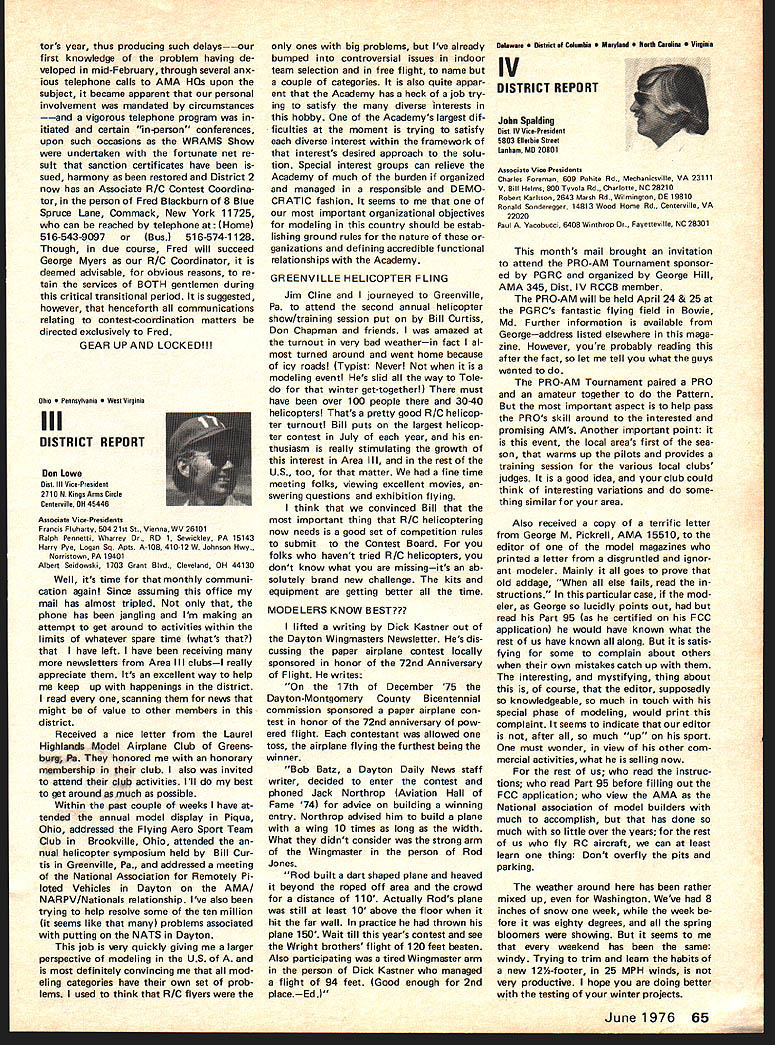
Our profound thanks to clubs and C/Ds who have experienced delays in receiving 1976 contest sanctions, for their monumental patience and understanding—and, at the same time, our heartfelt sympathies to George Myers, who has had a series of grievous blows and has been laid up in recent weeks, representing, this, the busiest time of a Contest Coordinator.
AMA News
AMA VISIT TO FCC OBTAINS RELIEF
About a year ago AMA officers became concerned over complaints about encroachment on the use of frequencies allocated for radio control purposes. The complaints developed on discovery of the FCC approving, apparently on a routine basis, use of RC frequencies by government, particularly military agencies. The situation got serious enough to warrant a request for relief. The FCC responded favorably. Here's the story.
Although it has been understood that use of frequencies for RC purposes is protected from interference by other legal users, it was also expected that other use would be minimized except in specific unusual problem situations. The pre-existing situation last year, however, produced enough examples of what appeared to be arbitrary, unnecessary cases of approval for uses other than RC to suggest a serious danger developing—that rash interference problems could cause model aircraft crashes.
About the same time AMA's counterpart organization, the American Radio Relay League (ARRL), became similarly concerned regarding encroachment on the 6 meter band (50-54 MHz). Some correspondence and phone calls between AMA and ARRL leaders led to a joint meeting at AMA HQ in February, followed by a visit to the FCC. ARRL, particularly helpful in arranging the meeting and introducing the case, is highly respected at the FCC as a result of years of communications service by hams during disaster situations—hurricanes, earthquakes, floods, etc.—and because of their long history of trouble-free operation in accordance with FCC rules. AMA has also a highly respectable relationship with ARRL, one which involves licenses. A joint AMA-ARRL presentation to the FCC therefore felt far more effective than AMA alone. It worked out very well.
Basic groundwork was laid by John Strong, chairman of AMA's Frequency Committee, and Vic Clark, ARRL First Vice-President, who outlined the problem. The FCC made suggestions for improving the situation. Also attending and supporting the effort were Walt Good, current Frequency Committee member and former chairman; John Worth, AMA Executive Director; Eugene Malisewskyj, member of the staff; and Jeremiah Courtney, AMA's legal counselor. The meeting with FCC officers progressed very well, leading to an agreement the situation would be improved, per the letter appearing on the following page.
[In listing Frequency Coordination Requests supplied to the FCC, it should be noted some State locations are assigned to State National Guard units.]
NEW AMA-NAA AGREEMENT APPROVED
Ever since the beginning of AMA in 1936 it has had a very close working relationship with the National Aeronautic Association (NAA). In fact, at one time AMA was part of NAA; AMA has now been an independent organization for many years. However, since the earliest days after AMA's separation from NAA there has always been a written agreement between the two organizations, particularly with regard to AMA's participation in international aeromodeling activities. The worldwide governing body of sport aviation is the Federation Aeronautique Internationale (FAI).
FAI recognizes the National Aero Club (NAC) of each member country. The NAC governs international sport aviation activities in its country. In the USA the NAC is the NAA. NAA delegates various types of sport aviation activities to specific organizations in the NAA family. Thus AMA is recognized as the division responsible for international aeromodeling activities in the USA—such things as world championship team selection, world records, and representation on FAI's Committee for International Aero Modeling (CIAM).
A new agreement between AMA and NAA became necessary because various sections of the previous document became obsolete due to changes in FAI dues structure and because details of operation and the general cost of participating in FAI activities have escalated greatly in recent years. The new agreement therefore has been drawn up to strengthen AMA's responsibility for FAI matters and to clarify the relationship between AMA and NAA, allowing changes in the fee/FAI dues structure without obsoleting the agreement. The new agreement was approved by the AMA Executive Council at its February 14, 1976 meeting and signed by AMA N signed by AMA and NAA.
AMA VISIT TO FCC OBTAINS RELIEF
About a year ago AMA officers became concerned about complaints of encroachment in the use of frequencies allocated for radio-control purposes. Complaints developed upon discovery of the FCC approving, apparently on a routine basis, use of R/C frequencies by government, particularly military, agencies. The situation got serious enough to warrant a request for relief. The FCC responded favorably. Here's the story.
Although it has been understood that use of frequencies for R/C purposes is protected from interference by other legal users, it was also expected that other uses would be minimized except in specific unusual problem situations pre-existing in that area. Over the past year, however, enough examples of what appeared to be arbitrary, unnecessary cases of approval for uses other than R/C became known to suggest a serious danger developing—that a rash of interference problems could cause model aircraft crashes. About the same time, AMA's counterpart organization, the American Radio Relay League (ARRL), became similarly concerned regarding encroachment on the 6 meter band (50–54 MHz).
Some correspondence and phone calls between AMA and ARRL leaders led to a joint meeting at AMA headquarters in February, followed by a visit to the FCC. ARRL was particularly helpful in arranging the meeting and in introducing the case. ARRL is highly respected by the FCC, a result of years of communications service by hams during disaster situations—hurricanes, earthquakes, floods, etc.—and because of a long history of trouble-free operation in accordance with FCC rules. AMA's own history with the FCC is also highly respectable and the ARRL relationship, which in older matters involved licenses, made a joint AMA–ARRL presentation to the FCC far more effective than AMA working alone.
The visit worked out very well. The basic groundwork was laid by John Strong, chairman of AMA's Frequency Committee, and Vic Clark, ARRL First Vice-President, who outlined the problem. The FCC made suggestions for improving the situation. Also attending and supporting the effort were Walt Good (current Frequency Committee member and former chairman), John Worth (AMA Executive Director), Eugene Malisewskyj (member of staff), and Jeremiah Courtney (AMA's legal counselor). The meeting with FCC officers progressed very well, leading to agreement that the situation would be improved, per the letter appearing on the following page.
[In listing Frequency Coordination Requests supplied to the FCC, it should be noted some State locations are assigned to a state's National Guard unit.]
FCC PROPOSES ELIMINATION OF 27 MHz R/C FREQUENCIES
John Strong, Chairman, AMA Frequency Committee
On March 29 the Federal Communications Commission released Docket 20120, a docket believed will have widespread effect on the overall R/C community. In the opinion of the Commission, present R/C channels in the 27 MHz band are seldom used and thus would be better utilized by turning regular voice channels into R/C channels. In brief, the docket will:
- A eliminate Class C licenses and reclassify Class D
- B expand voice channels and re-allocation of present 27 MHz R/C channels
(End of continued text on this page.)
NEW AMA-NAA AGREEMENT APPROVED
Ever since the beginning of AMA in 1936 there has been a very close working relationship with the National Aeronautic Association (NAA). In fact, at one time AMA was part of the NAA. AMA now has many years as an independent organization. However, since the earliest days after AMA's separation from the NAA there has always been a written agreement between the two organizations, particularly with regard to AMA's participation in international aeromodeling activities.
The worldwide governing body for sport aviation is the Federation Aeronautique Internationale (FAI). FAI recognizes a National Aero Club (NAC) in each member country. The NAC governs international sport aviation activities in its country. In the USA the NAC is the NAA. NAA delegates various types of sport aviation activities to specific organizations in the NAA family. Thus AMA is recognized as the division responsible for international aeromodeling activities in the USA such as world championship team selection, world records and representation in FAI's Comité International d'Aéromodélisme (CIAM).
A new agreement between AMA and NAA became necessary since various sections of the previous document became obsolete due to changes in FAI dues structure, details of operation and the general cost of participating in FAI activity which has escalated greatly in recent years. The new agreement therefore was drawn up to strengthen AMA's responsibility in FAI matters and to clarify the relationship between AMA and NAA and to allow changes in the FAI dues structure without obsoleting the agreement. The new agreement was approved by the AMA Executive Council at its February 14, 1976 meeting and signed.
AMA VISIT TO FCC OBTAINS RELIEF
About a year ago AMA officers became concerned about complaints about encroachment in the use of frequencies allocated to radio control purposes. Complaints developed on discovery of the FCC approving, apparently on a routine basis, use of RC frequencies by government, particularly military, agencies. The situation got serious enough to warrant a request for relief. The FCC responded favorably. Here's the story.
Although it has been understood that the use of frequencies for RC purposes is protected from interference by other legal users, it has also been expected that other use would be minimized except for specific unusual problem situations or pre-existing situations. The past year, however, produced enough examples of what appeared to be arbitrary, unnecessary cases of approval for use of RC frequencies by others to suggest a serious danger developing—that rash interference problems could cause model aircraft crashes.
About the same time AMA's counterpart organization, the amateur radio operators' American Radio Relay League (ARRL), was becoming similarly concerned regarding encroachment on the 6-meter band (50-54 MHz). Some correspondence and phone calls between AMA and ARRL leaders led to a joint meeting at AMA Headquarters in February followed by visits to the FCC. ARRL was particularly helpful in arranging the meeting and introducing the case. ARRL is highly respected at the FCC because of years of communications service by hams during disaster situations—hurricanes, earthquakes, floods, etc. Also, because of the long history of trouble-free operation in accordance with FCC rules, AMA's own history with the FCC is also highly respectable. The ARRL relationship, older and involving licenses, meant that the joint AMA-ARRL presentation to the FCC was therefore felt far more effective than AMA alone. It worked out very well.
Basic groundwork was laid by John Strong, chairman of AMA's Frequency Committee; Vic Clark, ARRL First Vice-President, outlined the problem. The FCC made suggestions for improving the situation. Also attending and supporting the effort were Walt Good, current Frequency Committee member and former chairman; John Worth, AMA Executive Director; Eugene Malisewskyj, member of the staff; and AMA's legal counselor Jeremiah Courtney. The meeting with FCC officers progressed very well, leading to an agreement that the situation would be improved, per the letter that appears on the following page.
AMA HQ Note: This column was intended for the April issue but just missed the deadline.
FCC PROPOSES ELIMINATION OF 27 MHz RC FREQUENCIES
John Strong, Chairman, AMA Frequency Committee
March 29 — The Federal Communications Commission released Docket 20120, a docket believed will have widespread effect on the overall RC community. The Commission feels the present RC channels in the 27 MHz band are seldom used and thus would be better utilized by turning them into regular voice channels. In brief, the docket will:
A. Eliminate Class C licenses and reclassify them as Class D.
B. Expand voice channels and reallocate present 27 MHz RC frequencies.
AMA News
AMA VISIT TO FCC OBTAINS RELIEF
About a year ago AMA officers became concerned over complaints about encroachment in the use of frequencies allocated for radio control purposes. Complaints developed on discovery of the FCC approving, apparently on a routine basis, use of RC frequencies by government, particularly military agencies. The situation got serious enough to warrant a request for relief. The FCC responded favorably. Here's the story.
Although it has been understood that use of frequencies for RC purposes is protected from interference by other legal users, it has also been expected that other use would be minimized except in specific unusual problem situations. Pre-existing situations in the past year, however, produced enough examples of what appeared to be arbitrary, unnecessary cases of approval of uses other than RC to become known and suggest a serious danger developing—that rash interference problems could cause model aircraft crashes. About the same time the AMA's counterpart organization, amateur radio operators' American Radio Relay League (ARRL), became similarly concerned regarding encroachment in the 6 meter band (50–54 MHz). Some correspondence and phone calls between AMA and ARRL leaders led to a joint meeting at AMA HQ in February, followed by a visit to the FCC. ARRL was particularly helpful in arranging the meeting and introducing the case. ARRL is a highly respected communications service to hams during disaster situations—hurricanes, earthquakes, floods, etc.—and also because of a long history of trouble-free operation in accordance with FCC rules. AMA's own history with the FCC is also highly respectable. The joint AMA-ARRL presentation to the FCC therefore felt far more effective than AMA alone would have been.
John Strong, chairman of AMA's Frequency Committee, and Vic Clark, ARRL First Vice-President, outlined the problem and the FCC made suggestions for improving the situation. Also attending and supporting the effort were Walt Good, current Frequency Committee member and former chairman; John Worth, AMA Executive Director; Eugene Malisewskyj, member of the staff; and AMA's legal counselor Jeremiah Courtney. The meeting with FCC officers progressed very well, leading to an agreement that the situation would be improved, per the letter that appears on the following page. [In listing Frequency Coordination Requests supplied to the FCC, it should be noted some state locations are assigned to state National Guard units.] AMA HQ Note: This column was intended for the April issue but just missed the deadline.
NEW AMA–NAA AGREEMENT APPROVED
Ever since the beginning of the AMA in 1936 there has been a very close working relationship with the National Aeronautic Association (NAA). In fact, at one time AMA was part of the NAA. AMA has been an independent organization for years, however, and since the earliest days following AMA's separation from NAA there has always been a written agreement between the two organizations, particularly with regard to AMA's participation in international aeromodeling activities.
The worldwide governing body of sport aviation, the Federation Aéronautique Internationale (FAI), recognizes the National Aero Club (NAC) of each member country. The NAC governs international sport aviation activities in its country. In the USA the NAC is the NAA. The NAA delegates various types of sport aviation activities to specific organizations in the NAA family, designated divisions. Thus the AMA is recognized as the division responsible for international aeromodeling activities in the USA, such as world championship team selection, world records and representation on the FAI's International Aero Modeling Committee (CIAM).
A new agreement between AMA and NAA became necessary since various sections of the previous document had become obsolete due to changes in the FAI dues structure. Details of operation and the general cost of participating in FAI activity have escalated greatly in recent years. A new agreement therefore was drawn up to strengthen AMA's responsibility for FAI matters and to clarify the relationship between AMA and NAA, allowing changes in the fee/FAI dues structure without obsoleting the agreement. The new agreement was approved by the AMA Executive Council at its February 14, 1976 meeting and signed by AMA...
Transcribed from original scans by AI. Minor OCR errors may remain.

