
AMA NEWS
'82 Nomination Procedures
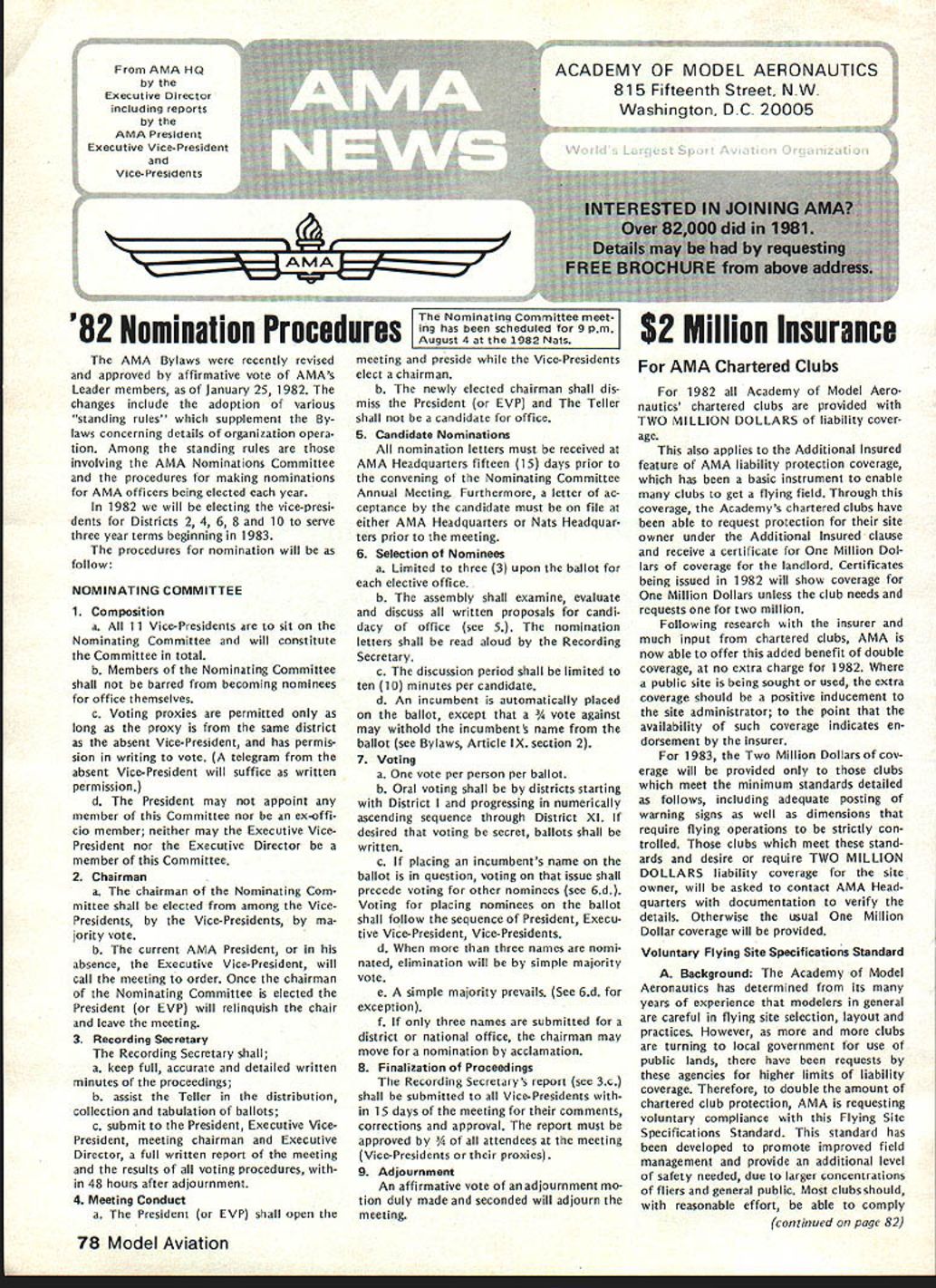
The AMA Bylaws were recently revised and approved by affirmative vote of AMA members as of January 25, 1982. The changes include adoption of various standing rules which supplement the Bylaws concerning details of organization operation. Among the standing rules are those involving the AMA Nominating Committee and procedures for making nominations for AMA officers elected each year.
In 1982 we will be electing the vice‑presidents for Districts 2, 4, 6, 8 and 10 to serve three‑year terms beginning in 1983. The Nominating Committee meeting has been scheduled for 9 p.m., August 4 at the 1982 Nats.
NOMINATING COMMITTEE
- Composition
- a. All 11 Vice‑Presidents shall sit on the Nominating Committee and will constitute the Committee in total.
- b. Members of the Nominating Committee shall not be barred from becoming nominees for office themselves.
- c. Voting proxies are permitted only if the proxy is from the same district as the absent Vice‑President and has permission in writing to vote. A telegram from the absent Vice‑President will suffice as written permission.
- d. The President may not appoint any member of this Committee nor be an ex‑officio member; neither may the Executive Vice‑President nor the Executive Director be members of this Committee.
- Chairman
- a. The chairman of the Nominating Committee shall be elected from among the Vice‑Presidents by majority vote.
- b. The current AMA President, or in his absence the Executive Vice‑President, will call the meeting to order. Once the chairman is elected, the President (or EVP) will relinquish the chair and leave the meeting.
- Recording Secretary
The Recording Secretary shall:
- a. keep full, accurate and detailed written minutes of the proceedings;
- b. assist the Teller in the distribution, collection and tabulation of ballots;
- c. submit to the President, Executive Vice‑President, meeting chairman and Executive Director a full written report of the meeting and the results of all voting procedures within 48 hours after adjournment.
- Meeting Conduct
- a. The President (or EVP) shall open the meeting and preside while the Vice‑Presidents elect a chairman.
- b. The newly elected chairman shall dismiss the President (or EVP). The Teller shall not be a candidate for office.
- Candidate Nominations
- All nomination letters must be received at AMA Headquarters fifteen (15) days prior to the convening of the Nominating Committee Annual Meeting.
- A letter of acceptance by the candidate must be on file at either AMA Headquarters or Nats Headquarters prior to the meeting.
- Selection of Nominees
- a. The ballot for each elective office shall be limited to three (3) names.
- b. The assembly shall examine, evaluate and discuss all written proposals for candidacy; nomination letters shall be read aloud by the Recording Secretary.
- c. The discussion period shall be limited to ten (10) minutes per candidate.
- d. An incumbent is automatically placed on the ballot, except that a 3/4 vote against may withhold the incumbent's name from the ballot (see Bylaws, Article IX, section 2).
- Voting
- a. One vote per person per ballot.
- b. Oral voting shall be by districts starting with District I and progressing numerically through District XI. If secret voting is desired, ballots shall be written.
- c. If placing an incumbent's name on the ballot is in question, voting on that issue shall precede voting for other nominees. Voting to place nominees on the ballot shall follow the sequence of President, Executive Vice‑President, Vice‑Presidents.
- d. When more than three names are nominated, elimination will be by simple majority vote.
- e. A simple majority prevails (see 6.d for exception).
- f. If only three names are submitted for a district or national office, the chairman may move for a nomination by acclamation.
- Finalization of Proceedings
- The Recording Secretary's report shall be submitted to all Vice‑Presidents within 15 days of the meeting for comments, corrections and approval. The report must be approved by 3/4 of all attendees at the meeting (Vice‑Presidents or their proxies).
- Adjournment
- An affirmative vote on an adjournment motion, duly made and seconded, will adjourn the meeting.
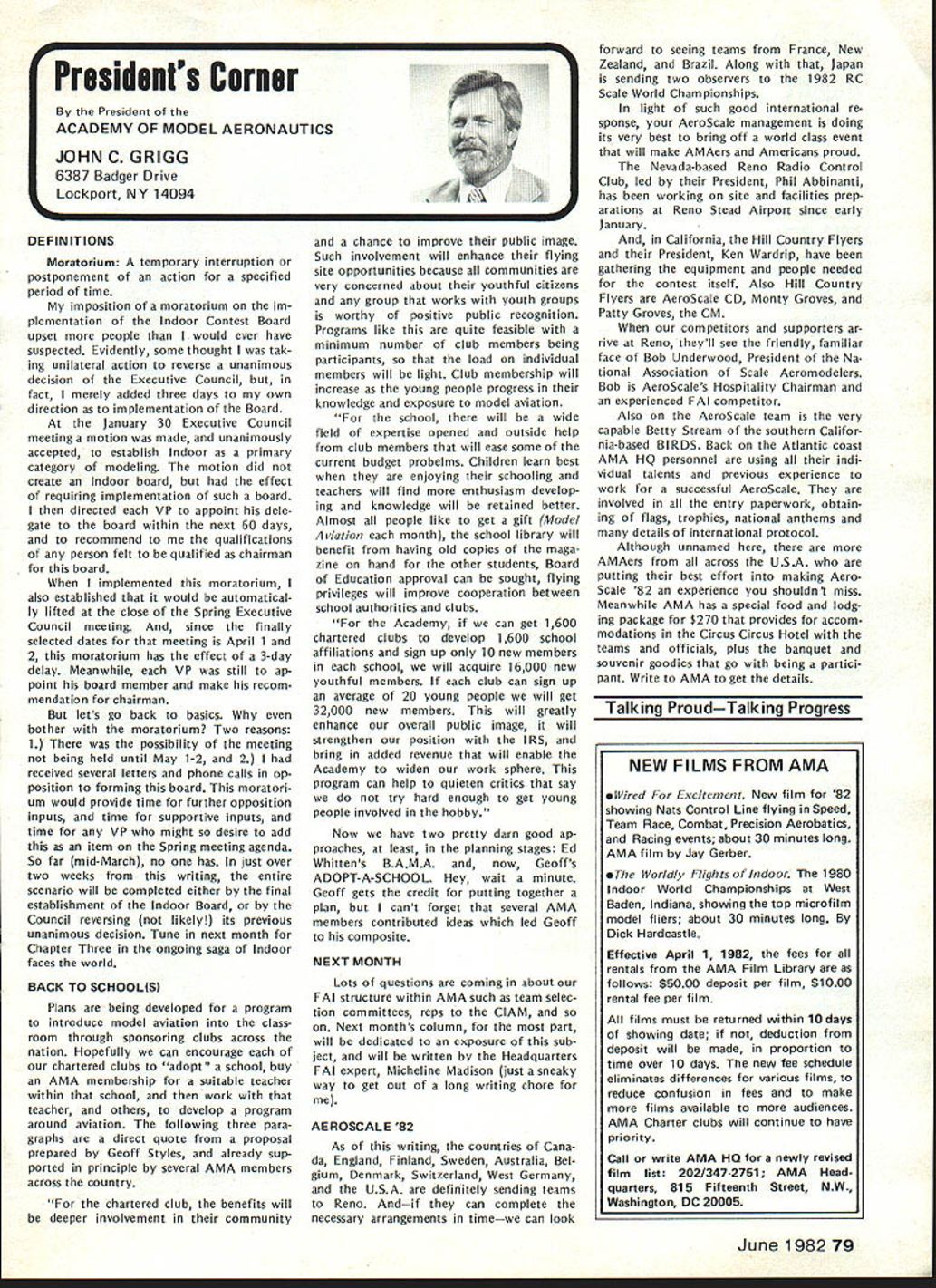
AeroScale '82 — International Response and Local Preparation
We are looking forward to seeing teams from France, New Zealand and Brazil. Japan is sending two observers to the 1982 RC Scale World Championships. In light of such good international response, AeroScale management is doing its best to present a world‑class event that will make AMA members and Americans proud.
- The Nevada‑based Reno Radio Control Club, led by President Phil Abbinanti, has been working on site and facilities preparations at Reno Stead Airport since early January.
- In California, the Hill Country Flyers and their President, Ken Wardrip, have been gathering equipment and people needed for the contest. AeroScale CD Monty Groves and CM Patty Groves are working with Hill Country Flyers.
- Bob Underwood, President of the National Association of Scale Aeromodellers and AeroScale Hospitality Chairman, will be present; he is an experienced FAI competitor.
- Betty Stream of the southern California BIRDS is serving on the AeroScale team.
- AMA HQ personnel are handling entry paperwork, flags, trophies, national anthems and international protocol.
More AMA volunteers across the U.S. are working to make AeroScale '82 an experience you shouldn't miss. AMA also offers a special food and lodging package for $270 that provides accommodations at the Circus Circus Hotel with teams and officials, plus the banquet and souvenirs. Write to AMA for details.
Executive VP's Report
Jim McNeill AMA Executive VP 617 South 20 Avenue Birmingham, AL 35205
Letters on Contest Director Status
Contest Director Mack Henry (MACA) wrote: "I personally lose money and lots of time CDing a meet a year ... If I had to go through a hassle to keep the license, I would just let it go. It's not worth the trouble for $30 a year."
Bill Boss, former District II VP Council member, wrote: "I have been a CD for more than 20 years ... With this record of service regarding competition and rules making I cannot imagine why I should be denied CD status."
W.J. Mowrey of Kinsley, KS, wrote strongly against proposed CD changes, equating them to arbitrary removal of Council status. Art Schroeder, Model Airplane News Executive Editor, also defended long‑serving CDs.
The letters keep pouring in concerning Contest Directors being stripped of their CD status. Two replies favor a periodic written test, but more than 80 are against it — about a 40 to 1 ratio opposing change. All replies are being distributed to the active Council; some are exhibited in the AMA National Newsletter. There are 15 votes on the Council; the Executive VP is only one of them.
A committee charged by the President in the November '81 Council meeting to recommend limits on CD terms experienced a change in chairman and a delay in reporting recommendations. The issue may or may not be aired at the April Toledo Council meeting. This issue has come up before (e.g., 1974). The system is slow but works: AMA members pick leaders and set policies. Members are encouraged to express themselves; the Executive VP applauds the many CDs who wrote on this hot issue.
BAD NEWS — SORROW — SADNESS
Hilda Paulsen, who loved working for AMA and was looking forward to our new building, died a couple of weeks ago. She was pushing 90 and had once flown in 1910 in a Curtiss Pusher at a state fair in the Midwest. We will miss her.
GOOD NEWS — PROGRESS BREAKTHROUGH
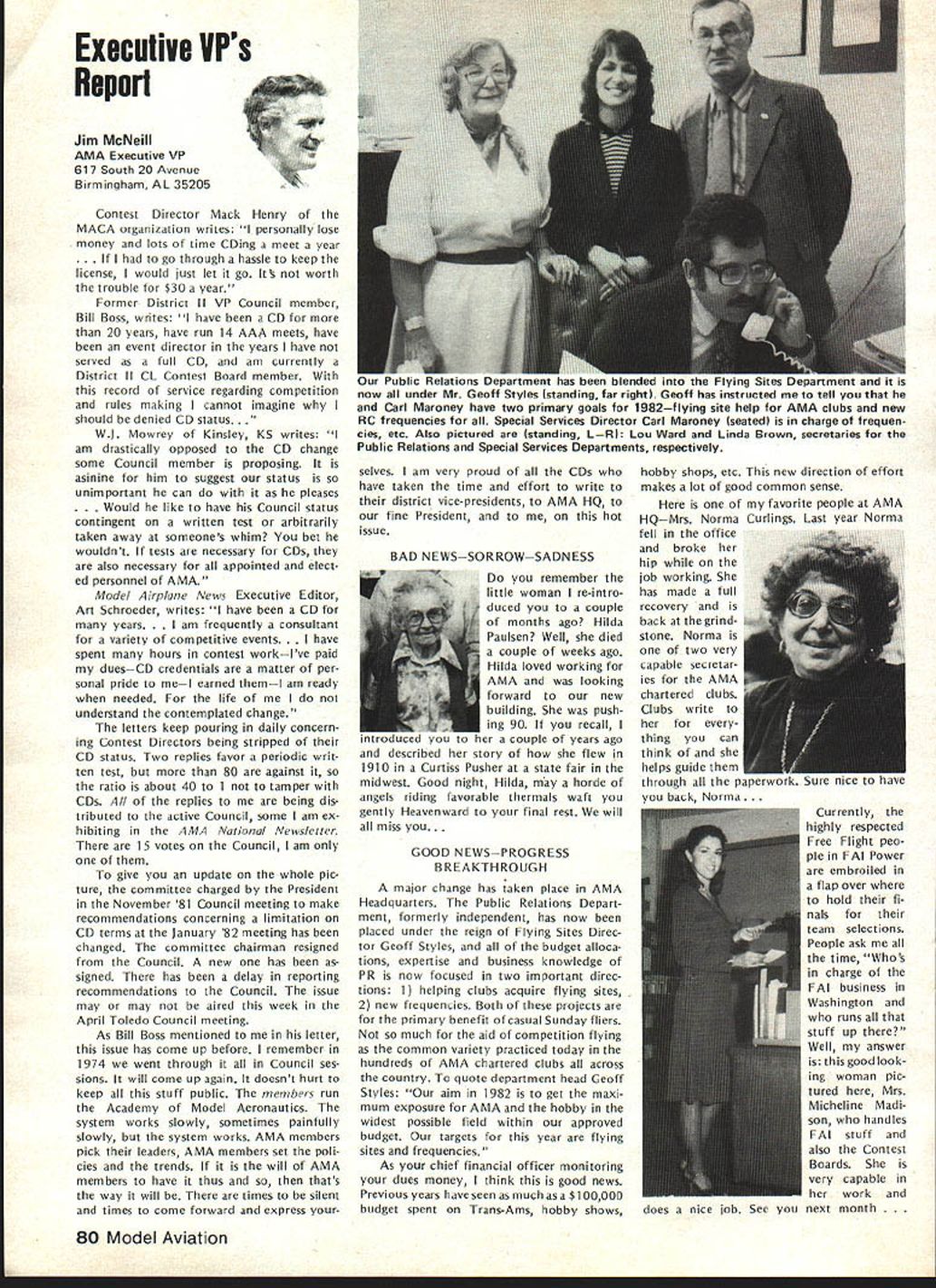
A major change at AMA Headquarters: the Public Relations Department is now placed under Flying Sites Director Geoff Styles. PR resources are focused on:
- helping clubs acquire flying sites, and
- new frequencies.
These projects are primarily for the benefit of casual Sunday fliers and hundreds of AMA‑chartered clubs. Geoff Styles: "Our aim in 1982 is to get maximum exposure for AMA and the hobby in the widest possible field within our approved budget. Our targets for this year are flying sites and frequencies."
Previous years saw large budgets spent on Trans‑Ams, hobby shows and other promotions. This new direction is considered a sensible use of dues money.
Norma Curlings, one of two capable secretaries for AMA chartered clubs, has made a full recovery after breaking her hip last year and is back at work. Micheline Madison handles FAI matters and Contest Boards; she is commended for her capable work.
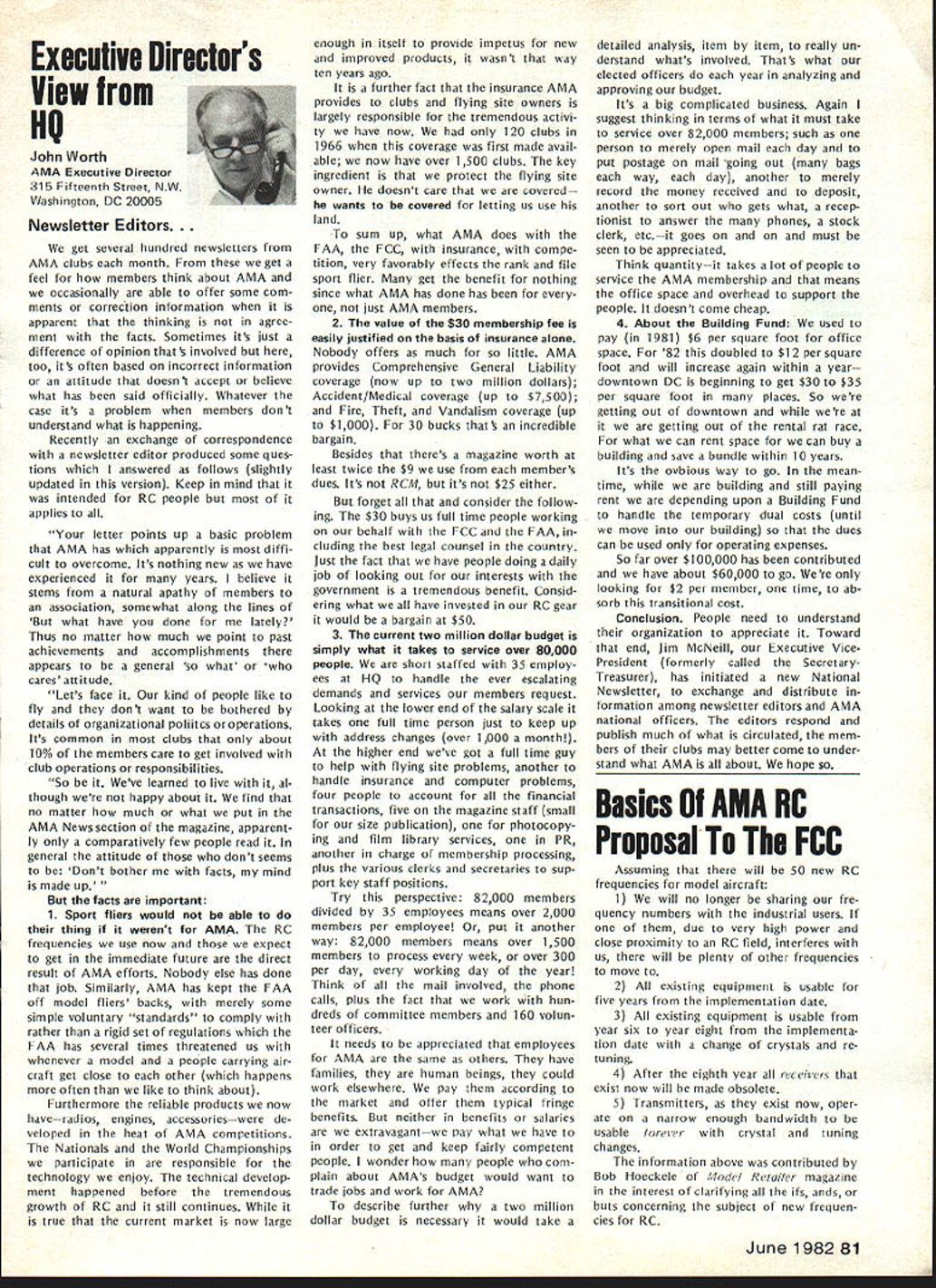
Newsletter Editors
AMA receives several hundred club newsletters each month and uses them to gauge member thinking and to correct misinformation. Many members are apathetic about organizational details; typically only about 10% of club members get involved in operations. The Executive VP notes the importance of publicizing AMA accomplishments and the need for members to understand what AMA does.
Key facts stressed:
- RC frequencies and keeping the FAA off model fliers' backs are direct results of AMA efforts.
- The value of the $30 membership fee is justified by insurance alone plus magazine value and government representation.
- The current $2 million budget is necessary to service over 80,000 members with 35 employees; this is a high member‑to‑employee ratio and requires significant overhead.
- Building Fund rationale: rising downtown DC rent made owning a building preferable. The Building Fund is intended to cover temporary dual costs during the move so dues can be used for operating expenses. Over $100,000 has been contributed; about $60,000 remains to reach the goal. The one‑time request is about $2 per member to cover transitional costs.
Conclusion: Jim McNeill has initiated a National Newsletter to exchange information among newsletter editors and national officers so club members better understand AMA.
$2 Million (continued)
Chartered Club Certificates for 1982 indicate $1,000,000 of liability coverage; however, in essence each chartered club will have two million dollars of coverage extended to them when the Additional Insured feature is requested. Certificates of Insurance for Additional Insured will reflect the Two Million Dollar level, if requested by the club, and should be requested only if necessary to secure or maintain the site. The interim program is for 1982; for 1983 only clubs meeting revised standards may obtain the extra level of coverage.
Please note that as much as 85% of members pursue the RC aspect of the hobby; this standard is applicable to RC activities. During 1982 additional standards will be developed for both Control Line and Free Flight clubs.
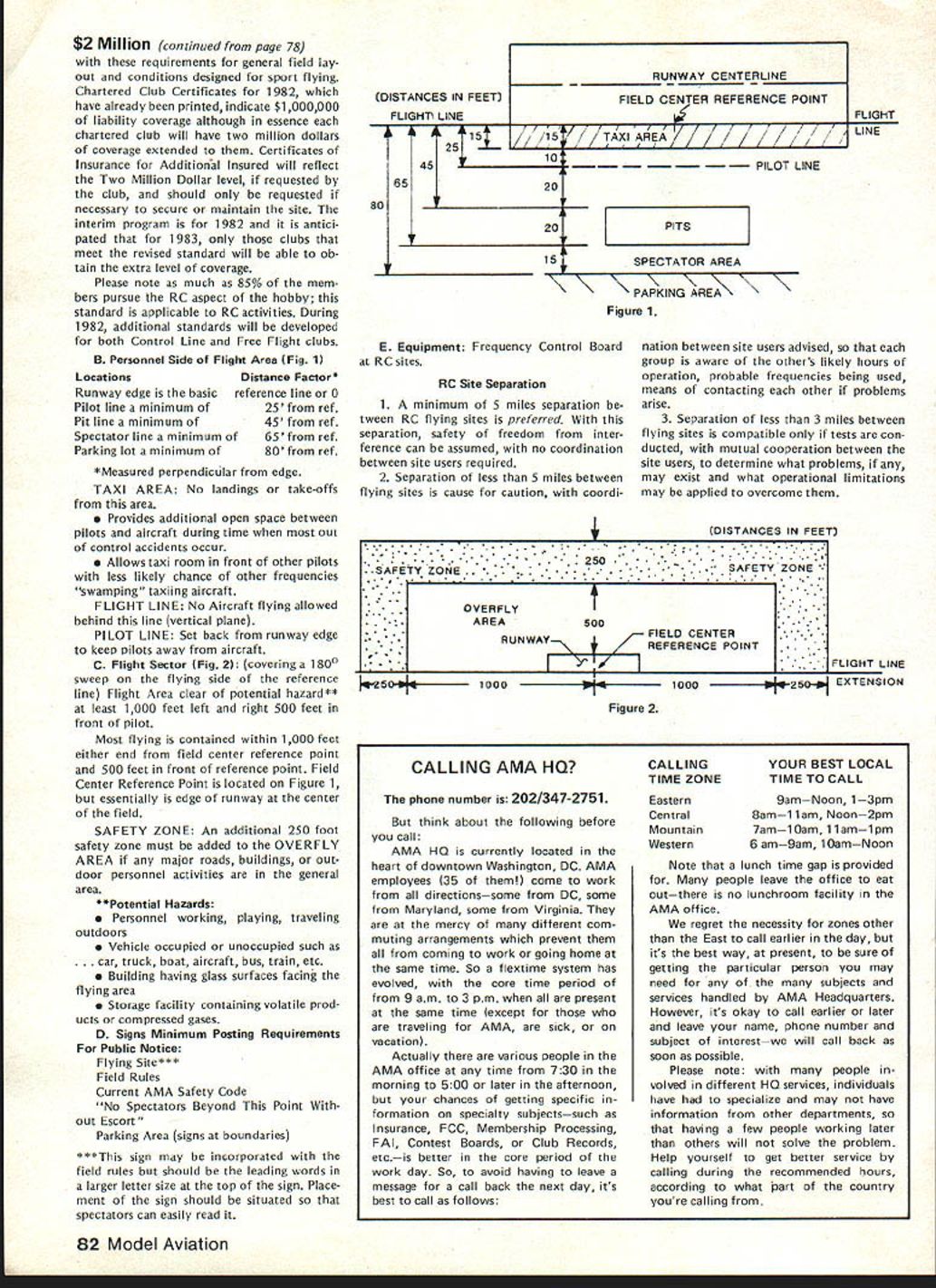
B. Personnel Side of Flight Area (Fig. 1)
Locations — Distance Factor* (measured perpendicular from runway edge)
- Runway edge is the basic reference line or 0.
- Pilot line: a minimum of 25' from reference.
- Pit line: a minimum of 45' from reference.
- Spectator line: a minimum of 65' from reference.
- Parking lot: a minimum of 80' from reference.
TAXI AREA: No landings or take‑offs from this area.
- Provides additional open space between pilots and aircraft during times when most out‑of‑control accidents occur.
- Allows taxi room in front of other pilots with less chance of other frequencies "swamping" taxiing aircraft.
FLIGHT LINE: No aircraft flying allowed behind this line (vertical plane).
PILOT LINE: Set back from runway edge to keep pilots away from aircraft.
C. Flight Sector (Fig. 2)
- Covers a 180° sweep on the flying side of the reference line.
- Flight area clear of potential hazard at least 1,000 feet left and right, 500 feet in front of pilot.
- Most flying is contained within 1,000 feet either end from field center reference point and 500 feet in front of reference point. Field Center Reference Point is essentially the edge of the runway at the center of the field.
SAFETY ZONE: An additional 250 foot safety zone must be added to the overfly area if any major roads, buildings, or outdoor personnel activities are in the general area.
Potential Hazards:
- Personnel working, playing or traveling outdoors.
- Vehicles occupied or unoccupied (car, truck, boat, aircraft, bus, train, etc.).
- Buildings with glass surfaces facing the flying area.
- Storage facilities containing volatile products or compressed gases.
D. Signs — Minimum Posting Requirements for Public Notice:
- Flying Site (this may be incorporated with Field Rules but should be prominent).
- Field Rules.
- Current AMA Safety Code.
- "No Spectators Beyond This Point Without Escort".
- Parking Area (signs at boundaries).
E. Equipment: Frequency Control Board at RC Sites.
RC Site Separation
- A minimum of 5 miles separation between RC flying sites is preferred; with this separation, freedom from interference can be assumed and no coordination is required.
- Separation of less than 5 miles is cause for caution; coordination between site users is advised.
- Separation of less than 3 miles is compatible only if tests are conducted with mutual cooperation to determine problems and operational limitations.
Calling AMA HQ?
Phone number: 202/347‑2751.
Before you call, consider the flexitime core period at AMA HQ (35 employees): 9 a.m. to 3 p.m. is when most staff are present. For the best chance of reaching someone with specialty information (insurance, FCC, Membership Processing, FAI, Contest Boards, Club Records), call during these local best times:
- Eastern: 9 a.m.–Noon, 1–3 p.m.
- Central: 8 a.m.–11 a.m., Noon–2 p.m.
- Mountain: 7 a.m.–10 a.m., 11 a.m.–1 p.m.
- Western: 6 a.m.–9 a.m., 10 a.m.–Noon
A lunch gap is provided. If you call outside these times, leave your name, phone number and subject; AMA will call back as soon as possible. Note that staff specialization means some individuals may not have information from other departments.
1982 Flying Site Survey
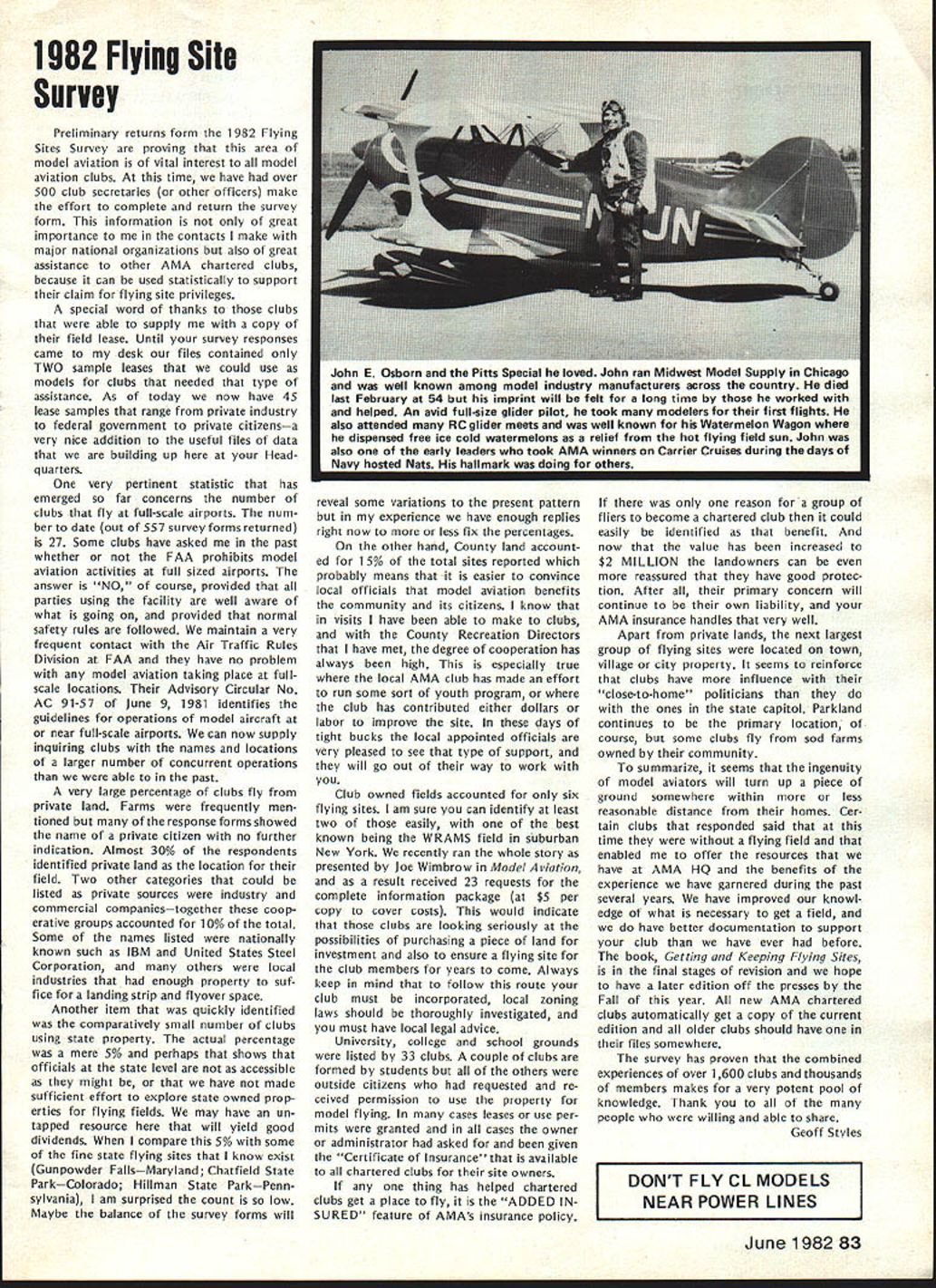
Preliminary returns from the 1982 Flying Sites Survey show strong interest in flying sites by model aviation clubs. Over 500 club secretaries or officers have returned the survey. The information helps contacts with national organizations and assists other AMA clubs statistically when claiming flying site privileges.
A special thanks to clubs that supplied field lease copies. Previously AMA HQ had only two sample leases; now there are 45 samples ranging from private industry to federal government to private citizens — a useful file for clubs seeking site agreements.
One pertinent statistic from 557 survey forms returned: 27 clubs fly at full‑scale airports. The FAA does not prohibit model aviation at full‑scale airports provided all parties are aware and normal safety rules are followed. FAA Advisory Circular No. AC 91‑57 (June 9, 1981) provides guidelines for operations at or near full‑scale airports.
Survey highlights:
- Almost 30% of respondents identified private land as the location for their field (farms and private citizens).
- Industry and commercial companies accounted for about 10% of sites (names included IBM and United States Steel Corporation).
- State property accounted for only 5% of sites — possibly an untapped resource.
- County land accounted for 15% of sites, suggesting local officials are often cooperative, especially when clubs run youth programs or contribute labor/dollars.
- Club‑owned fields accounted for six sites; purchasing land requires incorporation, local legal advice and zoning review.
- University, college and school grounds were used by 33 clubs; often leases or use permits were granted and landlords requested Certificates of Insurance as "Additional Insured."
If one benefit of chartering a club is most important, it is the "Additional Insured" feature of AMA's insurance policy. With the increased $2 million level, landowners can feel even more reassured.
The combined experiences of over 1,600 clubs make a potent pool of knowledge. The revised book Getting and Keeping Flying Sites is in final stages and should be available in the Fall. New chartered clubs automatically receive a copy.
— Geoff Styles
AMA Chartered Clubs 1982
Academy of Model Aeronautics chartered clubs are provided TWO MILLION DOLLARS liability coverage. The Additional Insured feature also applies. This liability protection has been instrumental in enabling clubs to secure flying fields. Certificates reflecting TWO MILLION DOLLARS coverage are being issued and are available to request when needed to secure or maintain a site.
Who's Who and What at Headquarters
Readers of Jim McNeill's reports will recall a series introducing AMA Headquarters personnel. Below is a handy summary of names and duties for use when corresponding with or telephoning (not collect) HQ concerning various matters. Phone: 202/347‑2751.
- LARRY BOLICH: Special Events Director — Nats, PR, promotional material, show teams, special events, trade show exhibits, hobby shop service. (Note: Special Events department is now part of the PR Department under GEOFF STYLES.)
- FRANK EHLING: Technical Director — AMA records, industry liaison, museum curator, rule book questions, procurement and distribution of trophies and awards, youth programs (AMA Cub/Delta Dart).
- DEBBIE DEWS: Contest dates, calendar, national records, sanctions.
- JOYCE HAGER: Executive Secretary — accident reports, Hall of Fame, officers' supply requests, scholarship program, life membership information, Building Fund.
- MICHELINE MADISON: FAI and Contest Boards Director — contest board matters, FAI Sporting Code, team selection, trophies, agenda items and committees, international meets, rule proposals, World Championships, world records.
- CARL MARONEY: Executive Assistant — FAA matters, frequency problems, incorporation and IRS exempt status, insurance program questions, muffler/noise, Safety Code.
- CAROL MEFRELD: Membership Department Director.
- TRINA YOUNG: Address changes, CD/LM applications.
- GLORIA COOK: Club Services — Certificate of Insurance, chapters, charters, club records.
- MIKE WOODFOLK: Membership Services — license cards, membership kits, membership records, rule books, subscriptions.
- GEOFFREY STYLES: Flying Site Programs Director — landowner liability laws, site support data, government programs, Civil Air Patrol, 4‑H, Boy Scouts, recreation and parks.
- CARL WHEELEY: Publications Director — magazine policies, magazine articles.
- JOHNNIE SHIPLEY: Hobby shop resale, plans orders.
- RANDALL VLAHOS / CHUCK KAUFMAN: Magazine advertising — 703/690‑2575.
- ROBERT VOJSLAWEK: Administration Coordinator.
- ANTHONY HOLMES: Contest judging forms, Nats entry, supply and service.
- SHIRLEY SHIPLEY: Films.
A LAKEHURST NATS IN '83!
If you or your club use AMA films or display booths, follow the instructions for prompt return to the next destination. If distribution problems continue, films may be retained at HQ for use only and clubs will be required to rent films from the AMA film library at $15 rental plus $50 deposit. VP copies are intended primarily for use by the VPs.
National Model Airplane Show at Randall Park Mall (Cleveland) celebrated its 31st annual show and was a success thanks to AVP Joe Eiben, Jack and Peggy Leverty, Larry Weimer and Bob Sargent. The SOME Show in Cincinnati has also grown and now involves several clubs and full‑scale FAA displays, adding appeal and PR value.
The Executive Council will meet in Toledo as scheduled (motion to move was defeated). Support for the AMA Building Fund is requested. Please update mailing addresses for club newsletters.
VI DISTRICT REPORT
Illinois • Indiana • Kentucky • Missouri
Jim Sears District VI Vice‑President P O Box 308 Burgin, KY 40310
Associate Vice‑Presidents
- Loren Holm, 643 Hall and Brook, Quincy, IL 62301
- William Kern, 1808 12th St., Bedford, IN 47421
- Glenn Lee, 819 Mandrake, Batavia, IL 60510
- Bruce Maloney, 1516 Kendall Pkwy., Owensboro, KY 42301
- Raymond Myers, P O Box 243, Smithville, MO 64089
- Helen Olson, 820 Old Bonhomme, University City, MO 63132
- Bill Zimmer, Box 72, Varns, IL 61375
Column notes:
- Mall shows are valuable for public exposure; the Flying Cardinals had over 200 planes and multiple films running.
- Lexington Model Airplane Club's mall show provided a chance to reconnect with friends.
- District fun flies are being revived; Bob Suhr (Peoria, IL) and his club are working on rules and a self‑supporting format to encourage small clubs' participation.
- On alcohol at club contests: an Executive Council vote allowed it, but significant feedback suggests many clubs oppose alcohol at fields. Input is requested on whether control should be at club level or governed by AMA.
- Bickering between CL (Control Line) and RC (Radio Control) is counterproductive; all forms of model aviation can benefit from cooperation. CL and Free Flight (FF) are important entry avenues for youth.
The VP requests black‑and‑white pictures and newsletters for the column.
VII DISTRICT REPORT
Iowa • Michigan • Minnesota • Wisconsin
Hardy Brodersen District VII Vice‑President P O Box 1184 Birmingham, MI 48012
Assistant Vice‑President
- Tony Italiano, 1655 Revere Dr., Brookfield, WI 53005
Associate Vice‑Presidents
- James Clark, 4444 Woodlawn Dr. N.E., Cedar Rapids, IA 52401
- John E. Luedtke, 8547 N. 67th St., Milwaukee, WI 53218
- Robert D. Lundbeck, 42328 N.E. 130th St., Duluth, MN 55804
- William Rohring, 3444 Tangledwood Tr., St. Joseph, MI 49085
- Al Sondrome, 3013 Dorothy Dr., Madison, WI 53711
- Ron Sears, 132 S. Roslyn, Pontiac, MI 48056
- Terry Taylor, 6038 Lombardy Lane, Crystal, MN 55428
Column notes:
- Support local hobby shops for personal service, inventory, guidance and community.
- AMA Exhibit and movies are available for shows (schedule permitting). Clubs pay UPS freight and can add their own signage.
- Cub Pack 3079 assembled 25 Delta Darts in two hours at a shopping center event; good youth outreach.
- Dave Sugden (Canada) had notable Free Flight results overseas.
VIII DISTRICT REPORT
Ted White District VIII Vice‑President 1109 Greendale Bedford, TX 76021
Associate Vice‑Presidents
- Bob Friedl, 5512 Southwood, Little Rock, AR 72205
- William Hurley III, 927 Commerce, Pleasanton, TX 78064
- Dan Parsons, 11809 Folsom NE, Albuquerque, NM 87111
- Ed Perez, 1102 W. Tarryn Rd., Grand Prairie, TX 75050
- Al Rabe, 1904 Valley Oak Ct., Irving, TX 75061
- Larry Sarto, 1415 Manor Dr., Bartlesville, OK 74003
- Ed Shearer, 3416 David Dr., Metairie, LA 70003
Column notes from the 1/8 Air Force Scale Fun Fly (Phoenix):
- Attendance approx. 90–95 pilots with 115+ airplanes.
- Over $2,000 in pilot prizes donated by local hobby shops and manufacturers.
- Visitors included participants from England, Canada, Australia and Germany.
- Event format included surprise judged events and People's Choice displays.
- Various awards and winners noted (Best Scale, People's Choice, Best Maneuver, etc.).
- Banquet perpetuated the good‑natured feud between scale groups.
- A humorous note: due to Buddy Irwin's continued absence the 1/8 Air Force joked that he must be a figment of imagination.
IX DISTRICT REPORT
Travis McGinnis District IX Vice‑President 8027 W. 81st Circle Arvada, CO 80005
Associate Vice‑Presidents
- Robert Ball, 2622 S. Garrison, Casper, WY 82601
- Ed Cox, 8009 Linden Dr., Prairie Village, KS 66208
- Dick Greenly, 16413 E. Stanford Pl., Aurora, CO 80015
- Glen Lau, 3701 S. 44th St., Lincoln, NE 68506
- Tim Mattox, 429 Dogwood, Grafton, ND 58237
- Jim Ricketts, 516 S. Cladius, Sioux Falls, SD 57103
Column notes:
- Wichihawks (Wichita, KS) held a local fun fly featuring shoestrings with Fox .35 stunt engines; the event is their most popular local race.
- Visit to Hutch Bunch RC Club (Hutchinson, KS) included an AMA update, movie and banquet; the club reported increased interest in big planes.
XI DISTRICT REPORT
Ed McCollough District XI Vice‑President 53 S.E. 61st Ave. Portland, OR 97215
Associate Vice‑Presidents
- Al Curry, 1607 S. Vista, Pocatello, ID 83201
- Gary R. Fuller, 3050 Riverwood, Juneau, AK 99801
- Dave Mathies, 807 E. Vickburg St., Spokane, WA 99207
- Dick Wickline, P.O. Box 623, Klamath Falls, OR 97601
- Bud J. Johnson, 20920 N.E. Aum, E. 34, Federal Way, WA 98003
- Don Zisey, 21418 N.E. Main St., Redmond, WA 98052
Column notes:
- First Annual Puyallup Expo is growing and drew large crowds; manufacturers, models and demonstrations were well received.
- Bill Painter (SRAC) announced upcoming contests: RC Carnival (June 12–13) and CAN‑DO event (July 31–Aug 1). Contact Bill at 20406 Little Bear, No. 164, Woodinville, WA 98072.
- Congratulations to Dick Salter (Seattle) on Mr. Competitor honors.
- Upcoming events include NW Regional Champs (May 29–30, Eugene), CLAM‑bash V at Astoria, and BLADDER GRABBER for AMA Combat (June 27, Kent, WA).
- Recommended newsletter: Flying Lines (Mike Hazell, John Thompson) — informative for UC and general readers.
- Hillsboro Indoor meets continue; Dave Hagen is recommended for the new Indoor Contest Board for District XI.
- Ernie Linn transferred to Wichita; replacement for FF contest board is Steve Riley of the Strat‑O‑Bats.
- Indoor meet possibilities at the Kibbie Dome (Moscow, ID) are under consideration.
- Safety note regarding battery fuel: keep fuel in plastic containers and avoid flight boxes with unvented wells for fuel containers.
HAPPY FLYING
JUNIOR FLIGHT!
Ed Whitten Box 176, Wall St. Sta., New York, NY 10005
Join The Beginning Aero Modelers Association (B.A.M.A.)
B.A.M.A. aims to:
- Help beginners of all ages and keep them from "hitting the ground".
- Promote aeromodeling in schools.
- Encourage public officials to accept aeromodeling as a worthwhile hobby/sport/art.
- Urge manufacturers to produce good beginner kits at reasonable cost and make them available to schools, clubs and youth groups.
- Advocate contests, magazines and national leaders pay more attention to beginners.
B.A.M.A. receives no funds from AMA or other sponsors. Membership in B.A.M.A. costs $10 for 12 issues of the newsletter Star Skippers. Send checks to Ed Whitten/B.A.M.A. at the above address.
Starting a Beginner Program
There is no single best program; objectives must match the leader, the beginners, finances and available building/flying sites. Four important elements to consider:
- The leader
- Assess your modeling experience and teaching ability honestly. Experience limits and defines what you can accomplish.
- The group
- Age, numbers, abilities, discipline and transportation of the beginners will shape the program. Don't take on too many participants at once.
- The finances
- Who pays for materials? Sponsors help, but if beginners don't pay anything they often won't become modelers. Consider starting with a couple of free introductory kits, then require modest participant contributions.
- Building and flying sites
- Available facilities (gymnasium, playground, school room) and transportation will determine whether you build/fly indoor or outdoor models.
Reshape plans based on these elements. Decide on kit selection carefully — repeating the same model may teach fundamentals better than constantly changing kits. Bulk purchasing from a good supply house may be appropriate depending on the situation.
A Reader Writes
Lester Deily (Control Line speed flier, Douglaston, NY) suggests increasing junior‑level content in Model Aviation and coordinating monthly editors to produce beginner articles for an expanded "Junior Flight" section. He argues AMA can do more to attract juniors and that a token effort is insufficient.
A Reader's Suggestion
William Beck (Lakewood, CO), a Free Flight Scale modeler, recommends programs for juniors and suggests specific kits (Peck‑Polymers' Peanut Nesmith Cougar, Sterling Models' '30' Citabria, Flying Models' Me 100 D) as suitable builds. He reports using a junior high school football field for flying and thanking the school by donating a Model Aviation subscription to the library — a low‑cost, effective way to say thanks to property owners.
Bill McCombs' new book Making Scale Model Airplanes Fly is recommended — send $6.95 plus $1.00 postage/handling to Aircraft Data, Box 32021, Dallas, TX 75224.
Join B.A.M.A. — the Beginning Aero Modelers Association.
See you next month.
Transcribed from original scans by AI. Minor OCR errors may remain.

