
AMA RC Frequency Meetings 4/30–5/1
Attendance
- AMA Headquarters Staff: John Worth, Vince Mankowski, Geoff Styles, Carl Maroney, Cindy Peck
- AMA RC Frequency Committee: Bob Aberle, Jack Albrecht, Dave Brown, Bill Hershberger, Dick Jansson, Fred Marks, John Strong, Torrey Williams (Dr. Walter Good was unable to attend but provided inputs)
- RC Industry: Ace RC — Tom Runge; Airtronics — Lee Renaud; Bavarian Precision Products, Inc. — Alex Amarilios; EMS — Mark Schwing; Futaba — York Daimon; Kraft Systems — Art Leighton; World Engines — Jim Lanterman
- AMA Attorneys: Jeremiah Courtney, Dennis C. Brown, Jack R. Smith
- Model Press / Retail: Bob Hoeckele; George M. Myers
- Special Interest Groups: IMPBA (Boating) — Len Skwiera
Purpose and Outcome
The meeting reviewed industry and membership comments on the FCC Notice of Proposed Rule Making (NPRM) proposing 80 new channels exclusively for RC model use. Enough information was gathered to permit drafting a unified AMA response to the NPRM (due to the FCC May 13, 1982).
Under counsel's advice, the AMA was urged to support the NPRM wording as closely as possible to obtain the new frequencies quickly. With only a few small procedural changes, the AMA will fully endorse the NPRM. Remaining differences were resolved so as not to hinder progress.
The FCC allows a 30‑day reply (counter‑comments) period, taking the schedule to June 13, 1982. If few negative comments are received, the new frequencies could likely be allocated by mid‑October 1982.
Phase‑In Plan, Frequency Flags, and Compliance
- The Phase‑In Plan and the new Frequency Flag Identification System were reviewed and finalized to promote an orderly introduction of the new frequencies and minimize disruption to existing operations.
- Initial use of the new channels will be limited during the transition period (see "New RC Frequencies" section).
- A Compliance Plan for safe use of the new RC model channels is being drafted (Fred Marks assigned). The plan draws on the SMAE (Great Britain) experience with 10 kHz‑spaced RC channels. The final compliance document will require industry coordination and is expected later in the summer.
Bob Aberle, Chairman AMA RC Frequency Committee
---
AMA Response to FCC Proposal
On May 13, 1982, the Academy of Model Aeronautics, Inc., through its attorneys, submitted Comments to the Federal Communications Commission (General Docket 82‑181, RM‑3248) supporting the NPRM to provide additional spectrum between 72 and 76 MHz for radio control of model aircraft, boats, cars and similar devices.
Key Points of the AMA Response
- The AMA reiterated the critical need for additional RC frequencies, updating the original 1978 petition for relief.
- The April 30/May 1 AMA/RC industry meeting produced a consolidated position to avoid a flood of individual comments that could delay FCC action.
- The AMA endorsed the Commission’s proposal, with certain minor suggestions.
Specifically, the AMA recommended:
- Support for allocation of 80 new interstitial frequencies to the RC Radio Service in the 72–76 MHz band and scheduling withdrawal of seven frequencies currently used on a co‑channel basis with various primary services. Adoption should provide sufficient channels (aiming for 20 interference‑free channels in a typical modeling area) and avoid crisis allocations in the future.
- Recognition that most existing RC equipment is designed to tolerate adjacent‑channel separations no closer than 40 kHz (assuming intermodulation and image interference are avoided). Manufacturers advised:
- Equipment reliably operating with adjacent channels as close as 20 kHz should be available by Christmas 1982 if rulemaking is not unduly delayed.
- Equipment with 10 kHz selectivity is in design.
- Adoption of a Phase‑In Plan to allow continued use of existing transmitters and receivers for a transitional period, protecting locations for five years and phasing in new narrow‑band equipment to prevent harmful interference.
- Revision of Rule Section 95.617 and RC Rule 20 to permit any type of non‑voice modulation (including pulse position modulation — PPM — and pulse width modulation — PWM) in appropriate bands, provided occupied bandwidth limits (8 kHz, or 4 kHz for single‑sideband) are not exceeded. This would regularize existing practice and encourage efficient system development.
- Consideration of prescribing minimum selectivity characteristics for RC receivers (via Section 95.617 revision) to minimize image and intermodulation interference and ease coordination between legacy wide‑band and new narrow‑band equipment.
Included with the AMA Comments was an April 4, 1982 letter to the FCC, signed by representatives of 12 RC industry firms, endorsing the AMA proposal and urging speedy approval.
---
New RC Frequencies
There has been widespread press coverage and member interest about what the new frequencies mean in practice. Key points and practical guidance:
Transition Timetable and Equipment
- The new frequencies will be allocated exclusively to modelers.
- Present equipment can be used without change for five years (frequency changes to be made within that period as required).
- Present receivers will remain useful for up to eight years from rule inception. After eight years, many users will likely need to purchase new narrow‑band receivers (particularly for competition flying). Local club flyers who encounter no interference may continue using present receivers longer, if they manage adjacent‑channel use.
- Initially, only a few of the new channels will be usable because many new frequencies are interleaved with existing channels and could cause interference (a risk of being "shot down"). For the first five years, use must be restricted to a small set of channels — likely about 11 or 12 including the present seven.
- Between years five and eight, roughly half (about 24) of the new channels may become usable as equipment improves.
- By the time the FCC issues the Rule and Order (expected fall), all 80 channels will be legally available; however, chaos will result if the implementation plan is not followed strictly.
Manufacturer and Club Actions
- Manufacturers are expected to:
- Produce equipment in accordance with the Phase‑In Plan.
- Offer conversions of existing equipment to new channels (by mid‑winter many manufacturers should accept conversions).
- Offer new narrow‑band equipment possibly in time for the Christmas shopping season.
- Clubs and modelers must apply peer pressure to ensure compliance (e.g., avoid using "bootleg" crystals) because AMA cannot police the plan centrally.
"Don'ts"
- Don’t buy radios on frequencies that are not within the implementation plan.
- Don’t allow friends to use frequencies not authorized by the plan — it can cause interference and safety issues.
- Don’t delay buying new equipment if you need it — new equipment will be usable for many years with minor modifications (transmitter crystal changes, etc.).
- Don’t forget to acknowledge the efforts of those who worked on getting the new frequencies (e.g., letters of thanks to committee members).
---
Building Fund
The AMA building fund drive has gone "over the top" with over $160,000 raised. Special thanks to several contributors:
- Frank Garcher — led industry fundraising (about one‑third of total).
- Betty Stream — outstanding district fundraising (District X).
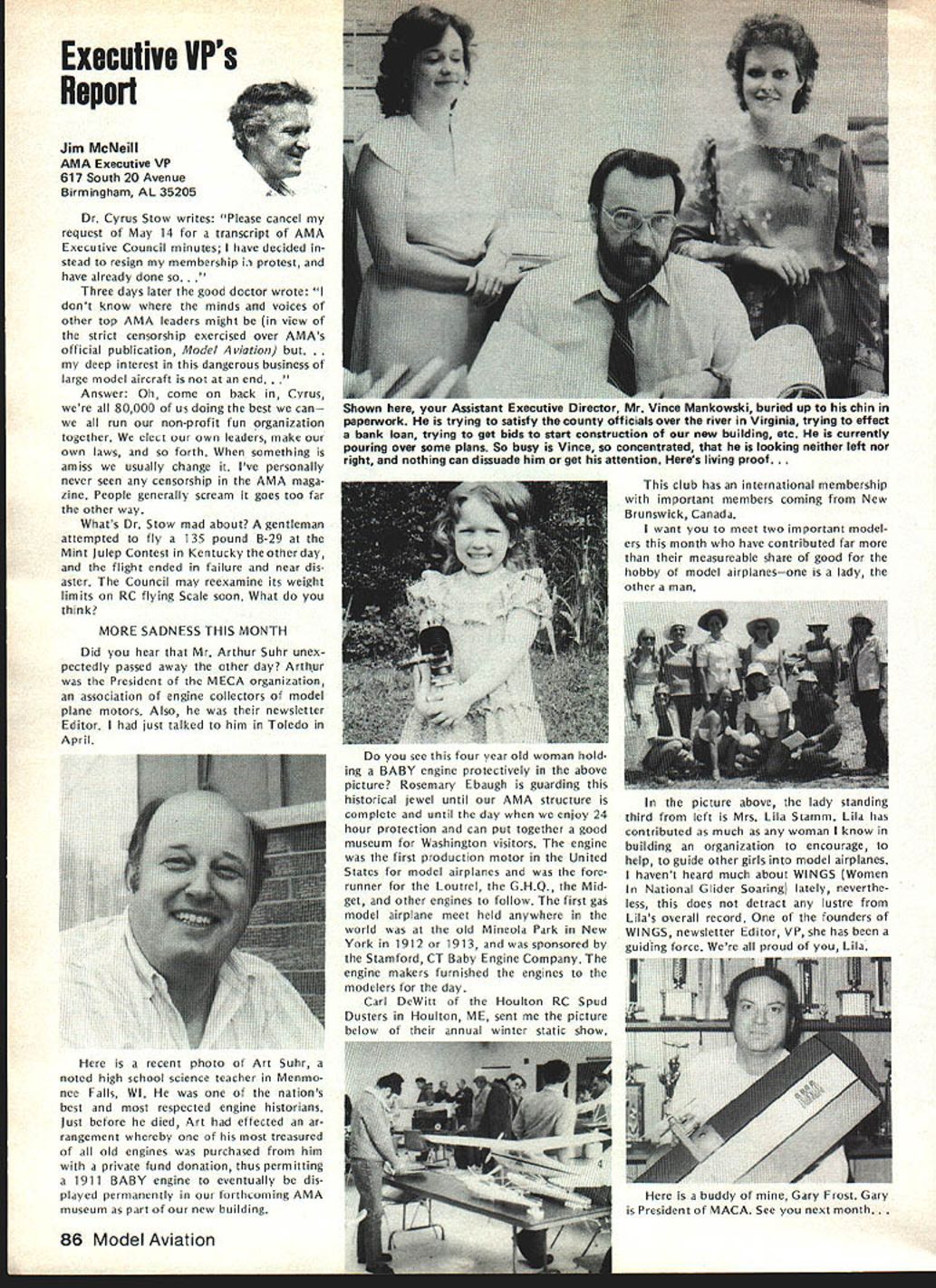
- Vince Mankowski — spearheaded and planned the overall drive at AMA HQ.
More funds are still needed for overall building and maintenance costs. Members are encouraged to continue contributions to reach a $200,000 goal (and beyond).
A note: Dr. Cyrus Stow requested cancellation of a transcript of AMA Executive Council minutes (May 14) and resigned in protest, but later expressed continuing interest in large model aircraft. The editorial reply invites him back and emphasizes collective volunteer governance of AMA publications and policies.
---
More Sadness This Month
Mr. Arthur Suhr, President of MECA (an association of engine collectors) and their newsletter editor, has passed away unexpectedly. He was active in the community and had been in contact recently.
---
RC Frequency — Additional Notes
- Frequency Flag Identification System: New flags will be color‑coded and numbered tags with colored streamers to identify channels by both number and color. They are inexpensive and simple to use; they do not change existing flags or band operations. The Phase‑In Plan and Frequency Flag System will be submitted to the AMA Executive Council in June 1982 for approval and then published.
- Compliance Plan: The final compliance document (safety and enforcement guidance) will be prepared with industry input and may not be released until the end of summer due to required coordination.
---
Club News & Notes
- Newark, OH club hosted Mark Radcliff (Mexico World Championships speaker). Mark declined honoraria. His wife Charmel is expecting a child imminently.
- The Mississippi Coast RC Club sent high‑quality photos for publication.
- Charleston RC Society showcased a new version of Ken Willard’s design.
- Pinellas Soaring Association (Central Florida) won a postal contest against Brisbane Model Soaring Club (Australia); task was 4 rounds of 6 minutes plus spot landing; top five individual scores made the club score.
- Puerto Rico Nats renamed “El Coquí” (after the Puerto Rican tree frog); to be held in Fajardo, PR on September 4–6.
- Jack Finn (AMA 8416) appointed Assistant Vice‑President in District VII (Cedar Rapids Skyhawks); he holds an RC duration record published in Model Aviation (Feb 1982).
- Tim Holmes (Port City R/Cers, Muskegon, MI) received an "All Season Flying Award" from his club and District VP.
---
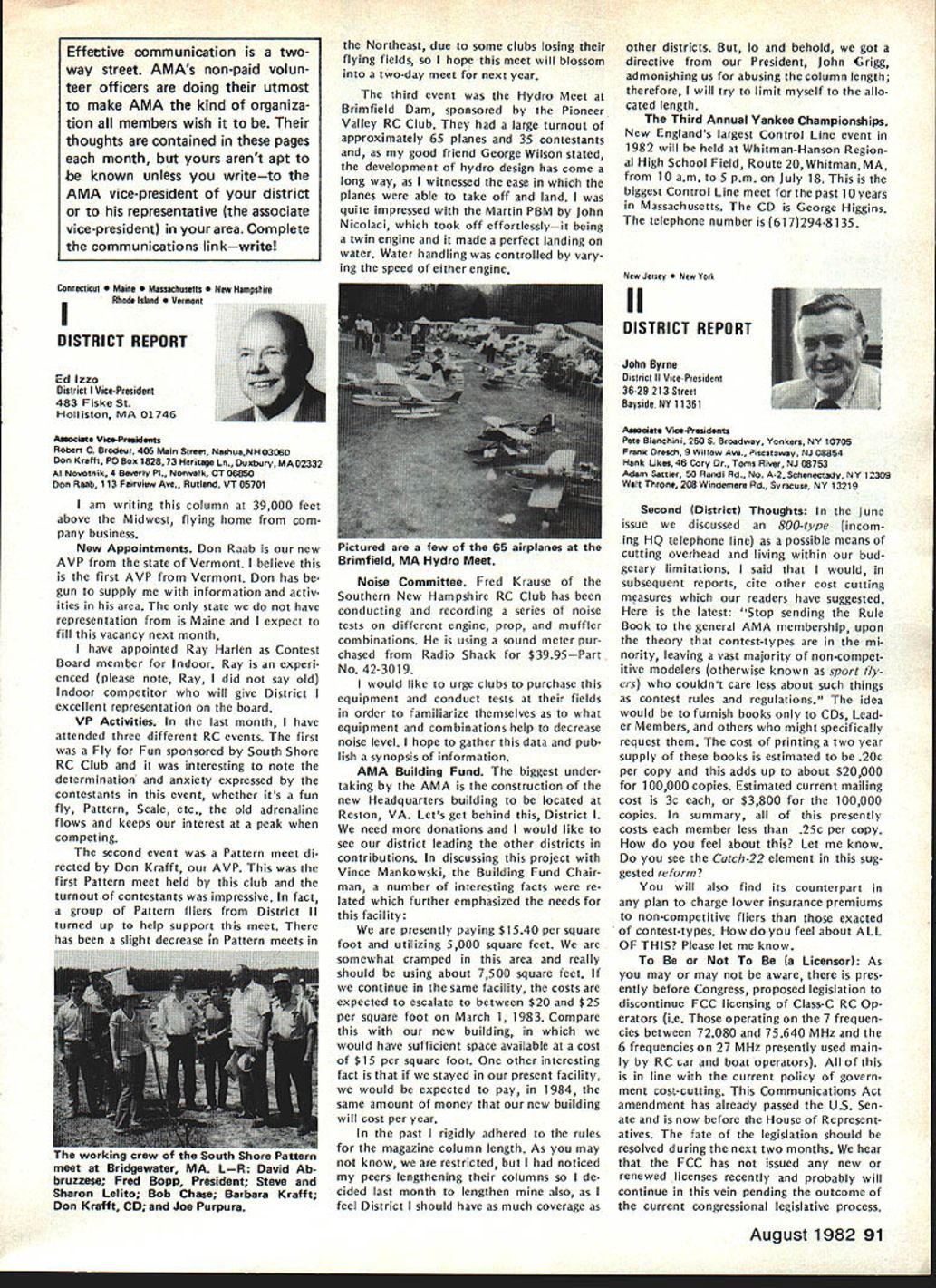
DISTRICT REPORT — District I (Connecticut • Maine • Massachusetts • New Hampshire • Rhode Island • Vermont)
Ed Izzo, District I Vice‑President 483 Fiske St., Holliston, MA 01746
Associate Vice‑Presidents
- Robert C. Brodeur — 405 Main Street, Nashua, NH 03060
- Don Krafft — PO Box 1828, 73 Heritage Ln., Dudley, MA 02332
- Al Nowak — 4 Beverly Pl., Norwalk, CT 06851
- Don Rabb — 113 Fairview Ave., Rutland, VT 05701
Notes from the VP
- New appointments: Don Rabb is the new AVP from Vermont; Maine remains without representation but a vacancy is expected to be filled next month. Ray Harlen appointed to the Contest Board for Indoor events.
- Events attended: South Shore RC Club Fly for Fun; a Pattern meet directed by Don Krafft (impressive turnout); Hydro Meet at Brimfield Dam (Pioneer Valley RC Club) with about 65 planes and 35 contestants — notable hydro development (example: Martin PBM by John Nicolaci).
- Noise Committee: Fred Krause (Southern New Hampshire RC Club) is conducting noise tests with a Radio Shack sound meter (Part No. 42‑3019). Clubs are urged to purchase a meter (~$39.95) and conduct local tests; data will be compiled and summarized.
- AMA Building Fund: District I is encouraged to contribute more; moving to a new AMA Headquarters in Reston, VA will provide adequate space at lower projected per‑square‑foot cost than continuing in the present facility.
- Third Annual Yankee Championships (Control Line): Whitman‑Hanson Regional High School Field, Whitman, MA — July 18, 10 a.m.–5 p.m. CD: George Higgins — (617) 294‑8135.
---
DISTRICT REPORT — District II (New Jersey • New York)
John Byrne, District II Vice‑President 36‑29 213 Street, Bayside, NY 11361
Associate Vice‑Presidents
- Pete Bianchini — 250 S. Broadway, Yonkers, NY 10705
- Frank Orese — 9 Willow Ave., Piscataway, NJ 08854
- Hank Lukas — 46 Cory Dr., Toms River, NJ 08753
- Adam Satter — 50 Randl Rd., No. 2A, Schenectady, NY 12303
- Walt Throne — 208 Windemere Rd., Syracuse, NY 13219
Notes from the VP
- Cost‑saving idea: cease general mailing of the Rule Book to all members, supplying it only to CDs, League Members, and those who request it. Printing and mailing of a two‑year supply was estimated at about $0.25 per copy in total. Feedback requested from members on this and related ideas (e.g., insurance premium differentials for non‑competitive flyers).
- Licensing legislation: Proposed Congressional legislation may discontinue FCC licensing of Class C RC operators (72–76 MHz) and certain 27 MHz frequencies used by car/boat operators. The amendment has passed the Senate and is before the House; the FCC has reportedly not issued new or renewed licenses pending legislative outcome.
---
(End of reformatted AMA News content)
Transcribed from original scans by AI. Minor OCR errors may remain.

