
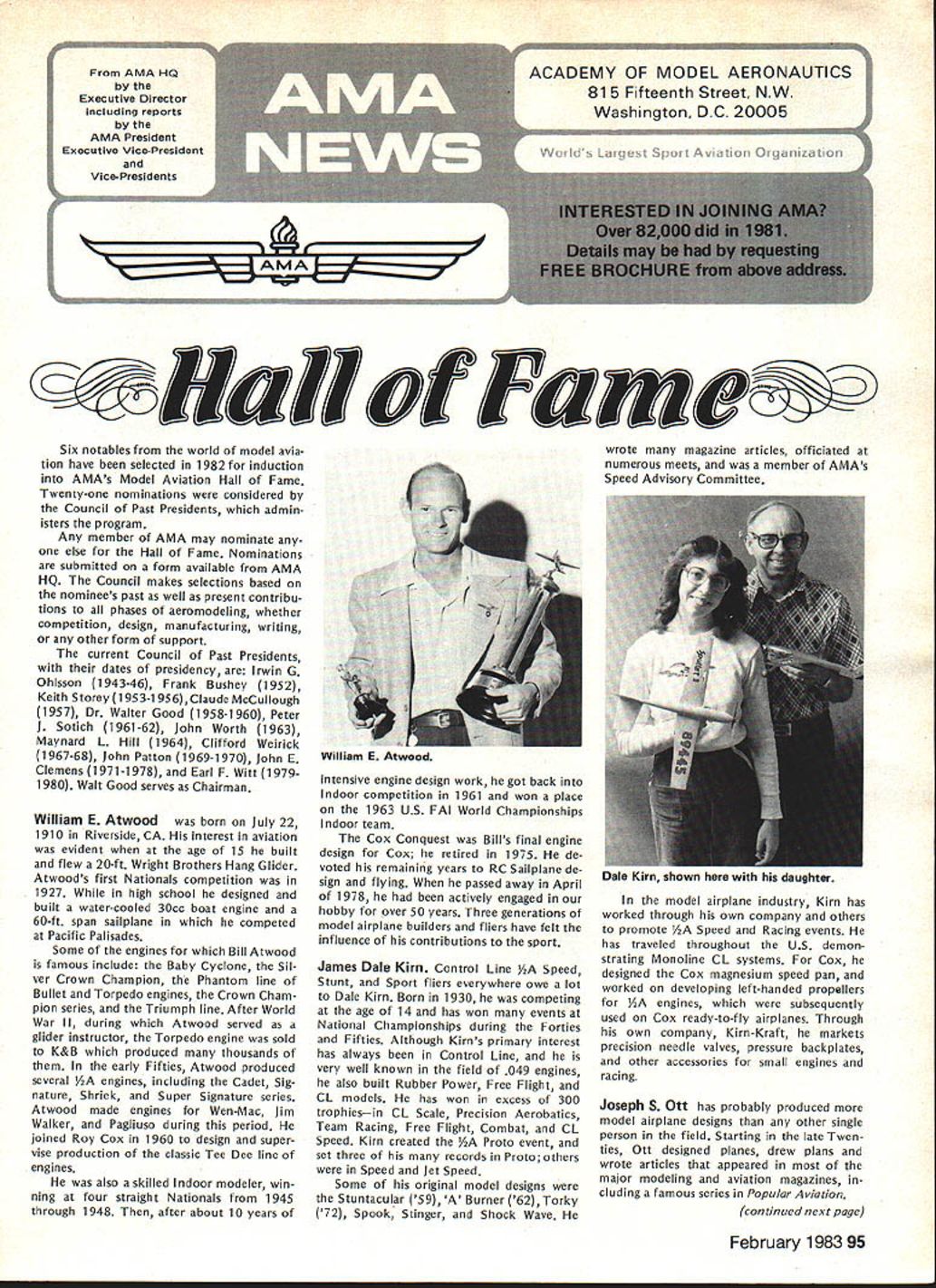
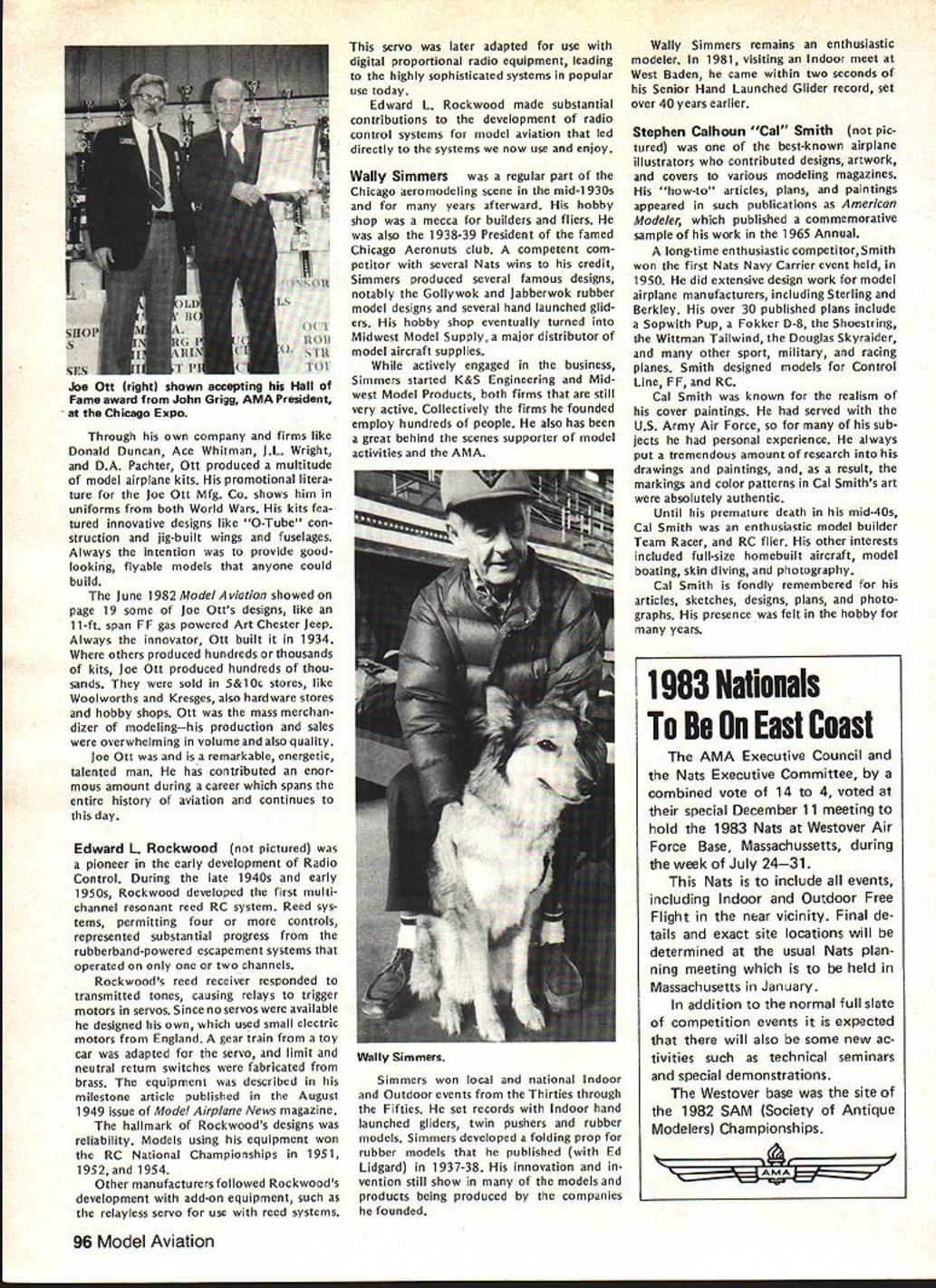
Hall of Fame
Six notables from the world of model aviation were selected in 1982 for induction into AMA's Model Aviation Hall of Fame. Twenty-one nominations were considered by the Council of Past Presidents, which administers the program.
Any member of AMA may nominate anyone else for the Hall of Fame. Nominations are submitted on a form available from AMA HQ. The Council makes selections based on the nominee's past as well as present contributions to all phases of aeromodeling, whether competition, design, manufacturing, writing, or any other form of support.
The current Council of Past Presidents, with their dates of presidency, are:
- Irwin G. Ohlsson (1943-46)
- Frank Bushey (1952)
- Keith Storey (1953-56)
- Claude McCullough (1957)
- Dr. Walter Good (1958-60)
- Peter J. Sotich (1961-62)
- John Worth (1963)
- Maynard L. Hill (1964)
- Clifford Weirick (1967-68)
- John Patton (1969-70)
- John E. Clemens (1971-78)
- Earl F. Witt (1979-80)
Dr. Walter Good serves as Chairman.
William E. Atwood William E. Atwood was born on July 22, 1910, in Riverside, CA. His interest in aviation was evident when, at the age of 15, he built and flew a 20-ft. Wright Brothers hang glider. Atwood's first Nationals competition was in 1927. While in high school he designed and built a water-cooled 30cc boat engine and a 60-ft. span sailplane in which he competed at Pacific Palisades.
Some of the engines for which Bill Atwood is famous include the Baby Cyclone, the Silver Crown Champion, the Phantom line of Bullet and Torpedo engines, the Crown Champion series, and the Triumph line. After World War II, during which Atwood served as a glider instructor, the Torpedo engine was sold to K&B, which produced many thousands of them. In the early 1950s, Atwood produced several 1/2A engines, including the Cadet, Signature, Shriek, and Super Signature series. Atwood made engines for Wen-Mac, Jim Walker, and Pagliuso during this period. He joined Roy Cox in 1960 to design and supervise production of the classic Tee Dee line of engines.
He was also a skilled indoor modeler, winning four straight Nationals from 1945 through 1948. After about ten years of intensive engine design work, he returned to indoor competition in 1961 and won a place on the 1963 U.S. FAI World Championships indoor team.
The Cox Conquest was Bill's final engine design for Cox; he retired in 1975. He devoted his remaining years to RC sailplane design and flying. When he passed away in April 1978, he had been actively engaged in the hobby for over 50 years. Three generations of model airplane builders and fliers have felt the influence of his contributions to the sport.
James Dale Kirn Control Line 1/2A Speed, Stunt, and Sport fliers owe a lot to Dale Kirn. Born in 1930, he was competing at the age of 14 and won many events at National Championships during the 1940s and 1950s. Although Kirn's primary interest has always been in Control Line and he is well known in the field of .049 engines, he also built rubber-power, free flight, and CL models. He has won in excess of 300 trophies—in CL Scale, Precision Aerobatics, Team Racing, Free Flight, Combat, and CL Speed. Kirn created the 1/2A Proto event and set three records in Proto; others were in Speed and Jet Speed.
Some of his original model designs include the Stuntacular (’59), "A" Burner (’62), Torky (’72), Spook, Stinger, and Shock Wave. He wrote many magazine articles, officiated at numerous meets, and was a member of AMA's Speed Advisory Committee.
In the model airplane industry, Kirn worked through his own company and others to promote 1/2A Speed and Racing events. He traveled throughout the U.S., demonstrating Monoline CL systems. For Cox, he designed the Cox magnesium speed pan and helped develop left-handed propellers for 1/2A engines, which were later used on Cox ready-to-fly airplanes. Through his company, Kirn-Kraft, he marketed precision needle valves, pressure backplates, and other accessories for small engines and racing.
Joseph S. Ott Joe Ott probably produced more model airplane designs than any other single person in the field. Starting in the late 1920s, Ott designed planes, drew plans, and wrote articles that appeared in most major modeling and aviation magazines, including a famous series in Popular Aviation.
Through his companies and firms like Donald Duncan, Ace Whitman, J.L. Wright, and D.A. Pachter, Ott produced a multitude of model airplane kits. His promotional literature for the Joe Ott Mfg. Co. shows him in uniforms from both World Wars. His kits featured innovative designs like "O-Tube" construction and jig-built wings and fuselages, intended to provide good-looking, flyable models that anyone could build.
The June 1982 Model Aviation showed some of Joe Ott's designs, like an 11-ft. span free-flight gas-powered Art Chester Jeep he built in 1934. Where others produced hundreds or thousands of kits, Joe Ott produced hundreds of thousands. They were sold in 5 & 10¢ stores, hardware stores, and hobby shops. Ott was the mass merchandiser of model kits—his production and sales were overwhelming in both volume and quality.
Joe Ott is a remarkable, energetic, talented man who has contributed enormously during a career that spans the entire history of aviation and continues to this day.
Edward L. Rockwood Edward L. Rockwood was a pioneer in the early development of radio control. During the late 1940s and early 1950s, Rockwood developed the first multi-channel resonant-reed RC system. Reed systems, permitting four or more controls, represented substantial progress from rubber-band-powered escapement systems that operated on only one or two channels.
Rockwood's reed receiver responded to transmitted tones, causing relays to trigger motors in servos. Since no servos were available, he designed his own, using small electric motors from England. A gear train from a toy car was adapted for the servo, and limit and neutral-return switches were fabricated from brass. The equipment was described in his milestone article published in the August 1949 issue of Model Airplane News.
The hallmark of Rockwood's designs was reliability. Models using his equipment won the RC National Championships in 1951, 1952, and 1954. Other manufacturers followed Rockwood's development with add-on equipment, such as the relayless servo for use with reed systems. This servo was later adapted for use with digital proportional radio equipment, leading to the sophisticated systems in popular use today.
Edward L. Rockwood made substantial contributions to the development of radio control systems for model aviation that led directly to the systems we now use and enjoy.
Wally Simmers Wally Simmers was a regular part of the Chicago aeromodeling scene from the mid-1930s and for many years afterward. His hobby shop was a mecca for builders and fliers. He was President of the Chicago Aeronauts in 1938-39. A competent competitor with several Nats wins, Simmers produced several famous designs, notably the Gollywok and Jabberwock rubber models and several hand-launched gliders. His hobby shop eventually turned into Midwest Model Supply, a major distributor of model aircraft supplies.
While in business, Simmers started K&S Engineering and Midwest Model Products, both firms that are still active and together employ hundreds of people. He has been a great behind-the-scenes supporter of model activities and the AMA.
Simmers won local and national indoor and outdoor events from the 1930s through the 1950s. He set records with indoor hand-launched gliders, twin pushers, and rubber models. He developed a folding prop for rubber models, published with Ed Lidgard in 1937–38. His innovations still show in many models and products produced by the companies he founded.
Wally Simmers remains an enthusiastic modeler. In 1981, at an indoor meet at West Baden, he came within two seconds of his Senior Hand-Launched Glider record set over 40 years earlier.
Stephen Calhoun "Cal" Smith Stephen Calhoun "Cal" Smith was a well-known airplane illustrator who contributed designs, artwork, and covers to modeling magazines. His how-to articles, plans, and paintings appeared in publications such as American Modeler, which published a commemorative sample of his work in the 1965 Annual.
A long-time competitor, Smith won the first Nats Navy Carrier event in 1950. He did extensive design work for manufacturers, including Sterling and Berkley. His more than 30 published plans include a Sopwith Pup, a Fokker D-8, the Shoestring, the Wittman Tailwind, the Douglas Skyraider, and many sport, military, and racing planes. Smith designed models for Control Line, free flight, and RC.
Cal Smith was known for the realism of his cover paintings. He served with the U.S. Army Air Force, so many subjects reflected personal experience. He always performed extensive research for his drawings and paintings, resulting in absolutely authentic markings and color patterns.
Until his premature death in his mid-40s, Cal Smith was an enthusiastic model builder, team racer, and RC flier. His other interests included full-size homebuilt aircraft, model boating, skin diving, and photography.
Cal Smith is fondly remembered for his articles, sketches, designs, plans, and photographs. His presence was felt in the hobby for many years.
AMA News
President's Corner
By the President of the Academy of Model Aeronautics JOHN C. GRIGG 6387 Badger Drive Lockport, NY 14094 Home: (716) 434-3955 Work: (716) 631-6314
#### NEW RADIO FREQUENCIES—AT LAST On November 4, 1982, the commissioners of the FCC voted unanimously to grant the frequencies for radio control of model aircraft, boats, and cars as requested by the AMA. Publication of the FCC Report and Order in the Federal Register made the new frequencies official as of December 20, 1982. The new frequencies are to be used in compliance with the AMA implementation plan concerning the transition from old to new.
- On January 1, 1983, we began with 11 new frequencies plus the existing seven (in the 72 MHz band) for a total of 18.
- On January 1, 1988, the existing seven frequencies are scheduled to be lost (equipment can be converted), while additional new channels will be added.
- On January 1, 1991, we are to have use of a total of 50 channels, all for model aircraft only.
Boat and car users will gain 30 channels in the 75 MHz band for their exclusive use. After five years, aircraft fly only on 72 MHz frequencies and boats/cars use only 75 MHz frequencies.
My heartiest congratulations to Bob Aberle and the entire Frequency Committee for their efforts in gaining this success.
#### COUNCIL REPORT The October meeting of the Executive Council was very productive, handling a three-page agenda in a day and a half. A synopsis of the entire meeting appeared in the January 1983 issue.
#### ANNUAL MEMBERSHIP MEETING ITEMS
Nats Publicity All agreed last year’s Nats publicity was poorly done and late. John Worth and I accept responsibility. This will not occur again during my administration.
Nats Entry Form Publishing the entire Nats entry form in Model Aviation would require six pages—impractical. Publication of only the entry blank could be done in two pages and will be investigated.
Bumper Stickers Some members preferred receiving a set of their AMA numbers (as was done years ago) rather than the bumper-sticker device supplied with renewals. PR will investigate, though logistics for 83,000 members could double membership processing costs.
Dues Differentials The idea of dues based on aircraft category has been discussed for years and rejected—processing costs and practical enforcement make it unlikely to succeed. The current license allows participation in all types of model flying without holding specific licenses for each category.
#### OTHER COUNCIL ITEMS
Noise Ed Izzo, Chairman of the Noise Committee, demonstrated a model airplane designed to minimize noise: tuned pipe, muffler, three-bladed prop, non-resonant structures. He appears promising and has spent none of the committee's budget so far.
Special Interest Groups Eight groups are recognized as Special Interest Groups to AMA:
- SAM
- NASA
- NSRCA
- USPAA
- NFFS
- NAA
- MACA
- NSS
Other groups are encouraged to seek approval.
New Licenses Issuing Authorized officers in charge can now accept a new membership application and grant immediate membership and insurance coverage at AMA-sanctioned contests.
FAI Aerobatics, 1983 The Executive Council approved AMA’s proposal to host the world-class FAI Aerobatics event; final FAI approval through CIAM is pending. The FAI-CIAM accepted Australia as host for the 1983 Free Flight World Championships.
Giant Models Don Godfrey, President of IMAA, presented IMAA’s safety and aircraft regulations for giant models and requested AMA acceptance. Bill Wilbur assisted; the proposals were directed to AMA’s Safety Committee for review.
CL Combat The Council approved funding a mechanic for each Combat flier sent by AMA to a World Championship.
1983 Nats At the time of writing there was no site or date decided for the 1983 Nats. A joint meeting between the Executive Council and the Nats Executive Committee was scheduled to resolve this.
Special Order A special rule of order was introduced, whereby discussion on an item will be introduced at one meeting but no vote taken until the next, with provisions for priority or time-critical items.
Since this issue reaches you around the end of December or early January, I wish you a happy holiday season and a successful 1983. God bless.
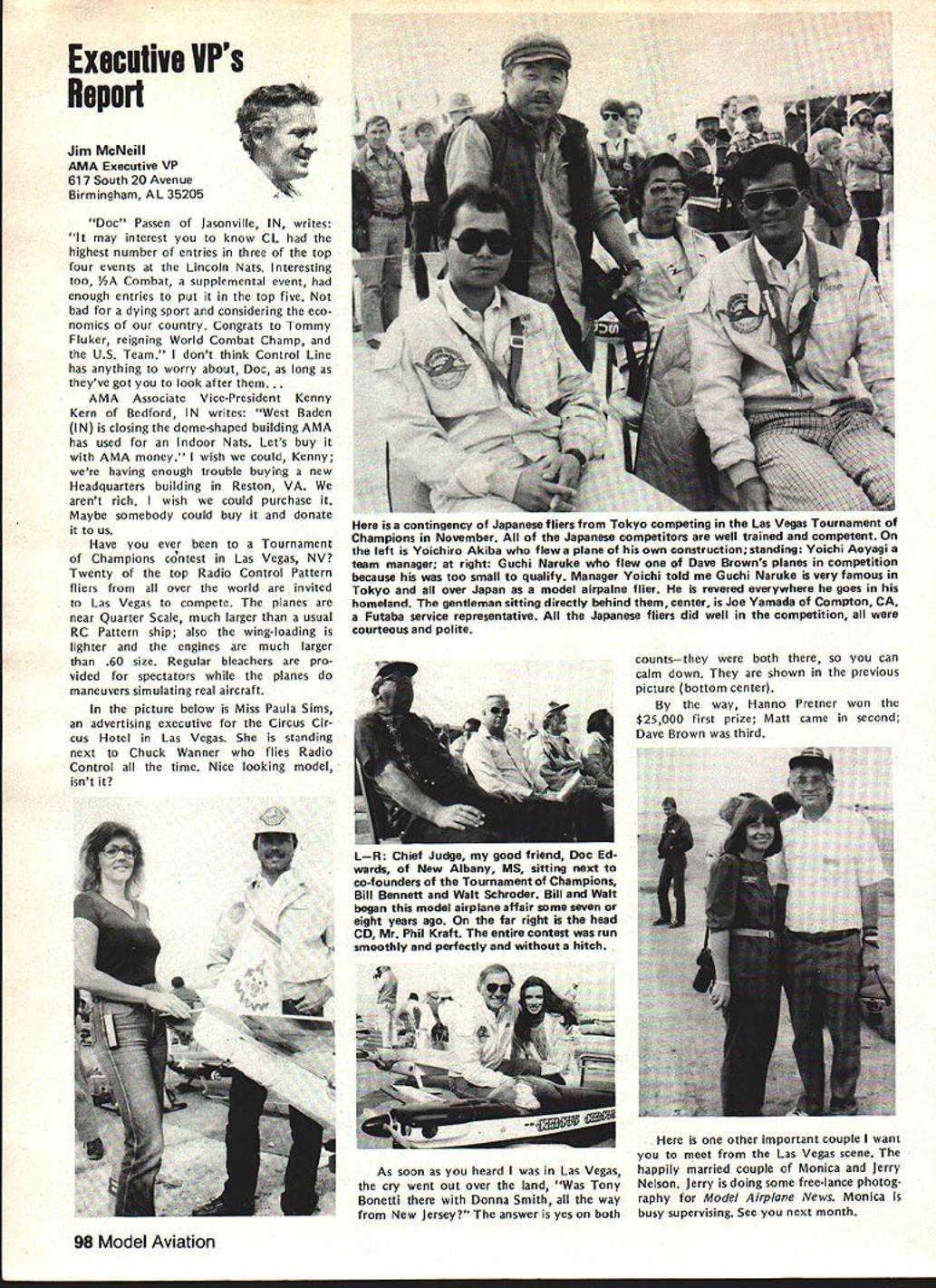
Executive VP's Report
Jim McNeill AMA Executive VP 617 South 20 Avenue Birmingham, AL 35205
"Doc" Passen of Jasonville, IN, notes that Control Line had the highest number of entries in three of the top four events at the Lincoln Nats. Also, 1/2A Combat, a supplemental event, had enough entries to be in the top five.
AMA Associate Vice-President Kenny Kern of Bedford, IN suggested buying the West Baden dome used for an Indoor Nats; we cannot afford that presently. We are working on buying a new Headquarters building in Reston, VA.
Tournament of Champions in Las Vegas invites 20 top RC Pattern fliers worldwide. The planes are near quarter scale, with light wing-loading and large engines. This year Hanno Prettner won the $25,000 first prize; Matt came second; Dave Brown third. Tony Bonetti and Donna Smith attended and Monica and Jerry Nelson were featured from the Las Vegas scene.
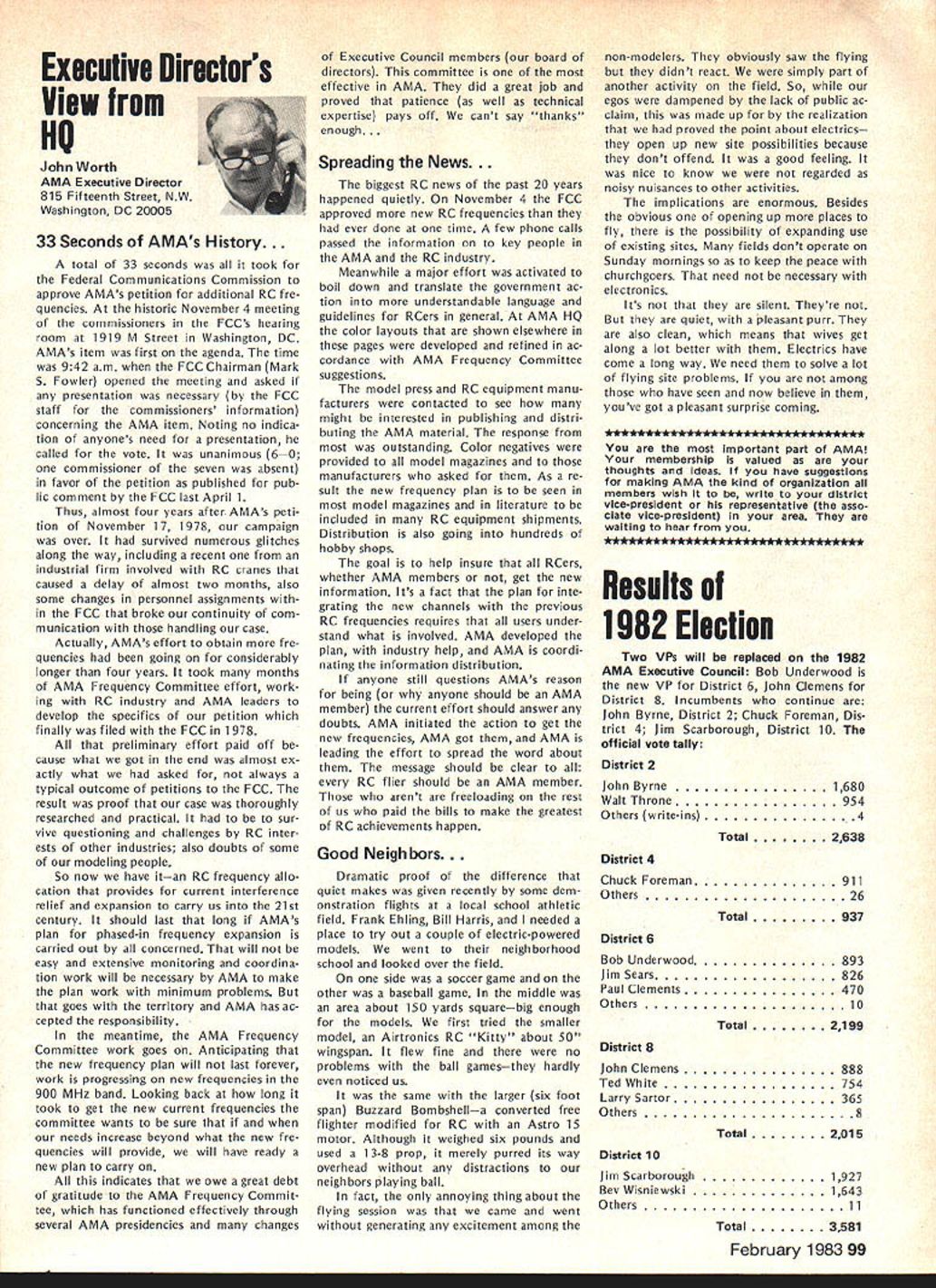
Executive Director's View from HQ
John Worth AMA Executive Director 815 Fifteenth Street, N.W. Washington, DC 20005
#### 33 Seconds of AMA's History At the November 4 FCC meeting, AMA's petition for additional RC frequencies was approved in 33 seconds. The vote was unanimous (6-0). The petition filed on November 17, 1978, and the subsequent years of work by the Frequency Committee and industry partners produced almost exactly what was requested.
The new frequency allocation plan provides current interference relief and expansion for future needs. AMA must coordinate a phased-in implementation to make the plan work with minimum problems. Work is also progressing on new frequencies in the 900 MHz band.
#### Spreading the News AMA developed clear materials describing the FCC action and distributed them widely—magazines, equipment manufacturers, and hobby shops. The goal is to ensure all RCers understand the phase-in and how to integrate new channels with previous frequencies. AMA led the initiative, obtained the frequencies, and is coordinating information distribution.
#### Good Neighbors A demonstration flight at a local school athletic field with electric-powered models (Airtronics "Kitty" and a converted Buzzard Bombshell) showed that electric models are quiet and can open up new flying sites without disturbing other activities. Electrics are quiet, clean, and can help resolve flying-site conflicts.
You are the most important part of AMA. If you have suggestions, write to your district vice-president or associate vice-president.
AMA News
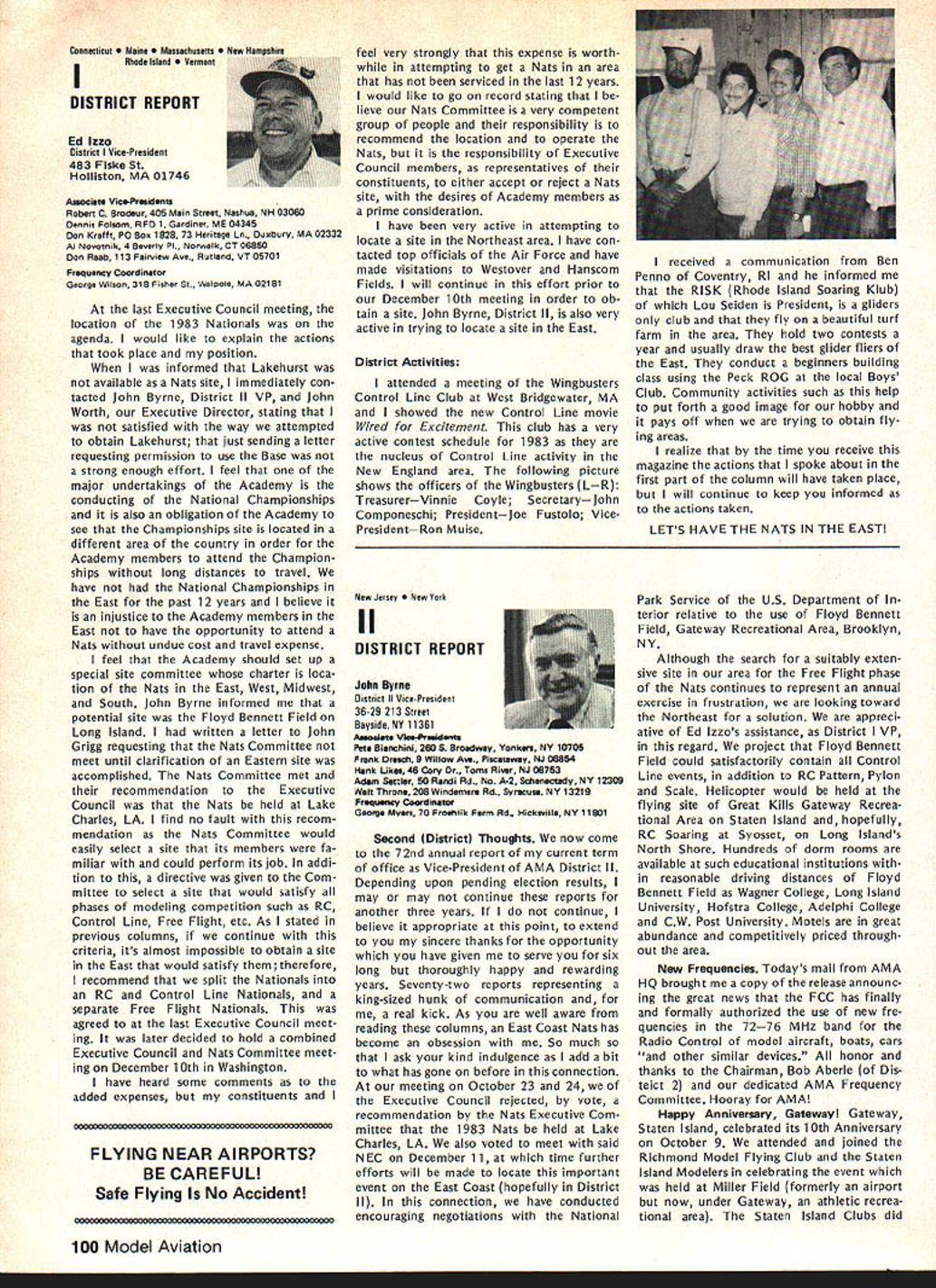
I DISTRICT REPORT
(Connecticut • Maine • Massachusetts • New Hampshire • Rhode Island • Vermont)
Ed Izzo District I Vice-President 483 Fiske St. Holliston, MA 01746
Associate Vice-Presidents:
- Robert C. Brodeur, Nashua, NH
- Dennis Folsom, Gardiner, ME
- Don Krafft, Duxbury, MA
- Al Nowotnik, Norwalk, CT
- Don Raab, Rutland, VT
Frequency Coordinator:
- George Wilson, Walpole, MA
When Lakehurst was unavailable as a Nats site, I contacted John Byrne (District II VP) and John Worth to express dissatisfaction with the effort to obtain Lakehurst. I believe the Academy should ensure the National Championships rotate geographically so members in the East can attend without undue travel expense. I recommend a special site committee to locate the Nats in the East, West, Midwest, and South.
Potential eastern sites include Floyd Bennett Field on Long Island. The Nats Committee initially recommended Lake Charles, LA, which I do not fault; however, a directive to select sites that satisfy all modeling phases makes eastern venues difficult. I therefore recommend splitting the Nationals into an RC and Control Line Nationals and a separate Free Flight Nationals—that recommendation was agreed to at the last Executive Council meeting. A combined Executive Council and Nats Committee meeting was scheduled for December 10 to finalize plans.
District Activities:
- I attended the Wingbusters Control Line Club meeting in West Bridgewater, MA, where I showed the Control Line movie Wired for Excitement.
- RISK (Rhode Island Soaring Klub) holds two glider contests a year and runs beginners’ building classes at the local Boys' Club, promoting good community relations and our hobby.
LET'S HAVE THE NATS IN THE EAST!
II DISTRICT REPORT
(New Jersey • New York)
John Byrne District II Vice-President 36-29 213 Street Bayside, NY 11361
Associate Vice-Presidents:
- Pete Bianchini, Yonkers, NY
- [other names and addresses as listed originally]
At the October 23–24 meeting the Executive Council rejected the Nats Committee recommendation to hold the 1983 Nats at Lake Charles, LA, and voted to meet with the NEC on December 10 to try to locate the event on the East Coast, hopefully in District II. Negotiations with the National Park Service regarding Floyd Bennett Field, Gateway Recreational Area (Brooklyn, NY), are encouraging.
Floyd Bennett Field could contain Control Line events plus RC Pattern, FAI events, and Scale. Helicopter might be at Great Kills on Staten Island and RC Soaring at Syosset. Nearby colleges provide dormitory housing and motels are abundant and reasonably priced.
New Frequencies: The FCC authorized new frequencies in the 72–76 MHz band. Thanks to Bob Aberle and the AMA Frequency Committee.
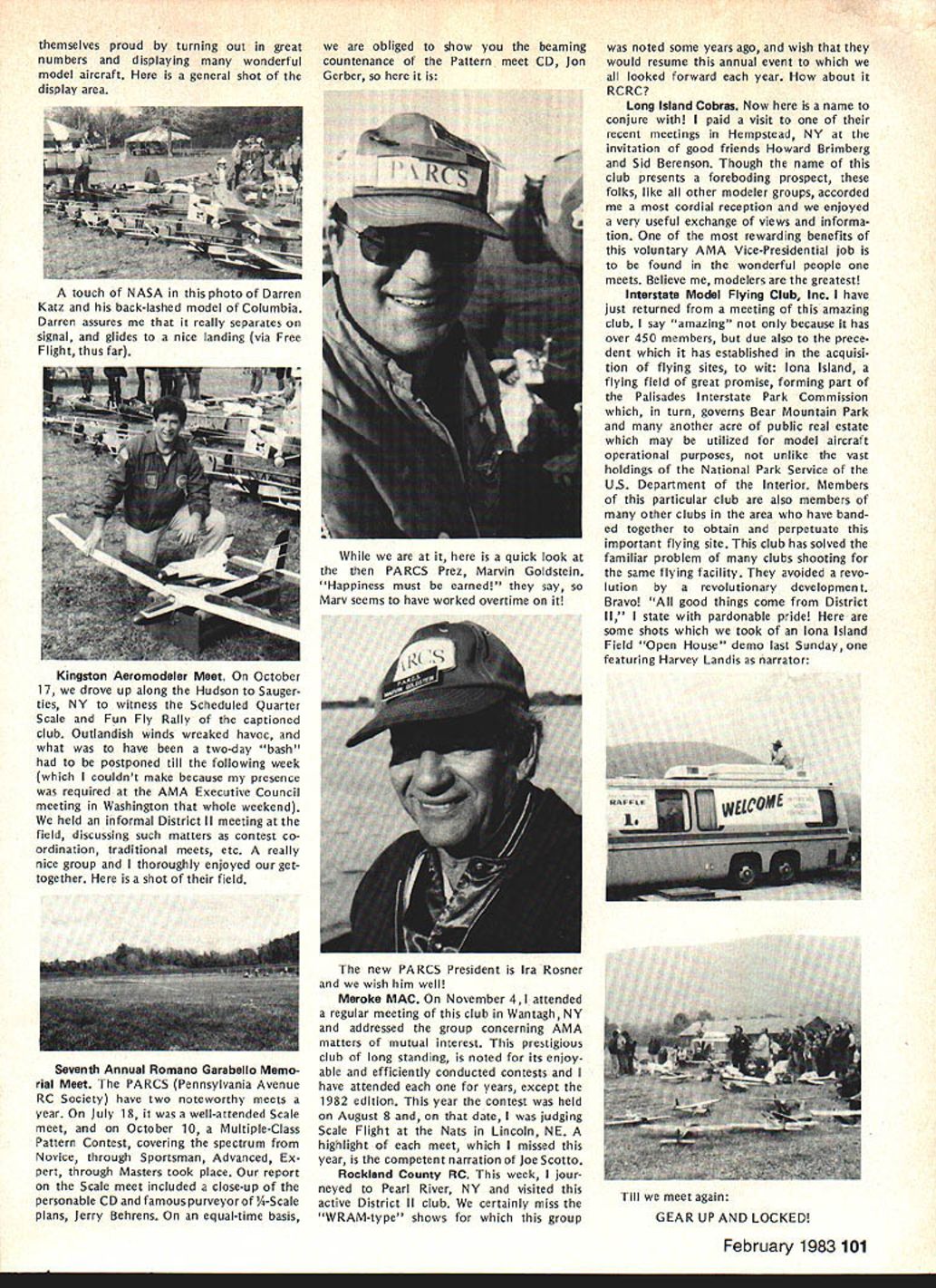
Gateway (Staten Island) celebrated its 10th anniversary on October 9 with Richmond Model Flying Club and Staten Island Modelers participating.
Kingston Aeromodeler Meet On October 17, high winds forced postponement of a two-day Quarter Scale and Fun Fly Rally in Saugerties, NY. An informal District II meeting discussed contest coordination and traditional meets.
Seventh Annual Romano Garabello Memorial Meet PARCS held a well-attended Scale meet in July and a Multiple-Class Pattern Contest on October 10.
Meroke MAC I spoke to the Meroke MAC in Wantagh, NY about AMA matters.
Rockland County RC Visited Pearl River, NY; the club was active and well organized.
Long Island Cobras Visited a meeting in Hempstead, NY; received a cordial reception and useful exchanges.
Interstate Model Flying Club, Inc. This club has over 450 members and has established Iona Island (Palisades Interstate Park Commission) as a flying site, illustrating effective collaboration among clubs to obtain and perpetuate flying facilities.
GEAR UP AND LOCKED!
III DISTRICT REPORT
(Dave Brown — District III)
Dave Brown District III Vice‑President 4560 Layhigh Rd. Hamilton, OH 45013
Associate Vice‑Presidents: Joe Eiben; Francis Flaherty; Corky Hageman; Laird Jackson; Eugene Shelley
The FCC approved our frequency proposal on November 4. Implementation is expected January 1, 1983, for convenience. Although the FCC gave 50 new aircraft frequencies and 30 non-aircraft frequencies, it is vital to stick to the phase-in plan (only 11 new frequencies for the first five years) to avoid interference. Use of frequencies outside the phase-in plan will be prohibited at AMA-sanctioned events.
Gratitude is due to Bob Aberle (Frequency Committee Chairman) and Mike Gilbertson (electronics engineer) for their instrumental work.
Tournament of Champions (Las Vegas) is over; District III was well represented with Brown, Tony Frackowiak, Mark Radcliff, and Don Lowe—four of the top seven and the top four Americans.
District III Symposium and Workshop Bob Buttons of Cambridge, OH, is hosting a District III Symposium at Salt Fork Lodge on January 22–23, 1983. Sessions include talks on Aresti-style Pattern, helicopters, engines, RC soaring, MonoKote, and more. Registration fee: $5.00.
See you at Salt Fork.
IV DISTRICT REPORT
(Chuck Foreman — District IV)
Chuck Foreman District IV Vice‑President 607 Pointe Drive Mechanicsville, VA 23111
Associate Vice‑Presidents: (listed in original)
I visited District IV clubs in the Carolinas. I was guest speaker at the Radio Control League of North Carolina anniversary meeting in Greensboro; the Greensboro Grams hosted a fun fly. I also attended the Raleigh Aeromasters Club meeting as a guest speaker; they have a good field, rapid membership growth, and a show team.
1983 NATS: At this writing the Nats site is undecided. The Nats Executive Committee recommended Lake Charles, LA, because Lakehurst Naval Base was unavailable. The Council initially voted to site the Nats at Floyd Bennett Field but later rescinded that motion pending a joint meeting with the Nats Executive Committee. The Nats Executive Committee has deep knowledge of what it takes to run the Nats and should guide the decision.
What's Happening in District IV:
- Tidewater Model Soaring Society: Hosting an FAI contest at Fentress Field in Norfolk on the Fourth of July weekend 1983.
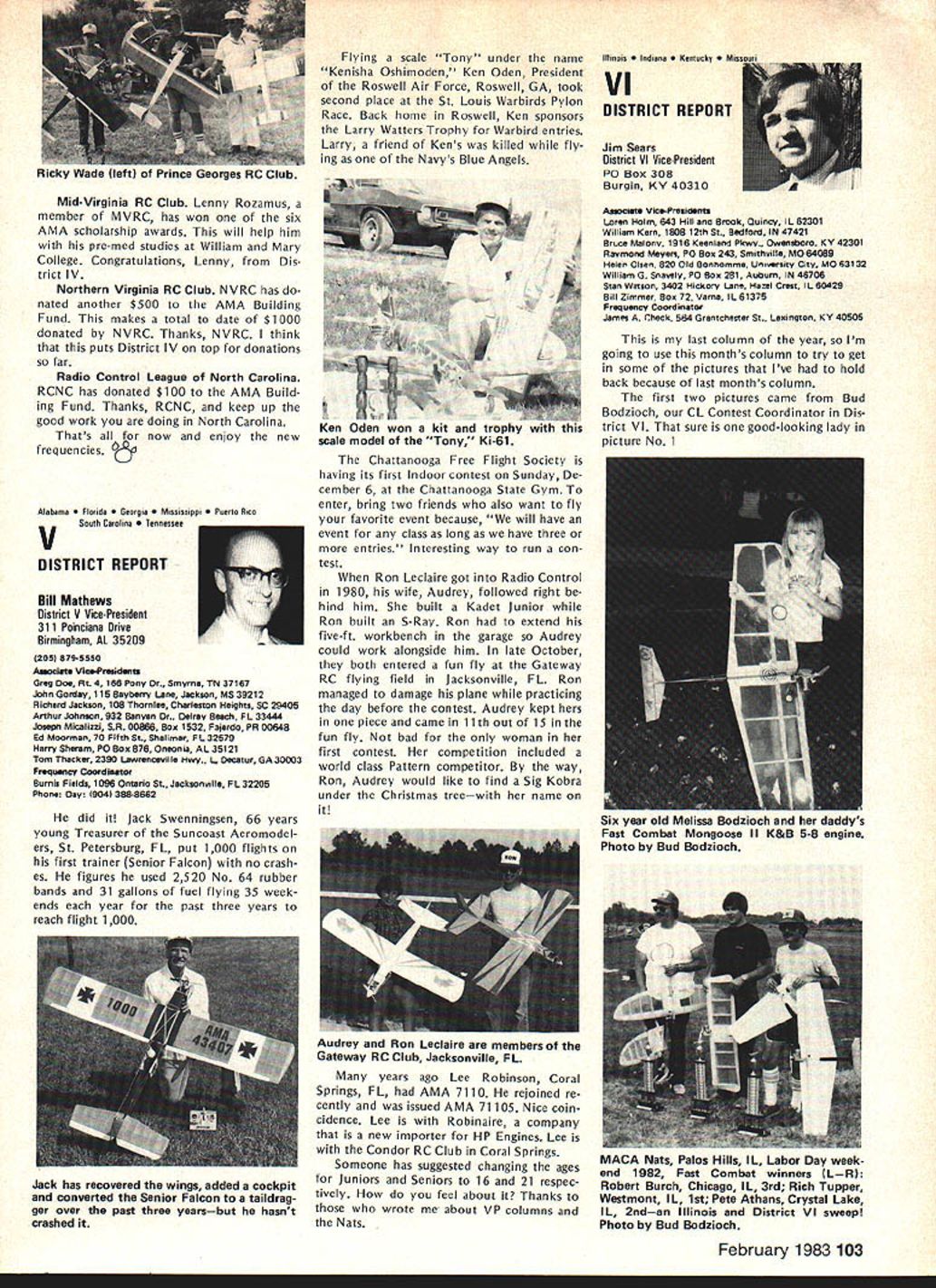
- Prince George Radio Control Club: Ricky Wade won the PGRC Quickie 500 Race.
- Mid-Virginia RC Club: Lenny Rozamus won one of six AMA scholarship awards for pre-med studies at William and Mary College.
- Northern Virginia RC Club: Donated $500 to the AMA Building Fund, totaling $1,000 from NVRC to date.
- Radio Control League of North Carolina: Donated $100 to the AMA Building Fund.
Enjoy the new frequencies.
V DISTRICT REPORT
(Alabama • Florida • Georgia • Mississippi • Puerto Rico • South Carolina • Tennessee)
Bill Mathews District V Vice-President 311 Poinciana Drive Birmingham, AL 35209 (205) 879-5550
Jack Swenningesen, 66, Treasurer of the Suncoast Aeromodelers (St. Petersburg, FL), completed 1,000 flights on his first trainer (Senior Falcon) without a crash—an impressive milestone.
The Chattanooga Free Flight Society is holding its first indoor contest on Sunday, December 6, at the Chattanooga State Gym. To enter, bring two friends—events will run if there are three or more entries.
Ron and Audrey Leclaire (Jacksonville, FL) both took up radio control in 1980; Audrey flew in a recent fun fly and placed 11th out of 15 in her first contest.
Lee Robinson (Coral Springs, FL) rejoined AMA (former AMA 7110, now 71105) and is associated with Robinair, a new importer for H.P. Engines.
A suggestion to change junior and senior age cutoffs to 16 and 21 respectively has been raised—comments welcome.
VI DISTRICT REPORT
Jim Sears District VI Vice-President PO Box 308 Burgin, KY 40310
This is my last column of the year. Jim Check, District VI Frequency Coordinator, asks that you report non-model-related interference (fixed station, paging, etc.) to (606) 299-0577 (do not call collect) or send a postcard.
Thanks for your support this year. Best wishes for the new year.
VII DISTRICT REPORT
Hardy Brodersen District VII Vice-President P.O. Box 1104 Birmingham, MI 48012
Assistant Vice-President:
- Jack Finn, Cedar Rapids, IA
Associate Vice-Presidents:
- Arthur A. Rice, Ann Arbor, MI
- Russell Keeler, Milwaukee, WI
- Robert O. Lundberg, Duluth, MN
- William Rohling, St. Joseph, MI
- Al Siciliano, Madison, WI
- Ron Sears, Pontiac, MI
- Terry Taylor, Crystal, WI
Frequency Coordinator:
- Pete Waters, Northville, MI
Phones: Day (313) 348-0085; Evening (313) 437-4244
From District VII AVP Al Scidmore:
- An AMA convention modeled after Oshkosh has appeal, but competition must be retained. Competitions drive development and provide role models and goals for sport fliers.
- The Nats offers a special experience for competitors and non-competitors alike—an opportunity for enthusiasts, clubs, and the public to engage with the hobby.
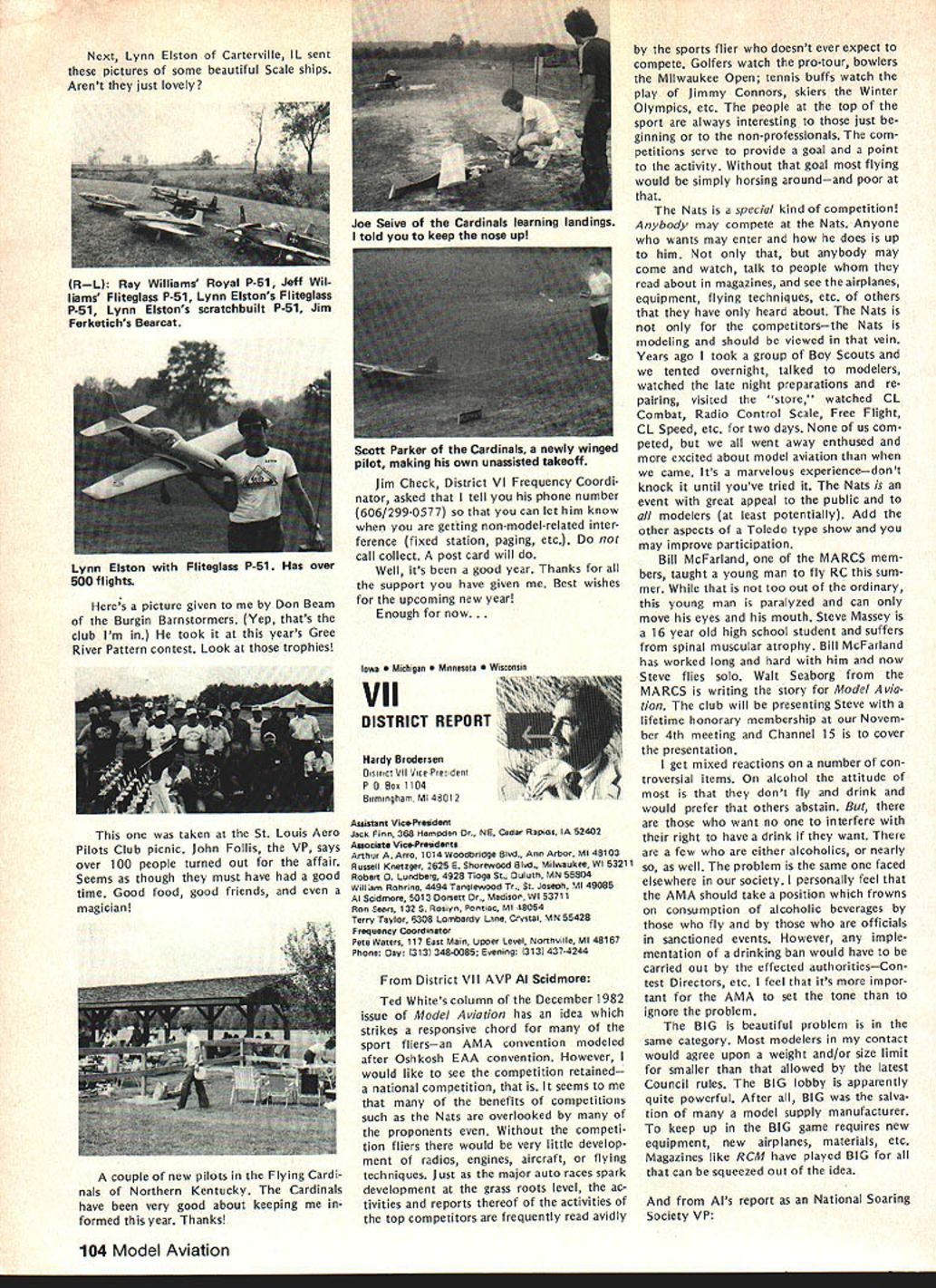
- Bill McFarland (MARCS) taught Steve Massey, a paralyzed 16-year-old with spinal muscular atrophy, to fly RC; the club presented Steve with a lifetime honorary membership.
On alcohol and flying: Most members prefer pilots abstain while flying; the AMA should set a tone that discourages consumption by pilots and officials, though implementation must be by local authorities.
On "BIG" models: Many members favor size/weight limits smaller than recent Council rules. The BIG movement has driven product development and publication interest, but raises questions and resource demands.
From Al as NSS VP:
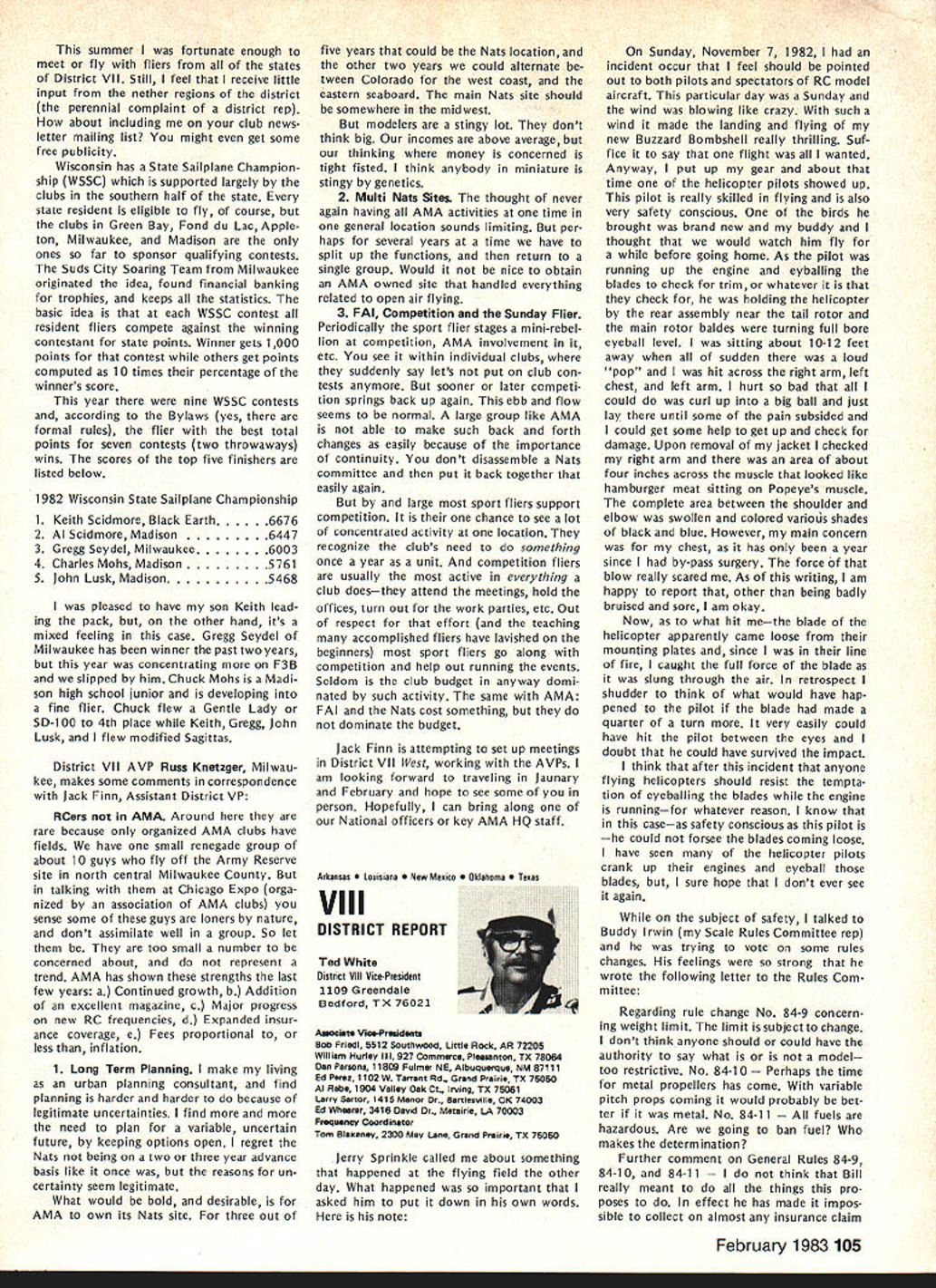
- Wisconsin State Sailplane Championship (WSSC) was supported by multiple clubs. Top five finishers for 1982 were:
- Keith Scidmore, Black Earth, 6676
- Al Scidmore, Madison, 6447
- Gregg Seydel, Milwaukee, 6003
- Charles Mohs, Madison, 5761
- John Lusk, Madison, 5468
District VII AVP Russ Knetzger reports:
- Non-AMA RCers are rare in the area because AMA clubs control fields. AMA strengths include continued growth, an excellent magazine, progress on new RC frequencies, expanded insurance coverage, and fees reasonable compared to inflation.
Long-term planning suggestions:
- Consider AMA owning a Nats site for stability, rotating other locations as needed.
- Multi-site Nats could be used when necessary.
- Competition ebb and flow is normal; most sport fliers ultimately support competition and its benefits.
Jack Finn is setting up meetings in District VII West. Travel plans for January and February will include meeting district clubs.
A safety incident Jerry Sprinkle reported a dangerous accident at a field where a helicopter blade apparently came loose and struck him, causing severe bruising. He urges helicopter pilots to avoid eyeballing blades while engines are running—safety should be paramount.
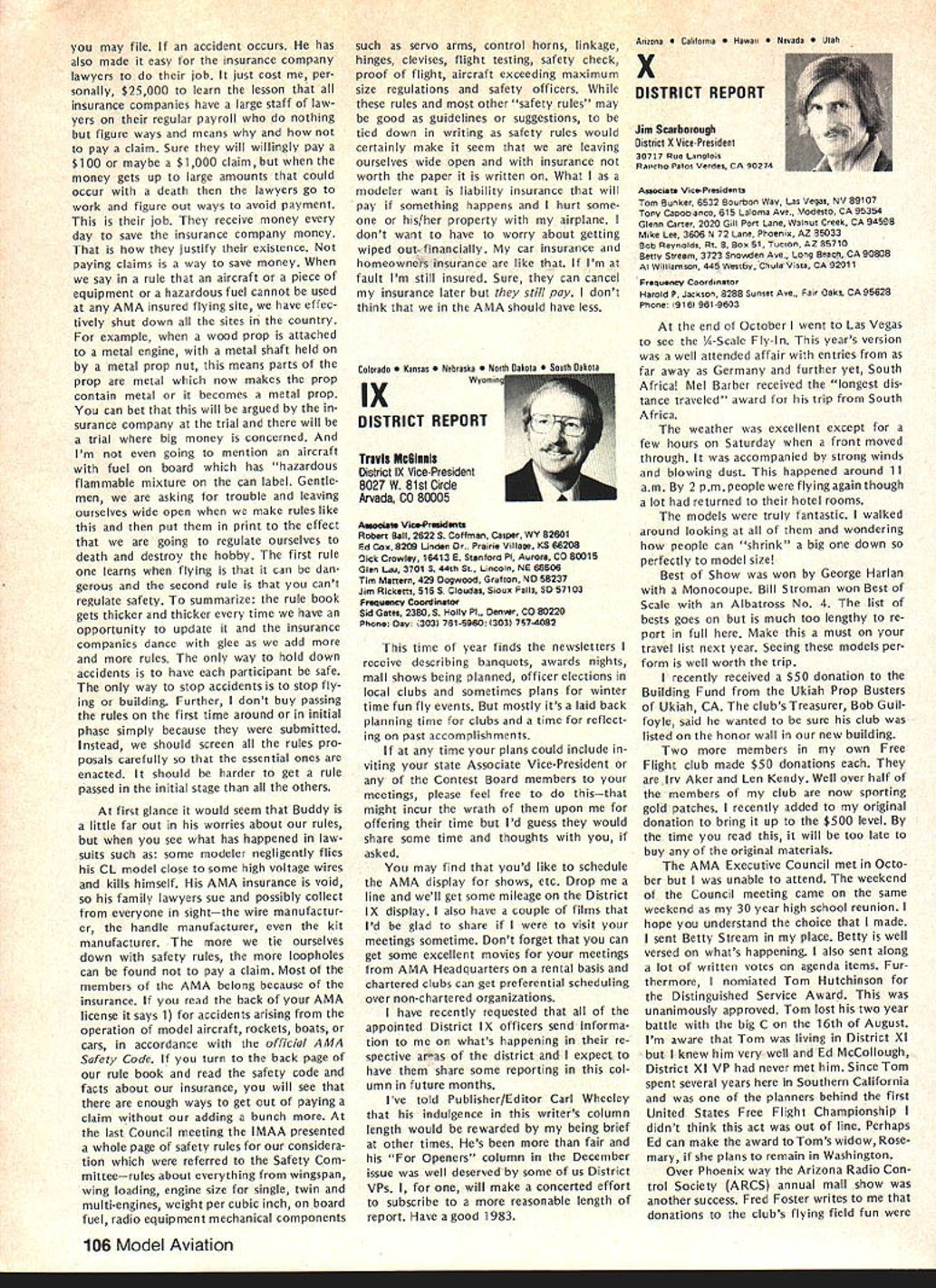
On safety rules and insurance Buddy Irwin (Scale Rules Committee rep) voiced concerns that overly prescriptive safety rules (e.g., bans on metal parts or certain fuels) could inadvertently jeopardize insurance claims and open loopholes for insurers to deny coverage. He argues the emphasis should be on participant responsibility and sensible guidelines, not rules that might make insurance less effective.
Phoenix and Arizona reports
- The ARCS mall display at Maryvale Mall impressed management; Tom Randall and Fred co-chaired successfully.
- Phoenix Model Airplane Club held a well-attended free-flight meet in October.
- Luke AFB open house featured model flying when full-scale aerial displays were canceled.
- Sun Valley Fliers raised funds to pave their field and are close to their $16,000 goal.
- San Diego plans to propose hosting the 1984 Nats, with Chula Vista Model and RC Club as host and other local clubs assisting.
As of early November, no Nats site or format for 1983 was finalized; a special Council meeting in December was planned to decide.
Thermals!
Transcribed from original scans by AI. Minor OCR errors may remain.

