
AMA News
Some Thoughts on the New RC Channels
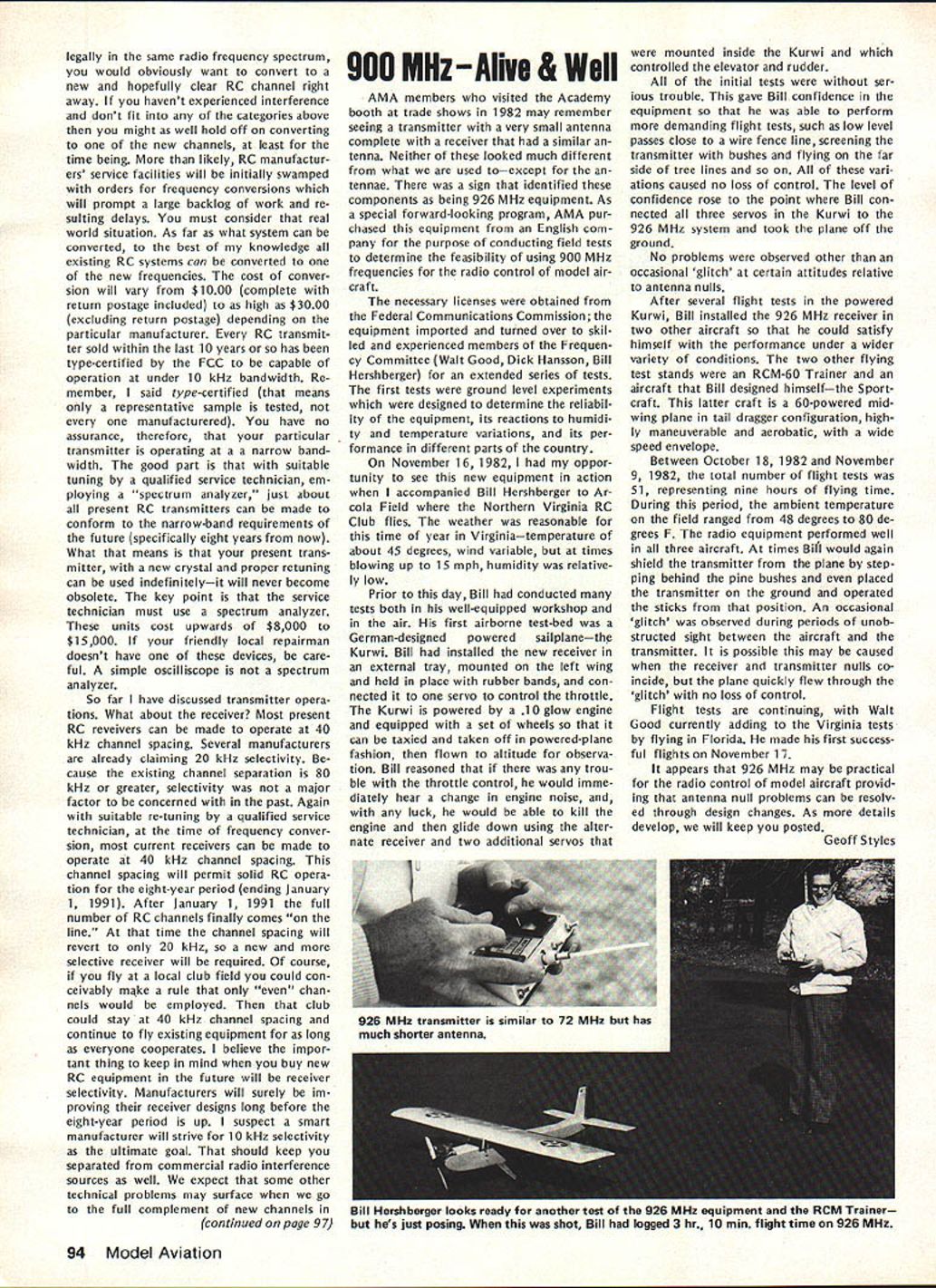
By Bob Aberle, Chairman, AMA's RC Frequency Committee; Technical Editor, Flying Models magazine
Hal Carstens, publisher of Flying Models, graciously agreed to reprint this article as a public service to help distribute information on the current RC frequency situation and what lies ahead. By the time you read this it will be late January or early February.
On November 4, 1982 the FCC voted unanimously to approve a series of new RC channels. The FCC's effective date for the new channels was December 20, 1982. For AMA-sanctioned competition purposes, some of those new channels became effective January 1, 1983 to correspond with the start of the new calendar-year flying season.
The effort to obtain these new channels took roughly four to five years of concentrated, carefully planned work by the Academy of Model Aeronautics (AMA), its RC Frequency Committee, its attorneys, and RC industry representatives. The initial proposal was submitted to the FCC in 1978; the final proposal was filed in September 1980. It then took a bit over two years to move through the government rule-making processes.
Two charts summarizing the new RC channels and the corresponding identification/control flags appear in the March issue of Flying Models and the February issue of Model Aviation. The material is printed so it can be removed from the magazine and posted for reference.
- The new RC model aircraft channels are located between 72 and 73 MHz.
- The new surface-model channels (RC cars, boats) are in the 75 MHz range.
- The rules create a clear separation of more than 2 MHz between RC aircraft and other radio-controlled models to give each hobby faction autonomy and to allow peaceful, safe coexistence where flying fields, race tracks, and ponds are co-located.
Phase-in scheme and channel availability
Because many of the old RC channels were located among the new channels, a carefully planned phase-in was required. The scheme permits continued safe use of existing RC channels for a five-year transition period (until January 1, 1988) while new channels are gradually introduced.
- Effective January 1, 1983:
- Aircraft modelers: retain the existing seven channels plus 11 new aircraft channels. The "oddball" aircraft channel at 75.640 MHz may be used legally during the full five-year withdrawal period, but aircraft modelers are encouraged to vacate it as soon as possible to achieve complete separation.
- Surface-model (non-aircraft) operators: retain the existing three channels (in the 72 MHz band) and gain access to 11 new channels in the 75 MHz band. RC car and boat operators are urged to convert equipment operating on the three existing 72 MHz channels (72.160, 72.320, 72.960 MHz) to the new 75 MHz channels to help achieve separation.
When to convert and conversion capability
Common questions are: 1) When should I convert my equipment? and 2) Can my present equipment be converted?
- Convert right away if:
- You are an aircraft modeler operating on 75.640 MHz.
- You are a surface-model operator on 72.160, 72.320, or 72.960 MHz.
- You have experienced severe interference from nearby commercial radio stations.
- If you haven't experienced interference and don't fit the above categories, you may delay conversion. Expect manufacturers' service facilities to be swamped initially, causing backlogs and delays.
Most existing RC transmitters can be converted to one of the new frequencies. Transmitters sold within roughly the last ten years have been type-certified by the FCC to operate at under 10 kHz bandwidth (type certification tests samples, not each unit). That does not guarantee your particular transmitter meets narrow-band operation, but with suitable retuning and a crystal change by a qualified service technician using a spectrum analyzer, most transmitters can be made to conform to future narrow-band requirements. This retuning should allow your transmitter to be used indefinitely; it will not become obsolete if properly converted.
- Typical conversion cost: $10 to $30 (return postage may be excluded by some manufacturers).
- Important: The service technician must use a spectrum analyzer (not an oscilloscope). Spectrum analyzers typically cost $8,000–$15,000.
Receivers, channel spacing, and future needs
Most current receivers can be retuned to operate at 40 kHz channel spacing; some manufacturers claim 20 kHz selectivity already. Historically, because existing channel separation was 80 kHz or greater, receiver selectivity was not critical. With the new channel plan:
- The 40 kHz spacing will permit solid operation during the eight-year period ending January 1, 1991.
- After January 1, 1991 the full complement of RC channels becomes active and channel spacing will be 20 kHz, requiring more selective receivers.
- Clubs could agree to use only "even" channels to preserve 40 kHz spacing and allow existing equipment to operate longer if all members cooperate.
- Manufacturers are expected to improve receiver selectivity; a 10 kHz selectivity goal would provide good protection against common commercial interference.
Other technical issues expected when the full channel set comes online include image rejection and intermodulation (I.M.) rejection. Many modern RC receivers use a 455 kHz intermediate frequency (I.F.), which may need revision for future receiver designs.
Long-term channel rollout
- Over time, AMA will release more channels according to the FCC timetable.
- After five years (January 1, 1988) usage of the existing seven aircraft channels must be dropped; the new channels that were guarding the old ones during the transition will be added.
- After another three years (January 1, 1991) the full number of FCC-authorized RC channels will be available.
Note: Being a secondary user in these frequency bands means commercial radio stations may operate as close as 10 kHz from an RC channel. If a commercial station causes interference, the rules require the RC user to change frequency. Because of this secondary status, AMA obtained a relatively large number of authorized channels.
Frequency coordination and data base
Selecting the correct RC channel for your area will be a significant challenge. AMA has appointed a Frequency Coordinator in each AMA district; their names and addresses appear in the AMA District VP columns in Model Aviation. These coordinators will receive master frequency listings of commercial radio stations operating between 72–73 MHz and will advise on likely problem channels for given locations. Modelers should report interference directly to their District Frequency Coordinator to help build a first-hand database. AMA plans to feed this data to a central computer at AMA Headquarters so a modeler could call a toll-free number, give a zip code, and receive a real-time list of known problem channels in that area.
New frequency flags and identification system
A new frequency-flag and identification system has been developed for the expanded RC channel set. The system includes color-coded tags and wind streamers bearing channel numbers. AMA hopes modelers will adopt channel numbers as the primary means of identification. All existing RC identification flags remain valid. A copy of the complete flag plan is available from AMA Headquarters (printed in the February 1983 Model Aviation).
License, please
The FCC currently requires a Class C license to operate an RC transmitter; AMA requires pilots to show this license before flying in sanctioned meets. The FCC is considering eliminating the license requirement — a move AMA views favorably for reasons including less paperwork, no renewal worries, and removing minimum age restrictions.
Until the FCC takes final action, maintain an active Class C license. There is no fee for the license, but the FCC will not accept renewal applications filed more than 90 days before the end of the license term.
Closing thoughts
Looking back on the effort to obtain these frequencies, it would have been simpler to gain a dozen or so new channels in unused spectrum. Spectrum is now at a premium, and competition from commercial services is intense. We were fortunate to obtain what we did. With patience and responsibility, the new RC rules can serve the hobby for many years.
AMA's volunteer officers are working hard on members' behalf. If you want your views known, write to the AMA vice-president of your district or to an associate vice-president.
---
A Terrible Loss, But Whose?
Found in the Statesville RC Club Newsletter (Shakey Thumb), shared for District IV:
A few Sundays ago at the field I was talking to a boy of about 12. He was articulate and imaginative. We talked about school, math, and English. He told me his grandfather had given him the choice of an RC glider or an Atari for Christmas. Sheepishly he chose the Atari.
It bugs me — what a waste. Here was a possible future aeronautical talent lost to instant electronic gratification. Modeling offers painless learning: aerodynamics, blueprint reading, geometry, drafting, reading comprehension, and manual dexterity. A TV ad said, "A mind is a terrible thing to waste." How right that is.
---
What's Happening in District IV
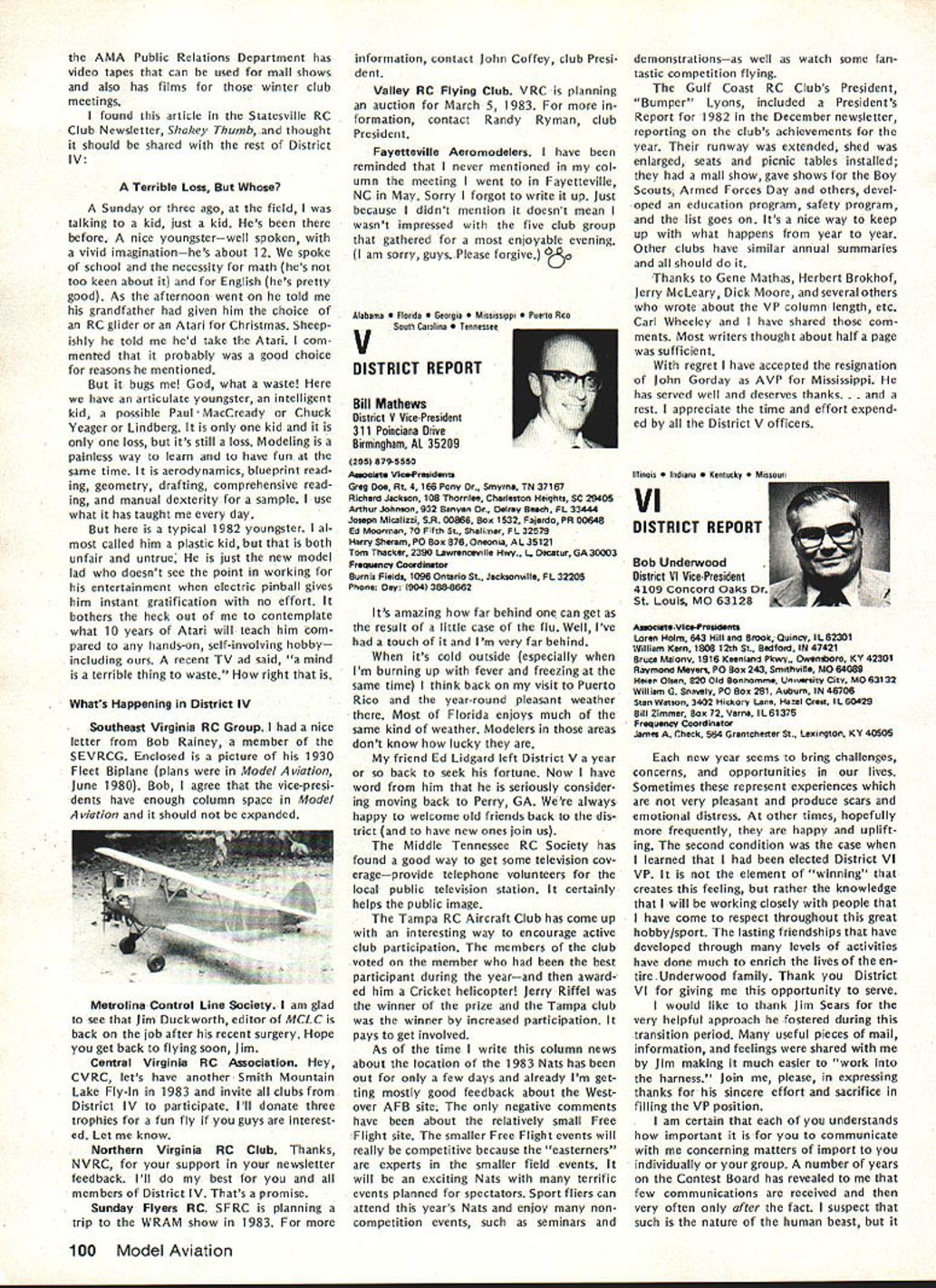
- Southeast Virginia RC Group: A letter from Bob Rainey included a photo of his 1930 Fleet biplane (see Model Aviation, June 1980). Comment: vice-presidents already have enough column space in Model Aviation and it should not be expanded.
- Metrolina Control Line Society: Editor Jim Duckworth is back after recent surgery.
- Central Virginia RC Association: Proposal for another Smith Mountain Lake Fly-In in 1983; donation of three trophies for a fun fly was offered.
- Northern Virginia RC Club: Appreciation for newsletter feedback and support.
- Sunday Flyers RC: Planning a trip to the WRAM show in 1983 — contact John Coffey, club president.
- Valley RC Flying Club: Planning an auction for March 5, 1983 — contact Randy Ryman, club president.
- Fayetteville Aeromodelers: Apology for having omitted a May meeting recap previously; the author was impressed with the five-club gathering.
States included in District IV: Alabama, Florida, Georgia, Mississippi, Puerto Rico, South Carolina, Tennessee.
---
District V Report
Bill Mathews, District V Vice-President 311 Poinciana Drive, Birmingham, AL 35209 Phone: (205) 879-5550
Associate Vice-Presidents:
- Greg Dee, Rt. 4, 166 Peery Dr., Smyrna, TN 37167
- Richard Jackson, 108 Thornlee Dr., Charleston Heights, SC 29405
- Arthur Johnson, 932 Sorrento Dr., Delray Beach, FL 33444
- Joseph Miccic — [address partly unreadable]
- Ed Moorman — [address partly unreadable]
- Harry Sherman, PO Box 376 — [city partly unreadable]
- Tom Tincker, 2309 Lawrenceville Hwy., Lawrenceville, GA 30043
Frequency Coordinator:
- Burns Fields, 1096 Oriole St., Jacksonville, FL 32205
Phone: Day (904) 396-0662
Notes from the column:
- The author recovered from the flu and reflects on the year-round pleasant weather in Puerto Rico and Florida.
- Friend Ed Lidgett may move back to Perry, GA.
- Middle Tennessee RC Society gained TV coverage by providing telephone volunteers for public television.
- Tampa RC Aircraft Club voted to award a Cricket helicopter to the member judged the best participant of the year; Jerry Riffel won.
- Good feedback about the Westover AFB site for the 1983 Nats; concerns mainly about the relatively small Free Flight site.
- Gulf Coast RC Club reported runway extension, shed enlargement, added seating and picnic tables, mall shows, demonstrations, education and safety programs.
- Accepted the resignation of John Gorday as AVP for Mississippi with thanks for his service.
---
District VI Report
Bob Underwood, District VI Vice-President 4109 Concord Oaks Dr., St. Louis, MO 63128 Phone: (314) 487-1957 (unlisted in St. Louis book)
Associate Vice-Presidents:
- [Names and addresses partly unreadable in the source image]
Notes from the column:
- The author expresses gratitude for being elected District VI VP and thanks predecessor Jim Sears for a helpful transition.
- Encourages communication from clubs and individuals; stresses dialogue based on rational, considered discussion rather than emotion.
- Appointed John Guenther of Borden, IN to replace him on the Scale Contest Board. John has been instrumental in the Mint Julep Scale Contest and served as Team Manager for the U.S. Scale Team at the Reno World Championships.
- The new RC frequencies have created excitement; many clubs are figuring out local implementation.
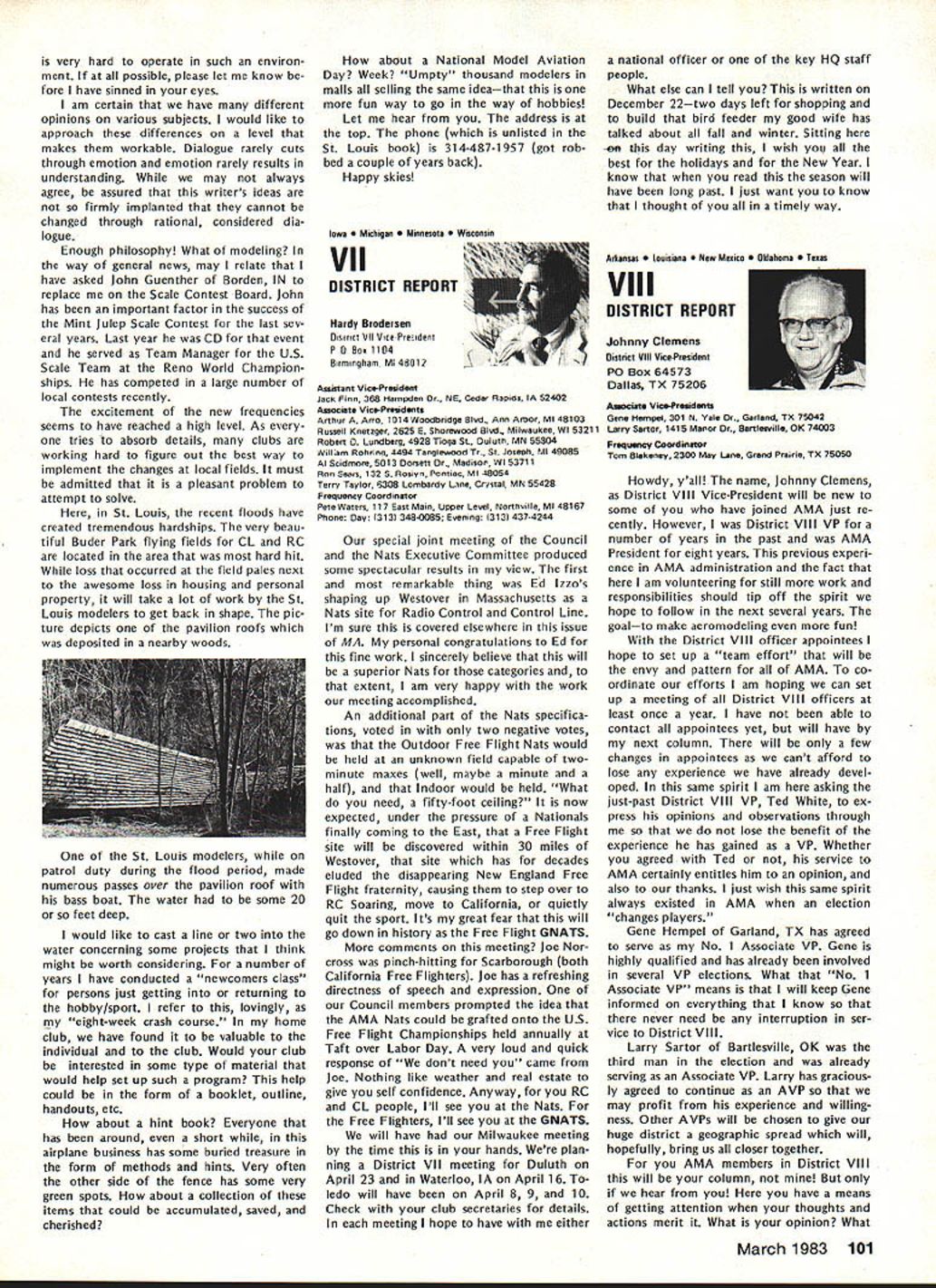
- Recent floods in St. Louis caused damage to Buer Park flying fields; recovery will require significant effort.
- Proposes projects clubs might consider:
- A "newcomers" class (eight-week crash course) with supporting materials (booklet, outline, handouts).
- A hint book compiling useful tips and methods from experienced modelers.
- A National Model Aviation Day or Week to promote the hobby nationwide.
- Contact and feedback encouraged.
---
District VII Report
Hardy Brodersen, District VII Vice-President P.O. Box 1104, Birmingham, MI 48012
Assistant Vice-President:
- Jack Finn, 3659 Hampden Dr. NE, Cedar Rapids, IA 52402
Associate Vice-Presidents:
- Arthur A. Ames, 1014 Woodbridge Blvd., Ann Arbor, MI 48103
- Russell Knetzer, 2625 E. Sherwood Blvd., Milwaukee, WI 53211
- Robert O. Lindberg, 4928 Tioga St., Duluth, MN 55804
- Wm. A. Robinson, 4494 Tangerine Dr., St. Joseph, MI 49085
- Al Gadsen, 5013 Doxon Dr., Medina, MN 55428
- Terry Taylor, 5308 Cumberland Ave., Crystal, MN 55428
Frequency Coordinator:
- Pete Waters, 117 East Main, Upper Level, Northville, MI 48167
Phone: Day (313) 343-0085; Evening (313) 437-4224
Notes from the column:
- A joint meeting of the Council and the Nats Executive Committee produced positive results, notably Ed Izzo's work securing Westover, Massachusetts as a Nats site for Radio Control and Control Line.
- Outdoor Free Flight Nats specifications were adjusted; planners expect to locate a nearby Free Flight site capable of long maxes within 30 miles of Westover.
- District VII meetings were planned for Duluth (April 23), Waterloo, IA (April 16), and Toledo (April 8–10). Club secretaries will have details.
- Holiday season well wishes.
---
District VIII Report
Johnny Clemens, District VIII Vice-President P.O. Box 64573, Dallas, TX 75206
Associate Vice-Presidents:
- Gene Hempel, 301 N. Yale Dr., Garland, TX 75042
- Larry Sartor, 1415 Manor Dr., Bartlesville, OK 74003
Frequency Coordinator:
- Tom Blakney, 2300 May Lane, Grand Prairie, TX 75050
Notes from the column:
- Johnny Clemens returns as District VIII VP; he previously served as District VIII VP and was AMA President for eight years.
- Plans to create a team approach among District VIII officers and hold an annual meeting of all officers.
- Gene Hempel will serve as No. 1 Associate VP to ensure continuity of service; Larry Sartor continues as an AVP.
- District VIII members are urged to contribute to the column: send opinions, club news, meet dates, and visitor policies.
- The author will not indulge aimless complaining; suggestions for better ways are welcome.
- Emphasis: keep aeromodeling fun and work together to improve the hobby.
Transcribed from original scans by AI. Minor OCR errors may remain.

