
RC Crisis Needs Immediate Response to FCC by AMA'ers
FCC PROPOSAL TO ELIMINATE 27 MHz FREQUENCIES CAN AFFECT ALL OTHER RADIO CONTROL OPERATIONS
Everyone who currently enjoys Radio Control has a stake in the outcome of the FCC's Docket 20120. Excerpts from the docket (legalese for proposed government action) are included along with this article. Although the docket is directly concerned only with the 27 MHz frequencies, its result, if passed, is expected to seriously affect all RC operation. Here's why.
The elimination of 27 MHz RC activity will force those now using it to move into other frequency areas. This will mean more crowding on the 72 MHz frequencies and also those in the 50-54 amateur band. It will also drastically affect competition activities by wiping out a major portion of the total RC spectrum. Pylon, Soaring and Aerobatics competition will lose a big slice of the simultaneous flying activity which permits many people to fly at one time. Similarly, it will mean longer waiting lines to fly for fun at most club flying fields. The net result will be pressure for more flying sites, an already very large problem.
But aside from the overall effect, the direct impact on those who now operate on the 27 MHz frequencies is very serious. They will simply be forced out of RC activity within a year if they can't switch to other frequencies — if they can make the switch they will have to invest more money. The number of people affected is far more than has generally been realized. While the 72 MHz RC frequencies are the most popular, because they are generally safer from interference, there are still many thousands of 27 MHz RC sets in regular use. In fact many 72 MHz operators also have one or more 27 MHz sets for secondary uses (boats, cars, spare planes, etc.). A recent survey of RC manufacturers indicates that there are at least 80,000 27 MHz RC sets in regular operation.
The number may well be far higher. Note the following statement from a recent letter to the FCC: "Citizen-Ship Radio Division alone since 1969 has manufactured and sold in excess of 44,000 radio control units on the 27 MHz frequency." We estimate that Citizen-Ship Radio since its inception has manufactured far in excess of 50,000 radio sets on the 27 MHz frequency. Our current production of 27 MHz radio sets is approximately ten thousand per year.
There are international effects, too. Many meets each year are jointly participated in by modelers from the U.S. and Canada. World Championships may also be affected. In most countries the 27 MHz frequencies are the most popular, and in many 72 MHz is not legal for RC—our team could be put in the peculiar position of having to fly at a World Championship with equipment which would be illegal in the U.S. The implications regarding practice flying problems and the uncertainty of switching equipment at the last minute are enough to rattle the confidence of any team we send out of the country.
There are many other significant effects threatened by the FCC proposal, but the most aggravating is one which is a matter of principle. Our use of the RC frequencies over the years has been highlighted by compliance with FCC regulations. In short, the FCC has had little or no problem with RC'ers. By contrast the FCC (and many RC'ers) have had a nightmare with CB operations.
Except, perhaps, for the Prohibition period of the 30's, there has not been such a flagrant violation of federal law by a group of people as in the case of the CB'ers. Despite some excellent performances by a few organizations of CB operators, it is common knowledge that the vast majority of operations are illegal. The FCC frankly admits the impossibility of enforcement of its CB regulations. Yet CB'ers apparently are rewarded by legalization; much activity and the promise of frequencies made available to them. Meanwhile the FCC has proposed to replace the RC frequencies they may take away.
Discussions with FCC officials indicate that they are sympathetic with our plight, but the fact remains that they did not propose relief in the docket which threatens to take away five 27 MHz frequencies. Furthermore, the proposal as currently written threatens to do away with future licensing of one basic age group—those under 18. Youngsters in this age bracket who are not otherwise licensed would not be allowed to have a Citizen's Service license, at least not even on 27 MHz.
Yet this is our prime youth group. Rhett Miller was the National RC Aerobatic Champion at 15 in 1973; he repeated at 16 in 1974 and was on the team representing the U.S. at the World Championships in 1975 at 17. This example points up the incredibility of one aspect of the FCC proposal, which therefore makes other aspects suspect.
The rewarding of illegality while taking away from responsible users of the airwaves suggests that all the years of trouble-free operation by RC'ers is not fully appreciated by the FCC. That's not quite so, but it leads to emotional reactions which suggest that in order for RC'ers to be recognized and given help they should ignore the FCC regulations. operate as they please, with any equipment, in any manner, on any frequency. Then, perhaps, if enough of them so act as to make enforcement of the FCC regulations impossible, the FCC might propose to offer relief by legalizing what was unacceptable before.
This, of course, is not what we want or advocate. But the situation does generate that kind of thinking, based on what actually happened with the CB'ers. Hopefully, however, a more satisfactory end result can be produced, through the proper use of democratic processes currently available.
Thus we urge response to the FCC proposal, as called for by law. This means that all who have something to say concerning the proposal should do so, as follows:
- Comment in writing, including objections and constructive counter-proposals, in the manner prescribed by the FCC;
- Send an original and eleven (required) copies to:
The Federal Communications Commission Attn: Vincent L. Mullins, Secretary Washington, DC 20554
- Use the following heading:
Comment to the Federal Communications Commission In the Matter of Docket 20120 Revision of operating rules for Class D stations in the Citizens Radio Service
- To be effective, use typing rather than handwriting. However, if typing is impossible, send anyway.
- Send a copy also to AMA.
- Mail in time to be delivered to the FCC no later than May 26, 1976.
Note: as this was written, a request was pending before the FCC to obtain a 30-to-60 day extension of the deadline date. It is possible that by the time you receive this an extension will have been granted. But the safest situation is to try to write to the FCC before May 26. If that is impossible, write anyway, but send it before June 15. Some word has been received that a 3 to 4 week extension may be possible.
- To help make the effort even more effective, copies to congressmen, along with a note asking for his or her help, are urged. This can be the most important help of all if your elected representatives respond—the FCC is sensitive to two congressional opinions.
The one very significant factor which makes this a crisis situation, one which must have the look of all RC'ers, is the need to dispel any feeling by FCC officials that RC use of 27 MHz is minor, so that it can simply be dispensed with. This is a point which needs massive rebuttal to make sure no such feeling prevails. FCC officials assure us they understand and respect our activity, but we should not take such assurances as granted.
Thus, while AMA, the Hobby Industry Association, the RC manufacturers, and the model press can be expected to represent the interests of all modelers in responding to the FCC, their arguments will only be effective if backed by hundreds—preferably thousands—of letters to the FCC. In other words, we need to make very visible how widespread the effects of the FCC proposal will be if it is put into law.
This is one time when "letting George do it" will not be good enough. "George" and all other major interests will respond but without support from the masses—the users of RC gear—their efforts may well be wasted.
Needed are letters which tell of personal problems to be caused by the proposal: how money already spent will be wasted if the equipment purchased cannot be used safely; the danger if aircraft are shot down by increased interference; the unfairness of preventing future youth participation in a scientific and educational activity; the forcing of additional investment in order to escape government-imposed crowding on existing frequencies; the taking away from a law-abiding group in order to appease a demand from an activity known to be plagued with unlawful and abusive operators; the giving away on the basis of improper rather than quality or purpose.
The reasons are many, but the most effective arguments are those based on the personal problems to be caused, rather than on hypothetical possibilities. Unfortunately, some in the FCC seem to be only vaguely aware of our activity, despite the fact that there are many major magazines in the field, millions of dollars of industry sales and investment, over a thousand AMA-sanctioned contests each year (most of them RC), hundreds of clubs and thousands of modelers. AMA, industry and press efforts to make the FCC aware can only be partially successful simply because we are so widely spread. It is essential that individual efforts to prove what the representatives are saying is really so. In this way we can enlighten those in government who may not appreciate the scope of our activity.
So it all gets down to each person who files a model plane, or enters a model car, or radios a boat, or flies by radio. If everyone pitches in—and quickly—the situation can be turned around. If it isn't, RC will be hurt seriously, and that means model aviation as a whole will be hurt since RC is the largest segment.
Something for Control Line and Free Flight interests to think about: the products available today are largely the result of the RC business. Because RC is so large it justifies the investments in new equipment and products for the total market. Without such a market the proliferation and progress of product design and availability can be expected to suffer.
Most of what's on the market today would not be available if only the CL and FF people were customers. So any serious curtailment of the market, which is what the FCC proposal threatens, can have a significant effect on non-RC activity. The crisis, therefore, is for all model aviation.
AMA's approach to the current problem has two goals. The first is to prevent or at least delay the effective date of the FCC proposal. The second is to obtain additional frequencies for RC.
As presently proposed the FCC would allow CB operation on the five 27 MHz RC channels on Jan. 1, 1977—less than a year from now. After that date and for an additional five-year period beyond expiration of a current license, CB and RC operations would presumably be permitted on the same frequencies. This is considered absolutely unacceptable. The two operations are not compatible, and all the harm to RC operation—the interference and safety problems—would be disastrous.
Lending support to AMA's position regarding safety, if CB operators are authorized on RC channels, is the Federal Aviation Administration. AMA has been working closely with the FAA in recent years regarding general safety problems related to model flying—the basic danger of models losing control and crashing, with potential property damage and personal injury.
When the FCC proposal was announced the AMA HQ conferred with FAA personnel in Washington and got their agreement on the fact that CB and RC operations on the same frequencies are incompatible and a real safety threat. As one FAA official put it, "...unless the discipline of CB operations can be improved, the chance for safe RC operations of model aircraft on the same frequencies are seriously compromised and probably impossible."
If the FCC proposal is to become fact (despite our basic objections) the AMA feels that at least a transition period should be provided, with CB not permitted on the current five RC frequencies during that period. This would allow those who currently have an investment in 27 MHz RC equipment to have a reasonable time for transition and amortization of their investment.
However, regardless of what happens with the FCC proposal, the need for additional frequencies is acute. When the FCC granted five 27 MHz frequencies for RC in 1966, AMA's membership was just over 17,000; about half involved with RC. Since then the membership has almost quadrupled, and about 60,000-plus AMA members—about 75%—are identified as RC'ers. The number of RC'ers in AMA has jumped 500%—from about 9,000 to about 45,000—in just a 10-year span.
And that's just for AMA. Studies indicate that AMA'ers are the more dedicated and active model fliers, the so-called "cream of the crop," but only about 10% of the total number involved (this is verified by industry sales figures which indicate far more RC equipment sold than can be accounted for by AMA members and clubs). Thus the total problem is far greater than is obvious from just looking at the AMA picture.
The point is that what was a relatively good RC picture in 1966 has deteriorated considerably in 10 years, in terms of crowding on the available RC channels. To lose any frequencies is, therefore, unacceptable; the need is to obtain more so as to relieve the constant increasing growth problem of the last few years. This is the situation without the current threat posed by the FCC proposal. If that proposal is given final approval, the effect will be far worse than merely setting RC back a few years—it will choke the activity drastically.
Current growth is already choking, but gradually. The situation needs relief, but instead of immediate relief the proposed denial of frequencies would be a further choke in the immediate horizon. You can help prevent this from happening by joining the effort—RIGHT NOW!
Note: This information has been directed-mailed to approximately 2,000 individuals, including presidents of over 1,200 AMA chartered clubs, special interest organizations, all AMA officers, the modeling press, RC manufacturers, over 400 newsletter editors. It will be most effective for as many individual responses to be made to the FCC, rather than petitions that a lot of people sign. FCC PROPOSAL TO ELIMINATE 27 MHz FREQUENCIES CAN AFFECT ALL OTHER RADIO CONTROL OPERATIONS
Everyone currently enjoying Radio Control has a stake in the outcome of the FCC's Docket 20120. Excerpts of the docket legalese and the proposed government action are included along with this article. Although the docket directly concerned 27 MHz frequencies, its result, if passed, is expected to seriously affect RC operation.
Elimination of 27 MHz RC activity will force those now using it to move to other frequency areas. This will mean crowding of the 72 MHz frequencies; the 50–54 MHz amateur band will also be drastically affected. Competition activities would be wiped out over a major portion of the total RC spectrum. Pylon, Soaring and Aerobatics competition will lose a big slice of simultaneous flying activity which permits people to fly at the same time. Similarly, it will mean longer waiting lines to fly at fun club flying fields; the net result will be added pressure on flying sites already a very large problem.
Aside from the overall effect, the direct impact on those who now operate on 27 MHz frequencies is very serious — they will simply be forced out of RC activity within a year if they can't switch to other frequencies. If they can make the switch it will require them to invest money. The number of people affected is far greater than has generally been realized. Seventy-two megacycle RC frequencies are popular because they are generally safer from interference. Still, thousands of 27 MHz RC sets are in regular use. In fact, 72 MHz operators also have 27 MHz sets for secondary uses — boats, cars, spare planes, etc.
A recent survey of RC manufacturers indicates at least 80,000 27 MHz RC sets in regular operation; the number may well be far higher. Note the following statement from a recent letter from the FCC Citizen's Radio Division: "Alone since 1969 we have manufactured and sold in excess of 44,000 radio control units on the 27 MHz frequency." Our estimate is that Citizen's Ship Radio, since its inception, has manufactured far in excess of 50,000 radio sets on the 27 MHz frequency. Current production of 27 MHz radio sets is approximately ten thousand per year.
International effects, too, must be considered. Meets held yearly and jointly participated in by modelers from the U.S., Canada and other countries, including World Championships, may also be affected since in some countries 27 MHz frequencies are popular while 72 MHz is the legal RC band in the U.S. Our team could be put in the peculiar position of having to fly World Championship equipment that would be illegal in the U.S. Implications regarding practice, flying problems and uncertainty in switching equipment at the last minute would be enough to rattle the confidence of a team sent out of the country.
At an AMA-sponsored meeting during the Toledo RC Conference, AMA officers, Frequency Committee members and RC manufacturers explored reactions to the FCC's current proposal which would include giving RC frequencies to CB operators. The AMA also sponsored a model press briefing the following night to advise of AMA plans to oppose the proposals.
Aggravating the matter is the fact that principal use of RC frequencies over the years has demonstrated compliance by RCers with FCC regulations. In contrast, the FCC has had major problems with CB operations. Except perhaps during the prohibition period of the 1930s, there has been no such flagrant violation of federal law as by a group of CB operators. Despite some excellent performances by a few organizations, the vast majority of CB operations have been illegal. The FCC frankly admits the impossibility of full enforcement of its CB regulations. Yet CBers apparently have been rewarded by legalization and the promise of frequencies being made available. Meanwhile the FCC has proposed to replace RC frequencies it may take away.
Discussions with FCC officials indicate sympathy for the plight of RCers. The fact remains, however, that the proposal as written threatens to take away five 27 MHz frequencies. Furthermore, the proposal, as currently written, threatens future licensing for the basic age group — those under 18. Youngsters in the age bracket now licensed would not be allowed to have Citizens' Service licenses on 72 MHz. Yet prime youth competitors — for example, Rhett Miller, National RC Aerobatic Champion at 15 in 1973, repeating at 16 in 1974, and a member of the U.S. team at the World Championships in 1975 at 17 — point up the incredibility of the FCC proposal.
Therefore, other aspects of the proposal are suspect. Rewarding illegality while taking away the airwaves of responsible users who have enjoyed years of trouble-free operation suggests the FCC does not fully appreciate the situation. That fact alone leads to emotional reactions, but in order to be effective RCers recognized that, given help, they should not ignore FCC regulations.
AMA News
WHO IS YOUR PERSONAL REPRESENTATIVE?
It is the Vice President of your district. There are eleven districts and you live in one of them. If you don't know which is the V.P. ask at the office. The V.P.'s columns in the AMA NEWS section of Model Aviation magazine list the states of which each V.P. is responsible for. Your V.P. is the one who makes all appointments to committees and boards in your district.
If you want to be "on-top-of-things" get in touch with your V.P. and let him know in what areas you'd like to help. You will find that these V.P.s have "been over the hurdles" and are DARNED FINE FOLKS. And DO get in touch with your V.P. — don't expect him to find you and read your mind. He already has from about 3,000 to 5,000 folks to worry about.
Dave Vallick has promised to get in touch with his V.P., Don Lowe, and, folks, he is one of the directive forces of AMA who have been built into the handsome machine that built AMA up to 60,000 members to serve us all with the fun of a well-organized recreation/sport/hobby. BLESS ALL OF OUR VOLUNTEERS!
A PHILOSOPHER ONCE SAID ---
"EXPERIENCE IS THE MOST EXPENSIVE FORM OF KNOWLEDGE."
I SAY ---
"THAT'S RIGHT, BUT IT IS ALSO THE MOST THOROUGH AND MOST INDELIBLE OF LESSONS."
CANADIAN AND AMA NATIONALS SAME WEEK!
Last year this unfortunate circumstance occurred when the Canadian National Model Airplane Championships and the AMA National Model Airplane Championships were on the same week. The planners of both moved to avoid it, and it shouldn't happen again. BUT DARNED IF IT DIDN'T — thru no one's fault!
While we were waiting to hear from the Air Force that the Canadians had to go ahead and commit themselves on a date, they chose the first full week of August. We had intended to hold the AMA Nats the week previous so that anyone who chose could attend both championships. When the final word came in we found that Wright-Patterson AFB and dormitory housing would only be available on that same first full week in August.
WARREN HITCHCOCK, the handsome President of MAAC (Model Aeronautics Association of Canada) and I have gotten to know each other and have since he visits were made. We are both very sorry of the conflict, but in the spirit of friendly sportsmanship that has existed between our associations and their members we offer a joint invitation. The Canadian Nationals will be in Western Canada, in Calgary, Alberta, while our AMA Nationals will be in the East of the U.S. at Dayton, Ohio.
In instances where it might be difficult to travel clear across the country, both of us, the Presidents of AMA and MAAC warmly invite you to cross the border and enjoy "the other guy's NATS."
PARDON MY SMUG EXPRESSION !!
It isn't often that one of us little ordinary people get a chance for a "put-down" on a real "biggie." While looking up the spelling of one of the tools I found a spelling mistake in the dictionary! If you wish to check me, on page 299 of the paperback "NEW EDITION WEBSTER'S DICTIONARY" from Banner Press the word "manger" has been misprinted to read "manager." It will be some time before many people read their dictionary that thoroughly. WATCH IT WEBSTER!!
MILESTONE — THE MODEL PRESS INVITED!
As AMA President and the Chairman of the Meetings of the AMA Executive Council I have during my term in office occasionally invited interested guests to the meetings. This has been kept to a very limited few because the council consists of fourteen people and there are usually a lot of people attending. The meetings could be very easily become impracticable with the always-great agendas loaded.
Feeling that it might help the model press understand Council problems and resulting actions, I am using my Presidential privilege to invite a representative from each of the model airplane consumer magazine publishing firms to attend the Executive Council's next meeting. It will be held in an all-day session at the Quality Inn, Anaheim, California, on April 30th. The press folks are invited to witness the entire meeting, or as much as they wish.
I sincerely hope these press folks will attend in order to better understand how and why decisions are made in the guiding of AMA's destinies.
FRUSTRATION ---
All day I am forced to make weighty decisions.
Then along comes some well-meaning friend and takes me to an ice-cream parlor that has 31 flavors!
FEARLESS AUSTRALIAN MODELER!!
A very colorful and friendly group of Australian modelers traveled all the way to Bern, Switzerland, for the R/C World Championships last September. Tom Prosser was the Australian Team Manager, and he was a jolly round-faced guy, but his friends told me he had proven himself absolutely fearless. When I asked why, they said that once the model plane had flown over and landed in a Swiss park in the "Down-Under land," Tom didn't hesitate — he went right in after it.
Well, wouldn't you?
WORTH THINKING ABOUT --
As an average we have about 14 hours a day during which we have a chance to be successful at something!
AMA DISTRICT 1 MEETING — GREAT!
I had the pleasure and honor of attending a really outstanding District Meeting in the New England area. The 45th R/C Squadron hosted the meeting in the Nashoba Valley Tech Auditorium. It was complete with displays of model aircraft, door prizes, refreshments, and I counted 350 people and there were still more coming in. That, my friends, is a heck of a District Meeting representation!
The meeting was conducted by the AMA District I Vice President, Cliff Piper, Cliff, incidently, is the oldest person on the Executive Council for the office of Vice President and he has steadfast dedication and years of service, and that indicates great dedication and long belief. John Norton, AMA Executive Director, and I were the honored guests, and we both agreed that it was an honor to be present.
The 45th Squadron did such a fine job of putting on the meeting that it made me real proud to be wearing their honorary patch on my jacket!
I hope that leading clubs in some of the other districts which at present aren't having District Meetings will take an interest from the 45th Squadron's efforts and gather the modelers in their districts together so we can communicate better.
You New Englanders set a fine example!
ARE YOUR EARS BURNING??
An avid model plane builder showed up at a club meeting with both ears badly burned. When asked how come, he described the accident. He said, "I was busy working on my plane when the phone rang. Without looking I reached over and instead of the phone I picked up the hot iron my wife was using. When I put it to my ear I burned the heck out of myself! How did I burn the other one? Well, I had to call the doctor didn't I!"
NO VISIBLE MEANS OF SUPPORT — I GUESS
At the FAI World Conference in Ottawa, Canada, last September I met many new people. Among them was a cute nineteen-year-old lady, Berris Roth. She is the wife of Mickey Roth of the NAA (National Aeronautics Association) staff and was interested in hearing of all my travels and experiences of representing the Academy of Model Aeronautics in so many places. So interested, in fact, that she blurted out, "Do you have a legitimate business?"
A FLATTERING RESPONSE — THANKS!
I honestly have no idea how many of you actually read what I write, but when I asked to be put on your newsletter mailing lists I was OVERWHELMED! And they are such excellent newsletters, too!! THANKS! You are wonderful people, and so worth keeping in touch with!!!
All for now —
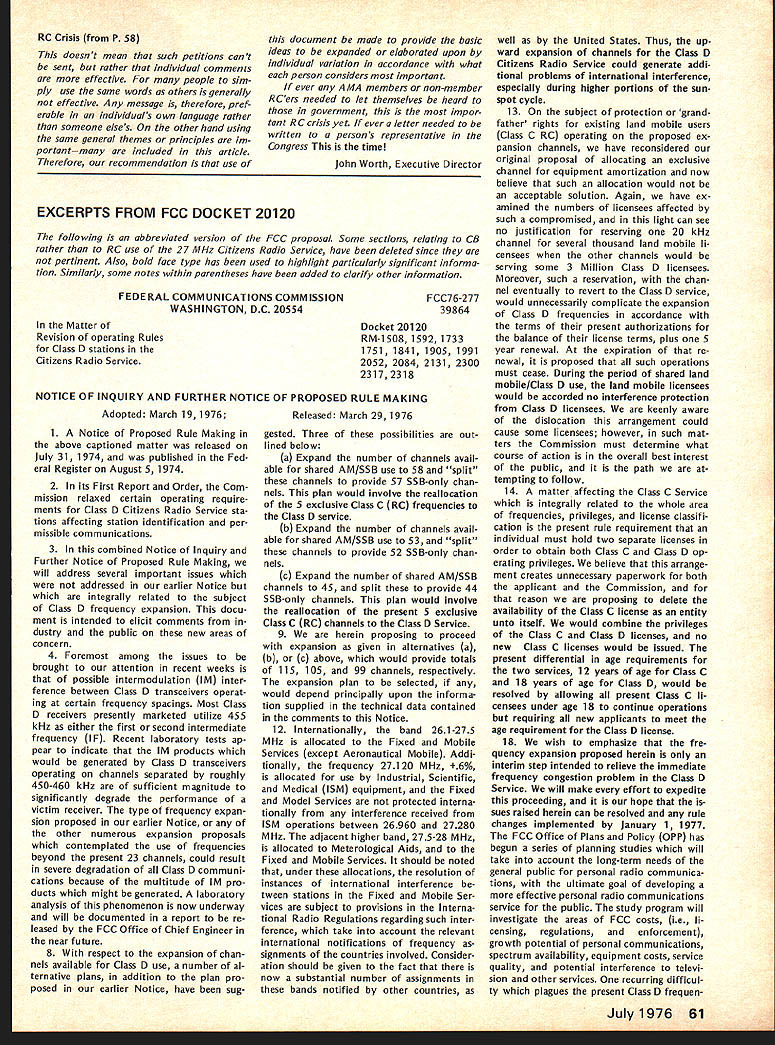
RC Crisis (from P. 58)
This doesn't mean that such petitions can't be sent, but rather that individual comments are more effective. For many people to simply use the same words as others is generally not effective. Any message is, therefore, preferable in an individual's own language rather than someone else's. On the other hand using the same general themes or principles are important — many are included in this article. Therefore, our recommendation is that use of this document be made to provide the basic ideas to be expanded or elaborated upon by individual variation in accordance with what each person's consider most important.
If ever any AMA members or non-member RC'ers needed to let themselves be heard to those in government, this is the most important RC crisis yet. If ever a letter needed to be written to a person's representative in the Congress This is the time!
John Worth, Executive Director
EXCERPTS FROM FCC DOCKET 20120
The following is an abbreviated version of the FCC proposal. Some sections, relating to CB rather than to RC use of the 27 MHz Citizens Radio Service, have been deleted since they are not pertinent. Also, bold face type has been used to highlight particularly significant information. Similarly, some notes within parentheses have been added to clarify other information.
FEDERAL COMMUNICATIONS COMMISSION WASHINGTON, D.C. 20554 FCC76-277 39864
In the Matter of Revision of operating Rules for Class D stations in the Citizens Radio Service.
Docket 20120 RM-1508, 1592, 1733 1751, 1841, 1905, 1991 2052, 2084, 2131, 2300 2317, 2318
NOTICE OF INQUIRY AND FURTHER NOTICE OF PROPOSED RULE MAKING Adopted: March 19, 1976 Released: March 29, 1976
- A Notice of Proposed Rule Making in the above captioned matter was released on July 31, 1974, and was published in the Federal Register on August 5, 1974.
- In its First Report and Order, the Commission relaxed certain operating requirements for Class D Citizens Radio Service stations affecting station identification and permissible communications.
- In this combined Notice of Inquiry and Further Notice of Proposed Rule Making, we will address several important issues which were not addressed in our earlier Notice but which are integrally related to the subject of Class D frequency expansion. This document is intended to elicit comments from industry and the public on these new areas of concern.
- Foremost among the issues to be brought to our attention in recent weeks is that of possible intermodulation (IM) interference between Class D transceivers operating at certain frequency spacings. Most Class D receivers presently marketed utilize 455 kHz as either the IF or second intermediate frequency (IF). Recent laboratory tests appear to indicate that the IM products which would be generated by Class D transceivers operating on channels separated by roughly 450-460 kHz are of sufficient magnitude to significantly degrade the performance of a victim receiver. The type of frequency expansion proposed in our earlier Notice, or any of the other numerous expansion proposals which contemplated the use of frequencies beyond the present 23 channels, could result in severe degradation of all Class D communications because of the multitude of IM products which might be generated. A laboratory analysis of this phenomenon is now underway and will be documented in a report to be released by the FCC Office of Chief Engineer in the near future.
- With respect to the expansion of channels available for Class D use, a number of alternative plans, in addition to the plan proposed in our earlier Notice, have been suggested. Three of these possibilities are outlined below:
(a) Expand the number of channels available for shared AM/SSB use to 58 and "split" these channels to provide 57 SSB-only channels. This plan would involve the reallocation of the 5 exclusive Class C (RC) frequencies to the Class D service.
(b) Expand the number of channels available for shared AM/SSB use to 53, and "split" these channels to provide 52 SSB-only channels.
(c) Expand the number of shared AM/SSB channels to 45, and split these to provide 44 SSB-only channels. This plan would include the reallocation of the present 5 exclusive Class C (RC) channels to the Class D Service.
- We are herein proposing to proceed with expansion as given in alternatives (a), (b), or (c) above, which would provide totals of 115, 105, and 99 channels, respectively. The expansion plan to be selected, if any, would depend principally upon the information supplied in the technical data contained in the comments to this Notice.
- Internationally, the band 26.1-27.5 MHz is allocated to the Fixed and Mobile Services (except Aeronautical Mobile). Additionally, the frequency 27.120 MHz, ±6%, is allocated for use by Industrial, Scientific, and Medical (ISM) equipment, and the Fixed and Mobile Services are not protected internationally from any interference received from ISM operations between 26.960 and 27.280 MHz. The adjacent higher band, 27.5-28 MHz, is allocated to Meteorological Aids, and to the Fixed and Mobile Services. It should be noted that, under these allocations, the resolution of instances of international interference between stations in the Fixed and Mobile Services are subject to provisions in the International Radio Regulations regarding such interference, which take into account the relevant international notifications of frequency assignments of the countries involved. Consideration should be given to the fact that there is now a substantial number of assignments in these bands notified by other countries, as well as by the United States. Thus, the upward expansion of channels for the Class D Citizens Radio Service could generate additional problems of international interference, especially during higher portions of the sunspot cycle.
- On the subject of protection or "grandfather" rights for existing land mobile users (Class C RC) operating on the proposed expansion channels, we have reconsidered our original proposal of allocating an exclusive channel for equipment amortization and now believe that such an allocation would not be an acceptable solution. Again, we have examined the numbers of licensees affected by such a compromise, and in this light can see no justification for reserving one 20 kHz channel for several thousand hand mobile licensees when the other channels would be serving some 3 Million Class D licensees. Moreover, such a reservation, with the channel eventually to revert to the Class D service, would unnecessarily complicate the expansion of Class D frequencies in accordance with the terms of their present authorizations for the balance of their license terms, plus one 5 year renewal, until the expiration of that renewal; it is proposed that all such operations must cease. During the period of shared land/mobile/Class D use, the hand mobile licensees would be accorded no interference protection from Class D licensees. We are keenly aware of the dislocation this arrangement could cause some licensees; however, in such matters the Commission must determine what course of action is in the overall best interest of the public, and if it is the path we are attempting to follow.
- A matter affecting the Class C Service which is integrally related to the whole area of frequencies, privileges, and license classification is the present rule requirement that in individual areas of service which are to obtain both Class C and Class D operating privileges. We believe that this arrangement creates unnecessary paperwork for both the applicant and the Commission, and for that reason are proposing to delete the availability of the Class C license as an entity unto itself. We would combine the privileges of the Class C and Class D licenses, and new Class C licenses would be issued. The present differential in age requirements for the two services, 12 years of age for Class C and 18 years of age for Class D, would be resolved by allowing all present Class C licensees under age 18 to continue operations but requiring all new applicants for Class D licenses to meet the age requirement for the Class D license.
- We wish to emphasize that the frequency expansion proposed herein is only an interim step intended to relieve the immediate frequency congestion problem in the Class D Service. We will make every effort to expedite the proceeding, and it is our hope that the issues raised can be resolved and any rule changes implemented by January 1, 1977. The FCC Office of Plans and Policy (OPP) has begun a series of planning studies which will take into account the long-term needs of the general public for personal radio communications, with the ultimate goal of developing a more effective personal radio communications service for the public. This study program will investigate the areas of FCC costs, (i.e., licensing, regulations and enforcement), growth potential of personal communications, spectrum availability, equipment costs, service quality, and potential interference to television and other services. One recurring difficulty which plagues the present Class D frequency structure is the lack of international protection for certain portions of the band, and any expansion must take into account existing international allocations and assignments.
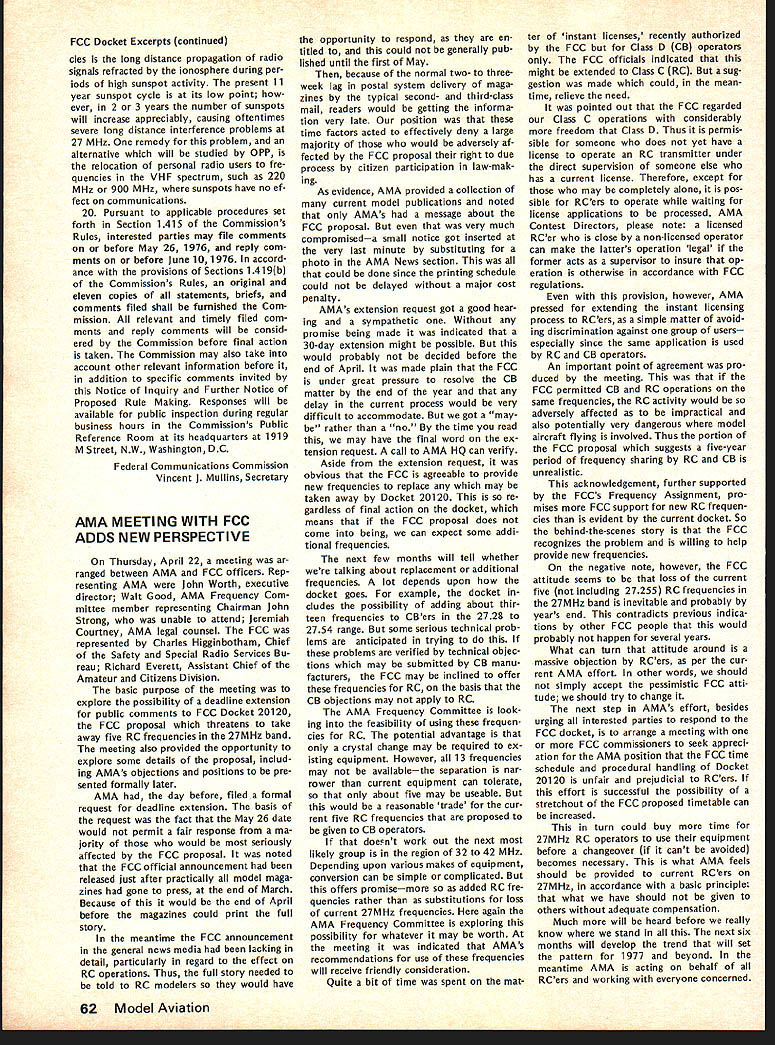
AMA News
AMA MEETING WITH FCC ADDS NEW PERSPECTIVE
On Thursday, April 22, a meeting was arranged between AMA and FCC officers. Representing AMA were John Worth, executive director; Walt Good, AMA Frequency Committee member representing Chairman John Strong, who was unable to attend; Jeremiah Courtney, AMA legal counsel. The FCC was represented by Charles Higginbotham, Chief of the Safety and Special Radio Services Bureau; Richard Ewert, Assistant Chief of the Amateur and Citizens Division.
The basic purpose of the meeting was to explore the possibility of a deadline extension for public comments to FCC Docket 20120, the FCC proposal which threatens to take away five RC frequencies in the 27 MHz band. The meeting also provided the opportunity to explore some details of the proposal, including AMA's objections and positions to be presented formally later.
AMA had, the day before, filed a formal request for deadline extension. The basis of the request was the fact that the May 26 date would not permit a fair response from a majority of those who would be most seriously affected by the FCC proposal. It was noted that the FCC official announcement had been released just after practically all model magazines had gone to press, at the end of March. Because of this it would be the end of April before the magazines could print the full story.
In the meantime the FCC announcement in the general news media had been lacking in detail, particularly in regard to the effect on RC operations. Thus, the full story needed to be told to RC modelers so they would have the opportunity to respond, as they are entitled to, and this could not be generally published until the first of May.
Then, because of the normal two- to three-week lag in postal system delivery of magazines by the typical second- and third-class mail, readers would be getting the information very late. Our position was that these time factors acted to effectively deny a large majority of those who would be adversely affected by the FCC proposal their right to due process by citizen participation in a law-making process.
As evidence, AMA provided a collection of many current model publications and noted that only AMA's ad had a message about the FCC proposal. But even that was very much compromised—a small notice got inserted at the very last minute by substituting for a photo in the AMA News section. This was all that could be done since the printing schedule could not be delayed without a major cost penalty.
AMA's extension request got a good hearing and a sympathetic one. Without any promise being made it was indicated that a 30-day extension might be possible. But this would probably not be decided before the end of April. It was made plain that the FCC is under great pressure to resolve the CB matter by the end of the year and that any delay in the current process would be very difficult to accommodate. But we got a "maybe" rather than a "no." By the time you read this, we may have the final word on the extension request. A call to AMA HQ can verify.
Aside from the extension request, it was obvious that the FCC is agreeable to provide new frequencies to replace any which may be taken away by Docket 20120. This is so regardless of final action on the docket, which means that if the FCC proposal does not come into being, we can expect some additional frequencies.
The next few months will tell whether we're talking about replacement or additional frequencies. A lot depends upon how the docket goes. For example, the docket discusses the possibility of adding about thirteen frequencies to CB in the 27.28 to 27.54 MHz range. But some serious technical problems are anticipated in trying to do this. If these problems are verified by technical objections which may be submitted by CB manufacturers, the FCC may be inclined to offer these frequencies for RC, on the basis that the CB objections may not apply to RC.
The AMA Frequency Committee is looking into the feasibility of using these frequencies for RC. The potential advantage is that only a crystal change may be required to existing equipment. However, all 13 frequencies may not be available—the separation is narrower than current equipment can tolerate so that only about five may be usable. But this would be a reasonable "trade" for the current five RC frequencies that are proposed to be given to CB operators.
It is not clear whether this next most likely group is in the region of 32 to 42 MHz. Depending upon various makes of equipment, conversion can be simple or complicated. But this offers promise—more so as additional RC frequencies rather than as substitutions for loss of current 27 MHz frequencies. Here again the AMA Frequency Committee is exploring this possibility for whatever it may be worth. At the meeting it was indicated that AMA's recommendations for use of these frequencies will receive friendly consideration.
Quite a bit of time was spent on the matter of "instant licenses" recently authorized by the FCC but for Class D (CB) operators only. The FCC officials indicated that this might be extended to Class C (RC). But a suggestion was made which could, in the meantime, relieve the need.
It was pointed out that the FCC regarded our Class C operations with considerably more freedom than Class D. Thus it is permissible for someone who does not yet have a license to operate an RC transmitter under the direct supervision of someone else who has a current license. Therefore, except for those who may be completely alone, it is possible for RC'ers to operate while waiting for license applications to be processed. AMA Contest Directors, please note: a licensed RC'er who is close by a non-licensed operator can make the latter's operation "legal" if the former acts as a supervisor to insure that operation is otherwise in accordance with FCC regulations.
Even with this provision, however, AMA pressed for extending the instant licensing process to RC'ers, as a simple matter of avoiding discrimination against one group of users—especially since the same application is used by RC and CB operators.
An important point of agreement was produced by the meeting. This was that if the FCC permitted CB and RC operations on the same frequencies, the RC activity would be so adversely affected as to be impractical and also potentially very dangerous where model aircraft flying is involved. Thus the portion of the FCC proposal which suggests a five-year period of frequency sharing by RC and CB is unrealistic.
This acknowledgement, further supported by the FCC's Frequency Assignment, promises more FCC support for new RC frequencies than is evident by the current docket. So the behind-the-scenes story is that the FCC recognizes the problem and is willing to provide new frequencies.
On the negative note, however, the FCC attitude seems to be that loss of the current five RC frequencies in the 27 MHz band is inevitable and probably by year's end. This contradicts previous indications by other FCC people that this would probably not happen for several years.
What can turn that attitude around is a massive objection by RC'ers, as per the current AMA effort. In other words, we should not simply accept the pessimistic FCC attitude; we should try to change it.
The next step in AMA's effort, besides filing an informed position to the FCC docket, is to arrange a meeting with one or more FCC commissioners to seek appreciation for the AMA position and for the FCC to understand the seriousness and procedural handling of Docket 20120. If the effort is successful, it may be possible to get a stay of the FCC proposal that would allow more time for proper consideration.
This in turn could buy more time for 27 MHz RC operators to use their equipment before a changeover (if it can't be avoided) becomes necessary. For this, AMA feels it should be provided to current RC'ers on 27 MHz, in accordance with a basic principle that what we have should not be given up to others without adequate compensation.
Much more will be said later here and in the magazines. We intend to act on behalf of all RC'ers and work with everyone concerned.
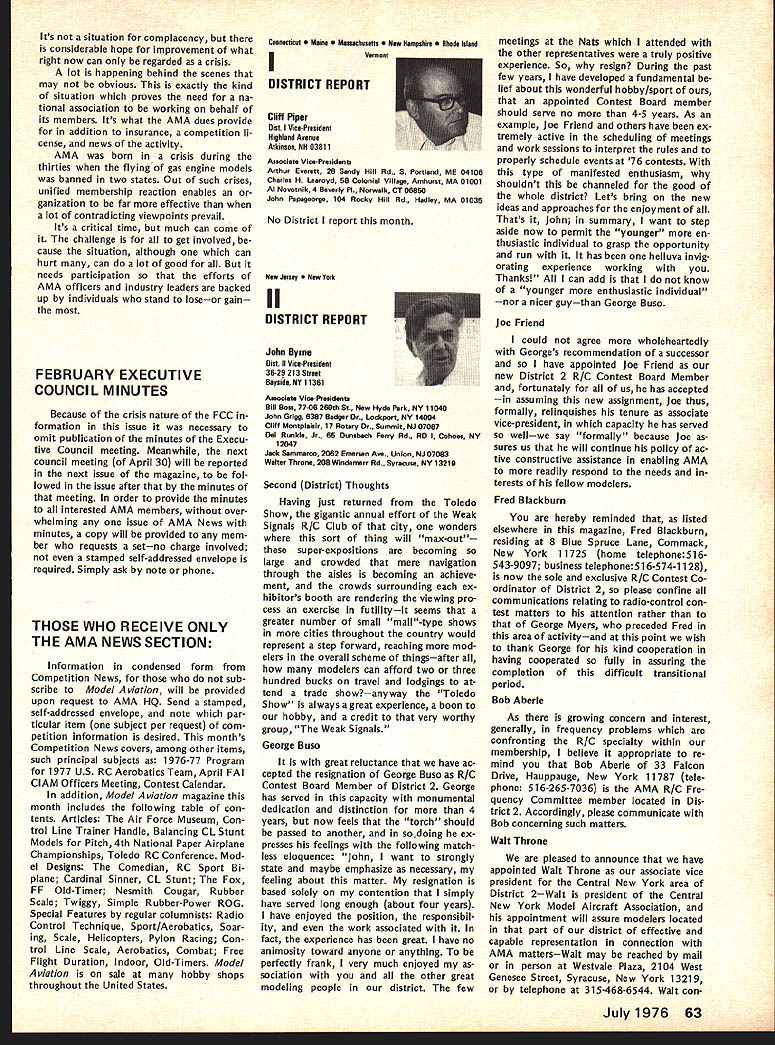
AMA News
FEBRUARY EXECUTIVE COUNCIL MINUTES
Because of the crisis nature of the FCC information in this issue it was necessary to omit publication of the minutes of the Executive Council meeting. Meanwhile, the next council meeting (of April 30) will be reported in the next issue of the magazine, to be followed in the issue after that by the minutes of that meeting. In order to provide the minutes to all interested AMA members, without overwhelming any one issue of AMA News with minutes, a copy will be provided to any member who requests a set—no charge involved; not even a stamped, self-addressed envelope is required. Simply ask by note or phone.
THOSE WHO RECEIVE ONLY THE AMA NEWS SECTION:
Information in condensed form from Competition News, for those who do not subscribe to Model Aviation, will be provided upon request to AMA HQ. Send a stamped, self-addressed envelope, and note which particular item (one subject per request) or competition information is desired. This month's Competition News covers, among other items, such principal subjects as: 1976-77 Program for U.S. R/C Aerobatics Team, April FAI/CIAM Officers Meeting, Contest Calendar.
In addition, Model Aviation magazine this month includes the following table of contents. Articles: The Air Force Museum, Control Line Trimmer Handle, Balancing CL Stunt Models for Pitch, 4th National Paper Airplane Championships, Toledo R/C Conference. Model Design: The Comedian, RC Sport Bi-plane; Cardinal Sinner, CL Stunt; The Fox, FF Old-Timer; Nesmith Cougar, Rubber Scale; Twiggy, Simple Rubber-Power ROG. Special Features by regular columnists: Radio Control, Techniques, Sport/Aerobatics, Soaring, Scale, Helicopters, Nylon Racing; Color Line Scale, Aerobatics, Combat; Free Flight Duration, Indoor, Old-Timers. Model Aviation is on sale at many hobby shops throughout the United States.
DISTRICT REPORT
No District I report this month.
II DISTRICT REPORT
Second (District) Thoughts
Having just returned from the Toledo Show, the gigantic annual effort of the Weak Signals R/C Club of that city, one wonders where this sort of thing will "max-out"—these super-expositions are becoming so large and crowded that mere navigation through the aisles is becoming an achievement, and the crowds surrounding each exhibitor's booth are rendering the viewing process an exercise in futility—it seems that a greater number of small "fly" type shows in more cities throughout the country would represent a step forward, reaching more modelers in the overall scheme of things—after all, how many modelers can afford two or three hundred bucks on travel and lodgings to attend a trade show?—anyway the "Toledo Show" is always a great experience, a boon to our hobby, and a credit to that very worthy group, "The Weak Signals."
George Buso
It is with great reluctance that we have accepted the resignation of George Buso as R/C Contest Board Member of District 2. George has served in this capacity with monumental dedication and distinction for more than four years, but now feels that the "torch" should be passed to another, and in so doing he expresses his feelings with the following matched eloquence: "John, I want to strongly state and maybe emphasize as necessary, my feeling about this matter. My resignation is based solely on my contention that I simply have served long enough (about four years). I have enjoyed the position, the responsibility, and even the work associated with it. In fact, the experience has been great. I have no animosity toward anyone or anything. To be perfectly frank, I very much enjoyed my association with you and all the other great competing people in our district. The few meetings at the Nats which I attended with the other representatives were a truly positive experience. So, why resign? During the past few years, I have developed a fundamental belief about this wonderful hobby/sport of ours, that an appointed Contest Board member should serve no more than 4-5 years. As an example, Joe Friend and others have been extremely active in the scheduling of meetings and work sessions to interpret the rules and to properly schedule events at '76 contests. With this type of manifested enthusiasm, why shouldn't this be channeled for the good of the whole district? Let's bring on the new ideas and approaches for the enjoyment of all." That's it, John; in summary, I want to step aside now to permit the "younger" more enthusiastic individual to grasp the opportunity and run with it. It has been one helluva invigorating experience working with you. Thanks! All I can add is that I do not know of a "younger more enthusiastic individual"—nor a nicer guy—than George Buso.
Joe Friend
I could not agree more wholeheartedly with George's recommendation of a successor and so I have appointed Joe Friend as our new District 2 R/C Contest Board Member and, fortunately for all of us, he has accepted—in assuming this new assignment, Joe, thus, formally, relinquishes his function as associate vice-president, in which capacity he has served so well—we say "formally" because Joe assures us that he will continue his policy of active constructive assistance in enabling AMA to be more readily responsive to the needs and interests of its fellow modelers.
Fred Blackburn
You are hereby reminded that, as listed elsewhere in this magazine, Fred Blackburn, residing at 8 Blue Spruce Lane, Commack, New York 11725 (home telephone: 516-543-9007; business telephone: 516-674-1128), is now the sole and exclusive R/C Contest Coordinator of District 2, so please confer all communications relating to radio-control contest matters to his attention rather than to that of George Myers, who preceded Fred in this area of activity—and at this point we wish to thank George for his kind cooperation in having cooperated so fully in assisting the completion of this difficult transitional period.
Bob Aberle
As there is growing concern and interest, generally, in frequency problems which are confronting the R/C specialty within our membership, I believe it appropriate to remind you that Bob Aberle, 33 Falcon Drive, Hauppauge, New York 11787 (telephone: 516-265-7036) is the AMA R/C Frequency Committee member located in District 2. Accordingly, please communicate with Bob concerning such matters.
Walt Throne
We are pleased to announce that we have appointed Walt Throne as our associate vice president for the Central New York area of District 2—Walt is president of the Central New York Model Aircraft Association, and his appointment will assure modelers located in that part of our district of effective and capable representation in connection with AMA matters—Walt may be reached by mail in person at Westvale Plaza, 2104 West Genesee Street, Syracuse, New York 13219, or by telephone at 315-468-6544. Walt con...
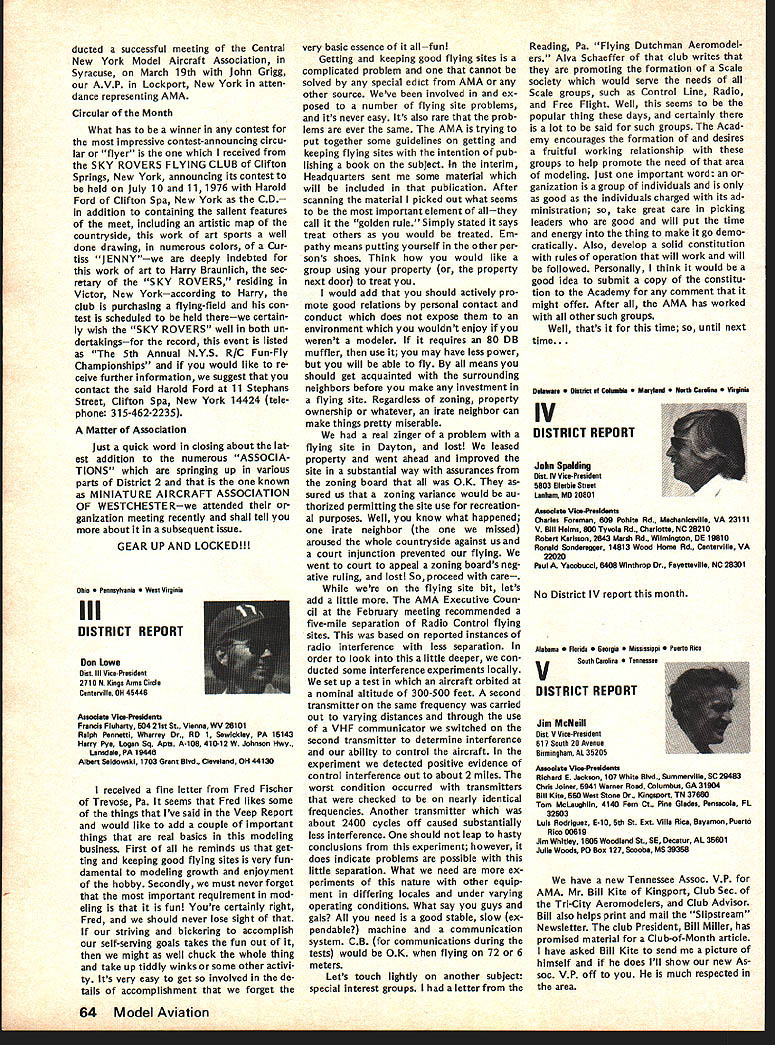
AMA News
conducted a successful meeting of the Central New York Model Aircraft Association, in Syracuse, on March 19th with John Grigg, our A.V.P. in Lockport, New York in attendance representing AMA.
Circular of the Month
What has to be a winner in any contest for the most impressive contest-announcing circular or "flyer" is the one which I received from the SKY ROVERS FLYING CLUB of Clifton Spa, New York, announcing its contest to be held on July 10 and 11, 1976 with Harold Ford of Clifton Spa, New York as the C.D. In addition to containing the salient features of the meet, including an artistic map of the countryside, this work of art sports a well done drawing, in numerous colors, of a Curtiss "JENNY" — we are deeply indebted for this work of art to Harry Braunlich, the secretary of the "SKY ROVERS," residing in Victor, New York—according to Harry, the club is purchasing a flying-field and his contest is scheduled to be held there—we certainly wish the "SKY ROVERS" well in both undertakings—for the record, this event is listed as "The 5th Annual N.Y.S. R/C Fun-Fly Championships" and if you would like to receive further information, we suggest that you contact the said Harold Ford at 11 Stephens Street, Clifton Spa, New York 14424 (telephone: 315-462-2235).
A Matter of Association
Just a quick word in closing about the latest addition to the numerous "ASSOCIATIONS" which are springing up in various parts of District 2 and that is the one known as MINIATURE AIRCRAFT ASSOCIATION OF WESTCHESTER—we attended their organization meeting recently and shall tell you more about it in a subsequent issue.
GEAR UP AND LOCKED!!!
very basic essence of it all—fun!
Getting and keeping good flying sites is a complicated problem and one that cannot be solved by any special edict from AMA or any other source. We've been involved in and exposed to a number of flying site problems, and it's never easy. It's also rare that the problems are ever the same. The AMA is trying to put together some guidelines on getting and keeping flying sites with the intention of publishing a book on the subject. In the interim, Headquarters sent me some material which will be included in that publication. After scanning the material I picked out what seems to be the most important element of all—call it the "golden rule." Simply stated, it says treat others as you would be treated. It means putting yourself in the other person's shoes. Think how you would like your group using your property (or, the property next door) to treat you.
I would add that you should actively promote good relations by personal contact and conduct which does not expose them to an environment which you wouldn't enjoy if you weren't a modeler. If it requires an 80 DB muffler, then use it; you may have less power, but you will be able to fly. By all means you should get acquainted with the surrounding neighbors before you make any investment in a flying site. Regardless of zoning, property ownership or whatever, an irate neighbor can make things pretty miserable.
We had a real zinger of a problem with a flying site in Dayton, and lost! We leased property and went ahead and improved the site in a substantial way with assurances from the zoning board that all was O.K. They assured us that a zoning variance would be authorized permitting the site use for recreational purposes. Well, you know what happened—one irate neighbor (the one we missed) aroused the whole countryside against us and a court injunction prevented our flying. We went to court to appeal a zoning board's negative ruling, and lost! So, proceed with care.
While we're on the flying site bit, let's add a little more. The AMA Executive Council at the February meeting recommended five-mile separation of Radio Control flying sites. This was based on reported instances of radio interference with less separation. In order to look into this a little deeper, we conducted some interference experiments locally. We set up a test in which an aircraft orbited at a normal altitude of 300-500 feet. A second transmitter on the same frequency was carried out to varying distances and through the use of a VHF communicator we switched on the second transmitter to determine interference and our ability to control the aircraft. In the experiment we detected positive evidence of control interference out to about 2 miles. The worst condition occurred with transmitters that were checked to be on nearly identical frequencies. Another transmitter which was about 2400 cycles off caused substantially less interference. One should not leap to hasty conclusions from this experiment; however, it does indicate problems are possible with this little separation. What we need are more experiments on this nature with other equipment in differing locales and under varying operating conditions. What say you guys and gals? All you need is a good stable, slow (expendable?) machine and a communications system. C.B. (for communications during the tests) would be O.K. when flying on 72 or 6 meters.
Let's touch lightly on another subject: special interest groups. I had a letter from the Reading, Pa., "Flying Dutchman Aeromodelers." Alva Schaeffer of that club writes that they are promoting the formation of a Scale society which would serve the needs of all Scale groups, such as Control Line, Radio, and Free Flight. Well, this seems to be the popular thing these days, and certainly there is a lot to be said for such groups. The Academy encourages the formation of and desires a fruitful working relationship with these groups to help promote the need of that area of modeling. Just one important word: an organization is a group of individuals and is only as good as the individuals charged with its administration; so, take great care in picking leaders who are good and will put the time and energy into the thing to make it go democratically. Also, develop a solid constitution with rules of operation that will work and will be followed. Personally, I think it would be a good idea to submit a copy of the constitution to the Academy for any comment that it might offer. After all, the AMA has worked with all other such groups.
Well, that's it for this time; so, until next time...
AMA News
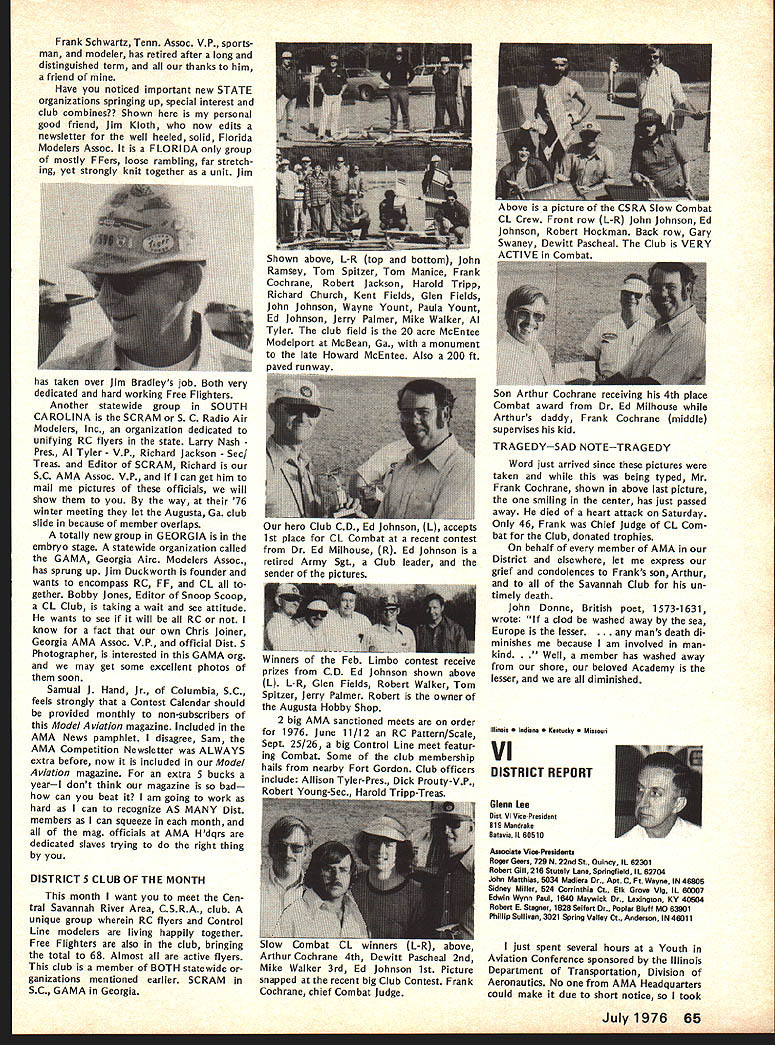
Frank Schwartz, Tenn. Assoc. V.P., sportsman, and modeler, has retired after a long and distinguished term, and all our thanks to him, a friend of mine.
Have you noticed important new STATE organizations springing up, special interest and club combines?? Shown here is my personal good friend, Jim Kloth, who now edits a newsletter for the well-heeled, solid, Florida Modelers Assoc. It is a FLORIDA-only group of mostly FFers, loose rambling, far stretching, yet strongly knit together as a unit. Jim has taken over Jim Bradley's job. Both very dedicated and hard working Free Flightters.
Another statewide group in SOUTH CAROLINA is the SCRAM or S. C. Radio Air Modelers, Inc., an organization dedicated to unifying RC flyers in the state. Larry Nash - Pres., Al Tyler - V.P., Richard Jackson - Sect./Treas. and Editor of SCRAM, Richard is our S.C. AMA Assoc. V.P., and if I can get him to mail me pictures of these officials, we will show them to you. By the way, at their '76 winter meeting they let the Augusta, Ga. club slide in because of member overlaps.
A totally new group in GEORGIA is in the embryo stage. A statewide organization called the GAMA, Georgia Air Modelers Assoc., has sprung up. Jim Duckworth is founder and wants to encompass RC, FF, and CL all together. Bobby Jones, Editor of Snoop Scoop, a C.L. club, is taking a wait-and-see attitude. He wants to see if it will be all RC or not. I know for a fact that our own Chris Joiner, Georgia AMA Assoc. V.P., and official Dist. 5 Photographer, is interested in this GAMA org., and we may get some excellent photos of them soon.
Samuel J. Hand, Jr., of Columbia, S.C., feels strongly that a Contest Calendar should be provided monthly to non-subscribers of this Model Aviation magazine. Included in the AMA News pamphlet, I disagree, Sam, the AMA Competition Newsletter was ALWAYS extra before, now it is included in our Model Aviation magazine. For an extra 5 bucks a year — I don't think our magazine is so bad — how can you beat it? I am going to work as hard as I can to recognize AS MANY Dist. members as I can squeeze in each month, and all of the mag. officials at AMA HQ's are dedicated slaves trying to do the right thing by you.
DISTRICT 5 CLUB OF THE MONTH
This month I want you to meet the Central Savannah River Area, C.S.R.A., club. A unique group wherein RC flyers and Control Line modelers are living happily together. Free Flightters are also in the club, bringing the total to 68. Almost all are active flyers. This club is a member of BOTH statewide organizations mentioned earlier, SCRAM in S.C., GAMA in Georgia.
2 big AMA sanctioned meets are on order for 1976: June 11/12, an RC Pattern/Scale; Sept. 25/26, a big Control Line meet featuring Combat. Some of the club membership hails from nearby Fort Gordon. Club officers include: Allison Tyler - Pres., Dick Prouty - V.P., Robert Young - Sec., Harold Tripp - Treas.
AMA News
properly about aviation. The biggest problem they have is that they are working with full-scale airplanes, and high school age youngsters cannot afford flying airplanes, or associated equipment. It's logical to get them building and flying model airplanes rather than the big ones.
Working with the above mentioned organizations could also set AMA involved in high school model aviation programs to teach aerodynamic principles and effects. Such a program can fit into math, science, and physics classes.
Our AMA Junior Program has not progressed much beyond the Delta Dart, mainly because we didn't know just what direction to go. It is possible that, however, we can generate a definite model building achievement program, developed by AMA, and present necessary information to CAP, Boy Scouts, junior AFROTC, the 4-H program, and high schools. There are plenty of good kits available so they can start with Delta Dart, then advance through the steps of increased complexity in building to advanced Free Flight, Control Line, or Radio Control models. They only have to be told what is available as to kits and instruction manuals, and what sequence to build and fly. It's important that they learn to fly the models as well as build them.
We'll be discussing this at the April 13 Executive Council meeting.
action, and to respond to additional and new inputs from the membership. I can tell you that your membership should call Horis at work, and if you don't think so, and can make a constructive utterance, he may be totally receptive. Write to me or to AMA headquarters.
Sites. Flying Sites. What is AMA doing about flying sites? About the only flying site problem that AMA headquarters will work on is a NATS site. Our flying site is our own. Yours and mine. AMA is preparing a very useful booklet on Flying Sites, prepublication excerpts of which I can send you. But our site acquisition problem is right in our own backyard; we are going to have to write our own book.
I see it like this: First, within our AMA district, it has to be treated as a state level problem. Michigan, Wisconsin, Minnesota, Iowa. I would like to form a Site Task Force in each state, comprised of highly placed people in the several areas of government, business, and professional life which come together in a county commission for Sport Aviation. Here's an ideal Site Task Force: one man from the governor's office, one man from the legislature (that is, state senator who still has a zipper with Brown D in his attic), five people from municipal government (I'll take one mayor, one assistant city manager in charge of economic development, two recreation department heads, and one city councilman), about three men from the state and county agricultural and conservation bureaucracies, three men from education at state university, high school and grade school levels; one man from special education (retarded children, correction institutions), five men from industry (a GM community relations director, American Aggregate's VP for land acquisition, Leonard Oil's director of leases and acquisitions, men from the telephone and gas companies' legal or real estate departments), one highly placed man each from the State Bar Association, the State Real Estate Board and the Association of Accounting Firms, about four men highly placed in banking from various parts of the state, representation from three major newspapers, four men in radio and TV, and five professional consultants on land use and development, one civil engineer, and one or two candidates for important offices such as governor, state senator, mayor, or better still, the U.S. Senate. And, as my good friend says, "That's about 36 people. They are all modelers, they know what we need, and where and how to get it, and in most examples, it is within the scope of their regular interests and responsibilities to work for this project."
In the first meeting we can identify the general value of sport aviation to the community. We can define the population centers to be served, we can pinpoint the site location, and give an idea of the type of facility required. We can also identify potential public, state and federal purchase, lease or gift, and determine need and availability of possible local funds, and/or the probable support of private industry.
The new idea is: take this approach to the state capital, tell your story in a non-technical language by people who are not modelers, and ask for appropriate action and support. We should get together a small handbook of model regulations to be followed in gate design, insurance, zoning, land use, and such. Then, pick up one or two modelers in the state who have some standing in the community and ask them to move on the problem.
Who do we have in the governor's office?
Everyone currently enjoying Radio Control has a stake in the outcome of the FCC's Docket 20120. Excerpts from the docket legalese and the proposed government action are included along with this article. Although the docket directly concerned 27 MHz frequencies, its result, if passed, is expected to seriously affect RC operations.
Here's how: elimination of 27 MHz RC activity will force those now using it to move to other frequency areas. That will mean crowding of 72 MHz frequencies. Also the 50–54 amateur band will be affected, which will drastically affect competition activities, wiping out a major portion of the total RC spectrum. Pylon, soaring and aerobatics competition will lose a big slice because simultaneous flying activity, which permits people to fly at the same time, will be curtailed. Similarly, it will mean longer waiting lines to fly at fun and club flying fields. The net result will be added pressure on flying sites, already a very large problem.
Aside from the overall effect, the direct impact on those who now operate on 27 MHz frequencies is very serious. They will simply be forced out of RC activity within a year if they can't switch to other frequencies — and if they can make the switch they will have to invest money. The number of people affected is far greater than has generally been realized. 72 MHz RC frequencies are popular because they are generally safer from interference, but there are still thousands of 27 MHz RC sets in regular use. In fact, 72 MHz operators also have 27 MHz sets for secondary uses — boats, cars, spare planes, etc.
A recent survey of RC manufacturers indicates at least 80,000 27 MHz RC sets in regular operation; the number may well be far higher. Note the following statement from a recent letter: "Citizen's Service Radio Division alone since 1969 has manufactured and sold in excess of 44,000 radio control units on the 27 MHz frequency." An estimate: "Citizen's Service Radio since its inception has manufactured far in excess of 50,000 radio sets on the 27 MHz frequency." Current production of 27 MHz radio sets is approximately ten thousand per year.
International effects, too: meets held yearly with joint participation of modelers from the U.S. and Canada and World Championships may also be affected. In other countries 27 MHz frequencies are popular where 72 MHz is not legal. Our team could be put in the peculiar position of having to fly World Championship equipment that would be illegal in the U.S. Other implications regarding practice flying, uncertainty in switching equipment at the last minute, are enough to rattle the confidence of a team being sent out of the country.
Aggravating the matter is the fact that principal use of RC frequencies over the years has highlighted compliance with FCC regulations. In short, the FCC has little or no problem with RCers; in contrast, the FCC has a nightmare with CB operations. There has been flagrant violation of federal law by many CBers. Despite some excellent performances by a few organizations, CB operators commonly have the vast majority of operations illegal. The FCC frankly admits the impossibility of enforcement of its CB regulations. Yet CBers apparently are rewarded by legalization of much activity and promise of frequencies made available. Meanwhile the FCC has proposed to replace RC frequencies that it may take away.
Discussions with FCC officials indicate sympathy for the plight of RCers and that they did propose relief; however, the docket threatens to take away five 27 MHz frequencies. Furthermore, the proposal as currently written threatens future licensing of the basic age group — those under 18. The youngsters in the age bracket now licensed would not be allowed to use other frequencies; they would be allowed to have Citizens Band service licenses on 72 MHz. Yet the prime youth group — Rhett Miller, National RC Aerobatic Champion (15 in 1973, repeated at 16 in 1974; team representing U.S. in World Championships 1975 at 17) — is an example that points up the incredibility of aspects of the FCC proposal. Therefore, the proposal, which rewards illegality while taking away responsible users of the airwaves who have had years of trouble-free operations, is something RCers fully appreciated.
AMA News
XI DISTRICT REPORT
Homer Smith Dist. XI Vice-President 1417 N.W. 191st Street Seattle, WA 98177
Associate Vice-Presidents Dick Carson, 3209 Hoffman W., Spokane, WA 99205 Al Culver, 231 Fairbanks, Pocatello, ID 83201 Simon Drees, Rt. 1, Box 28, Broadview, MT 59015 Robert D. Stalcik, 1120 Shady Lane, Albany, OR 97321
There are a lot of news items about some clubs around the district that should be reported to you, but it will have to wait till next month. This month I want to remind you about some special events around the area and then tell you about a neat trip I was privileged to take.
The Ute Radio Control Association of Salt Lake City is having a Pattern meet on the 6th of June. John and Brenda Perr (president and editor) have asked me to extend to you a special invitation to attend. Brenda will be happy to send you more information if you write to 3903 Lorna Drive, Salt Lake City, Utah 84120. The Ute R/C Association flies a lot with the group from southern Idaho, and both deserve your support. Look at the contest schedules.
Another Pattern meet you cannot afford to miss is the 1976 Northwest R/C Aerobatic Championships. The event will be held June 25 & 26 at the Hawks Field on the Boeing Space Center property in Kent, Washington. Besides trophies and merchandise, they will have five (5) K & B Veco .60 series 75 engines with mufflers for prizes. For more info write Oly R/C, 24 Harding, 3851 Place South, Kent, WA 98031. Be there! Sponsor is Boeing Hawks.
The 1st International VAA Pylon Racing Championships will be held Memorial Day weekend at the Space Center Field. This notice may be too late, but the event will be sponsored by the Hawks and Props and is expected to be an annual affair.
During the month of March it was my privilege to make the trip to Pocatello, Idaho for the 3rd Annual Southern Idaho R/C Symposium and District Meeting. I was excited to attend the meeting by an early invitation from Greg Shaw, the symposium director, and Al Culver, the AMA associate vice-president for the area. It has always been one of my pet items to try to help in keeping the district in tune with the national association and the activities of the AMA. The group I met in the Pocatello area were large in hospitality and talent as well.
A little history might be in order at this point. Three years ago the groups in southern Idaho determined that they too could have a symposium along the lines of the RAMS symposium held each spring. They started rather small, and the show has been held in several cities across the state.
As already stated, this was the 3rd show, and it has really grown. The display area was the banquet room of the Holiday Inn. The morning started with a modest 20 tables or so. By 10 a.m., they had to begin bringing in more tables, and by noon they had every table the motel had filled and some hanging from the ceiling. The day ended with about 70 models entered into the various categories of events for judging, and there were at least 30 that were not entered for judging. The smallest model was a Peanut Scale model, and the largest was an all-wood model of a Cessna 310 that must have had at least a 10-foot wingspan.
There were really no models that even the best of craftsmen would be ashamed of. Everyone was of the best quality, and as good as I have seen anywhere. Most of the models were of the R/C types, but there were also Free Flight and Control Line models. So many of the models were impressive that it is impossible to hit the highlights. The full range of types were represented, including helicopters.
One of the features of the symposium was voting by the public for the people's choice. The exact count of votes made is not available at press time, but the group agreed to send me some pictures and statistics. The number of votes cast, it is ironic that the people's choice was made by one vote! A helicopter was the winner, and it was a very realistic scale model. Unfortunately, my notes with names and associated information did not seem to get home with me, so the names will have to wait for the pictures and the written report by the sponsors.
At the banquet, which over 100 attended, I was privileged to sit at the head table beside Mayor Pierce of Pocatello. The mayor had declared the week before the symposium as Aviation Week in Pocatello and, our friend Paul Harvey honored the city and Mayor Pierce by mentioning it on his noon broadcast here in the area. It was a fun evening and many people were at the banquet.
The symposium was a great flying event, and the club provided the organization perfectly. The fine food and excellent arrangements made it an outstanding event. I was impressed with the talent shown by the youth and the number of people attending. The symposium will be held in Boise next year if all goes well. If you can attend you will be pleased as I was. It was an excellent opportunity to meet some wonderful people. Some of them were worth the effort to get there.
YOUTH COMMITTEE REPORT
Ed Abram, Oquaga, N.Y. 13826
Another good month for mail—keep 'em coming! Ed Whitten's latest issue of "Star Skippers" tells of much interest in the Manhattan event for Indoor. Ed indicates that this is a good event for Juniors, since the model is reasonably simple. If you're interested in either the Manhattan, or in Ed's continual postal contests, drop him a line at P.O. Box 176, Wall Station, N.Y., N.Y. 10005.
Coincidences keep coming. Along with Ed's newsletter there was one from Saudi Arabia, from YAC member Dave Linsherer, who is prominently mentioned in Ed's publication. Dave sends news of a Delta Dart event he conducted in Dhahran, Saudi, for the local Scout group; 35 kids participated, with Tom Lake, Vince Miesen, and Aimen Al Rafai taking top honors. The plane to land is the winner. This is a simple way to run the event, and just as effective as using stop watches.
Dave also sent a photo of the P-30 (Formula rubber) event, for small fields. I'm sure you'll see more of this in Dave's column in MAN. This looks like another good event for Juniors, although it's quite advanced for the Art.
Earl Rodriguez of "way down in Louisiana" wrote his thanks for the information we sent him regarding starting a Dart program. While any indication of gratitude is appreciated, I remember that that's why we're here—to give assistance wherever and whenever possible. To Earl, you're most welcome, and I'm glad we could help.
The longest letter of the month came from Sid Miller of Elk Grove Village, Ill. He sent a wall of clippings, pictures, and information regarding junior programs he's operated, going all the way back to 1942. Sid was also a big help to us at the Cleveland Nats., providing both assistance and kids to help in the event.
In reading through Sid's material, one thing stands out: the fact that through the years his biggest reward has been in seeing kids get interested in model flying. He also sums up what's involved by saying, "It takes knowledge, desire, work, and enthusiasm plus a world of patience to make a youth model aviation program go, go, go."
As we mentioned several months ago, our local youth program was suffering from contract resignations. However, the problem has been resolved, and we finally got back in business a couple of weeks ago. So far we have about 45 members, and another 50 or so turned out for the rocket club, our only other program. In fact, our combined membership amounts to one-fourth of the boys in our school, which indicates a fair amount of interest. The kids are presently involved in building Delta Darts, of course. We've been working on CL planes, with simple models being favored. The quickies are all .049, but I have a .19-powered job that we'll use for an advanced trainer.
We finally had some evidence of the value of demonstrations and other school programs. Hawthorne Junior High had one of our elementary schools and many of the kids are in the junior high. I was surprised at the number of them who showed up for our MAC meeting and said that they were there because they'd been impressed by my program. So it does pay off in the long run.
The Modelers of Binghamton, N.Y., met and included contests for Juniors and Open members recently, with Delta Darts, rubber cabin, and paper planes the order of the day. Final results aren't in yet, but it looks as if the experience with the Dart paid off in the beginners' area. We'll try to get a rundown on the Juniors as well as some photos.
For all the friends of LCDR Al Geimer, we have a letter from the Glenview Nats. Al had a call from San Diego the other night, and Al informed me that he had just been promoted to full commander. It was an honor to get that line (I was the first non-local friend he called with that news). As we've said before, the friendships we develop through model aviation are the greatest asset we can have. Congratulations to Al, from all of us at the YAC.
Transcribed from original scans by AI. Minor OCR errors may remain.

