
AMA News - Focus on Competition
Technical Director Steve Kaluf skaluf@modelaircraft.org
THERE IS NO real column this month, as we are in the middle of the Nationals. I am happy to report that as of this point, all events are running very well and have great participation; more in the next column.
We have a safety proposal to publish this month for Radio Control (RC) Scale Helicopter. This proposal has been put into effect by the AMA president, the Contest Board coordinator, and the chairman of the Scale Contest Board. For the proposal to remain in effect, it must be published; four weeks after publication we will take a ratification vote of the Scale Contest Board.
Safety Proposal — RC Scale Helicopter
Submitted by Peter Wales, AMA 532418 For event 518
All changes are shown in italics.
- General.
All pertinent AMA regulations (see sections entitled Sanctioned Competitions, Record, Selection of Champions, General and Scale General) shall be applicable except as specified below.
- Safety.
All models shall be subject to a safety inspection at the discretion of the Contest Director. A model judged to be unflyable due to a crash must be reinspected prior to reuse. Dangerous flying or poor sportsmanship shall be grounds for disqualification.
- Model Requirements.
There shall be no limitation on the types of equipment that can be fitted to the helicopter. Each contestant shall be permitted one model entry.
- Proof of Scale.
Contestants shall present the following materials with the helicopter for static judging:
- a. A published 3-view or more drawing, and
- b. Pictures published or otherwise pertaining to color markings and details.
- Static Judging.
Static judging is to be done at the flying site. It is recommended that different judges work the static and flying portions of the contest. The judging shall be done at a distance of two (2) meters. The model may be placed on an elevated or rotating table if desired.
- Static Scoring.
Entries shall be judged on the following items, with a maximum of 100 points each. Total of three (3) judges (Maximum 1800 points):
- a. Fuselage
- b. Cockpit
- c. Landing gear
- d. Rotor systems
- e. Craftsmanship
- f. Finish and markings
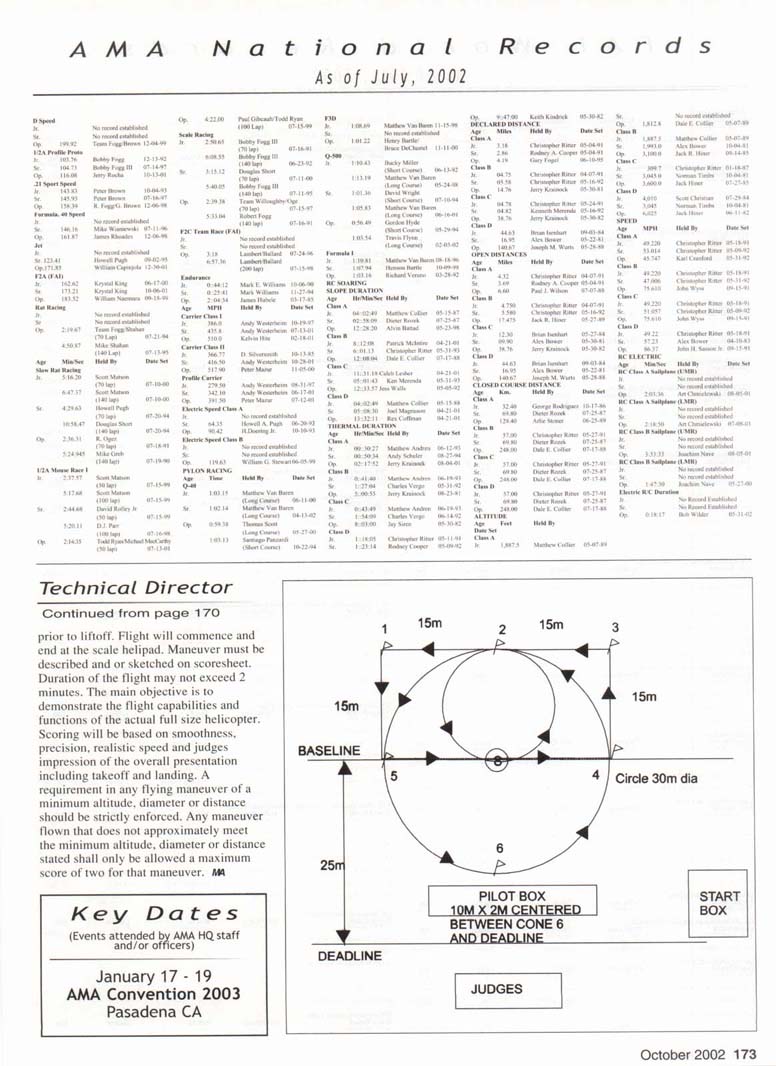
- Flight Plan. (See contest area layout page 101)
All maneuvers shall commence and end at the scale (S) helipad. The maneuvers shall be flown in proper sequence and away from the spectators. The pilot shall remain in the pilot box during all maneuvers. A minimum of one (1) meter altitude shall be maintained for all maneuvers. Each contestant shall have three (3) minutes to start their engine. This time may be used for adjusting and trimming as long as the engine is started within the allotted time. Once the contestant has announced the start of the first maneuver, they are not allowed to make any adjustments to the helicopter. Engine restarts after the flight has commenced are not allowed. All models shall be carried from the start box to the helipad. Models shall not be flown from the helipad to the pit area. Contestants shall fly the following maneuvers, each with a K factor of six (6) in the following order:
- a. Fifteen-second hover and 45-degree climbout
- b. Rectangular traffic pattern
- c. Translational landing
- d. 360-degree circle
- e. Freestyle maneuver (two [2] minutes maximum)
The maximum flying time is five (5) minutes. Helipads shall be 1.2 meters in diameter. All scale maneuvers shall commence at the scale (labeled "S" on layout) helipad.
- Flight Scoring.
Should a flight be aborted it shall be considered an official attempt upon completion of two (2) maneuvers. All contestants shall be permitted to fly as many equal rounds as time allows. Contestants shall fly the same equipment as that which was static judged. Should part of the aircraft be damaged so as to be replaced, that portion of the helicopter shall be rejudged. All maneuvers shall be judged zero to ten (0–10), this figure being multiplied by the K-factors indicated. The flight score shall be the sum of the scores from the three (3) judges. (Maximum score = 900 points)
- Official Score.
The final score shall be the sum of the static and flight scores.
Maneuvers must be described and/or sketched on the scoresheet prior to liftoff. The main objective is to demonstrate the flight capabilities and functions of the actual full-size helicopter. Scoring will be based on smoothness, precision, realistic speed, and the judges' impression of the overall presentation including takeoff and landing. Requirements in any flying maneuver for a minimum altitude, diameter, or distance should be strictly enforced. Any maneuver flown that does not approximately meet the stated minimum altitude, diameter, or distance shall be allowed a maximum score of two for that maneuver.
Transcribed from original scans by AI. Minor OCR errors may remain.

