

Sound & Model Aeronautics
Howard Crispin, Jr.
PATH:
When the amount by which model aircraft noise exceeds a detection level is known, that establishes the total separation distance required between the aircraft and a receiver so the aircraft would not be heard. How sound is heard at range depends on factors affecting sound propagation:
- Spherical spreading (geometrical spreading)
- Atmospheric absorption
- Ground (terrain) attenuation
- Refraction and scattering effects
In the simplest case — sound radiating from a point source in a homogeneous, loss‑free atmosphere (the free field) — sound pressure decreases inversely with distance. This produces a 6 dB decrease in sound‑pressure level for each doubling of distance and applies equally to all frequencies. All other factors beyond spherical spreading are grouped as excess attenuation.
Atmospheric absorption represents excess loss of energy in the sound field due to internal molecular modes (viscosity, heat conduction, heat radiation, diffusion). Molecular absorption depends strongly on frequency and also on temperature and relative humidity. Below a few hundred hertz the molecular absorption coefficients are very small and may be neglected. Classical absorption (the remaining losses) is negligible below several kilohertz and normally of no consequence for typical audible‑frequency studies.
Viscous dissipation (fog, rain), refraction and scattering also make real atmospheric propagation differ from the ideal free field. Terrain attenuation results from absorption and scattering by obstacles in the sound path; these effects are most pronounced for ground‑transmitted sound and are of less consequence for air‑to‑air transmission when the slant‑range angle between source and receiver is large (typically greater than about 6–10°). Consider terrain attenuation when models fly along paths where obstacles block or scatter sound and when observers are not directly under the aircraft. For air‑to‑ground propagation the principal sources of attenuation are spreading loss and atmospheric absorption.
Applying atmospheric absorption coefficients to the fundamental frequencies produced by typical engine/propeller combinations shows that, for frequencies below about 1,000 Hz, absorption coefficients are quite low and increase dramatically above that point. In practice, this means the common 6 dB per doubling of distance rule gives a good first approximation for estimating levels and separation distances at the frequencies most relevant to model engines. Slant‑range effects should also be considered — models generally fly above the ground, so terrain between aircraft and distant neighbors can reduce perceived levels, but low‑altitude flights over nearby terrain can be more intrusive.
More next time!
CORRECTIONS:
A recent inquiry asked about the effect of altitude and temperature on sound‑level readings. For most field work these effects are small compared with the typical errors of lower‑cost sound meters, but they matter if you need high precision or are correlating data from different days.
Examples and guidelines:
- Calibration reference: a Simpson Model 890‑2 calibrator (with a Simpson meter) uses 114 dB at 1,000 Hz as the standard reference curve, specified at 23°C (73.4°F) and sea level.
- Altitude effect: performing the same calibration at 7,500 ft (but at 23°C) would require adjusting the meter to about 113.5 dB — a 0.5 dB difference due to air density.
- Temperature effect: roughly ±0.05 dB per °C deviation from 23°C.
Both altitude and temperature effects are small for most applications. If you require precise, repeatable measurements (for design work or formal testing), use higher‑grade instrumentation and perform careful calibration.
PROFILE:
Continuing profiles of individuals working toward quieter model aircraft (AMA’s goal: under 90 dBA at 9 ft).
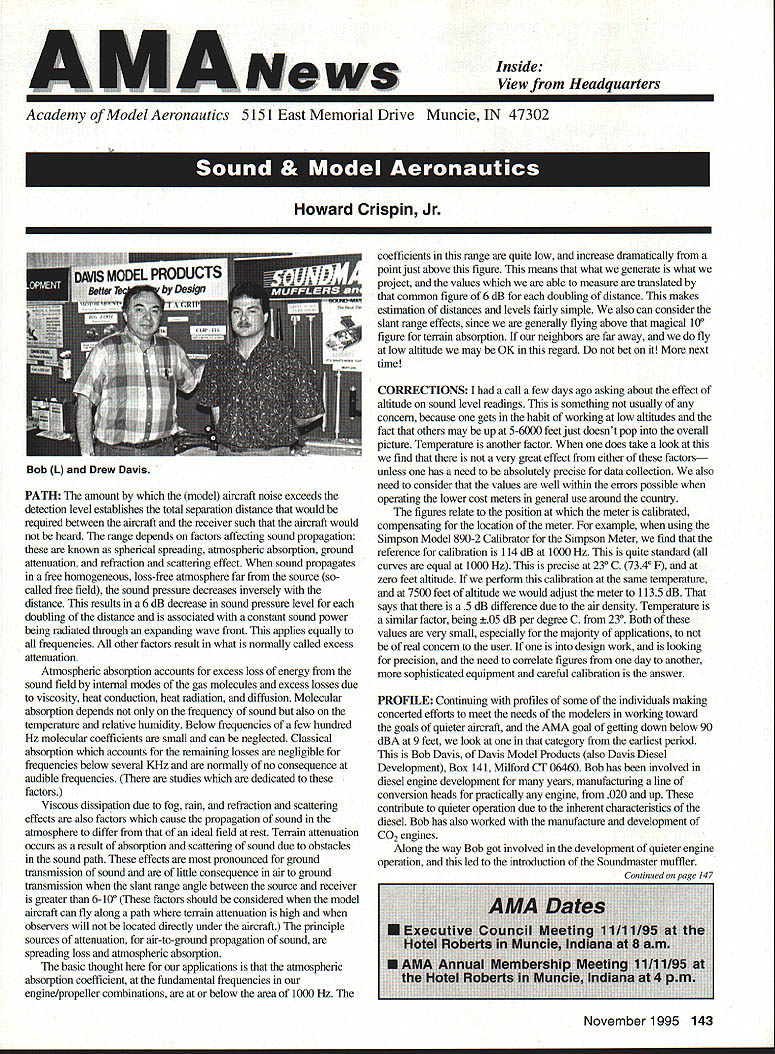
Bob Davis — Davis Model Products (Davis Diesel Development) P.O. Box 141, Milford, CT 06460
- Longtime developer of diesel model engines and conversion heads for engines from .020 and up; diesels often run quieter due to their inherent characteristics.
- Has worked on CO2 engine manufacture and development.
- Developed quieter engine accessories such as the Soundmaster muffler.
- Produces machined engine mounts for rigid mounting and protection, and vibration isolators.
- Company help includes his son, Drew Davis.
This team produces several products useful for reducing noise at flying sites.
DECAL: An emblem decal developed in District VII by Peter Waters promotes the 90 dB at 9 ft target. It is available to clubs and individuals in that District for application on aircraft meeting the standard. The decal is blue on white; look for information on wider distribution.
Transcribed from original scans by AI. Minor OCR errors may remain.

