
AMA/EAA Aeromodeling Academy
Twelve years is a long time to incubate an idea, but what began as a dream shared by Bob Underwood of the Academy of Model Aeronautics (AMA) and Chuck Larsen of the Experimental Aircraft Association (EAA) came to fruition last July with the first AMA/EAA Aeromodeling Academy. This week-long series of model-building activities for 14–17 year-olds was the first of what may be many jointly sponsored educational ventures.
Purpose and origins
The project began with the recognition that the two organizations had much in common. Whether flying full-scale or model aircraft, both hold high ideals of craftsmanship, both are interested in broadening public participation in aviation, and both are dedicated to promoting meaningful programs for young people. It was clear to Bob Underwood and Chuck Larsen that these mutually held goals could be strengthened by a cooperative venture to make both organizations stronger.
Program overview
The Academy was professionally led under the chairmanship of the AMA Education Committee. A number of companies generously donated models and equipment to support the camp. Projects selected were intended to teach basic building skills, introduce new modeling techniques, and provide hands-on flying experience in Free Flight, Control Line, and Radio Control (RC).
Volunteer staff
The volunteer staff comprised four individuals with diverse experience in modeling, full-scale aviation, and teaching children:
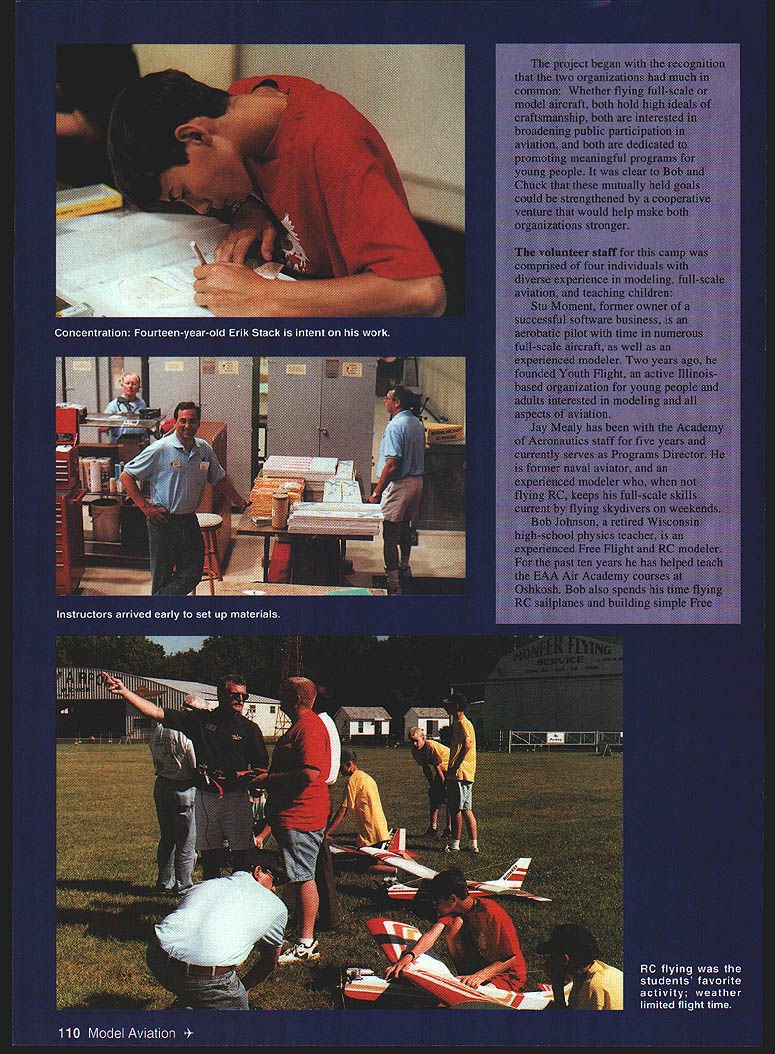
- Stu Moment — Former software-business owner, aerobatic pilot, experienced modeler, and founder of Youth Flight (an Illinois-based organization for young people and adults interested in modeling and aviation).
- Jay Mealy — Programs Director at the Academy of Aeronautics, former naval aviator, experienced modeler, and active full-scale pilot who flies skydivers on weekends.
- Bob Johnson — Retired Wisconsin high-school physics teacher, experienced Free Flight and RC modeler, long-time EAA Air Academy instructor, and builder/flyer of RC sailplanes and simple Free Flight models.
- Gordon Schimmel — Superintendent of schools in Connecticut, private pilot, chair of the AMA Education Committee, and responsible for curriculum work tied to the Wright brothers centennial and Free Flight model projects in classrooms.
Daily schedule and activities
- Saturday, July 12 — Arrival and fundamentals
- Students arrived and introduced themselves.
- Instruction focused on reading directions, understanding plans, safety, gluing, and creating good joints.
- First building project: Sig Pigeon hand-launched glider, selected to establish basic building skills.
- Short outing to the flying field for trimming and flying the Free Flight model.
- Sunday — Sig Cub construction
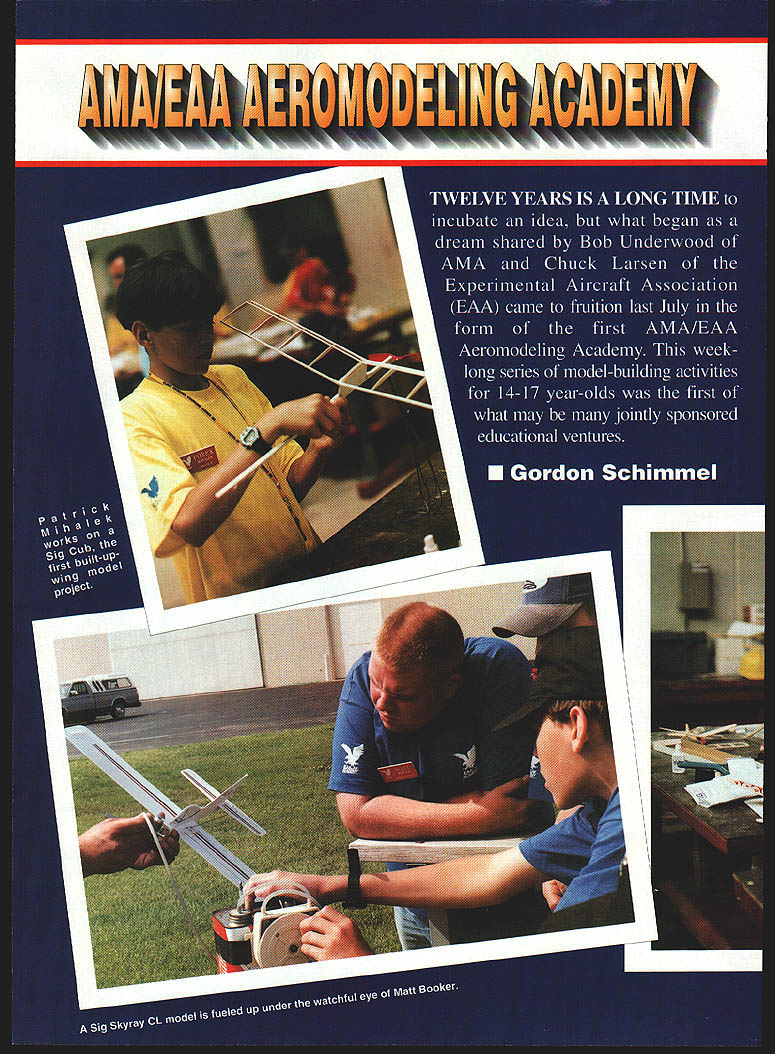
- Began assembly of the Sig Cub, emphasizing careful construction of a built-up wing.
- Introduced wire bending and tissue covering techniques.
- Afternoon devoted to completing the Cub and additional flying/trimming with the Pigeon.
- Rich Hanson (AMA Vice President, District X) visited to observe the program.
- Monday — Museum tours and Pioneer Airport
- Finished work on the Cub in the morning.
- Private tour of the Air Adventure Museum; noted similarities between model construction and full-scale aircraft on display.
- Afternoon tour of Pioneer Airport due to windy flying conditions; students viewed a flying replica of the Spirit of St. Louis and a Ford Trimotor.
- Tuesday, July 15 — Radio Control introduction
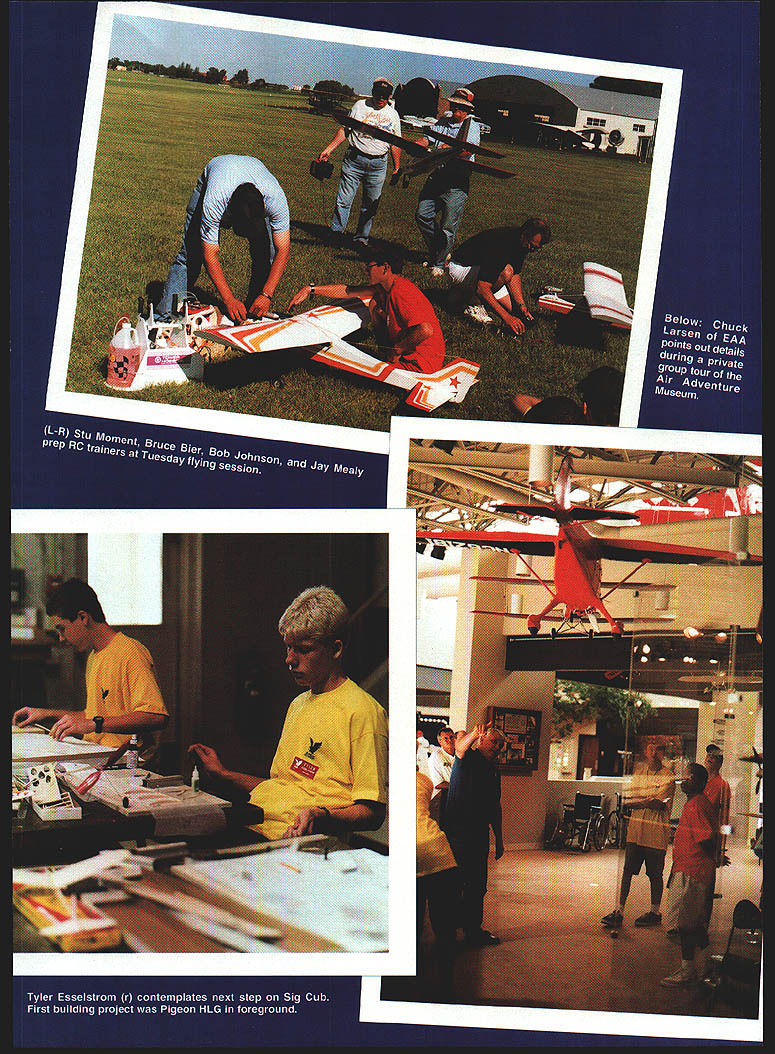
- Weather improved; introduced students to RC flying.
- Began at Pioneer Airport and moved to the local AMA flying field.
- Students practiced on RC sticks with guidance from experienced instructors.
- Two-dimensional training included RC cars running pylon figure-8 courses to develop stick coordination.
- Bob Underwood (AMA Education Director) and AMA President Dave Brown participated during the last two days, arriving in Brown’s Cessna 182.
- Wednesday — Control Line, engines, and take-home projects
- Half the group continued RC flying while the other half began construction of the Sig Skyray Control Line model.
- Despite high winds again grounding some flights, students progressed on mounting engines and painting.
- Introduced the Lanier Indicator RC airplane as a “take-home” project; covered engine operation/installation and fabric covering techniques to help students complete models satisfactorily.
Evaluation and lessons learned
- Students completed an end-of-program evaluation. Common feedback:
- Desire for more flying time: “Too short! The camp should be two weeks.”
- Strong interest in RC flying; many requested more focused time on RC.
- Some preferred fewer projects to allow deeper completion of each model.
- Appreciation for the instructors’ time and effort.
- Staff also learned valuable teaching techniques and identified improvements:
- Consider a Control Line model that reinforces wing-building and covering techniques to meet multiple objectives in one project.
- Keep several completed flying models available so students can gain experience with a finished example while building their own.
Future plans
The staff and organizers are optimistic about repeating and expanding the Academy. A second effort was scheduled for the summer of 1998, with plans to offer camps at the Muncie headquarters of AMA and at the EAA museum in Oshkosh. The joint AMA/EAA effort is a work in progress; the learning curve is still steep for students and staff, but the fun and excitement have just begun.
Acknowledgments and contributions
What cannot be adequately conveyed in print is the satisfaction volunteer instructors experienced in sharing skills and learning from one another. AMA has funded many programs through the YES (Youth Education Stipend) grant process, and the Academy could provide a useful educational program and a “menu” of activities for club members.
Contributions by the following manufacturers helped make the Academy a success:
- Sig Manufacturing
- Futaba
- Lanier RC
- Great Planes
- Indy RC
- Frank Tiano Enterprises
- Traxxas
- Novak Electronics
- NorVel
- K&B Manufacturing
- Airtronics
- Hitec
- JR
Gordon Schimmel 4 South Eagleville Rd. Storrs, CT 06268
Transcribed from original scans by AI. Minor OCR errors may remain.

