
AMA's Bicentennial Mindboggler: Transcontinental Air Races
Coast to coast in thirty days. A hundred miles a day—two hours each day averaging 50 miles per hour. Equivalent to eight fifteen-minute flights on a Sunday afternoon—not for everybody but well within the capability of many. With some added touches: do it from a car riding along the highway, and do it day after day for a month. It can happen in '76 if current thinking by many members of the Academy of Model Aeronautics develops as anticipated. Born of a brainstorm when AMA President Johnny Clemens had to spend many hours in a hospital bed, the idea has come alive in the minds of many others who have become excited about the possibilities.
There's no problem with technology—it's well within the state of the art. It's more a problem of logistics; to sustain a reasonable daily effort for a month. And it will involve a lot of people: drivers for cars to transport the pilots, AMA Contest Directors to certify performances, mechanics to help keep everything working, coordinators to arrange routes, lodging, and eating.
Cooperation from police and highway officials will be necessary to permit moving convertibles, station wagons, or pickup trucks across the country. Problems of traffic lights, other vehicles, underpasses and overpasses, detours and many other obstacles will add to the complications. But it's all feasible and a goldmine of PR possibilities.
Initially the news media reaction would probably treat it as a joke, but not for long. They know what our models can do so after the first few miles the possibility of doing the job will become more obvious, even to the uninitiated. Excitement will be generated within a few hours, especially after the first model gets from one town to another. Even if ignored initially by the national news media, local press, TV, and radio will focus on hometown favorites. And from this will be generated the national interest as one locality after another is linked in coverage.
Just like the barnstorming days of the aviation pioneers this cross-country hedge-hopping cavalcade will grow from grass roots interest to national prominence.
It's a "natural" which anybody can try. With what's on hand. Any Sunday flyer can give it a go in easy stages. Instead of going round and round at the club field, the flight path could be along a nearby road. One typical 15-minute tankful in an ordinary RC plane can go 15 miles. For a rough rule of thumb, figure one mile per ounce per minute.
We're not talking about going non-stop across the United States—that's a few years down the road. For now we're looking at a string of one hundred-mile legs with a basic goal of a hundred miles a day to celebrate Model Aviation Month. That adds up to 3,000 miles—New York to Los Angeles! Even the hundred mile legs don't have to be non-stop, although that wouldn't be difficult to do. But eight 15-minute flights will easily cover a hundred miles, without too much more doing than it takes for a good Sunday flying session with ordinary models. So, anybody can do it, in relatively easy bits, with what's on hand.
Regardless of whether special or conventional designs are used the achievement of flying one hundred miles a day is well within the capability of many. This suggests that we don't have to wait until 1976 to find out. In fact, it would be helpful to next year's project to initiate a series of 100-mile races this year. Any club can do it and the experience would be great for the longer haul later on.
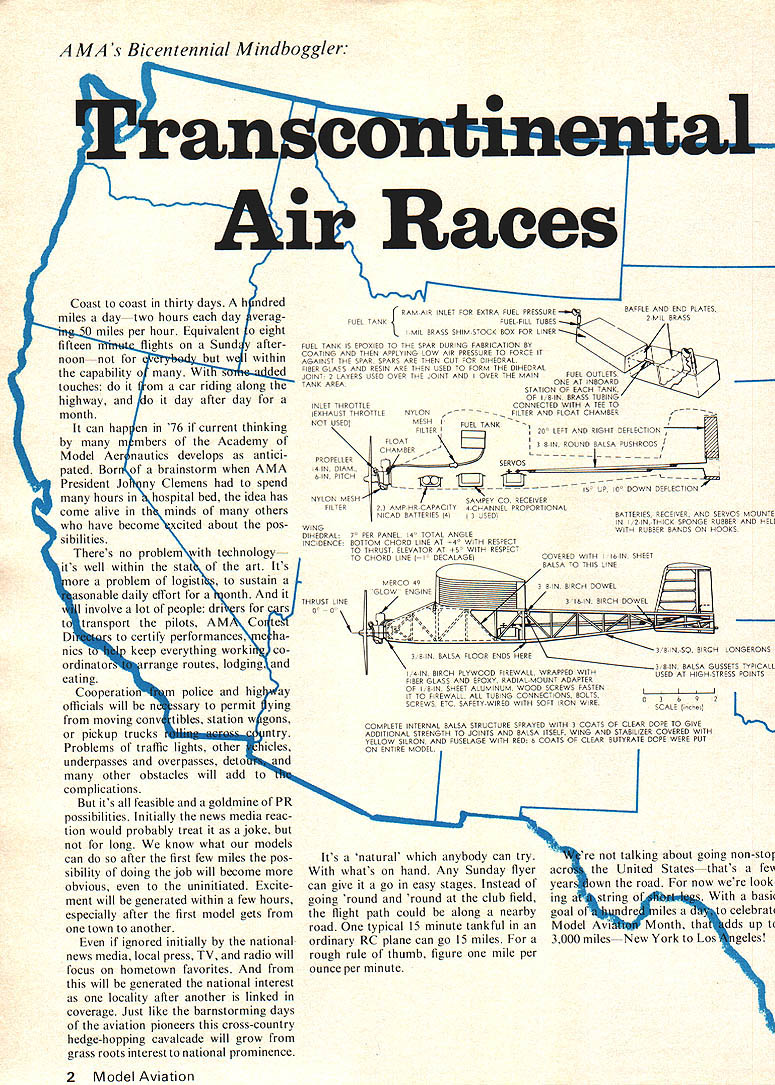
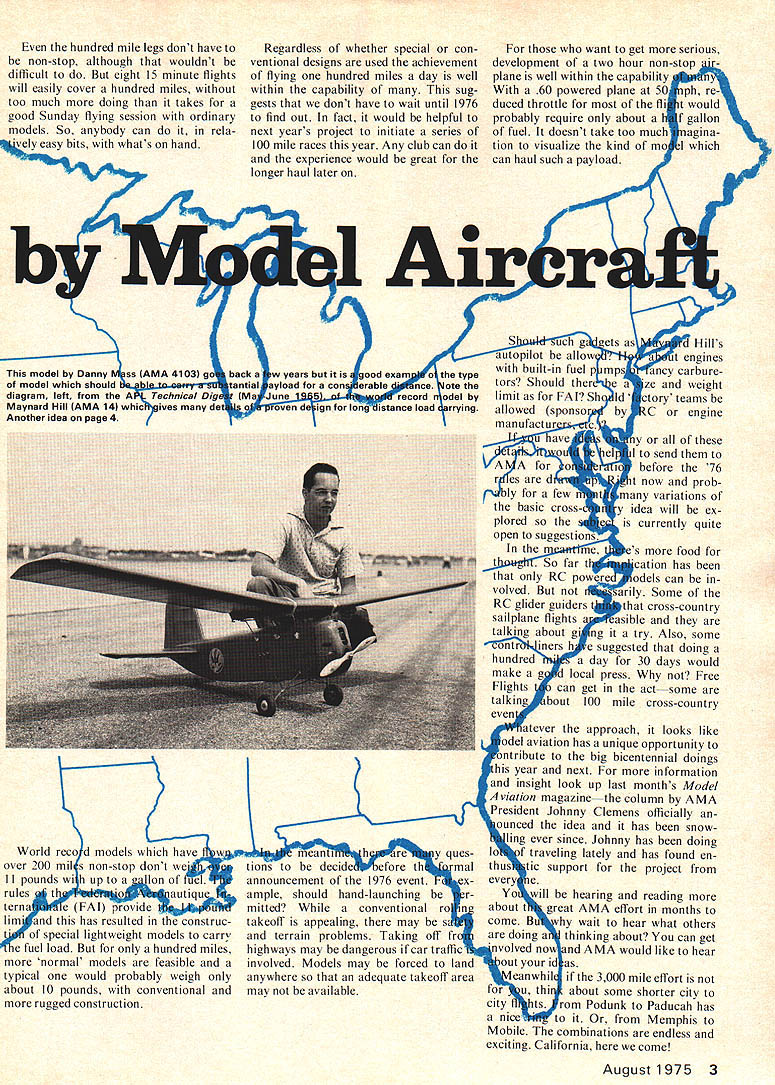
For those who want to get more serious, development of a two hour non-stop airplane is well within the capability of many. With a .60 powered plane at 50 mph, reduced throttle for most of the flight would probably require only about a half gallon of fuel. It doesn't take too much imagination to visualize the kind of model which can haul such a payload. World record models which have flown over 200 miles non-stop don't weigh over 11 pounds with up to a gallon of fuel.
The rules of The rules of the Fédération Aéronautique Internationale (FAI) provide the rules for the class which has resulted in the construction of special lightweight models to carry the fuel load. But for only a hundred miles, more normal models are feasible and a typical one would probably weigh only about 10 pounds, with conventional and more rugged construction.
In the meantime there are many questions to be decided before the formal announcement of the 1976 event. For example, should hand-launching be permitted? While a conventional rolling takeoff is appealing, there may be safety and terrain problems. Taking off from highways may be dangerous if car traffic is involved. Models may be forced to land anywhere so that an adequate takeoff area may not be available.
Should such gadgets as Maynard Hill's autopilot be allowed? How about engines with built-in fuel pumps to bypass carburetors? Should there be a size and weight limit as for FAI? Should factory teams be allowed (sponsored) by RC or engine manufacturers, etc.? If you have ideas on any or all of these details, it would be helpful to send them to AMA for consideration before the '76 rules are drawn up. Right now and probably for a few months many variations of the basic cross-country idea will be explored so the idea is currently quite open to suggestions.
In the meantime, there's more food for thought. So far the implication has been that only RC powered models can be involved. But not necessarily. Some of the RC glider types that make cross-country sailplane flights are feasible and they are talking about giving it a try. Also, some control-liners have suggested that doing a hundred miles a day for 30 days would make a good local press. Why not? Free flights can get in the act—some are talking about 100-mile cross-country events.
Whatever the approach, it looks like model aviation has a unique opportunity to contribute to the big bicentennial doings this year and next. For more information and insight look up last month's Model Aviation magazine—the column by AMA President Johnny Clemens officially announced the idea and it has been snowballing ever since. Johnny has been doing lots of traveling lately and has found enthusiastic support for the project from everyone.
You will be hearing and reading more about this great AMA effort in months to come. But why wait to hear what others are doing and thinking about? You can get involved now and AMA would like to hear from you about your ideas.
Meanwhile if the 3,000 mile effort is not for you, think about some shorter city-to-city flights. From Pomona to Paducah has a nice ring to it. Or, from Memphis to Mobile. The combinations are endless and exciting. California, here we come!
Transcribed from original scans by AI. Minor OCR errors may remain.

