
AMA/SEFLI "Unofficial" Electric Nats
Electric fliers wanted a Nationals that included more electric events—so SEFLI was given the challenge to organize one. The club overcame many obstacles to stage an Electric Nats.
BACKGROUND
No Special Interest Group representative was present to speak for electric-powered aviation when the AMA Nationals Committee met to set up the 1992 schedule. The AMA supports an FAI team in world competitions; therefore only F3E and F3E (seven-cell) were put on the Nationals schedule. These were scheduled on a time-, space-, and frequency-available basis. When the official Nationals schedule was published, this decision caused an outcry from the electric community.
Jay Putt, founder and secretary of the Silent Electric Flyers of Long Island, New York (SEFLI, pronounced See-Fly), contacted Joe Beshar, newly elected District 2 VP and former chairman of the FAI Electric Team Selection Committee. Joe handed the problem to Ron Farkas, his newly appointed AVP and a SEFLI member, and strongly suggested that SEFLI take the opportunity to conduct an unofficial Nationals event for electrics.
ORGANIZATION AND PLANNING
Ron presented the idea to SEFLI at the club's April meeting. The membership seemed mildly interested. Ron convened a meeting at Jay Putt's home to form an ad hoc committee to stage the event. The group estimated probable contestant numbers and decided upon the facilities and support needed, including food, parking, toilets, charging stations, flight stations, landing spots, clipboards, pencils, and more.
Ron Farkas and Don Mott qualified as Contest Directors for the event. A second committee meeting set support assignments. Ron, Don, and Jay sent over 250 invitations to clubs and known electric fliers. Eight people pre-registered. Ron and Jay made about 100 phone calls to move things along. Chip Smith, AMA Nationals Director, offered use of the Pioneer Valley RC Club (PVRC) flying site. The event was scheduled for Saturday, June 27.
VOLUNTEERS AND SUPPORT
Key volunteers and equipment included:
- Clyde Giest: scoreboards and RC channel clipboard.
- Gerhardt Spielman: scoring.
- Russ "der Impoundt Meister" Ainbinder and Joanne Ainbinder: stopwatches, clipboards, pencils, transmitter tags for impound (Russ's van), and walkie-talkies.
- Jay Putt: registration and bookkeeping.
- Steve "der Charge Meister" Anthony: seven-station battery-charging system.
- Flight-line management: Tom "No PA System Needed" Hunt and timers Al Huber, George Ray, Russ Riccardi, and Joe Salvator.
- Chef Greg Poulos: coffee, breakfast, and lunch supplies for up to 200 people.
- Cal Ettel, District 6 AVP: supplied the 1991 Nationals sailplane scoring program written by his son, Fred; George Myers loaded the program into his laptop.
- Don Mott: arranged crew T-shirts.
The pile of necessary equipment was distributed among the vehicles of the 17 club members who drove to Chicopee, Massachusetts, to work and compete.
SITE, LOGISTICS, AND SCHEDULING
Ron Farkas went to Westover on Wednesday to meet Nationals management and verify equipment and facilities. The PVRC field was no longer available. Chip Smith arranged for the Hampshire County RC Club (HCRC) field in Hadley, Massachusetts, as an alternate site. A frantic series of phone calls and faxes informed preentered contestants.
The SEFLI contingent assembled at the Red Roof Inn at 5:00 p.m. on Friday for a group supper and kickoff meeting. After supper they traveled to the new site for a lookover and test flying. SEFLI was cordially received by Fran Mitchell, president of HCRC. The five-acre lawn at the end of a cornfield proved to be an excellent site.
THE EVENT AND WEATHER
Saturday morning the crew returned to the site through a hailstorm. Setup proceeded under fog, cloudy skies, and light rain. Registration began at 8:00 a.m., with trim and sport flying allowed until competition started.
The pilots' meeting was held at 10:00 a.m., and flying commenced under clearing skies. Some weak thermals began to develop. Competition was halted when a thunderstorm blew in at noon, and resumed 90 minutes later. The weather improved until the contest ended at 6:30 p.m., but thermals didn't return.
There were no RF interference problems and only one crash caused by transmitter failure—the plane was recovered. Flying skill and preparation determined the winners. Many eight-minute maxes were scored despite the weather.
COMPETITORS AND CLASSES
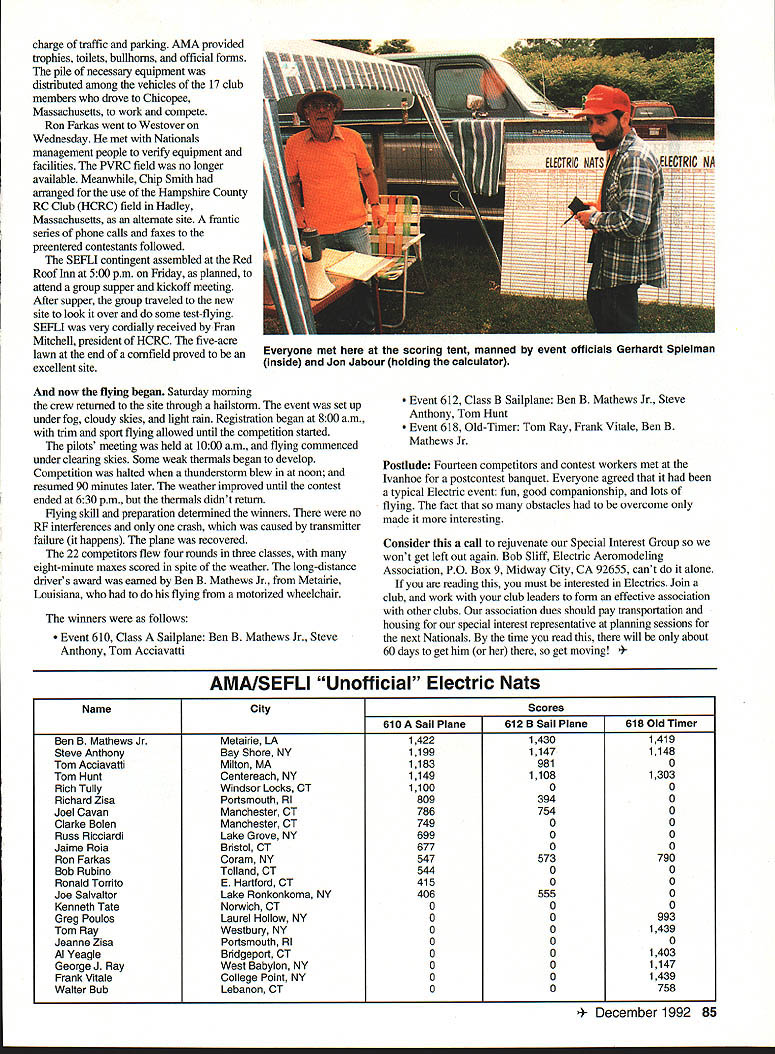
- 22 competitors flew four rounds in three classes.
- The long-distance driver's award went to Ben B. Mathews Jr. from Metairie, Louisiana, who had to do his flying from a motorized wheelchair.
RESULTS
- Event 610, Class A Sailplane:
- 1st: Ben B. Mathews Jr.
- 2nd: Steve Anthony
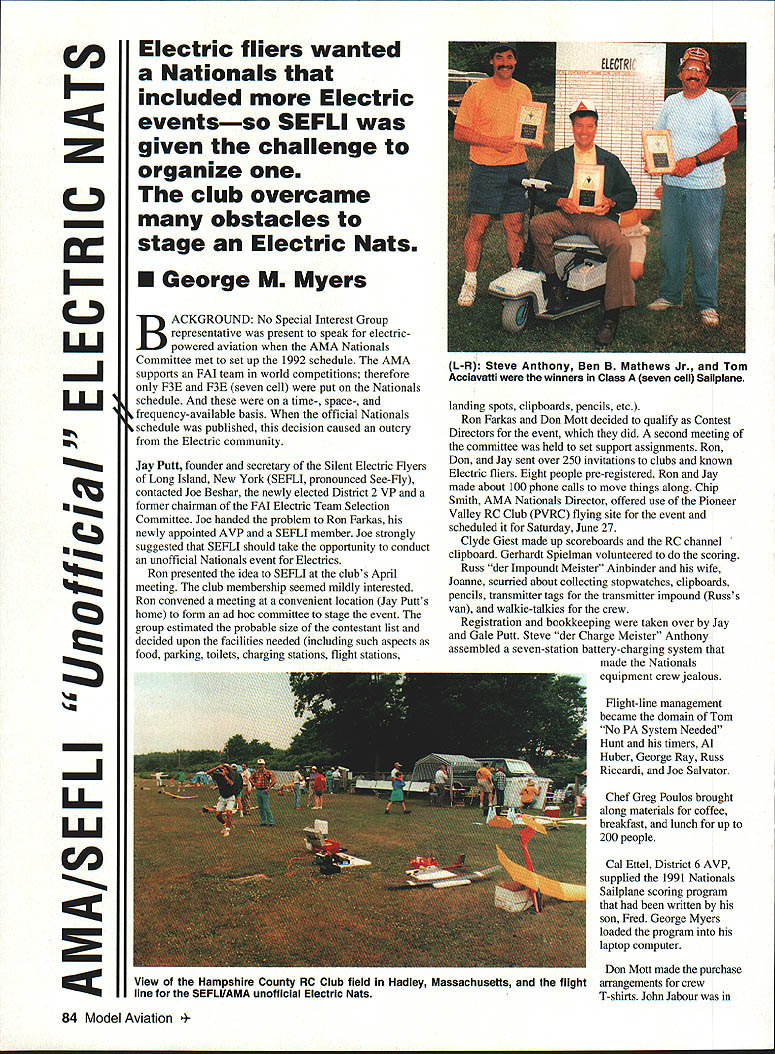
- 3rd: Tom Acciavatti
- Event 612, Class B Sailplane:
- 1st: Ben B. Mathews Jr.
- 2nd: Steve Anthony
- 3rd: Tom Hunt
- Event 618, Old-Timer:
- 1st: Tom Ray
- 2nd: Frank Vitale
- 3rd: Ben B. Mathews Jr.
POSTLUDE AND CALL TO ACTION
Fourteen competitors and contest workers met at the Ivanhoe for a postcontest banquet. Everyone agreed it had been a typical electric event: fun, good companionship, and lots of flying. The many obstacles only made it more interesting.
Consider this a call to rejuvenate our Special Interest Group so we won't get left out again. Bob Stiff, Electric Aeromodelling Association, P.O. Box 9, Midway City, CA 92655, can't do it alone.
If you are reading this, you must be interested in electrics. Join a club, and work with your club leaders to form an effective association with other clubs. Our association does provide transportation and housing for our special interest representative at planning sessions for the next Nationals. By the time you read this, there will be only about 60 days to get him (or her) here, so get moving!
Transcribed from original scans by AI. Minor OCR errors may remain.

