
The Amazing Engines of Laszlo Riesz
Bill Warner
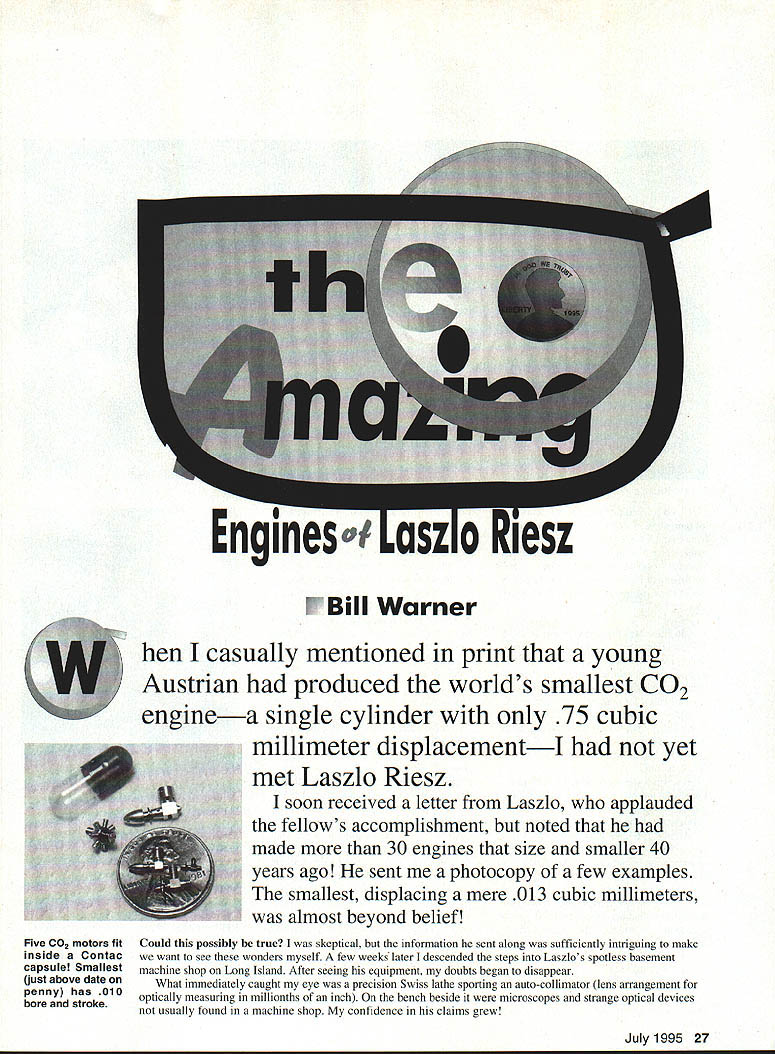
When I casually mentioned in print that a young Austrian had produced the world's smallest CO2 engine—a single cylinder with only .75 cubic millimeter displacement—I had not yet met Laszlo Riesz.
I soon received a letter from Laszlo, who applauded the fellow's accomplishment but noted that he had made more than 30 engines that size and smaller 40 years ago. He sent a photocopy of a few examples. The smallest, displacing a mere .013 cubic millimeters, was almost beyond belief.
Could this possibly be true? I was skeptical, but the information he sent along was sufficiently intriguing to make me want to see these wonders myself. A few weeks later I descended the steps into Laszlo's spotless basement machine shop on Long Island. After seeing his equipment, my doubts began to disappear.
What immediately caught my eye was a precision Swiss lathe sporting an auto-collimator (lens arrangement for optically measuring in millionths of an inch). On the bench beside it were microscopes and strange optical devices not usually found in a machine shop. My confidence in his claims grew.
I soon learned that Mr. Riesz had done a lot more than make the tiniest power plant I had ever seen. He proceeded to pull out marvel after marvel for the next three hours. When we finally had to take our leave, I had the feeling of having been in the presence of one of the most remarkable engineers of the century.
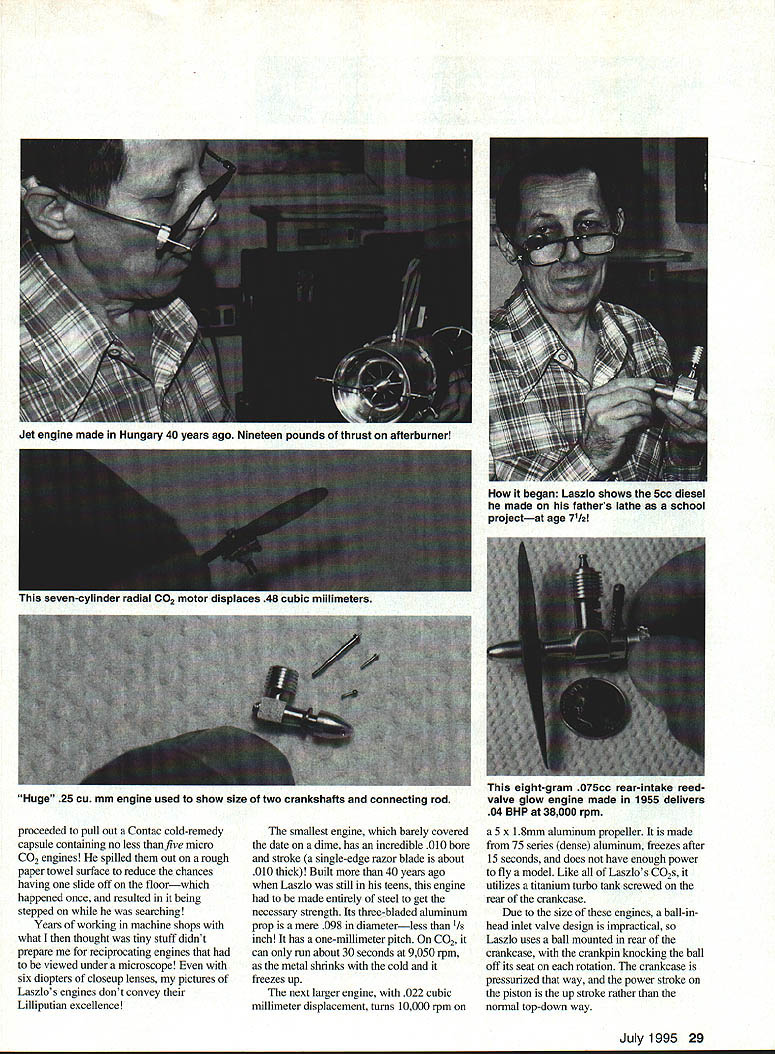
Laszlo Riesz was born in Hungary in 1936. His grandfather was a noted physicist, and his father manufactured wine presses. His first engine was a 5 cc diesel made from scrap metal on his father's 20-foot lathe, normally used for making wine-press parts. It was a school project, and Laszlo described it as "...not very precision," pointing out some unprofessional file work on the crankcase. He made the engine when he was seven and a half years old.
His father was so delighted that he gave Laszlo the use of a jeweler's lathe as well as the rest of his shop machinery. "It was the happiest moment of my life!" he recalls.
Around 1953, not long before he emigrated to the U.S. with his parents, he was making power plants as varied as turbine jets for model airplanes to tiny CO2 engines that just covered the date on a penny.
One engine was fairly crude compared to the others. It had been made by hand during Laszlo's nine-month stay in a refugee camp on the shores of Lake Ostevo in Yugoslavia. It was fashioned from bits and pieces using primitive tools. A twig made the handle for a piece of heavy copper wire to use as a soldering iron. Broken sewing-machine needles served as drills. "Files" were shaped and textured stones. Solder came from the seams in tin cans. Many of the brass parts came from a broken outboard motor carburetor.
This brass engine, sporting a balanced flywheel made from a Hungarian penny, powered a small boat that ran on steam generated from a candle flame. Laszlo also produced a steam turbine to propel his boats, which had fifty times more power but took two scarce candles to heat the boiler. The candles had to be made by hand from salvaged wax.
The Jets
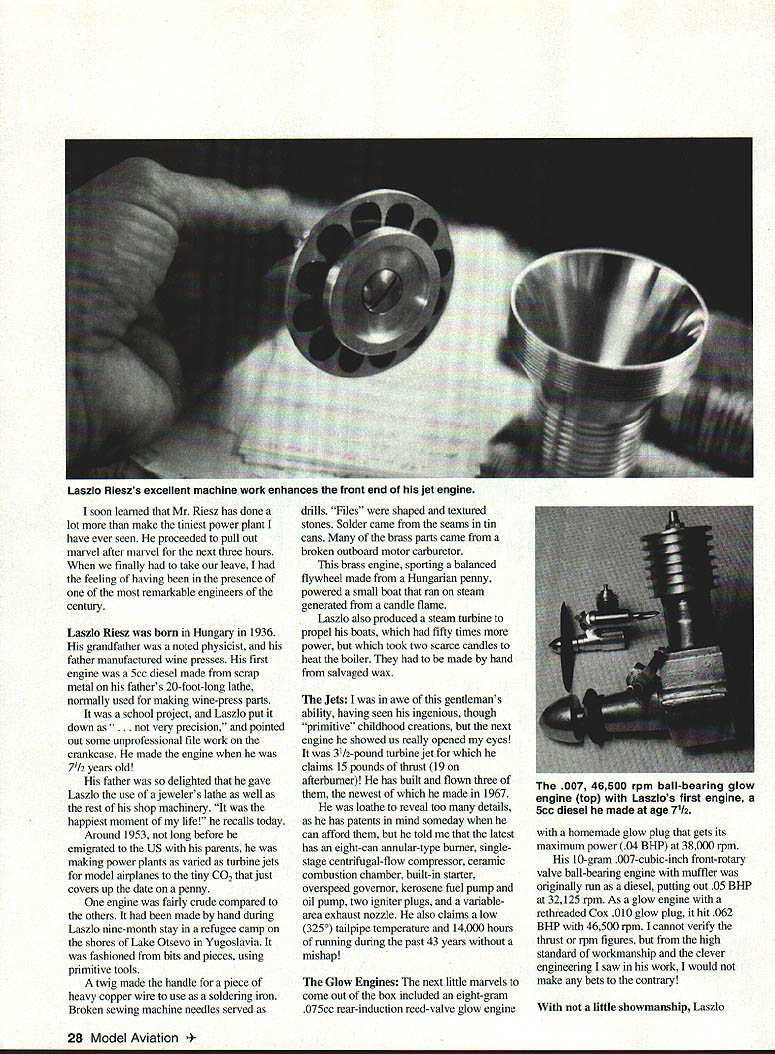
The next engine that really opened my eyes was a 3.5-pound turbine jet for which he claims 15 pounds of thrust (19 on afterburner). He has built and flown three of them, the newest of which he made in 1967.
He was loath to reveal too many details, as he has patents in mind someday when he can afford them, but he told me that the latest has:
- an eight-can annular-type burner
- single-stage centrifugal-flow compressor
- ceramic combustion chamber
- built-in starter
- overspeed governor
- kerosene fuel pump and oil pump
- two igniter plugs
- variable-area exhaust nozzle
He also claims a low (325°F) tailpipe temperature and 14,000 hours of running during the past 43 years without a mishap.
The Glow Engines
A number of small glow and diesel-type engines followed. Notable examples include:
- An eight-gram, 0.075 cc rear-induction reed-valve glow engine with a homemade glow plug that gets its maximum power (0.04 BHP) at 38,000 rpm.
- A 10-gram, 0.007-cubic-inch front-rotary-valve, ball-bearing engine with muffler. It was originally run as a diesel, putting out 0.05 BHP at 32,125 rpm. As a glow engine—with a rethreaded Cox .010 glow plug—it reached 0.062 BHP at 46,500 rpm.
I cannot independently verify the thrust or rpm figures, but from the high standard of workmanship and the clever engineering I saw, I would not bet against them.
With not a little showmanship, Laszlo proceeded to pull out a Contac cold-remedy capsule containing no fewer than five micro CO2 engines. He spilled them onto a rough paper towel to reduce the chances of one sliding off the floor—one did slide and was stepped on while he was searching.
Years of working in machine shops—what I then thought was tiny stuff—didn't prepare me for reciprocating engines that had to be viewed under a microscope. Even with six diopters of close-up lenses, my pictures of Laszlo's engines don't convey their Lilliputian excellence.
The smallest engine, which barely covered the date on a dime, has an incredible 0.010-inch bore and stroke (a single-edge razor blade is about 0.010 inch thick). Built more than 40 years ago when Laszlo was still in his teens, this engine had to be made entirely of steel to get the necessary strength. Its three-bladed aluminum prop is a mere 0.098 inch in diameter—less than 1/8 inch—and has a one-millimeter pitch. On CO2 it can only run about 30 seconds at 9,050 rpm, as the metal shrinks with the cold and it freezes up.
The next larger engine, with 0.022 cubic millimeter displacement, turns 10,000 rpm on a 5 x 1.8 mm aluminum propeller. It is made from 75-series (dense) aluminum, freezes after about 15 seconds, and does not have enough power to fly a model. Like all of Laszlo's CO2s, it utilizes a titanium turbo tank screwed onto the rear of the crankcase.
Due to the size of these engines, a ball-in-head inlet valve design is impractical. Laszlo uses a ball mounted in the rear of the crankcase, with the crankpin knocking the ball to its seat on each rotation. The crankcase is pressurized that way, and the power stroke on the piston is the upstroke rather than the normal top-down stroke.
The smallest engine that Laszlo actually flies in a model displaces 0.049 cubic millimeter (not cubic inches). It runs for more than a minute, flying a six-inch-span light foam airplane covered with 0.5 mil plastic cling wrap. It turns 6,500 rpm on a two-bladed nylon prop and features an aluminum crankcase, a chrome-steel cylinder liner, an aluminum piston with a nylon ring, and a titanium connecting rod.
A larger version (0.25 cubic millimeter) powers a 12-inch-span model.
The problems in making micro CO2 engines involve not only the crystalline structure of metal at the molecular level but also manufacturing suitable steel balls for the inlet valves. Laszlo says he has to make about 150 balls to get one good one without flat spots.
Since the smallest commercially available case-hardened ball is a whopping 1/32 inch in diameter, he turns his own from #303 nonmagnetic stainless steel slightly bigger than he needs. He then laps the balls between two cast-iron plates using diamond lapping paste and drills a shim stock to hold them in place.
Static charge buildup and the braking action of the lapping paste often prevent the balls from rolling properly, which creates tiny flat spots that render the balls unusable. The final ball must be round within 0.000008 inch.
A Seven-Cylinder Radial
One remarkable project is a seven-cylinder radial with a 6.4 mm diameter. It has only been run on the bench, needing a filler shut-off to prevent starting on its own. It utilizes a symmetrical crankshaft-distributed pressure feed. Turning 3,200 rpm, it should be able to power a light 20-inch-span model. It is the quietest of the engines and remarkably smooth-running. The crankcase breather features a number of tiny 0.004-inch holes to equal the piston displacement and are small enough to prevent dust particles from entering.
Demonstration and Operation
Did you see them run? Well, yes and no. They ran, but not on CO2. Unfortunately, the CO2 Laszlo had purchased for the occasion was no good—it gummed up the engines. (I too have had that problem, possibly stemming from the lubricant put in with the CO2.) When hooked up to 80 lb. air pressure, however, they ran fine, if not as fast as they would on high-pressure CO2. You could even feel the prop wash from the tiniest one a foot behind it, which was more than I expected from such a minuscule mill.
The engines needed to be oiled before each run with a special synthetic watchmaker's oil (Laszlo once worked for Bulova, before they moved their Accutron operations to Switzerland).
This impressive demonstration, the incredible machine work, and the volumes of theoretical studies ranging from metallurgy to the theory of compressor stalls give me complete confidence in Laszlo's ability to back up any claims he has made. I feel that if we had sufficient chance to see all of his engines perform (difficult to do with glow engines and jets in a crowded urban area), we'd be in for a treat.
Mr. Riesz does not seem like a man who exaggerates. For example, he insisted that I use the rpm figures at which maximum horsepower was obtained, and not the maximum-obtained rpm—a bit higher, but misleading.
What good are CO2 engines of such minuscule dimensions vis-à-vis actually flying "practical" model airplanes? For the smallest ones, probably no practical use. Still, they stand as inspiring monuments to human accomplishment. Laszlo's first engine impresses me as much as music written by Mozart at age seven. The thorough engineering and unbelievable craftsmanship that have gone into his later work are unexcelled.
Mr. Riesz plans to produce a wide variety of "larger" (more than one cubic millimeter displacement) CO2 engines, mainly for indoor fliers. He has no fewer than 26 different engines drawn up, ranging from singles to twins to flat fours to radials for Peanut and Pistachio models, with emphasis on scale appearance. He intends to make a variety and see what sells before going into full production.
He is fully aware of the competition from the excellent Gasparin engines from Czechoslovakia and the domestically produced Browns, but he feels there will be a market for his high-quality engines. He plans to sell directly to modelers to keep prices competitive.
By the time this article is published, he hoped to have a number of engines in stock. For more information, contact Laszlo Riesz at 2415 St. Marks Ave., Bellmore, NY 11710.
Transcribed from original scans by AI. Minor OCR errors may remain.

