
American in Leningrad
By Dan Rutherford
Introduction
With Mikhail Gorbachev holding his finger on the fast-forward button these days, the boundaries of the possible are swiftly changing. Suddenly it almost seems as if having reasonable hopes for world peace requires the courage to be unreasonable! Why be content with easy stuff like achieving religious freedom, or even breaking down the Berlin Wall? In the current atmosphere of heightened expectations, go ahead and shoot for the moon. Wait a month or two, and you'll likely see your dreams come true right there on your television set.
Though it hasn't been broadcast on the airwaves yet, that's exactly what's happening in the world-within-a-world of model aviation. U.S. and Soviet modelers competing in World Championship events have always gotten along very well. In 1989 a Soviet control-line and free-flight team from Leningrad participated in the AMA Nationals, something just a short year before that had been unheard of. Highly competitive and exotic—and accompanied by equipment rated among the world's best—the Russians enjoyed star status at our annual AMA contest. They carted several of our Nationals trophies back to the U.S.S.R. and left their U.S. counterparts with memories of very strong friendships based on mutual trust and respect.
When some of my new Russian friends invited me to visit Leningrad, it was an offer I couldn't refuse. There was the chance to see firsthand the radical changes the Soviet Union was undergoing; a business opportunity (I negotiated a contract to import Soviet-produced engines and accessories); and a chance to learn how Soviet modelers operate and why they so often dominate FAI World Championship events.
Arrival and first impressions
I used a business visa to avoid Intourist-consequent insulation from daily Soviet life. The trip itself, although long, was simple: Sea-Tac nonstop to Copenhagen, overnight in Helsinki, then an eight-hour train to Leningrad. At the train station I was met by Svetlana Filippova (woman CL stunt flier at the 1989 Nats), Valentin Aleshin (1989 AMA National Champion F/M Team Race), and Svetlana's father, Anatoly.
My first impression: instant pandemonium. We wrestled my typically American excess baggage into Filippova's Lada, a 15-year-old Soviet-produced car based on an older Fiat design. It made it—just barely. The luggage contained many modelers' items. Mike Pratt of Sig Manufacturing had arranged to send a Sig Magnum, a full-scale CL precision aerobatics model, to Svetlana after an internal control failure at the 1989 Nats. The huge kit box and my other luggage were filled with niceties—over $350 retail value—Satellite City UFO cyanoacrylate, Hot Shot accelerator, and a dozen or so TD .049 glow heads from Cox. Many thanks to the Hunts, Sig Manufacturing, and Cox Hobbies. The Soviets were amazed at American generosity.
The hospitality my Soviet friends provided was extraordinary. Almost before I had a chance to put my luggage down, I was introduced to neighbors, friends, and relatives; invariably there was tea and sweet rolls and a small gift for me. I was treated like a guest and an honored visitor representing America.
City life, culture, and social scenes
One morning Svetlana served caviar on buttered bread. That same day she announced, "Tomorrow night you are going to the most exclusive theater in Leningrad, in the company of three beautiful Soviet women." And we did—ballet in the front row of an incredibly beautiful, historic theater. Probing questions about how Valentin had obtained such choice tickets were largely ignored: "No problem, Dan."
On a clear, cold day Svetlana took me to a recreational area where low-effort cross-country skiing was popular. The high point of a 30-minute walk through snow-covered low hills was spotting European bison. Having had experience with American bison in my youth, I wasn't overly impressed—"my people killed them by the millions, to make hats," I joked.
While in Leningrad (a compact, beautiful city of about five million) for only a week, I heard positive sentiments about America and American citizens everywhere I went. Many Soviet youngsters wanted to find out how we did things and to make contacts. They were not the bitter, hate-filled people we had been taught to fear.
On another night Svetlana took me to a Soviet nightclub for dancing and drinks, accompanied by a school friend I immediately dubbed "Foxy Lady." In one room were American-made pinball and slot machines. In another, beer, Pepsi, and wine (and food of questionable quality) were served at rows of tables. We were seated at a reserved table in a third room—reserved only because Svetlana is resourceful—and watched Tom & Jerry cartoons on the monitor. Dancing was loud and energetic (low-quality speakers), the music was almost exclusively American (too much Madonna), and the dancers wore American or American-style clothing. The scene was a striking example of young Russians embracing borrowed culture while remaining aware that the next day's life—Perestroika or not—is often much tougher than what they enjoy that night.
Practicalities and small comforts
I took well-meaning advice from friends to bring food staples—peanut butter, tissue, and other supplies. While not required in Leningrad, these items proved popular. I brought whipped cream in a spray can, American-style processed cheese, popcorn, Jell-O gelatin and cook'n'serve pudding, canned pineapple, peaches, fruit cocktail, and various instant products such as macaroni and cheese. The canned pineapple, never seen fresh or canned locally, was especially appreciated. The hands-down favorites were Jell-O salads topped with whipped cream and good old popcorn.
Modeling under the Soviet system
One main incentive for the trip was to observe how Soviet modeling differs from the AMA system. There are few similarities. In Russia, aeromodeling—like gymnastics, ice skating, or weight lifting—is considered a sport and is basically state-funded. As with other centralized systems, resources are dispersed from Moscow.
In Leningrad and surrounding districts, the Leningrad Airmodel Club encompasses all types of flying models in the usual categories:
- Free Flight
- Control Line
- Radio Control
- Rocketry
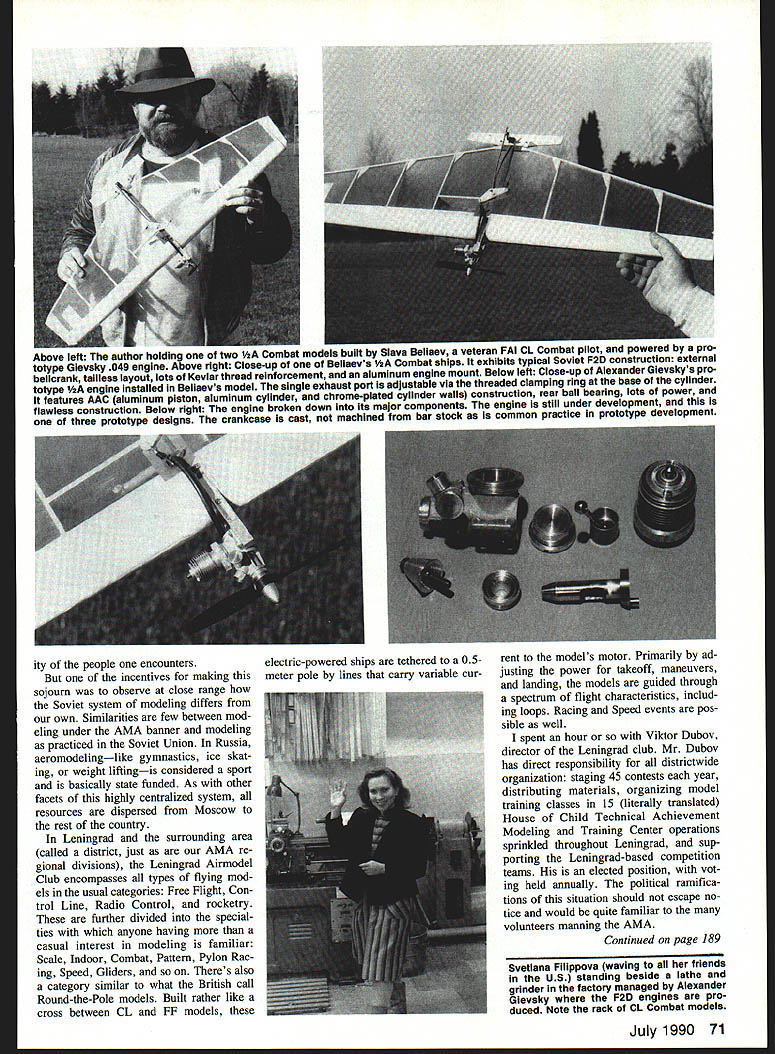
These are further divided into familiar specialties: Scale, Indoor, Combat, Pattern, Pylon Racing, Speed, Gliders, and so on. There's also a category similar to the British Round-the-Pole models. Built like a cross between CL and FF models, these electric-powered ships are tethered to a 0.5-meter pole by lines that carry variable current to the model's motor; by adjusting power for takeoff, maneuvers, and landing, the models are guided through a spectrum of flight characteristics, including loops. Racing and speed events are possible as well.
I spent time with Viktor Dubov, director of the Leningrad club. He is responsible for districtwide organization: staging about 45 contests each year, distributing materials, organizing model training classes in 15 House of Child Technical Achievement Modeling and Training Centers sprinkled throughout Leningrad, and supporting competition teams. His is an elected position with annual voting. The political ramifications of this arrangement are obvious and familiar to volunteers managing the AMA.
While all youngsters in the program are offered equal access to supplies, the more successful advance to national and then international competition as they progress through school and into careers. They remain connected to the state apparatus—you don't just drop into a local hobby shop when you need balsa and glue—so the brightest depend greatly on Viktor and his organization to further their participation in competition. Not an enviable system for individual autonomy, but one that has produced an enviable quantity of World Champions.
Dedication is expected in return for state support. The weekend I arrived, Alexander Gievsky, Vladimir Panov, and Slava Beliaev were 1,600 miles away in Sverdlovsk, competing in an FAI CL Combat meet. It was mid-February, with winds at 15–20 mph and temperatures down to −15°F, yet 68 hardy modelers entered the two-day contest. Competing in conditions this rugged represents pure dedication—and an indication of how intense competition at Soviet national contests can be.
Professionalism, factories, and modelers' employment
Some readers wonder whether Soviet national teams are made up of professional modelers. My answer was equivocal. Of the Soviets who attended the 1989 Nats, none are currently professional modelers—although all receive state support ranging from minimal (modeling supplies) to extensive (supplies plus paid travel). Many among this group are involved in cooperatives, capitalist operations that must pay for themselves and generate profit. For example, their trip to the 1990 AMA Nats will be supported by their own net, not by the state.
On the other hand, I met recent World Champs attached to large factories (workforces of 12,000) employed in design and prototype building. These men spend a lot of time making super-tricky models and have ready access to machinery, tools, and materials. An individual capable of winning at World Championship level will have outstanding fabrication and metalworking skills—talents ideally suited to prototype and tool-and-die work. The factory benefits from those skills and has easy access to tools and materials when it wants to develop, say, a new widget for manufacture.
Sometimes the modelers lend their knowledge to other purposes. One factory has a small team constructing four-man bobsleds for Olympic competition; when workers need help with aerodynamics, carbon fiber, Kevlar, and fiberglass layups, they consult the modelers across the hall.
The House of Child Technical Achievement centers
A visit to one of the 15 modeling and training centers was an eye-opener. These centers are organized and taken seriously. After checking your hat and coat at the entrance, you see modeling displays in glass cases, trophies, and pictures of competitions.
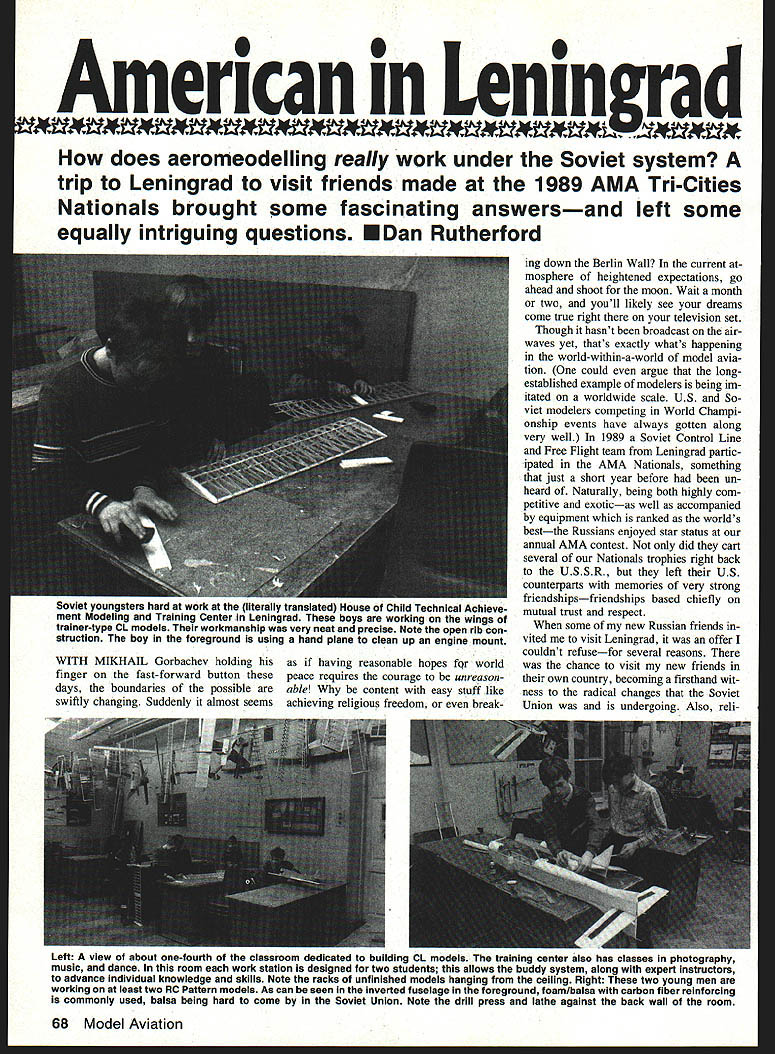
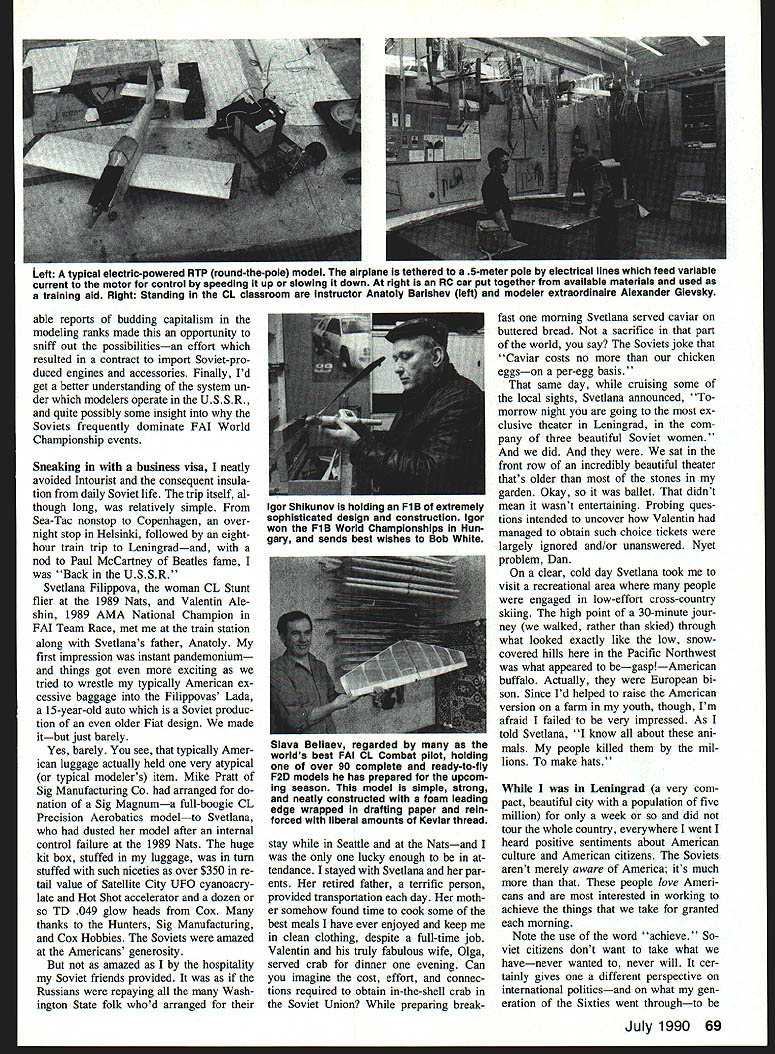
All forms of modeling coexist in each center. In a long hallway was a fair-sized four-lane slot car track featuring international standard 1/24-scale cars. The first training room we visited was dedicated to CL models, laid out like a traditional school shop with high ceilings, desk/work stations, and huge closets storing supplies. Hundreds of models hang from the ceiling—many unfinished, testimony to limited attention spans—but mixed among the trainers were some serious, ready-to-fly competition ships.
The CL instructor is a full-time teacher, often a professional teacher akin to a junior high shop teacher; some instructors are also accomplished modelers (Slava Beliaev teaches at one center). Instructors stress basic modeling skills developed through building standardized trainers using hand tools. There were no Dremel tools in the place; instead, students use sanding blocks, hand planes, coping saws, and carving knives that they learn to sharpen themselves. In the rear of most classrooms are small metalworking lathes, table saws, drill presses, and even metal casting equipment reserved for advanced students who have mastered the basics.
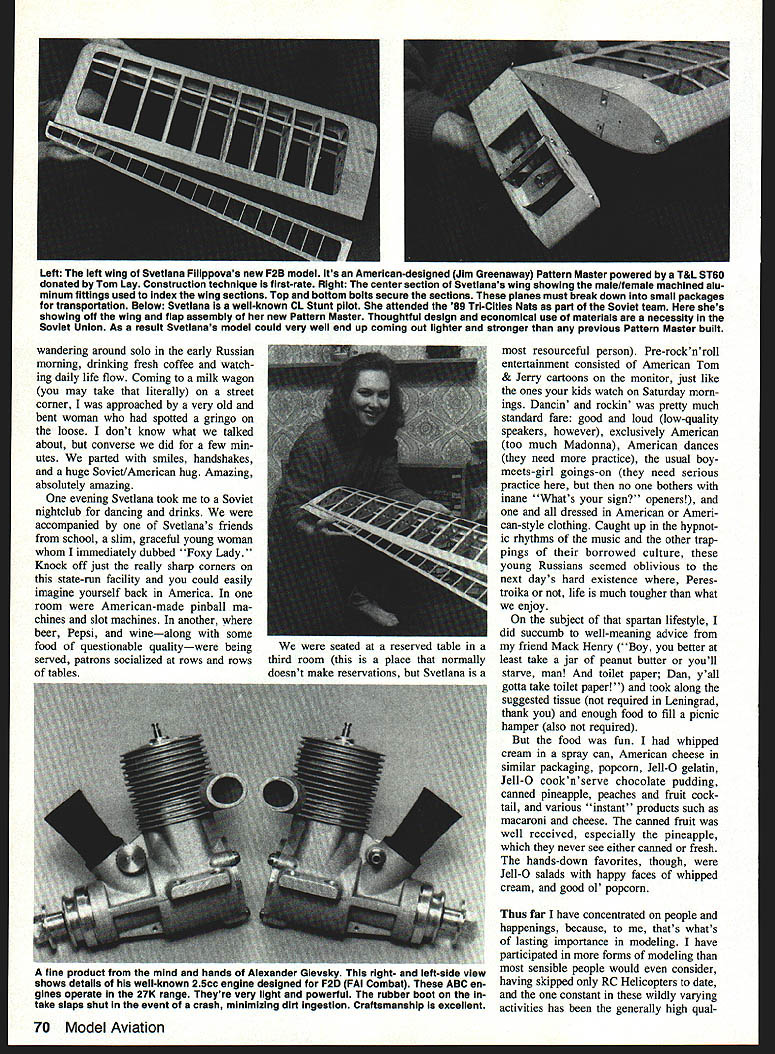
The RC modeling classroom had a few radio sets for training despite radio scarcity; several models were under construction. I enjoyed watching two 11-year-old boys working on a Pattern model using foam/balsa construction reinforced with carbon fiber. For some reason, Russia has large quantities of carbon fiber, so it is commonly used.
RC cars are used mainly as training tools to teach radio-system operation and engineering of functional R/C devices. This conserves scarce radio systems; if a car crashes, the system often survives.
The rocketry class, taught by a teacher who speaks a little English, knows Estes well and uses solid-fuel rockets copied from Estes products. The Soviets have high-powered motors in their repertoire, but only a few advanced students use them. As in the U.S., many participate in basic rocketry but few progress to super-duty models.
The Free Flight classroom mirrored the others: trainer models as introductions, many complete models hanging, a smattering of killer competition ships, and heavy emphasis on hand-tool skills. One common entry-level FF design uses CO2 motors, and these well-built motors are plentiful.
Other classrooms house photography, musical instruments, static display models, dance, and other subjects. These centers are not mere drop-off or evening-care facilities. They offer real opportunities to excel in a society that emphasizes its youth and selects a few promising youngsters for intensive training—just as the Soviet sports system does for gymnastics or skating. While aeromodeling is a bit more laid-back than top-level sports, the principle is the same: succeed or do something else.
Knowledge of international modeling and name recognition
In discussions with Viktor and others I discovered a surprising depth of knowledge about Western modelers. When I recognized an airfoil (an Epler 205) on an FB3 RC sailplane kit, Viktor was surprised by my interest—then shocked back when I dropped the name Bob Dodgson (designer of Lovesong and Windsong kits and a longtime friend and neighbor). Viktor immediately knew Bob's work. When I mentioned Kevin Collins (U.S. FFA-2 Glider FAI record holder), Viktor knew him too.
Throughout the trip I dropped names—Shadel, Schuette, Dodge, Gillott, Casale, Rush, Rudner, McCollum, White, Helms, Brown, Hunt—and never once got a blank stare. These folk know a lot more about us than we do about them. Perhaps that reflects current international politics.
Classes and tools: emphasis on basics and craftsmanship
The centers emphasize basic skills, manual proficiency, and progressive responsibility. Students master simple hand tools before using machinery, and advanced students access metalworking and fabrication equipment. This approach fosters strong craftsmanship, which helps explain Soviet success in producing World Champions. Students who show aptitude are advanced and supported, but they remain within the state and organizational structure.
Invitation and closing
The trip to Leningrad was terrific fun. Bob Carver, his wife Diana, and I are planning to attend the Cup of Leningrad CL contest in mid-May, and others—Carl Dodge (FAI Speed), Bob Whitley (FAI Precision Aerobatics), Tim Gillott and Jeff Hollfelder (FAI Team Race)—hope to join us. As an enticement to U.S. participation, the Soviets have added 1/2A Combat and AMA Combat to the scheduled events. How about Carver and I resisting being among the first to fly Fast Combat right in Vladimir Lenin's front yard?
Transcribed from original scans by AI. Minor OCR errors may remain.

