
An American Record
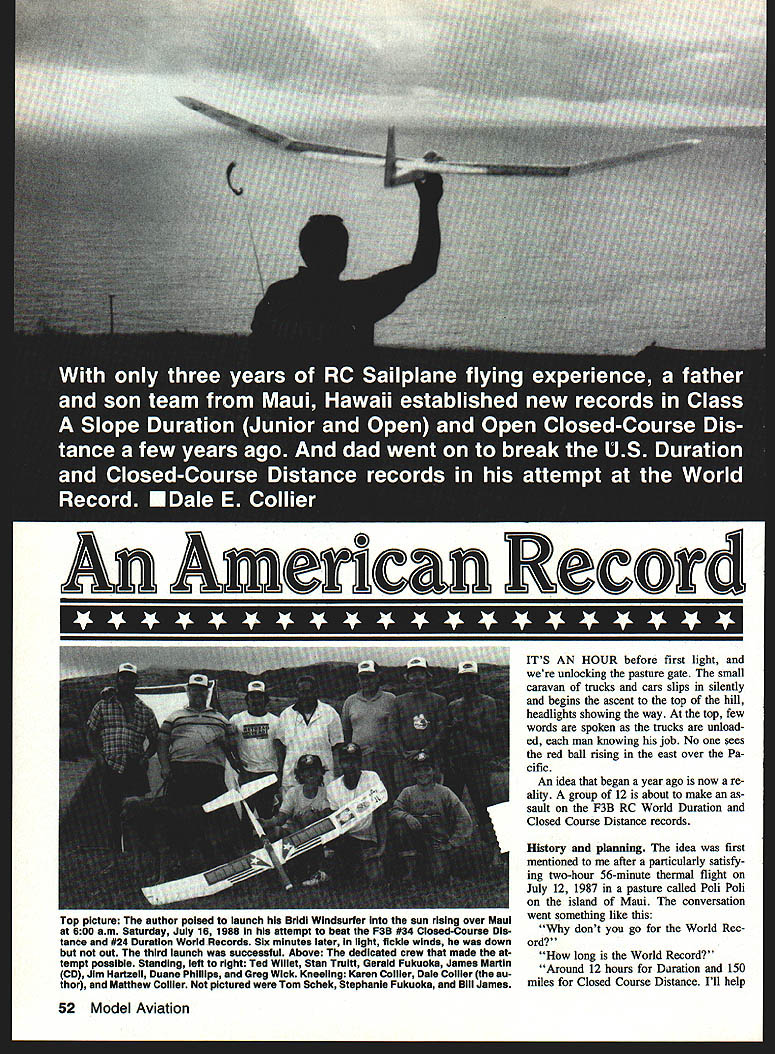
IT'S AN HOUR before first light, and we're unlocking the pasture gate. The small caravan of trucks and cars slips in silently and begins the ascent to the top of the hill, headlights showing the way. At the top, a few words are spoken as the trucks are unloaded, each man knowing his job. No one sees the red ball rising in the east over the Pacific.
An idea that began a year ago is now a reality. A group of 12 is about to make an assault on the F3B RC World Duration and Closed Course Distance records.
History and planning
The idea was first mentioned to me after a particularly satisfying two-hour 56-minute thermal flight on July 12, 1987, in a pasture called Poli Poli on the island of Maui. The conversation went something like this:
"Why don't you go for the World Record?"
"How long is the World Record?"
"Around 12 hours for Duration and 150 miles for Closed Course Distance. I'll help."
"You set it up."
"That doesn't sound that hard... Why not?"
And so it began—a simple idea based on erroneous information.
My son, Matthew, then 13, and I had been building and flying gliders together for about three years. We started with a used Super Malibu and radio equipment that had been loaned to us. I took the first flight. He took the second. We learned to fly at the "Epoxy School of Humility and Patience."
We have been crazy about flying RC gliders ever since, and a weekend doesn't pass that we don't take advantage of our island skies. A World Record attempt fit right in with my plans, since I was either flying or building during all my free time anyway. My wife long ago resigned herself to never seeing the beach again and has become our number-one crew member.
As a low-paid teacher at Maui High School, I knew I would need sponsoring support; so my first task was to identify potential sponsors. An article in the July 1987 Flying Models reporting on the 1987 WRAM show prompted me to write to 25 exhibitors. Incredibly, eight of the companies offered their support. From these I was able to select six manufacturers that I could put together as a team. Without their support the attempt would have been an impossibility. The fall was spent corresponding with the sponsors and planning for the materials I would need.
In early December of 1987 I contacted AMA Headquarters to clarify some of my questions and verify the records I was attempting to break. I was shocked to learn that they were American records, not World Records. The World Records were 33-plus hours for duration and over 700 kilometers for distance!
AMA Headquarters informed me that if I wanted more information on who held the records and how they were accomplished, it would request a dossier from FAI headquarters in Paris upon my payment of 250 French francs.
My dilemma was that I had asked for support from my sponsors for a World Record attempt. I could go back to them and explain that I had made a mistake, or change my plans and go for the World Record. I decided to go for the World Record.
I sent for only one dossier, on the assumption that the person who had stayed aloft for 33 hours and the individual who had flown 700 kilometers on the closed course were one and the same. As I'd later learn, that was an erroneous assumption. In the meantime I began to plan for an attempt to exceed the current World Record. My goal was 36 hours.
Design and construction
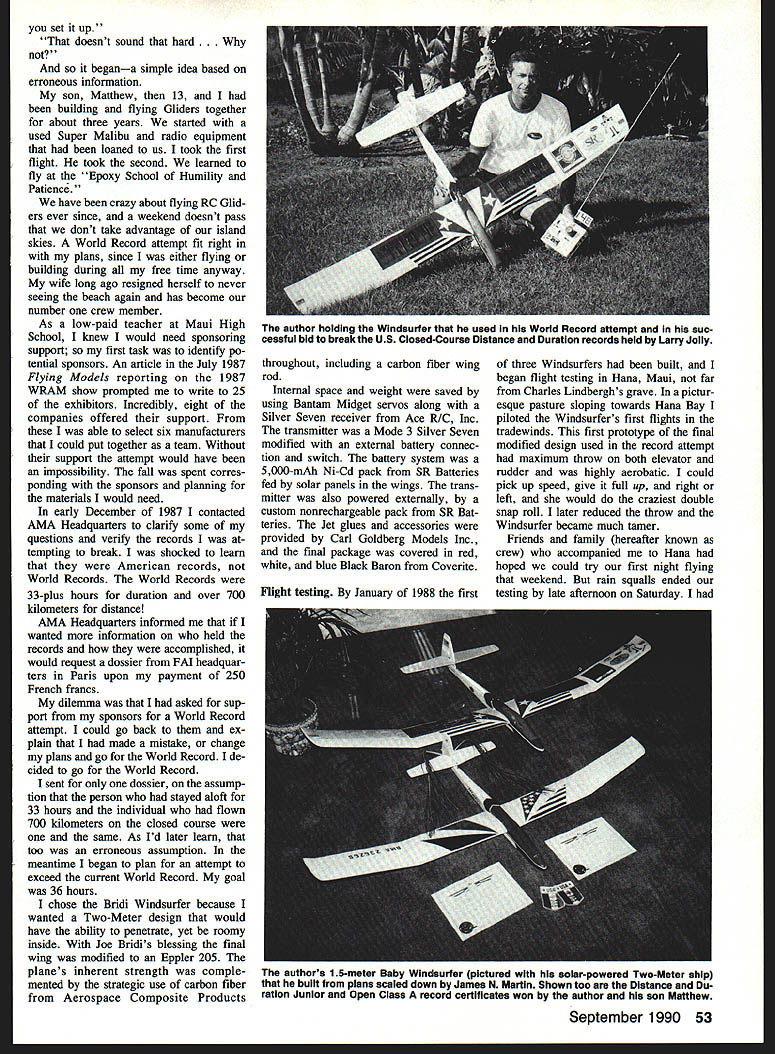
I chose the Bridi Windsurfer because I wanted a two-meter design that would have the ability to penetrate, yet be roomy inside. With Joe Bridi's blessing the final wing was modified to an Eppler 205. The plane's inherent strength was complemented by the strategic use of carbon fiber from Aerospace Composite Products throughout, including a carbon-fiber wing rod.
Internal space and weight were saved by using Bantam midget servos along with a Silver Seven receiver from Ace R/C, Inc. The transmitter was a Mode 3 Silver Seven modified with an external battery connection and switch. The battery system was a 5,000-mAh Ni-Cd pack from SR Batteries fed by solar panels in the wings. The transmitter was also powered externally by a custom nonrechargeable pack from SR Batteries. Jet glues and accessories were provided by Carl Goldberg Models Inc., and the final package was covered in red, white, and blue Black Baron film from Coverite.
Flight testing
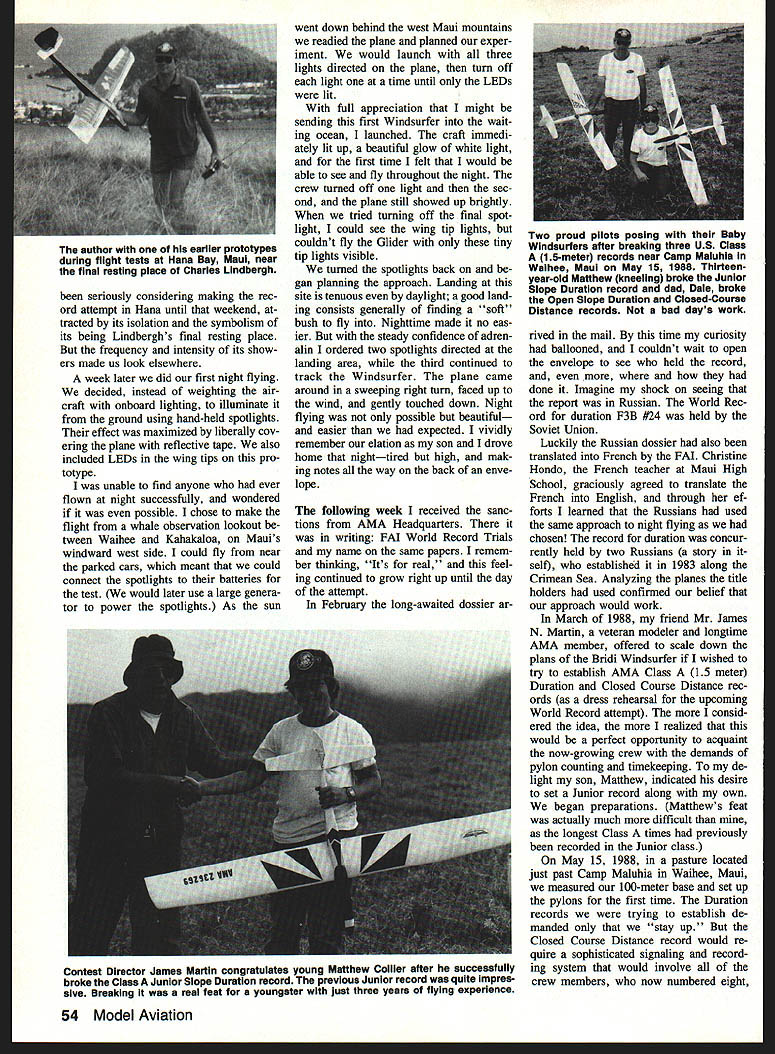
By January of 1988 the first three Windsurfers had been built, and I began flight testing in Hana, Maui, not far from Charles Lindbergh's grave. In a picturesque pasture sloping towards Hana Bay I piloted the Windsurfer's first flights in the tradewinds. This first prototype of the final modified design used in the record attempt had maximum throw on both elevator and rudder and was highly aerobatic. I could pick up speed, give it full up, and right or left, and she would do the craziest double snap roll. I later reduced the throw and the Windsurfer became much tamer.
Friends and family (hereafter known as crew) who accompanied me to Hana had hoped we could try our first night flying that weekend. But rain squalls ended our testing by late afternoon on Saturday. I had been seriously considering making the record attempt in Hana until that weekend, attracted by its isolation and the symbolism of its being Lindbergh's final resting place. But the frequency and intensity of its showers made us look elsewhere.
A week later we did our first night flying. We decided, instead of weighting the aircraft with onboard lighting, to illuminate it from the ground using hand-held spotlights. Their effect was maximized by liberally covering the plane with reflective tape. We also included LEDs in the wing tips on this prototype.
I was unable to find anyone who had ever flown at night successfully, and wondered if it was even possible. I chose to make the flight from a whale-observation lookout between Waihee and Kahakoloa, on Maui's windward west side. I could fly from near the parked cars, which meant that we could connect the spotlights to their batteries for the test. (We would later use a large generator to power the spotlights.) As the sun went down behind the west Maui mountains we readied the plane and planned our experiment. We would launch with all three lights directed on the plane, then turn off each light one at a time until only the LEDs were lit.
With full appreciation that I might be sending this first Windsurfer into the waiting ocean, I launched. The craft immediately lit up, a beautiful glow of white light, and for the first time I felt that I would be able to see and fly throughout the night. The crew turned off one light and then the second, and the plane still showed up brightly. When we tried turning off the final spotlight, I could see the wing-tip lights but couldn't fly the glider with only these tiny tip lights visible.
We turned the spotlights back on and began planning the approach. Landing at this site is tenuous even by daylight; a good landing generally consists of finding a "soft" bush to tip into. Nighttime made it no easier. But with the steady confidence of adrenaline I ordered two spotlights directed at the landing area, while the third continued to track the Windsurfer. The plane came around in a sweeping right turn, faced up to the wind, and gently touched down. Night flying was not only possible but beautiful — and easier than we had expected. I vividly remember our elation as my son and I drove home that night — tired but high, and making notes all the way on the back of an envelope.
The following week I received the sanctions from AMA Headquarters. There it was in writing: FAI World Record Trials and my name on the same papers. I remember thinking, "It's for real," and this feeling continued to grow right up until the day of the attempt.
In February the long-awaited dossier arrived in the mail. By this time my curiosity had ballooned, and I couldn't wait to open the envelope to see who held the record, and, even more, how they had done it. Imagine my shock on seeing the report was in Russian. The World Record for duration F3B #24 was held by the Soviet Union.
Luckily the Russian dossier had also been translated into French by the FAI. Christine Hondo, the French teacher at Maui High School, graciously agreed to translate the French to English, and through her efforts I learned that the Russians had used the same approach to night flying as we had chosen! The record for duration was then currently held by two Russians (a story in itself), who established it in 1983 along the Crimean Sea. Analyzing the planes and files the holders had used confirmed our belief that our approach would work.
Dress rehearsal: Class A records
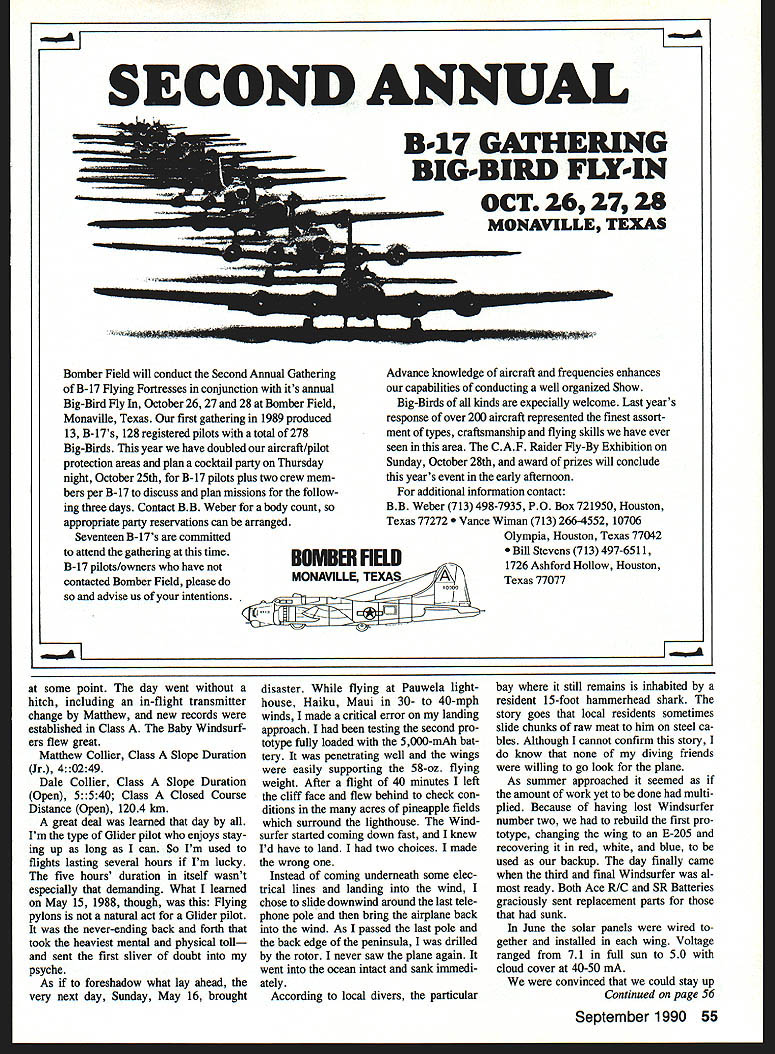
In March of 1988, my friend James N. Martin, a veteran modeler and longtime AMA member, offered to scale down the Bridi Windsurfer if I wished to try to establish AMA Class A (1.5 meter) Duration and Closed Course Distance records as a dress rehearsal for the upcoming World Record attempt. The more I considered the idea, the more I realized that this would be a perfect opportunity to acquaint the now-growing crew with the demands of pylon counting and timekeeping. To my delight my son Matthew indicated his desire to set a Junior record along with my own. We began preparations. (Matthew's task was actually much more difficult than mine, as the longest Class A times had previously been recorded in the Junior class.)
On May 15, 1988, in a pasture located just past Camp Maluhia in Waihee, Maui, we measured our 100-meter base and set up the pylons for the first time. The Duration records we were trying to establish demanded only that we "stay up." But the Closed Course Distance record would require a sophisticated signaling and recording system that would involve all of the crew members, who now numbered eight.
The day went without a hitch, including an in-flight transmitter change by Matthew, and new records were established in Class A. The Baby Windsurfers flew great.
- Matthew Collier, Class A Slope Duration (Jr.) — 4:02:49.
- Dale Collier, Class A Slope Duration (Open) — 5:54:40; Class A Closed Course Distance (Open) — 120.4 km.
A great deal was learned that day by all. I'm the type of glider pilot who enjoys staying up as long as I can, so I'm used to flights lasting several hours if I'm lucky. The five hours' duration in itself wasn't especially demanding. What I learned on May 15, 1988, though, was this: flying pylons is not a natural act for a glider pilot. It was the never-ending back and forth that took the heaviest mental and physical toll—and sent the first sliver of doubt into my psyche.
Loss and rebuild
As if to foreshadow what lay ahead, the very next day, Sunday, May 16, brought disaster. While flying at Pauwela lighthouse, Haiku, Maui in 30- to 40-mph winds, I made a critical error on my landing approach. I had been testing the second prototype fully loaded with the 5,000-mAh battery. It was penetrating well and the wings were easily supporting the 58-oz. flying weight. After a flight of 40 minutes I left the cliff face and flew behind to check conditions in the many acres of pineapple fields which surround the lighthouse. The Windsurfer started coming down fast, and I knew I'd have to land. I had two choices. I made the wrong one.
Instead of coming underneath some electrical lines and landing into the wind, I chose to slide downwind around the last telephone pole and then bring the airplane back into the wind onto the ridge. As I passed the last pole it struck the wing and the plane cartwheeled toward the ocean and sank immediately.
According to local divers, the particular bay where it still remains is inhabited by a resident 15-foot hammerhead shark. The story goes that local residents sometimes slide chunks of raw meat to him on steel cables. Although I cannot confirm this story, I do know that none of my flying friends were willing to go look for the airplane.
As summer approached it seemed as if the amount of work yet to be done had multiplied. Because of having lost Windsurfer number two, we had to rebuild the first prototype, changing the wing to an Eppler 205 and recovering it in red, white, and blue, to be our backup. The day finally came when the third and final Windsurfer was almost ready. Both Ace R/C and SR Batteries graciously sent replacement parts for those that had sunk.
In June the solar panels were wired together and installed in each wing. Voltage ranged from 7.1 V in full sun to 5.0 V with cloud cover, at 40–50 mA.
We were convinced that we could stay up.
The flight (July 16, 1988)
On Maui in July there is a 94% chance that the prevailing northeasterly winds, called tradewinds, will be blowing. The weatherman had predicted light to moderate trades of 10–20 mph for Saturday. Launch time was 5:55 a.m., Saturday, July 16, 1988. The winds were blowing 3 to 4 mph out of the east. Never having tried to fly this fully loaded Windsurfer in such light conditions, we didn't know if it could maintain its launch altitude on the ridge until the winds picked up, as we felt sure they would.
At 6:00 a.m. the breeze freshened to 6 mph and we launched, with cameras recording the moment for the scrapbooks. Six minutes later we were down, barely making the ledge, but intact. We'd try again.
At 7:00 a.m. the windspeed indicator read 7–8 mph, and we launched again. The heavy glider lumbered ever so slowly out and up. Working the cliff face back and forth methodically, it rose slowly on each pass. When the wind picked up a notch to 10 mph, we decided to man the pylons and start the closed course distance count. Each lap was 200 meters, with five making a kilometer. That meant we would take 3,655 laps to set a new World Record. The glider zigzagged back and forth, racking up laps as the clock moved toward our duration goal.
Forty kilometers and one hour 10 minutes later, the wind stopped. Within three minutes the Windsurfer was 20 ft. off the ledge and coming down. I said to one in particular, "What should we do? Go out?" Receiving no answer, I turned her out, away from the cliff face. The next peninsula with a sheer face to the "possible future" wind was my only hope.
I didn't make it. The plane caught a wing tip and spun to a halt, still in sight, over half a mile away and 500 ft. lower. The stopwatches recorded one hour 19 minutes. Miraculously the Windsurfer wasn't even damaged, although the antenna was broken. After a quick check we launched again and started counting laps. This time the thermals were in our favor. At 9:20 a.m. cloud streets formed out over the ocean and the glider gained altitude quickly, then dropped back on the ridge. Every lap showed improvement and by 10:00 a.m. we had passed the 100-lap mark and the ship was cruising.
My lowest moment came within the next few minutes. As we launched for the third time, my tether to the external transmitter battery pack disconnected. I now had a 58.5-oz. solar free flight. The plane made a slow, rolling turn to the left and disappeared around the side of the hill followed by running crew members. No words were spoken. The minutes seemed like hours, until finally word came back that the plane had been found and was OK. We made a thorough check of all systems, taped her up again, and relaunched for the fourth time at 9:26:20 a.m. Hawaiian Standard Time.
The hours that followed saw very light winds of 10–15 mph with numerous lulls. The lift came in cycles, and we could predict its intensity and duration by watching the windlines on the water and the cloud movement overhead. We averaged 14–30 kilometers per hour from late morning into late afternoon. On four occasions we were within one turn of putting the plane down when the wind died, but were saved each time by hitting thermal-like wind funnels in the ravines that run on both sides of the hill. We were able to stand the Windsurfer on her wing tip and circle in the lift. The joke of the day became, "Go to the well (in the ravine) and we'll be good for another 10 kilometers."
When we had altitude we were regularly joined by soaring birds. Small, white, long-tailed tropic birds or koa'e kea, sometimes called ahi birds because their presence indicates good fishing, tracked our sailplane in the morning. A large black frigate, or 'iwa, with a wingspan of 90 inches, followed our plane at a menacingly close distance for several minutes in late afternoon, finally tucking pterodactyl-like wings and diving aggressively at the Windsurfer. We resorted to doing some aerobatics, which the bird decided not to attempt, leaving the sky above our ridge to the "strange bird that flies upside-down." In the early evening we were joined by several Hawaiian owls, or pueo. They sometimes flew higher, but not without flapping.
As day merged into night, we realized that a new American Closed Course Distance record might be ours if we continued to run pylons into the night. This hadn't been our original plan, since we'd felt it would demand too much of crew and pilot. But because of our late start it was our only chance to surpass the record that day. (There were no guarantees that we would be flying in the daylight hours on the next day.) We calculated that we'd need to run pylons until 8:15 p.m., or about one hour into the darkness.
The twilight minutes that separated day from night were the hardest. We could barely make out the silhouette of the plane against the graying sky and blackening ocean backdrop. The hand-held spotlights weren't yet effective in this half-light, and the crew manning the lights couldn't pinpoint and follow the speeding glider as it crossed back and forth between the pylons.
Even though the plane had been well covered with reflective tape and had LEDs in the wing tips, we were still losing sight of it on nearly every turn. Everyone felt the tension. Small talk ceased. Twice I got crossed up and almost put it into the ground. We were only flying "one mistake high" because of the spotlights and were moving very fast, the wind having picked up considerably. Finally, the word came up from pylon number one that we had exceeded the previous distance record by two percent, and could stop running the pylons. This was a great moment. Everyone took a deep breath.
I immediately headed the plane into the wind so that it would hover and be easier for the spotlights to pick out. The problem now wasn't lack of lift but too much lift, and we were soon at the cloud base, 1,000 ft. directly overhead. When the clouds occluded the plane, the reflective tape/spotlight combination ceased to work and the plane began to disappear again. With over an hour to fly until we reached our next mark, the American Duration Record of 11:58, it was clear that we weren't going to be able to do it this way.
What I would have given then for a pair of spoilers. Needless to say we hadn't included them in our plans, which left us with some less-than-ideal ways to lose altitude. Earlier daytime flights had shown that the plane's spin was so violent that it threatened the structure. The best method I'd discovered for coming down steadily without stress had been to fly her inverted, but I couldn't do this at night with so little reflective tape on the wing's upper surfaces.
I chose to stall, spin twice, then fly her down. Everything held together, and there were no telltale snaps or cracks. We were soon back to "one mistake high" altitude, flying quickly back and forth over the cliff face, where we could clearly see the plane. If we lost the glider with the spotlights at this point, I planned to spin her in, wherever she was, and hope we were within the maximum landing distance of 300 ft.
The hour passed, and we knew we had the second American record in the bag. Our strategy all along had been to concentrate on one record at a time. Just as we were settling in for a long night of spotlight flying, the wind suddenly gave out. It had grown increasingly strong throughout the evening. Now it abandoned us entirely. After making two more passes at the cliff's edge, it became apparent that I'd have to either land or lose the plane. The crew directed two spotlights at the landing area while the third continued to track the plane. I turned out one more time and found the air perfectly still. The wind, after toying with us all morning and threatening us again with failure in the afternoon, now ended our flight. The plane landed at 9:34:24 p.m. HST, 12:08:04 into the flight. Our World Record attempt had fallen short.
Caught by surprise at the unexpected landing, half the crew came running to see what had happened. But when we all realized what we had accomplished, we were less upset by what we hadn't. Champagne was opened, toasts were raised, and laughter and excited talk filled the night.
We had accomplished our original goal that had begun as an idea just a year earlier. And we had earned every minute and meter of it on a day which was clearly not intended for World Records.
Thank yous and final thoughts
I have learned that no record can be accomplished alone. I would like to thank the following people for giving their time and/or products toward this goal:
- Joe Bridi, Bridi Aircraft Design, Inc.
- Tom Runge, Ace R/C, Inc.
- Art Kramer, Coverite
- Larry Sibrinck
- SR Batteries
- George Sparr, Aerospace Composite Products
- Frank Bachenheimer, Carl Goldberg Models Inc. (sponsors)
Crew and contributors:
- Gerald and Stephanie Fukuoka
- Stan Yamato
- Greg Wick (photographs)
- Tom Schek
- Duane Phillips
- Jim Hartzell
- Stan Truitt
- Ted Willet
- Dr. Bill James
- Karen and Matthew Collier (crew members)
- Chris Wayne (photography)
I know of few other endeavors that are as enjoyable or that offer the challenges and opportunities found in flying R/C sailplanes. My son and I had been building and flying together for only three years. When we started out, we didn't know why an airfoil creates lift, the difference between an amp and a volt, or how to make a good solder joint. Three years later, we had both accomplished national records with the help of many new friends.
The spirit of model aviation is strong. We can't wait to make it to the Nats someday. Thanks, AMA.
Editor's note
In the years since 1988, the Collier family has not been idle. On May 7, 1989, Dale Collier established a new Class A Open Altitude record of 1,812.8 feet. On the same day his son Matthew set new Class A and B Junior Altitude records of 1,887.5 feet.
Transcribed from original scans by AI. Minor OCR errors may remain.

