
ANALYSIS OF A CRASH
Don Brooks
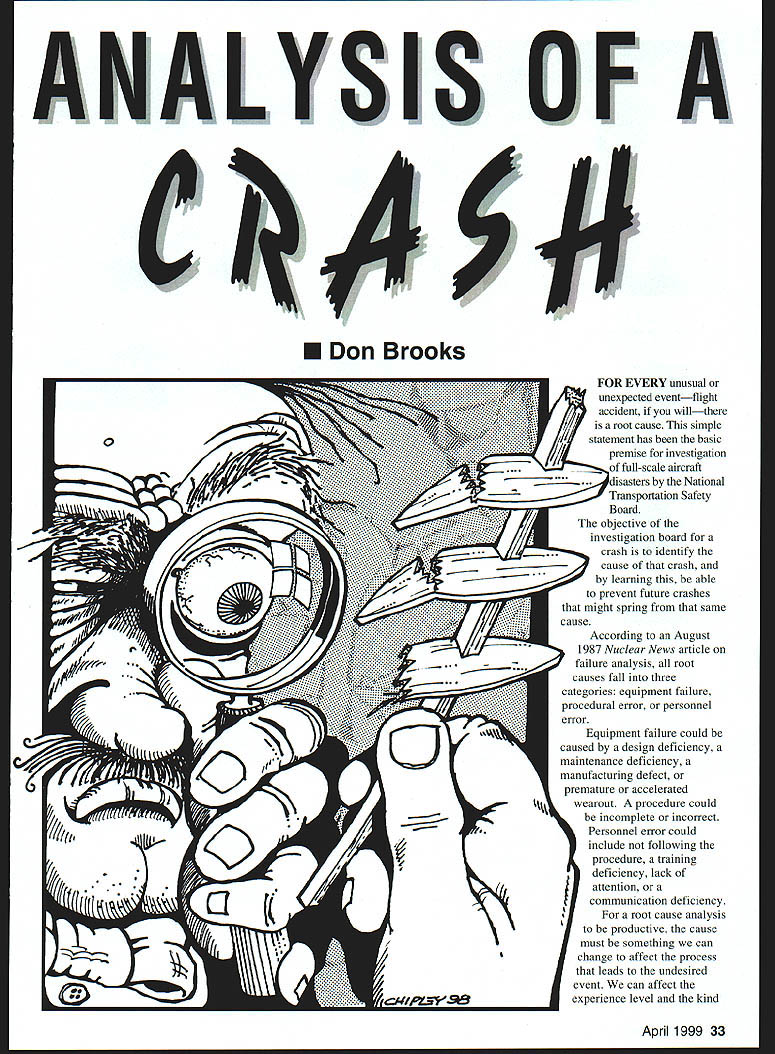
For every unusual or unexpected event—flight accident, if you will—there is a root cause. This simple statement has been the basic premise for investigation of full-scale aircraft disasters by the National Transportation Safety Board.
The objective of an investigation board for a crash is to identify the cause of that crash, and by learning this, be able to prevent future crashes that might spring from that same cause.
According to an August 1987 Nuclear News article on failure analysis, all root causes fall into three categories: equipment failure, procedural error, or personnel error.
- Equipment failure could be caused by a design deficiency, a maintenance deficiency, a manufacturing defect, or premature or accelerated wearout.
- A procedure could be incomplete or incorrect.
- Personnel error could include not following the procedure, a training deficiency, lack of attention, or a communication deficiency.
For a root cause analysis to be productive, the cause must be something we can change to affect the process that leads to the undesired event. We can affect the experience level and the kind and amount of training, for example. We cannot change human nature; humans do make mistakes.
So the root cause we seek must be some unique factor or action that, if present or accomplished, could have prevented the event. And this unique something must also be something that is within our power to change.
Since I became an AMA Intro Pilot Instructor, I have prevented the certain destruction of a flying model many times—too many to count. Students make many errors in the early flying sessions.
In two years of instructing five students, an aircraft has been damaged only once. In that instance, I not only failed to prevent damage to the model, I actually made the damage to the model worse than it would have been had the student been flying by himself.
I repaired the shattered wing and we flew the model again the next weekend, but this event can bear scrutiny under the same examination premise as used for full-scale aircraft accidents. What one thing, if changed, could have prevented this crash?
Why analyze a crash?
One might ask, "Why worry about it? Why spend any time trying to analyze a crash to death? A crash is a crash!" There are several very important reasons.
- Safety of pilots and observers is the first and primary reason. There is risk with any flight operation; one of the obligations of any RC pilot is to conduct flight operations such that the safety risk is minimized and the safety of persons and property is not compromised. AMA members sign a statement indicating that they will abide by the AMA Safety Code. Any crash places the aeronauts and the bystanders observing flight operations at risk of injury. Prevention of future crashes from the same root cause enhances model flight safety.
- Preventing damage to a fledgling pilot's aircraft while he or she learns is a second important reason. There is an unwritten contract with a beginning flying student that the likelihood of destroying his or her aircraft is much less if he or she spends the extra $100 or so and joins the AMA and the local flying club for the purpose of learning to fly. Otherwise, the beginner might well think, "Heck, I can crash this airplane on my own, and for no additional cost."
One of the innovations by which the AMA has tried to increase safety of persons and of the model being flown is to insist on the use of a buddy box for flight instruction in the Intro Pilot program. Use of a buddy box makes the transition from student to instructor control instantaneous and at the discretion of the instructor.
This was not necessarily the case in the old days, when the transmitter box had to be handed off or wrenched away as the case may be. Preventing crashes of a beginner's aircraft enhances enjoyment of the hobby and relieves the instructor of rebuilding models he doesn't own.
- The third reason is that others may learn lessons from the unusual event, i.e., crash, and prevent similar problems of their own. This third reason is the cause of my writing here.
Preflight practice and the buddy box
I like to fly whatever aircraft the fledgling pilot brings to the field, as long as it is structurally and aerodynamically sound. I use the student's aircraft, rather than mine, because the students enjoy the learning more by seeing their own aircraft go airborne.
Before going to a buddy box training flight, I test-fly the student's airplane by myself to become familiar with the aircraft's flight characteristics and to make sure that the aircraft is sound. I also use the student's radio equipment. I have several different buddy cord combinations that allow me to hook up one of my radios to almost any system the students brought.
One of my students brought a very attractive Almost Ready to Fly (ARF) model to the field for his instruction. He had progressed well through the initial stages of the flight training, was able to make level turns and figure-eights, and could fly the traffic pattern. He was flying landing approaches with increasing skill. So it was time to let him go all the way for the landing.
We discussed taking the final approach all the way through touchdown, including lineup, flare, control during the transition from flight to ground contact, and shutting off the engine if necessary after the aircraft was on the ground. For these landing approaches, I preset the throttle stick on my master control box to full power for a potential go-around, should it be needed to abort the landing attempt. I had made five or six "good saves" in aborting missed approaches on this particular day to keep his aircraft from harm. I felt confident that no matter what he did, I could take care of the problem.
Little did I know. His next landing approach looked good, but his turn onto final was a little short of 90°. Combined with the light crosswind, it left the model headed at an angle across our 100-foot-wide runway. The touchdown was good, but when the student pulled the throttle all the way back on the buddy box, the engine would not die.
When I released the trainer switch to take control of the model, my throttle stick was still preset to full throttle for a go-around. The engine roared back to life, the airplane accelerated, and before I could kill the engine with the master control, the left wing struck a vertical irrigation pipe marker at the edge of the runway, severely damaging the wing panel. It wasn't pretty, and I wasn't sure that I could repair it. After all, ARFs don't come with plans.
Root cause analysis method
In root cause analysis, one describes an observable effect and asks "Why?" to identify the cause(s) of the effect. That cause becomes the next effect to which the "Why?" question is posed, and so forth.
I have assigned each effect/cause item a number, so each item can be tracked through the process. We continue this process until each item becomes an original cause that we can correct. The root cause is that item which, if corrected, would have prevented this event and will prevent future such events.
It is possible that there could be one or more contributing causes, but there must be only one root cause.
Effect / Cause analysis
Effect: 0) The aircraft struck the stake.
- Cause(s): 1) The aircraft was on the wrong heading. 2) The engine would not shut off.
Effect: 1) The aircraft was on the wrong heading.
- Cause(s): 3) The student made no rudder correction on final approach to change the heading. 4) The instructor did not correct the faulty heading.
Effect: 2) The engine would not shut off.
- Cause(s): 5) The slave transmitter throttle control would not close the throttle sufficiently.
Effect: 3) The student made no rudder correction on final approach to change the heading.
- Cause(s): 6) Previous flight training had not emphasized using the rudder.
Effect: 4) The instructor did not correct the faulty heading.
- Cause(s): 7) The instructor failed to follow the correct landing procedure.
- This was a procedure error. The instructor did not follow the correct landing procedure nor ensure that it was followed throughout the approach. Experience is a factor but not critical to the item. This is only a contributing cause. If the engine had shut down properly when commanded by the student, the airplane would have coasted safely to a stop on the runway.
Effect: 5) The slave transmitter throttle control would not close the throttle sufficiently.
- Cause(s): 8) No preflight verification was made that the slave transmitter would kill the engine.
Effect: 6) Previous flight training had not emphasized using the rudder.
- Cause: 9) The flight training program did not call for practice flying with rudder vs. aileron.
Item 9 is an original cause that can be changed. A correction was made to the flight training program to have the student fly the landing pattern with rudder only and then with rudder and aileron, rather than relying on the aileron alone. This gets the student used to the feel of the rudder stick and the reaction of the airplane to his rudder input and makes for much-improved flying on the approach path.
I made this change in subsequent flight sessions that involved shooting landing approaches. The following week, my student pilot made four almost-picture-perfect landings right down the runway centerline using the rudder as the primary directional control for the approach. I also incorporated use of the rudder earlier in my own flight training sequence.
This item was a contributing cause to the accident, but not the root cause.
Would a better heading have prevented the accident? The answer is only "maybe." The throttle was still too high when the slave transmitter throttle stick was at idle. The accident may have happened at some other location on the field.
Effect: 7) No preflight verification was made that the slave transmitter would kill the engine.
- Cause: 10) The preflight checklist was incomplete (root cause).
Item 10 is an original cause: the preflight checklist was incomplete. The preflight checklist is something that can be changed; had the student been able to lower the throttle setting fully, the airplane would have coasted to a safe landing off-heading or not in the 100-foot-wide runway.
Further, this is the root cause. The proper functioning of the slave controller throttle control, if verified during the preflight, would have prevented the accident. There would have been no need for the instructor to take control of the aircraft, and the sequence of events would have stopped with the aircraft on the wrong heading but safe on the runway.
Sequence of events that led to the accident
- The preflight checklist was incomplete (root cause).
- As a result, no preflight verification was made that the slave transmitter would kill the engine.
- As a result, the slave transmitter throttle control would not close the throttle sufficiently.
- Therefore, the engine would not shut off.
- As a result, the aircraft struck the stake.
The corrective action for the root cause was to incorporate a verification in my preflight checklist that the slave transmitter is indeed set up the same as the master in both direction of movement and in capability to shut off the engine.
Contributing causes summarized
- Contributing cause: The flight training program did not call for practice flying with rudder vs. aileron.
- Therefore, previous flight training had not emphasized using the rudder.
- As a result, the student made no rudder correction on final approach to change the heading.
- As a result, the aircraft struck the stake.
- Contributing cause: The instructor failed to follow the correct landing procedure.
- Therefore, the instructor did not correct the faulty heading.
- As a result, the aircraft was on the wrong heading.
- As a result, the aircraft struck the stake.
This lack of action by the instructor was an error in judgment in failing to follow the correct landing procedure and making a tradeoff between two goals (maximizing training value and minimizing risk). Each contributing cause, although not sufficient to result in an accident by itself, decreases the margin for error and brings us closer to an accident.
Conclusion
Whether you're a pilot, instructor pilot, or student, you can use this simple approach to failure analysis as a tool to examine your few model crashes, to better learn from these occurrences, and to prevent repeating mistakes. Good flying!
Don Brooks 900 Bower Dr. Idaho Falls, ID 83404
Transcribed from original scans by AI. Minor OCR errors may remain.

