
Up and Around
George M. Aldrich 12822 Tarrytown, San Antonio, TX 78233
Introduction
If you're an Old-Timer Free Flight or Control Line buff, this is your column. Whether I'm focusing on models, engines, products, or events, my goal in writing this bimonthly column is to help you have more fun with the facet of modeling you enjoy most.
Competition and the AMA
Technical Director Bob Underwood really got my attention with a survey that revealed that less than 10 percent of the membership entered an AMA event last year. If more than 90 percent of our members entered no events at all, why are they in the AMA? Is it for the insurance alone? I don't believe that, any more than I believe that the average modeler (who apparently never enters a contest) should dismiss the value of competition.
Competition is the "Research and Development Center" of our industry. It's how we get better engines, props, radios—and, yes, better-flying models and the accessories for them.
What Bob's survey does tell me is that the main focus of our association has changed from my highly competitive days of the 1940–1970 era. The word association is important here, for our strength lies in the relationship of modeler to modeler. Our AMA will remain strong as long as we relate to one another in a manner that appeals to the majority.
Having committed every sin in the high-competitionitis book, I'm ready to share some ideas not only about how to do things better but also about how to have more fun doing them. And it's the fun that I want to stress. It's just possible that in our fast-paced, highly competitive workaday world, many—or most—of us turn to our models for relaxation. We want to get away from the "winning is the only thing" mentality. We want to get out of the attack mode for a breather.
Personal beginnings
It may seem strange to some, but my own roots go back to Free Flight. I wasn't quite two years old when my big brother Oliver fired up his Brown Jr. #201B and launched his twin-boomed pusher. That huge black-and-silver ship centered an ebony tree, demolishing it, as I sat in my mother's lap.
That was in 1934, and I've loved model airplanes ever since. It was like being in a dream world, the equivalent of meeting all our famous astronauts today. As a 16-year-old I met so many famous modelers that until then I had only read about; it was hero week for sure. I met Carl Goldberg, Bill Winter, the late Carl Smith, flew with Bob Palmer, held Dick Korda's rubber job, and watched Ted Enten do 10-minute maxes with his Gool. I've always attributed my going on to design my own models and winning in national competition to my association with such great people.
Old-Timer and Nostalgia interests
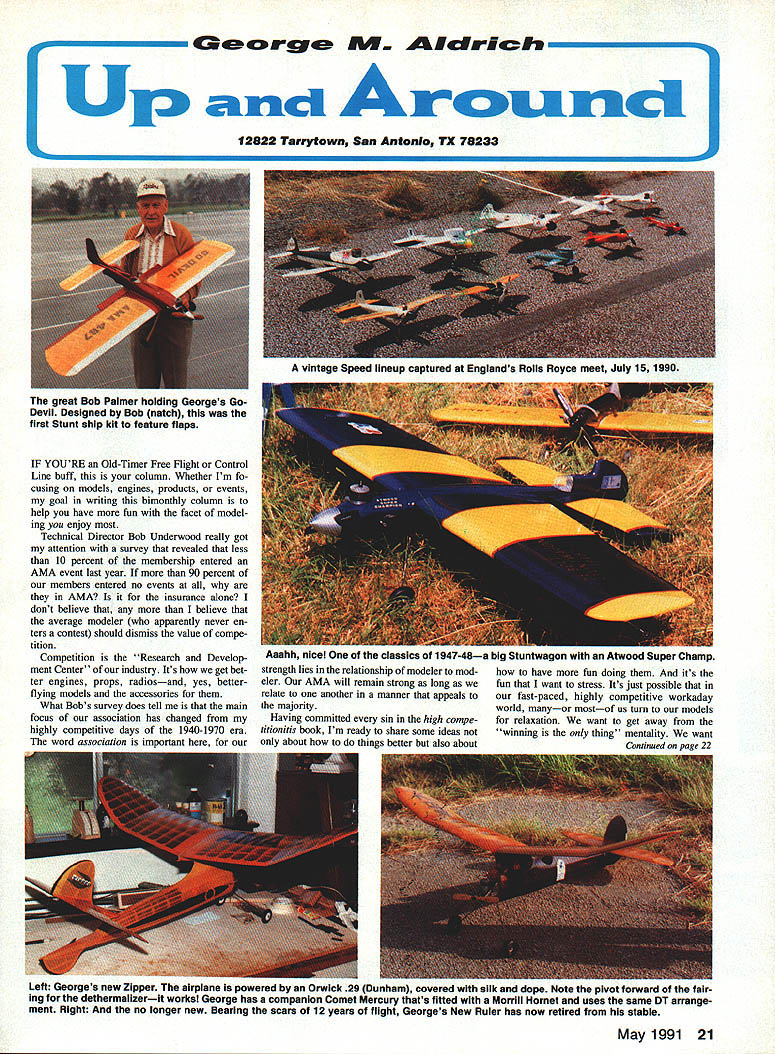
For the past 12 years, my main interests have been the building and flying of Old-Timer and Nostalgia Free Flight and Control Line models—and, of course, the engines that power them. From Bill Skipper's Acrobat and Bob Palmer's Go-Devil to Goldberg's Zipper and Struck's New Ruler, these past years have been more pure fun than all the rest put together. There's no denying it—much of the enjoyment has come from building or rebuilding models that I lacked the patience, or talent, or money to build in my youth.
Di-Dope, Flite Streak, and offset engines
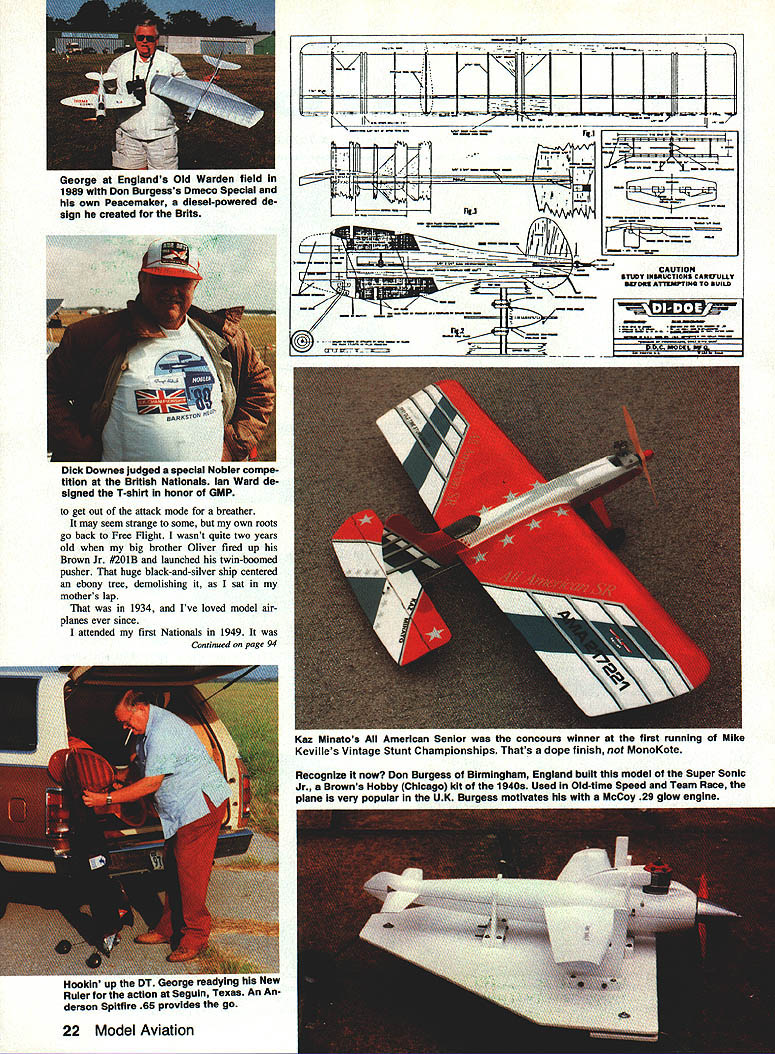
One design on my agenda this year is a fun Stunt ship and old Pats winner, the Di-Dope biplane. This is one you can fly in most any weather. What really makes it unique is the engine offset—something like 15 degrees! Talk about tight lines—you can fly in just about any wind. Howard Thorns flew two at the same time without any engine control.
Back in the late 1950s I adapted this large-offset feature to one of my Flite Streaks, powered by an Oliver Tiger .15 diesel. It flew in 45-mph winds and had no problems with slack lines. But the trick feature of the Flite Streak was its ability to stay on the lines when stalled, to the point that it could hang stationary at times. Often my helper would catch it, refill the tank, and turn it loose again.
I recently finished a couple of Flite Streaks, utilizing the original construction to keep the weight down. The improved performance was well worth the effort, and line tension, even with 60-ft. standard wires, is no problem. If there is any interest, I can prepare a sketch showing how the original Streak's wings were built. For ease of construction, I changed the kits quite a bit—particularly the V-2A version, in which I took four bays out of the wing. Once a hot Combat ship, the Flite Streak becomes a real blast to fun-fly with less power up front.
Ignition engines and modern batteries
How many of you have operated a spark-ignition engine? Or wanted to, but never understood all that "finky" wiring—points, coils, etc.? The one big difference between running an ignition engine 40 years ago and running one today is the batteries. Whether alkaline or Ni-Cd, today's batteries take most of the frustration out of ignition operation. With the help of some friends over the years, I developed a transistorized circuit that brings the entire ignition system to as little as 2.8 oz., including a 3.6-volt Ni-Cd pack. Perhaps a diagram and a couple of pictures would be of interest.
Covering and dope problems
A few years ago, some young local modelers came by while I was covering one of my Stunt ships for Mike Keville's first Vintage Stunt Championships. Before long, I realized that my audience was transfixed; they'd never seen anyone cover with silk-and-dope or tissue-and-dope before.
Is covering with dope really becoming a lost art? Covering has always been my favorite part of modeling, so using Japanese tissue, silkspan, silk, and the right kind of dope is second nature to me.
I've been buying Randolph dope from my local aircraft supply house for over 30 years, but recently have been experiencing some problems. I'd heard rumblings from several sources about clear coats of butyrate peeling off when sprayed over colored coats. Sure enough, as I started repainting my Nobler #1 (a replica of the original model) the clear coats began separating from the color in an irregular manner. Then as I started refinishing, the talc-and-dope filler cracked—both in splits and in a checkered pattern.
The filler was brushed on over clear coats of dope—the same dope used in the filler. This prompted me to call Randolph, where I spoke with a Mr. Henshaw. What I learned was anything but satisfying. It seems that eight or nine years ago the EPA (Environmental Protection Agency) mandated formulation changes, but failed to explain them fully. All Mr. Henshaw could tell me was, "You can't put our clear over our colored butyrate!"
I had another reason for calling Randolph. Back in the early 1960s, in an article on one of my Stunt designs, I recommended using Randolph's non-tautening butyrate in the filler areas to eliminate the blistering that is normal with butyrate dope. I described it something like this: "It has all the shrinkage of chicken gravy—it just lies there!" Mr. Henshaw could not explain why Randolph silk dope is no longer available. What this means to us CL modelers is that it may pay, in the long run, to look into acrylic lacquer automotive finishes or one of the epoxy systems. I'm deep into this problem and will share my findings.
Flying field, safety, and noise
My local club, the Tri-City RC, which includes Free Flight and Control Line fliers, is most fortunate in having an auxiliary AFB as a flying field. It's located in a fairly remote area, so noise isn't much of a problem. But safety and cleanup of the area were prime concerns; we use a dominant theme whenever we fly. The RC area is marked off and all safety provisions have been made.
For safest launching, the competition FF fliers station themselves according to the wind direction and park their cars across the runway they will be using. Those of us who fly Old-Timer Free Flight set up in another area and park so that we have the grass downwind of the runway. We can then walk out on the pavement or ramp and ROG into the wind. If we parked our cars on the upwind side of the pavement, we'd be launching our models straight at the vehicles! This problem hasn't been addressed by the AMA, and often a site is set up that—contest or not—is potentially dangerous.
For those of you who must hold noise to a minimum, some sort of muffling device is mandatory if you're going to keep your flying site. I once worked for a family-owned business, and the father and son boasted of shooting at the models flown in the park behind their home with 12-gauge shotguns. We who love control line have an extra cross to bear—the reverberations caused by the Doppler effect make our flying noises even more irritating. How well I remember when, 30-odd years ago, Britain's governing body put in a universal muffler rule and the doomsayers predicted the death of modeling. Obviously, that didn't happen. In fact the first mufflers I was able to buy came from the UK in 1963.
Diesels and fuels
If you haven't tried a diesel, you're missing a big treat. It's really a toy to go out and fly with only a fuel bulb. Once you've mastered the simple starting procedure, the diesel's steady power is a real bonus. And these engines are much quieter. I once wrote, tongue-in-cheek, that diesels aren't as popular as they might be in the U.S. because they stink. I said it to provoke a response and got more than I'd bargained for. To this day, a close friend in the UK teases me about ordering more "stinkers."
A wealth of diesels is imported today, and at least two major fuel blenders offer good fuel on a regular basis. My own stable grows each year as more interesting models are found. And at last, two manufacturers are working on engines in the .40–.60 cu. in. range. Of course, we also have the Davis Diesel conversions.
WD-40: use and misuse
Over the past few years, recommendations for WD-40 have appeared in various publications. I use WD-40 in my shop. It's excellent as a rust preventive for machines, tools and ferrous metal parts. But I never put WD-40 in a model engine. I learned that the hard way.
One day I pulled out a McCoy .60 that had been sitting in my display case for several years. It had been liberally sprayed with WD-40 before being put on display. After putting in a prop, I found that the engine was frozen solid. It took over a week's soaking in kerosene in my garage and a lot of other work to loosen up the engine enough to get it apart, followed by a few more hours to remove all the caked and dried WD-40 from the inner surfaces.
Another time, a good friend and Pattern flier noticed a power loss in his .61 engine. When he took it apart, he found the cylinder wall covered with a blackened varnish. It seems that after each day's flying, my friend would pull off the fuel line, squirt a generous shot of WD-40 in the venturi and exhaust, then hook up the starting battery and fire the engine to run out the excess WD-40. Since the carrier in this fluid is a volatile, it burned readily and baked the residue right onto the cylinder wall—like instant varnish!
Scotch-Brite and after-run lubrication
Speaking of varnish, let me tell you about a neat product that's the best I've found for cleaning varnish or other residue from engine parts. Made by the 3M Corporation, it's known as Scotch-Brite and is available at most auto paint stores. It comes in three colors:
- cream (coarse)
- dark red (medium)
- greenish-gray (fine)
I seldom use anything but the fine grade, which is adequate for all but the toughest jobs. Small engines like the Cox can be devarnished even without removing the engine from the model. Simply remove the cylinder and swab it with a piece of Scotch-Brite wrapped around a pencil or piece of doweling. Polish the piston lightly with another piece of Scotch-Brite, wash both parts with a bit of fuel, wipe clean, reassemble, and you're ready to go again.
For an after-run lube, I've used Rislone upper-cylinder lube for over 25 years with perfect results. A few drops in the venturi, three or four drops in the exhaust, flip the prop a few times, and you're protected until the next flying session. I use the standard product, not the concentrate. It comes in a yellow quart can and is available for $2 or less at your auto supply store.
Engine R&D and fuel observations
This past summer I did R&D on a number of projects, primarily with engines running on gasoline fuel. Two rather important findings emerged.
- Gasolines vary quite a bit.
- The old 70-weight SAE petroleum lube gives the best protection for our two-cycle engines.
An engine that refused to run more than 30 to 45 seconds on 25% castor oil without badly overheating would run out the whole tank with a 25% 70-weight lube mix. I'm now convinced that the reason so many engines manufactured between 1933 and 1948 are still around is that 70-weight oil was the commonly used lubricant.
I've found that a 92-octane unleaded gasoline works well in my area. Coleman or similar lantern fuel also gives consistent results, though it's a bit more expensive. Gasohol, which is usually 10% ethanol, will eventually attack plastic tanks.
Unfortunately, since 70-weight oil will not mix with methanol, our standard glow-fuel ingredients—methanol and nitromethane—are incompatible with that lubricant, so we're stuck with castor oil as second best. If you want your engine to last longer, always use some castor oil. My Stunt fuel is usually 28% castor, and never below 25%.
Contact
When you write, please enclose a SASE. If you do, I'll always answer. I will accept phone calls, but please don't call if writing will suffice. I do have a business to run.
Address: 12822 Tarrytown, San Antonio, TX 78233 Telephone: 512/656-2021
Transcribed from original scans by AI. Minor OCR errors may remain.

