
Up and Around
As this is written (late March), I am still on a pretty nice high after attending the Vintage Stunt Champs III in Tucson, Arizona on March 23–24. If any of you doubt that there is greater power in this hobby, let me assure you there is: it was great to see so many stunt fliers. The Thursday before the meet we drove through a blizzard, then awoke the next three days to beautiful, windless, sunny flying weather.
The events and happenings will be ably covered elsewhere, but I would like to present some thoughts on why Mike Keville's brainchild has been such a success from the start. From the outset these reunions have created instant flashbacks to the premier days of CL. For most of us, to compete again among models and old friends who had a very strong effect on the type of people we became is reason enough for going. Winning is great, but it never replaces friendships made over the years. There never was a trophy worth a friend.
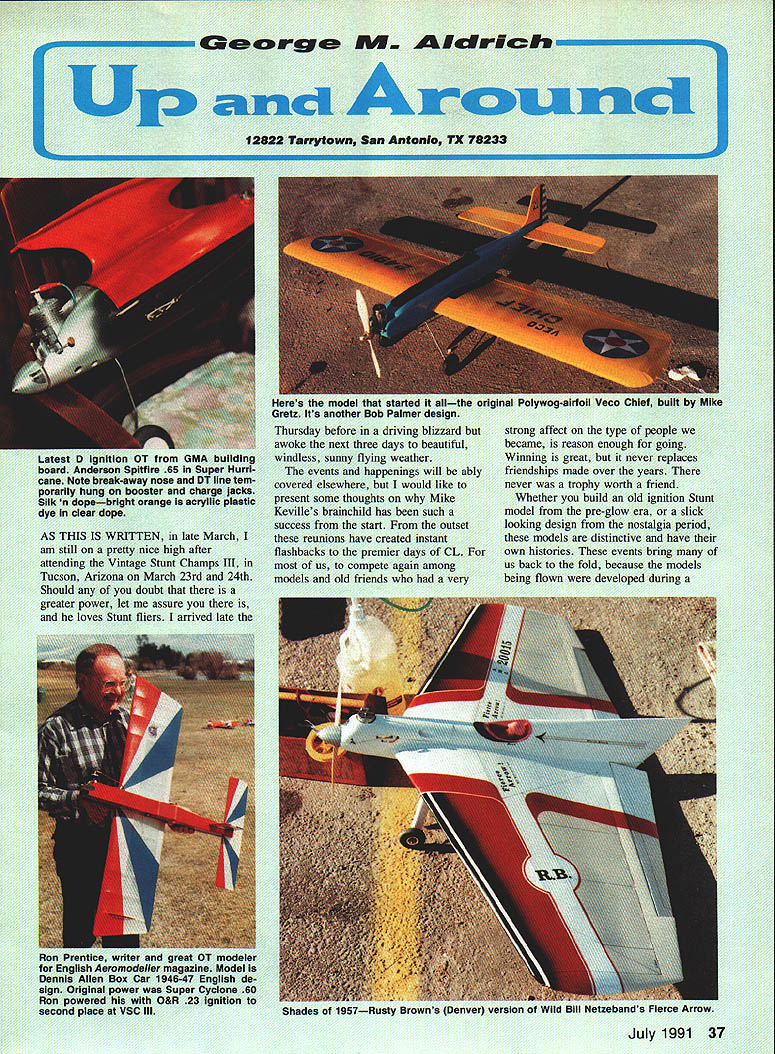
Whether you build an old ignition stunt model from the pre-glow era or a slick-looking design from the nostalgia period, these models are distinctive and have their own histories. These events bring many of us back to the fold, because the models being flown were developed during a period of rare activity.
Not at all unlike the SAM preamble, there can be no reason to re-prove what is already history, nor to advance the state of the art for a given period. Since it is not possible to change who won what during any year's competition, why should we want to change their designs? Vintage stunt of any kind is not a design contest. I would suggest that it is a glorious romp back through our formative years, taken at a time when we have the skills to construct — or the means to afford — models we were not ready for. It is an opportunity to relive the greatest times of our modeling lives.
This year a new thought was spawned at Tucson: how about a beginner's pattern? I was stunned; it suddenly dawned on me that this movement has attracted more than a bunch of old guys past our primes. After all, we can still fly most any pattern. The VSC events have attracted all sorts of new modelers, many of whom are interested in lower-key, less high-tech (yes), and less tenacious competition.
Since there is somewhat of an overlap between OT and Nostalgia designs, perhaps we need a class for less-experienced fliers to compete with Nostalgia/OT designs while flying the simpler OT stunt pattern.
While on the OT stunt subject, let me share some of the history of stunt. I have been writing on this topic over the past few years. If it proves popular here, I'll write a piece on the early days of CL in each column. In the beginning, Jim Walker gave his perpetual trophy for the highest points in stunt.
Up and Around / Aldrich
The problem was that there were two events — Novelty Stunt and Regular Stunt. Regular, I assume, was what we would now call Precision Aerobatics. Can anyone tell me what the novelty stunt rules were? Since Davey Slagle won the Walker Trophy three years in a row, I have to assume that Novelty Stunt was involved; as we know, he flew two models at once. I hope some of you who were active in the 1946–48 era can shed some light on this.
By 1950 the Novelty Stunt event was history. Both the 1950 and 1951 Nationals, held at the Naval Air Station in Grand Prairie, Texas, were well attended. In 1950 my first flight was made about 10:00 a.m. I delayed until around 11:00 a.m. to put my card in again, but never got my second official flight. Buzz Fergason made the last flight of the day in Senior Stunt and Lew Andrews the last flight in Open. In 1951 they repeated their 1950 wins, again with the last flight in each age category.
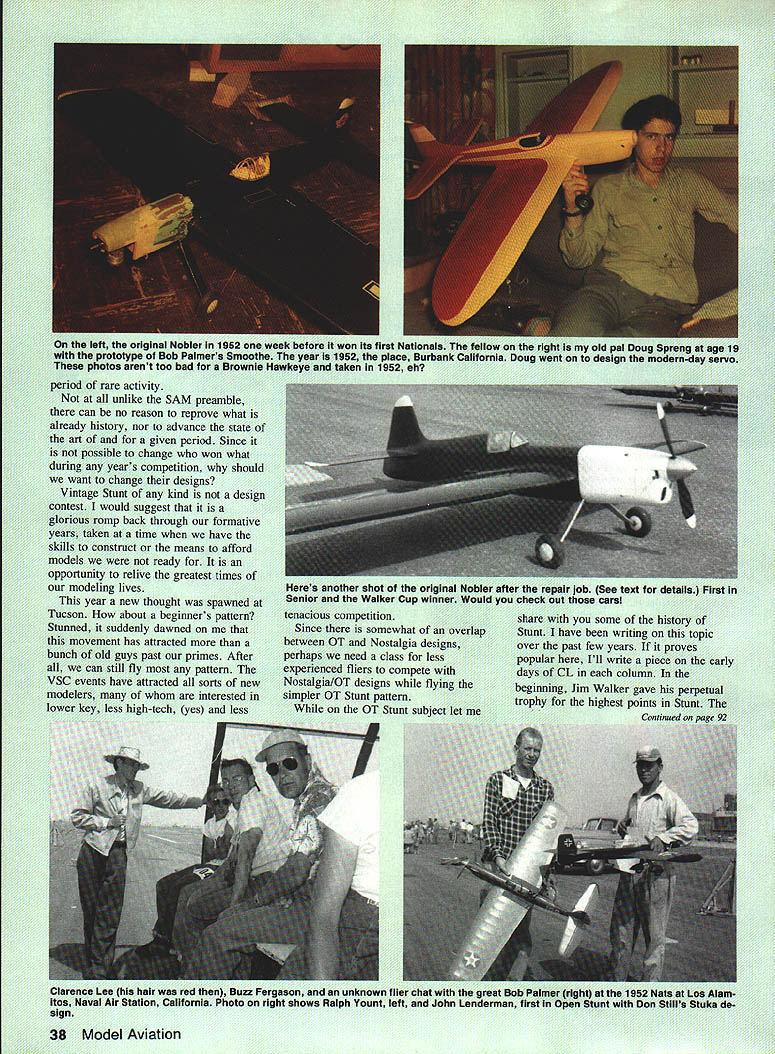
Los Alamitos NAS was the site for the 1952 Nationals, and my original Nobler was in Edinburg, Texas with the nose broken at the leading edge — the result of letting someone fly it who normally flew counterclockwise. I was in California trying to get on at Lockheed, and staying with Doug Sprengle. A phone call to Texas convinced my mother to have the old girl's crate shipped to me in care of Doug. A week later the nose was spliced back on with plywood inserts, Aero-Gloss C-77 cement, silk, and dope (no fiberglass or epoxies in those days). Doug was flying a perfect match version of Bob Palmer's first Smoothie. Both his and Palmer's models were painted in DuPont Dulux enamel, red with yellow trim and a white pinstripe.
Doug found a parking lot somewhere in the Burbank area where we could practice. This was on the Thursday before the Nationals started. By the following Tuesday, the second day of the Nats, we were well ensconced in the Navy's hangar, which hosted the greatest of all our national meets. The Navy gave us benches to hold our models and Navy-issued bench seats that not only served as a parking space but as a make-do bed as well on many occasions.
When I sat down on one of those bench seats it collapsed directly on top of Doug's Smoothie, crushing one wing panel. I was mortified; Doug, of course, was angry, but when he returned early the next morning — Stunt was to be held — he had everything repaired and was in top condition to fly. To my relief the event director gave us both 56 appearance points. Whew!
As far as I know, this was the first Nationals where all classes — Junior, Senior, and Open — flew in front of the same judges. I don't remember what John Lenderman received for appearance points but Bob Palmer got 76, and deserved every one of them. In those days 80 points was the maximum for appearance.
At the end of the day Palmer was first in Open and I thought I was first in Senior. I say "thought" because the judges told the runner on their circle to tell me that I was highest scored for the day. Doug and I sat around the officials' headquarters until almost 2:00 a.m. to get the final results. John Lenderman 367½, Bob Palmer 367 — Lenderman had upset Palmer and won Open Stunt. We were shocked. Aldrich 373 for first in Senior and both the Walker and Monogram trophies. It was days before I realized we had all flown in front of the same judges in both classes. We had waited so long for the final scores because the judges were re-adding the scores — five or six times! They couldn't believe I'd won the Walker either!
Whatever happened to the Monogram trophy? It was awarded for high point in Senior Stunt. I can find no one who saw it after 1952. I left the Walker and Monogram trophies with the Hobby Junction Shop in Burbank along with my original Nobler. My model was returned to me in Houston, and the trophies went to the AMA, but somehow the Monogram trophy never surfaced. In 1981 I had my miniature of the Air Trails trophy converted to the "Mother Award" for first place in Senior Stunt, honoring René Mechin.
Engine problems: wrist-pin wear and rich/lean symptoms
Let's talk about strange things that can happen to your engine. Recently a friend's engine that had been running like a perfect watch started to act really funny. One run in nice cool air was dead perfect — couldn't ask for a better run. Later in the day the engine went super-rich and died halfway through the pattern. This is perplexing: the gas gets warmer as the day progresses, and you would think that a higher temperature would produce a hotter and leaner run.
At the test circle, half way to the handle you have to go back and reset the needle a bit richer. Take off and the engine goes so rich you can't do anything but go round-and-round.
At home you pull the engine down and the wrist pin falls out of the piston before you can spit. What you find is a definite groove in the cylinder made by the wrist pin. A number of engines are affected by this problem, but the cause is wrist-pin wear in the piston, which allows it to slide out and wear a groove in the liner wall.
What happens when the day warms up? The cylinder gets warmer, grows larger, clears the wrist pin more, and the engine cools off allowing it to go richer and quit — or drive you crazy! In the 1960s we made Teflon or nylon pads that replaced the standard aluminum variety to ease this problem.
The old Johnson and McCoy stunt engines have unique pistons molded of sintered iron. Extremely light, these pistons have very narrow bosses to support the wrist pin. The McCoy suffered badly from this problem as the bosses wore quickly, allowing the wrist pin to slide out and groove the cylinder wall. H. Johnson countered the problem by hardening the cylinder so that it was harder than the wrist pin. In addition the piston was impregnated with molybdenum disulfide, making it very slick and reducing wear even further.
Most engines today either have chromed cylinders or use retaining circlips in the piston to eliminate the problem of the wrist pin bearing against the cylinder wall. Some have both chromed liner and circlips; these are usually all-out racing engines. When a circlip comes out, usually at very high revs (over 25,000), the cylinder assembly is a total loss. I have found that clipping off the little tin on the end of the wrist-pin clips after installation keeps this fatal event to a minimum. Only about 3/16" of the bit is left and it requires the use of two sharp scribes to remove the circlip. Often this distorts them badly and the safest thing to do is to use new clips upon reassembly.
Bearings, lubrication, and fuel
I have had a number of calls and letters lately concerned with the care of ball bearings used in our engines. I commented last time about the use of Rislone as an after-run and/or storage lube. Don't let anyone think an after-run lube is not important; a well-known manufacturer once commented that 3:1 oil had made him lots of money!
Another thing to remember is that manufacturers cannot afford to put highest-quality, high-performance bearings in their engines. The ultimate cost to the consumer would be prohibitive to all but a few.
I relate a lot of bearing problems to the failure to use castor oil in the fuel. Bert Striegler, lead engineer for Conoco (now retired), spent over $300,000 to prove that at least 3% castor oil is needed in our fuels. In addition, a chemical-engineer friend related laboratory tests which show that most of the synthetics used today produce acids that attack metal when burned. All these comments are directed toward longer engine life. I once ran a fuel that was 10% castor MSSR synthetic lube, 88% pure nitro, and 2% propylene oxide! This was during a speed meet and I was perfectly willing to sacrifice the engine to go fast. Let your desire be your guide.
Suppliers and miscellaneous notes
I'd like to compile a listing of suppliers of products for CL and FF, including specialty items for engines such as mufflers. Anyone who would like to be included should send a price list or catalog sheet. When the list is complete, it can be had by sending me a SASE.
And, as you may recall, Doug Sprengle didn't fly much CL stunt after 1952. Instead he became engrossed in radio control design and developed something I think they call a feedback servo. They tell me it's used in all the RC units today!
Transcribed from original scans by AI. Minor OCR errors may remain.

