
Up and Around
A nostalgia trip — meeting Jim Walker
Time for a nostalgia trip. The last time I saw Jim Walker was about two weeks before his untimely passing. At that time I was project engineer for a company with manufacturing facilities in an old cannery building in Broken Arrow, Oklahoma, and I was living in Tulsa. My route to and from work took me past the Tulsa Glue Dobbers flying field.
Late one Saturday afternoon there were several cars at the field, so I slowed to see who was there, intending to hurry home. I spotted a familiar metallic maroon Buick with an aluminum trailer. "That's Jim Walker's rig," I said aloud. As I pulled off to the shoulder, the familiar figure of Big Jim could be seen way out in the field. (We could fly free flight there in 1958—no longer possible today.)
As I wandered out to greet him, Jim had a long stick and was cranking something at the end of it like mad. From about 50 yards away he pointed the stick into the air and a little delta model went screaming up into the sky. When the model reached its peak it settled into a steep, slow glide back to the ground.
After our greeting, Jim showed me his "stick." It was a long coiled spring inside a housing. The spring was attached to a ratchet, the ratchet connected to a trigger in a pistol grip. The delta-winged model—about an eight-inch span—had an impeller/prop housed in a wire cage at its trailing edge. The model engaged a keyed driver at the impeller, so when the trigger was pulled the energy from the wound spring sent the model on its way. Truly another example of Jim Walker's genius.
Jim spent the night with my wife and me in our little rented house on Fulton Street—when we could finally get him to slow down. At 2:00 a.m. the next morning he was talking to his wife on his car phone and having intermittent conversations with other folks on his ham radio. After eating at least a dozen biscuits for breakfast he was off on his travels.
I have always considered the experience a rare privilege. To be one-on-one with Jim Walker was humbling. Usually Jim was "on stage," surrounded by so many people that the scene bordered on utter pandemonium. To sit at the dinner table and discuss things with him made it clear that his mind operated on a different level than those of us average folk.
Early impressions and the postwar years
My earliest memories of model magazines are the ads for Stanzel's Tiger Shark and Walker's Fireball. The first control-line flight I ever saw was Tom Killough's Fireball powered by an O&R .23 sideport in a little schoolyard in McAllen, Texas, about 1942. Given how marginal the power was, the idea that such a model could do a real loop never occurred to me.
The early post–World War II years were a frantic time in modeling history. Real balsa was once again available, and so many different engines were advertised that it was totally confusing. Those of us in small towns could only read about who—and what—was winning in modeling heaven, California.
Every state had its early stars. In Texas they were Skipper, Clemens, Snyder, Casburn, et al., but we all devoured Johnny Davis's "West Coast Tips" column in Model Airplane News. To read about Yates, Palmer, Saftig, Gullotta, and the rest of the California greats was about all a kid from a little hick town could stand.
Early stunt ships were typically powered by spark-ignition engines such as:
- Atwood
- Super Cyke
- Orwick
- K&B
A few in the East tried Leon Shulman's drone diesel. Early planes often carried payloads—coil, condenser, batteries—as experimenters tried different ideas. Kits such as the Akrobat, Zilch, Over Easy, and Box Car were available, but myriad designs unseen before showed up at contests. In those pioneering times everyone eventually came up with ideas of what was best.
Early stunt ships were likely around 36 inches wingspan—possibly the standard balsa length; splicing spars wasn't prevalent yet. Bob Palmer got his start in free flight, so splicing dihedral joints came naturally to him.
Stunt contests and rule changes (1946–1950s)
In the 1946–1948 Nats the CL stunt event was broken into three categories:
- Precision
- Aerobatics
- Novelty
Flyers' scores in the categories were added together to select the national stunt champion—winner of the Walker Trophy. Jim Walker's influence is easily detected in maneuver lists from that era; examples include stall recovery (requiring two‑speed engine control), various rolls, and carrier flight. Carrier flight was described as "flying out to at least 70 feet and reeling back to hand without touching ground."
Walker once published drawings of a mechanism that allowed a CL model to roll around its axis inside a wire frame.
In 1950 the Novelty category was dropped and a Precision Aerobatics schedule was presented in the rule book under the chairmanship of Roy Mayes. This basic pattern remained in effect through 1953 and is still essentially used today in Old-Time Stunt, except that the special maneuver was eventually dropped.
An interesting note in the 1949 rules: the special maneuver had to be performed by the plane, not by the flyer. The reason was that many fliers would perform maneuvers while lying on their backs or doing cartwheels or handstands!
It was not uncommon for a contestant to use a completely different model for the novelty event. In 1949 Lew Andrews used one of his Trixter designs with an O&R .29 glow engine and an intricate system to operate butterfly valves for variable-speed engine control.
Unlike today's rules, the pattern flown then did not specify minimum heights for most maneuvers—only a maximum elevation of 600' (except overhead eights, which required a minimum of 30° from the ground on each side of the maneuver).
The 1940s increasingly became the era of the spectacular pattern. From California contest reports, it must have started there: the pilot who flew the tightest, fastest, and closest to the ground usually won. Initially the horizontal eight was done as a lazy-eight, with fliers trying to almost touch the wheels and drag the fin on the ground. Many flew the tops of loops, horizontal eights, etc., not much over 30 feet high.
By 1949 the word was out: you had to dive vertically in the middle of the horizontal eight. Models were now flying 80–90 mph and capable of doing patterns at 30° (or less) to the ground.
Key designers and the shift in design philosophy
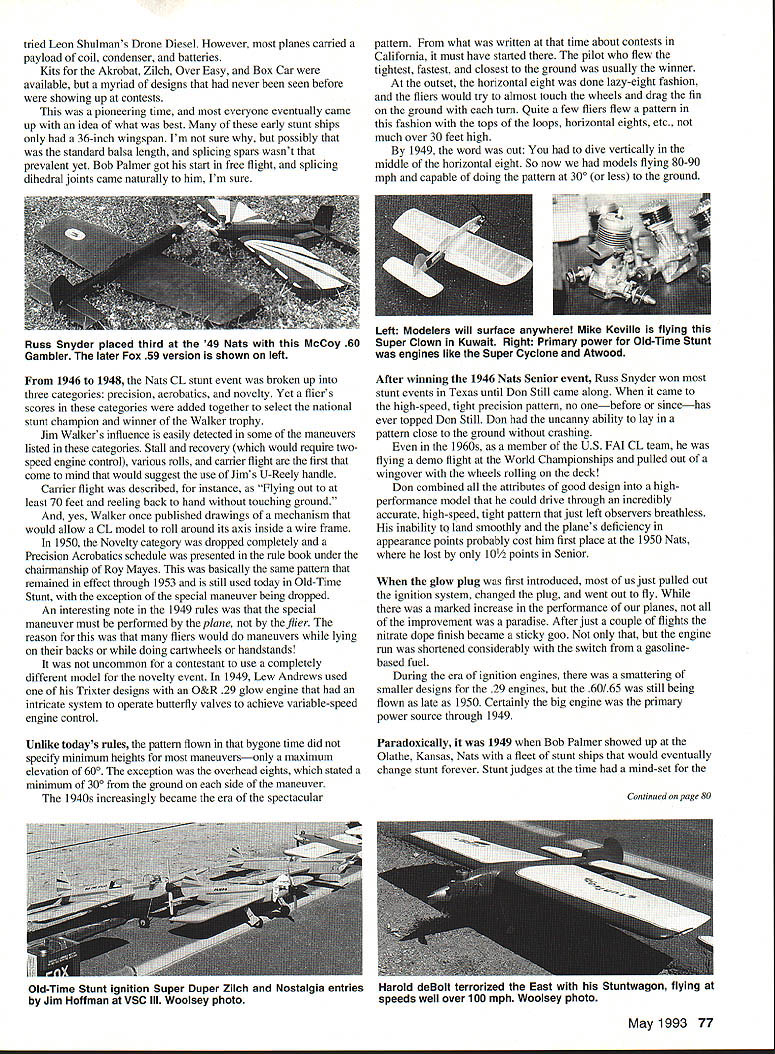
After winning the 1946 Nats Senior event, Russ Snyder won most stunt events in Texas until Don Still came along. When it came to high-speed, tight precision patterns, few have equaled Don Still. Don had the uncanny ability to lay in a pattern close to the ground without crashing. Even in the 1960s, as a member of the U.S. FAI CL team, he once pulled out of a wingover with the wheels rolling on the deck during a demonstration flight at the World Championships.
Don combined good design attributes into a high-performance model he could drive through an incredibly accurate, tight pattern that left observers breathless. His inability to land smoothly and his planes' appearance deficiencies probably cost him first place at the 1950 Nats, where he lost by only 10.5 points in Senior.
When the glow plug was first introduced most just pulled out ignition systems, changed plugs, and went flying. Performance increased, but not everything was paradise: nitro dope finishes became sticky after a couple of flights, and run times shortened compared with gasoline-based fuel.
During the ignition-engine era there were smaller designs for .29 engines, but the .60/.65 was still in use as late as 1950. The big engine was the primary power source through 1949.
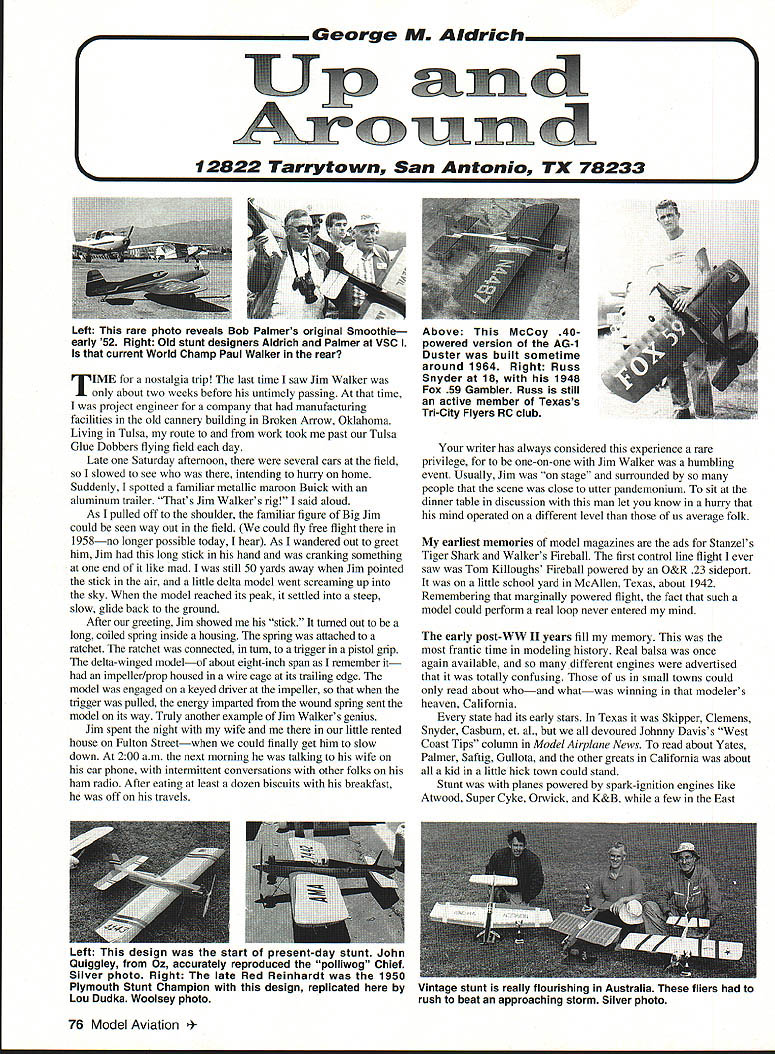
Paradoxically, 1949 saw Bob Palmer arrive at the Olathe, Kansas, Nats with a fleet of stunt ships that would eventually change stunt forever. Stunt judges then favored the big-engine/fast-pattern style of flying, and Palmer did not place in the top five with his slow, McCoy .29-powered Veco Chief. Meanwhile, Harold deBolt won fifth with his Stuntwagon, which clocked over 100 mph.
Palmer's '49 Chief—the "polliwog Chief"—had a recurved (cupped) trailing-edge airfoil devised by Hi Johnson, who engineered the kit for production to get more die-cut ribs out of a sheet of balsa. The main point: Palmer's Chief proved that a large (550-square-inch) model could be flown very well with a relatively small engine.
I was then 16 and enamored of Palmer and his design. What followed was a year of building and flying Chiefs feverishly. I built them with semicowls and spinners, 1/2-inch-thick spars, faced trailing edges with 1/32" sheet, and added nose weight to prevent porpoising. Appearance points were king then; you could put a spinner on a plane and get points for looks.
I campaigned a pair of box-stock Chiefs on the contest circuit in 1950, placing fourth in Senior at the Nats. By then I knew the Chief inside and out and realized some improvements were needed. I spent the summer building a Chief Special for the new Veco .29 engine plus several "quickies" to test ideas. From one earlier model I knew a short tail moment produced undesirable traits. Thinking back to the Chief's tendency to drop the outboard wing in a hard corner, I tried a longer tail moment.
Using an old Chief wing, I built a box fuselage with a full 12 inches between the flap trailing edge and the leading edge of the stab. This layout gave an excellent, crisp corner without the Chief's bad tendencies. In November of that year the basic layout of what would become the Nobler was made.
In the same period Don Still had also built a Chief that started the train of thought leading to his famous semiscale Stuka. Thus we saw the passing of an era in 1950: by 1951 I can't recall a single big .60/.65-powered stunt design at the Nats. The many big, fast designs that had brought stunt immense popularity had become passé—they had become Old-Time Stunt.
Russ Snyder remained another low-altitude master. I'm completing drawings of his 1948–49 Fox .59-powered stunt design; Russ is still active in our Tri-City Flyers club and has loaned me the notebook he's kept on his designs. I hope to get drawings made of his '49 Nats third-place Senior design, which used the Series 20 McCoy .60. I have also been in touch with Don Still, who has promised a copy of the plans for his '49 Nats winner. Perhaps the magazine can present the details for all three if there's enough interest.
Vintage stunt today
Stunt fliers who enjoy the old designs—as flown at the Vintage Stunt Championships in Tucson, Arizona, April 3–4 this year—are fortunate in that they don't need vintage two‑stroke engines for power. Unlike free flight or racing events, having the latest hot Schnuerle-ported engines offers no particular advantage for vintage stunt.
The Vintage Stunt community doesn't require (or want) high-speed engines, so if you don't have a vintage engine you can use a modern engine with no gain or loss over someone who has an old engine.
One practical point: in many areas you may need to use a muffler to keep your flying site. Installing a decent lightweight muffler can be a real problem on some old engines, while most modern engines provide muffler attachment points. I'm not talking about tuned pipes on old engines—I'm talking about reasonable muffling for general flying.
Closing
Early stunt ships and designers left a rich heritage. Some old designs have been accurately reproduced and vintage stunt is flourishing among fliers who enjoy the heritage and the challenge of the old ships. The pioneers’ innovations—engine control ideas, airfoil experiments, and daring low-altitude patterns—still inspire today’s enthusiasts.
Transcribed from original scans by AI. Minor OCR errors may remain.

