
Up and Around
George M. Aldrich 12822 Tarrytown, San Antonio, TX 78233
"Just what advantage is there in keeping secrets? What advantage is there in not helping a fellow competitor? Well, if you really try hard you can get your event to the state Speed modeling is today."
These were the opening lines to the "Secrets of Engine Performance" article I wrote in 1968. Thanks to Speed Times publisher Chris Sackett, CL Speed is no longer in the doldrums and is flourishing nicely.
(Speed Times is $22 a year; write to North American Speed Society, Box 82294, No. Burnaby, B.C. Canada V5C 5P7.)
I was reminded of that article during a recent speaking tour in Australia. The MAAA (the equivalent of our AMA) invited me to speak about engines and CL Stunt at their Nationals in Wagga Wagga, N.S.W., and to modelers in Adelaide and Perth.
What surprised me was that modelers from all parts of this great nation knew of the Aeromodeler Annual piece and often had copies with them. I was invariably asked, "Since you make your living by reworking engines for others, how can you give away your methods and techniques?"
The answer is simple: the fellow who wants to work on his engines is not going to be your customer anyway, so why not help him? It just adds to your pastime. As for abetting the competition, they are just starting out; you have already gone on to other development.
Secrets and port timing
In a column from the 1970s, I wrote about how the blow-down period governed the way an engine ran. This was the first time in my memory that anyone had put in print how port timing affected engine performance (as in the 4-2 break, Stunt mode).
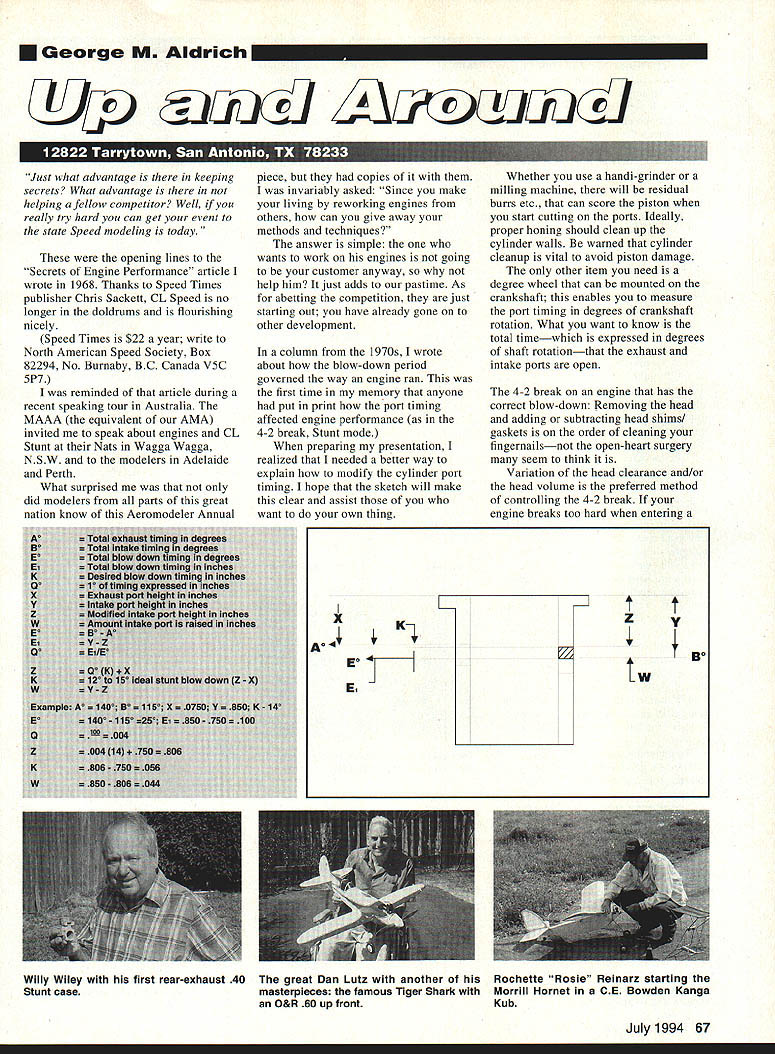
When preparing my presentation, I realized I needed a better way to explain how to modify the cylinder port timing. I hope the sketch I used will make this clear and assist those of you who want to do your own work.
Whether you use a handi-grinder or a milling machine, there will be residual burrs that can score the piston when you start cutting the ports. Ideally, proper honing should clean up the cylinder walls. Be warned that cylinder cleanup is vital to avoid piston damage. The only other item you need is a degree wheel that can be mounted on the crankshaft; this enables you to measure the port timing in degrees of crankshaft rotation. What you want to know is the total time—which is expressed in degrees of shaft rotation—that the exhaust and intake ports are open.
The 4-2 break on an engine that has the correct blow-down: removing the head and adding or subtracting head shims/gaskets is on the order of cleaning your fingernails — not the open-heart surgery many seem to think it is.
Variation of the head clearance and/or the head volume is the preferred method of controlling the 4-2 break. If your engine breaks too hard when entering a maneuver, chances are adding shims will correct the problem; possibly adjusting the point engine will never break (i.e., four-cycle through maneuvers). Lowering compression can also cause some power loss. Given venturi size, engines have run fairly high compression; low head clearance, power-controlled, restricting venturi size tends to result in the engine breaking two-cycle and staying there — exactly what you don't want.
Fuel, venturis, and historical examples
Old Fox .35 and McCoy .40s of the 1960s, which I consider some of the best pure Stunt designs ever, use fairly low compression ratios and generous venturi openings. The McCoy has a full .312 venturi bore (≈ .0765 sq. in.) and a .125 GD needle valve body, giving an effective venturi opening of about .0375 sq. in. Compare the old ST .46 sprinkler venturi bore .157, which gives ≈ .0194 sq. in. area—much smaller than the McCoy .40.
Such great variation is mainly because nitromethane costs about $120 a gallon in Europe. European modelers usually run engines at no-nitro levels. Consequently the ST .46 came set up to run such fuel, resulting in a wide squish band, low head clearance, and high-compression head set up to get power on what I call "cough syrup" fuel. It's hard to see how I got lured into such small venturi sizes. Longevity of the ST .46 exceeded the Fox .35, though the narrowed .46 squish band made large-volume hemi-heads desirable; venturi sizes remained relatively constricted. A .285 venturi is ≈ .0638 sq. in.; a small needle valve body reduces the effective flow area, so passing through ≈ .019 sq. in. effective area was common, the short engine being starved for fuel/air.
To understand how much head clearance a good Stunt engine can tolerate, look closely at old Testor McCoy engines. I've never known them to have accurate tolerances. I've seen examples with wrist-pin holes or pistons drilled .020 off the intended position, which means the piston baffle is .020 off the corresponding slot in the head. Yet assembled, the piston baffle never hit the head; the engine would run just fine and last a long time.
Fuel systems and practical tips
I've never cared for pressure fuel systems for CL Stunt — it's just one more thing that can go wrong. Bladders and crankcase pressure are certainly worth the trouble for Speed Stunt; for Stunt I've always preferred the consistent run from my suction tank. I've never experienced the so-called Fox .36 burp so many have mentioned over the years. My Fox .35s, Oliver Tigers, etc., have run with the consistent 4-2 break, no matter what maneuver—until recently.
Last summer I was test-running a customer's engine—or rather trying to test-run it, for it would not. The venturi was cut to the same parabolic shape that has been in use since 1968, when the tool was first ground.
My concentration focused on the needle valve; it was a generic brand I had not used before. Removing the body, I found the fuel-bleed hole diameter was only about .025–.030. This was opened to about .055, installed in the engine, and it ran on suction just fine, thank you. Little things can mean a lot!
Impressions of Australia
I would be remiss if I didn't mention my impressions of Australia. My first thoughts of this once-in-a-lifetime experience are of the people. I never met a rude or unfriendly person. Try that anyplace else you might want to go.
Australia is about the same size as the U.S. but has only about 17 million residents. Imagine being in the U.S. about 200 years ago with all of today's conveniences. I was also impressed by how clean the cities were—the streets looked as if they had been cleaned with a broom and dustpan.
While easy, inexpensive access to modern supplies is not at U.S. levels, Australian modelers incorporate intelligence, talent, and effort. I've been involved with modeling and modelers all my life, and these good folks are among the elite.
One modeler in particular was a pleasure to meet: a solid gentleman simply known as Ivor F. We first made contact back in the 1960s, and I have read about his many exploits and endeavors ever since. Famous for his many talents, jokes, and crazy capers, Ivor is a teacher by profession, and inside him beats the heart of one of the truest modelers who ever lived.
In the 1930s, Ivor started as a "fletchermite"—an endearing term used in England and Australia to describe lads enlisted to chase the "big boys" models. The neophytes this great man introduced to modeling number in the thousands, I'm sure.
Seeing a whole family arrive at a flying site is not uncommon in Australia. Mum and a baby on a blanket, while dad and the boys and girls fly. A wide selection of both CL and free flight is also the norm. It reminds me of my boyhood when we had only about 100 million or so.
Contact
I take calls from 6 p.m.–10 p.m., but I prefer that readers write, since calls often catch me with honing oil dripping off my elbows or losing a set of dimensions dealing with .0001 tolerances. I answer all SASEs.
Address: 12822 Tarrytown, San Antonio, TX 78233 Tel.: (512) 656-2021
Transcribed from original scans by AI. Minor OCR errors may remain.

