
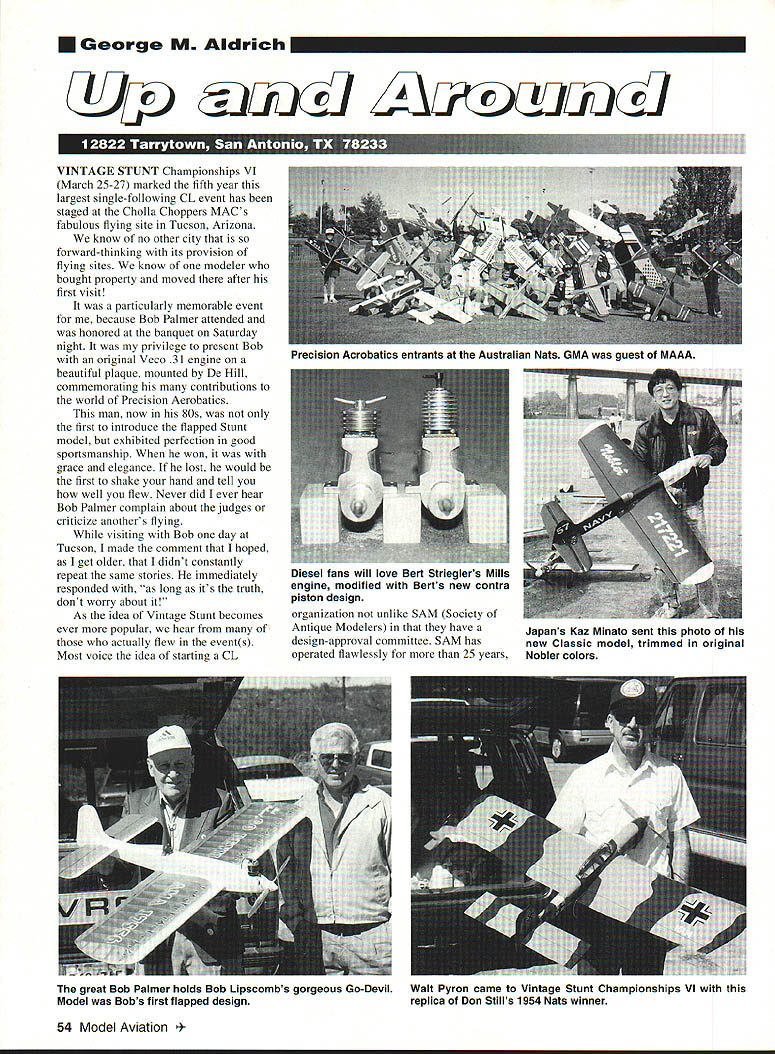
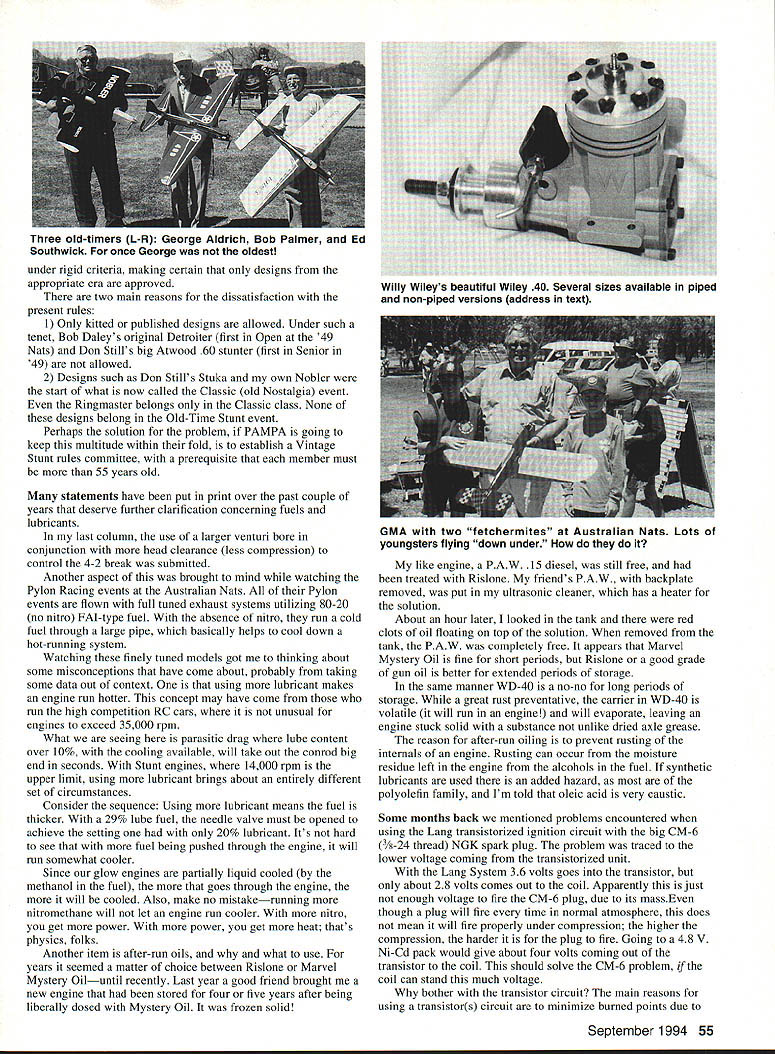
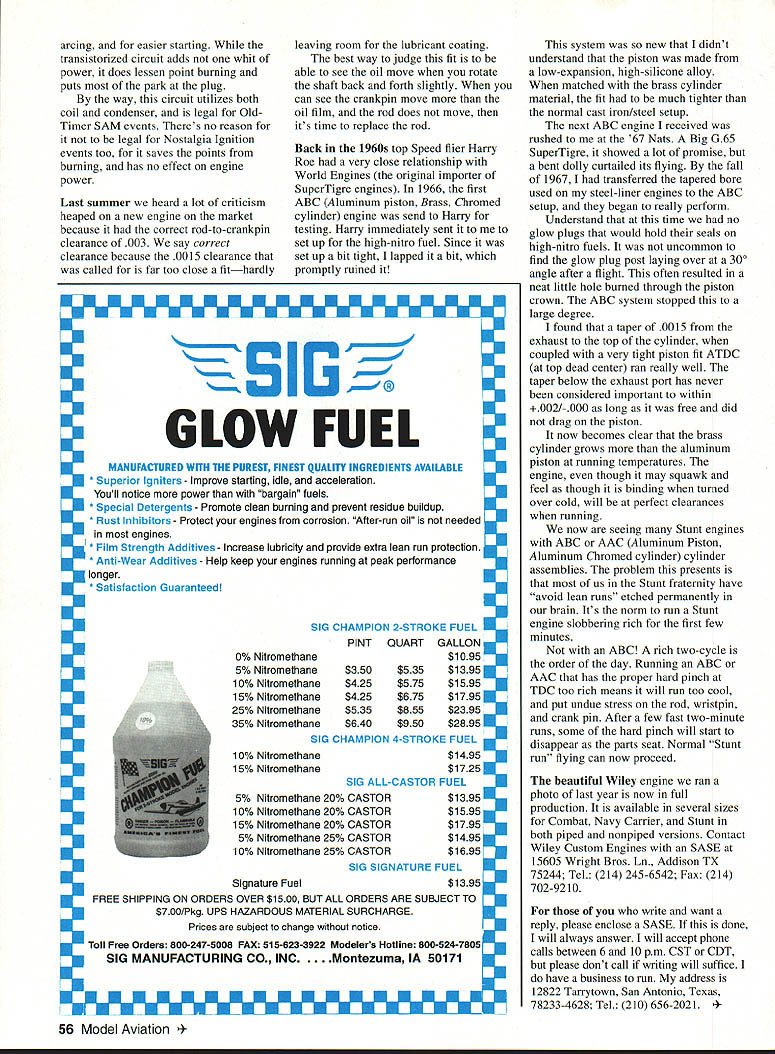
Up and Around
12822 Tarrytown, San Antonio, TX 78232
Vintage Stunt Championships VI
VINTAGE STUNT Championships VI (March 25–27) marked the sixth year this largest single-following CL event has been staged at the Cholla Choppers MAC's fabulous flying site in Tucson, Arizona.
Tucson is notable for its forward-thinking provision of flying sites. I know of one modeler who bought property and moved there after his first visit!
It was a particularly memorable event for me because Bob Palmer attended and was honored at the banquet on Saturday night. It was my privilege to present Bob with an original Veco .31 engine mounted on a beautiful plaque by De Hill, commemorating his many contributions to the world of Precision Aerobatics.
Bob, now in his 80s, not only introduced the flapped Stunt model but also exemplified perfect sportsmanship. When he won, it was with grace and elegance; if he lost, he was the first to shake your hand and compliment your flying. I never heard him complain about the judges or criticize another's flying. While visiting with Bob in Tucson, I said I hoped that as I get older I wouldn't constantly repeat the same stories. He replied, "As long as it's the truth, don't worry about it!"
Vintage Stunt organization and rules
As Vintage Stunt becomes more popular, many who actually flew in the events voice interest in forming a CL organization similar to SAM (Society of Antique Modelers), with a design-approval committee. SAM has operated flawlessly for more than 25 years.
Two main reasons for dissatisfaction with present rules:
- Only kitted, published designs are allowed. Under such a tenet, Bob Daley's original Detroiter (first Open 49 Nats) and Don Still's big Atwood 60 stunter (first Senior 49) would be excluded.
- Certain designs (for example Don Still's Stuka or Nobler) have spawned what is now called Classic or Nostalgia events. The Ringmaster belongs in the Classic class. None of these designs belong in the Old-Time Stunt event.
Perhaps the solution is for PAMPA to keep the multitude within the fold and establish a Vintage Stunt rules committee. A suggested prerequisite for membership might be 55 years old.
Fuels and lubricants — misconceptions and observations
Statements I have made over the past couple years deserve further clarification concerning fuels and lubricants.
Watching Pylon Racing events at the Australian Nats got me thinking. Pylon events were flown with full-tuned exhaust systems utilizing 80–20, no-nitro FAI-type fuel. In the absence of nitro, running cold fuel through a large pipe helps cool down a hot-running system.
Some misconceptions have arisen—probably by taking isolated data out of context. The idea that using lubricant makes an engine run hotter may have come from high-competition RC car engines, which exceed 35,000 rpm. There, parasitic drag is significant; with lube content over 10% the cooling available will fail the conrod big end in seconds. Stunt engines, with an upper limit around 14,000 rpm, behave differently: the lubricated, thicker fuel provides cooling because glow engines are partially liquid-cooled—the methanol in the fuel flows through the engine and takes heat away.
Consider the sequence: higher lubricant content makes the fuel thicker (for example, 29% lube fuel); the needle valve must be opened to achieve the equivalent mixture setting for 20% lubricant. It is hard to see how the fuel pushed through the engine would run hotter—liquid fuel still provides cooling.
Also, make no mistake—running nitromethane will NOT let an engine run cooler. Nitro increases power; more power generally produces more heat.
After-run oils and long-term storage
Which after-run oils to use? For years the choices seemed to be Marvel Mystery Oil or Rislone. A recent example clarified the difference. A friend brought a new engine that had been stored 4–5 years after being liberally dosed with Mystery Oil; it was frozen solid. A PAW 15 diesel treated with Rislone came out free. I put a Rislone-treated PAW in an ultrasonic cleaner with heated solution; after about an hour red clots of oil floated on the solution and the engine was completely free.
Conclusion:
- Marvel Mystery Oil is fine for short periods.
- Rislone, a good-grade gun oil, is better for extended storage.
WD-40 is a no-no for long storage. While a great rust preventative, its volatile carrier will run in an engine and then evaporate, leaving a residue that can harden like dried axle grease and lock the engine.
After-run oils are primarily to prevent rust of internal parts. Rust can form from moisture residue left by the alcohols in the fuel. If synthetic lubricants are used, there is an added hazard: many are in the polyolefin family, and I'm told that oleic acid is very caustic.
Ignition systems — Lang transistorized circuit
Some months back we reported problems when using the Lang transistorized ignition circuit with the large CM-6 (3/24 thread) NGK spark plug. The problem traced to lower voltage from the transistorized circuit.
With the Lang system, 3.6 volts goes into the transistor but only about 2.8 volts comes out to the coil. This is apparently insufficient to fire the CM-6 plug reliably under compression (the higher the compression, the harder it is for the plug to fire). Using a 4.8 V Ni-Cd pack would give about four volts coming out of the transistor to the coil and should solve the CM-6 problem, provided the coil can withstand the higher voltage.
Why use a transistor circuit? Main reasons:
- Minimize burned points due to arcing.
- Allow higher rpm operation because the coil charges quicker between sparks.
- Reduce sensitivity to point dwell settings.
- Easier starting and less point wear.
Caveats: transistorized circuits are not trouble-free. If the transistor gets hot it will reduce output; wiring resistance, connector corrosion, and poor grounds will cause voltage drops. All these factors must be addressed for reliable operation.
This circuit uses both coil and condenser and is legal for Old-Timer SAM events. There's no reason it should not be legal for Nostalgia Ignition events too, since it saves the points and has no effect on engine power.
Rod-to-crankpin clearance
Last summer there was criticism of a new engine because it had the correct rod-to-crankpin clearance of .003. We say .003 is correct because the .0015 clearance that was called for is far too close a fit—hardly leaving room for a lubricant film.
The best way to judge the fit is to see oil move when you rotate the shaft back and forth slightly. When the crankpin moves more than the oil film and the rod does not move, it's time to replace the rod.
ABC and AAC engines — experience and setup
Back in the 1960s, top Speed flier Harry Roe had a close relationship with World Engines (the original importer of SuperTiger engines). In 1966 the first ABC (aluminum piston, brass chromed cylinder) engine was sent to Harry for testing and he passed it to me to set up for high-nitro fuel. I lapped it a bit and promptly ruined it—the piston alloy was a low-expansion, high-silicone material, so the fit had to be much tighter than the normal cast-iron/steel setup.
The next ABC engine I received was rushed to me at the '67 Nats (a Big G .65 SuperTiger). By the fall of 1967 I had transferred the tapered bore used on my steel-liner engines to the ABC setup, and they began to perform very well.
At that time we had no glow plugs that would hold their seals on high-nitro fuels; it was common to find the glow-plug post bent after a flight and holes burned in piston crowns. The ABC system reduced that problem significantly.
I found that a taper of .0015" from the exhaust to the top of the cylinder, coupled with a very tight piston fit at ATDC (at top dead center), ran really well. The taper below the exhaust port has never been considered important within +.002/-.000 as long as it was free and did not drag on the piston. Brass cylinders grow more than aluminum pistons at running temperatures—an engine that feels tight cold will reach proper clearances when running.
We are seeing many Stunt engines with ABC or AAC (aluminum piston, aluminum chromed cylinder) assemblies. Most stunt pilots are conditioned to "avoid lean runs" and typically run a stunt engine rich for the first few minutes. With ABC/AAC engines that have a proper hard pinch at TDC, a rich two-stroke mixture is essential at first because running too rich initially will run the ABC/AAC too cool and place undue stress on the rod, wristpin, and crankpin. After a few fast two-minute runs the parts seat and normal "stunt run" flying can proceed.
Wiley engine and contacts
The Wiley engine we photographed last year is now in full production. It is available in several sizes for Combat, Navy Carrier, and Stunt in both piped and non-piped versions.
Contact Wiley Custom Engines:
- Address: 15065 Wyeth Bros. Ln., Addison, TX 75244 (include SASE)
- Tel.: (214) 245-6542
- Fax: (214) 702-9210
For those who write and want a reply, please enclose a SASE. If you do, I will always answer. I will accept phone calls between 6 and 10 p.m. CST/CDT, but please don't call if writing will suffice—I do have a business to run.
My address and phone: 12822 Tarrytown, San Antonio, Texas 78232 Tel.: (210) 656-2021
Transcribed from original scans by AI. Minor OCR errors may remain.

