
Up and Around
Since my mentioning the very peculiar reaction of Randolph dope on my more recent models, the mail I received says that about 80% of you have had the same or a similar experience. To date no sure solution or cure has been found. Apparently, it is founded in raw materials as they come from major chemical sources.
A very interesting conversation with Mike Pratt of Sig Manufacturing revealed that they now make their own blends of dope from these raw materials. Some months ago they also had problems not unlike those described in these pages. Mike said that these problems were immediately caught and corrected within the first batch. Sig does offer totally compatible butyrate, and I intend to try it.
One letter wanted to know why I didn't use nitrate dope with clear epoxy over it for protection. I'm sure this works fine for some, but one of the characteristics of nitrate is that it is very flammable. Butyrate was developed many years ago to help alleviate the great fire hazards of using nitrate on full-scale aircraft. The best illustration of this is a true story a friend relayed recently, of vandals who broke into his hangar and set fire to his Aeronca. The covering burned off so fast that the temper of the metal tubing was not affected one whit. He just cleaned it and refinished the airframe. The plane had been covered and coated with nitrate dope.
What many missed in my lamenting of the dope problems is the loss of "No Shrink" butyrate—not just non-tautening, but zero shrinkage. This product not only made a great plasticizer for clear or color with only 5% no-shrink to 95% standard butyrate, but it was great, used straight, for fillets. I still have six hand-launch gliders, built in 1964, that are nice and flexible. They were finished with the zero-shrink Randolph.
The trait that made this product special was that its surface dried as normal dope does, not rubbery, soft, or unsandable. I offer this as a challenge to all dope manufacturers: give us a zero-shrink, clear butyrate with high solids that is totally compatible with their other butyrate finishes.
There has been some confusion about my recommendation of the old SAE 70-weight oil as the lubricant for ignition engines using gasoline-based fuel. It was not my intention to imply that this lubricant would do anything other than protect the engine better and thus make it last longer. There are a number of ways to make a fuel with less parasitic drag, and that will help an engine to run faster. However, these blends will also wear out the engine faster. Everything we do requires some sort of compromise. My compromise is to sacrifice a few rpm to have these old and dear engines last longer.
I have spoken about a list I'm preparing of all producers of any product that could be of use to modelers. I want to stress that I am not asking for free goodies. All I want is information on what you offer and a current address, phone, fax, etc. In this way I can devote these lines to modeling, rather than product reviews.
I will tell you about a recent continuation of original production that rivals the finest engines ever made. And it's an original ignition engine! Marvin Miller, 250 Bronco Rd., Soquel, California 95073, not only purchased the original tooling to the Anderson Spitfire .65 ignition engine, but he repaired this equipment and is now able to produce an even finer product than the original. Marvin does everything himself so you only have to let him know you want one. When your engine is ready he'll send you a bill for about $240. And it's worth every penny.
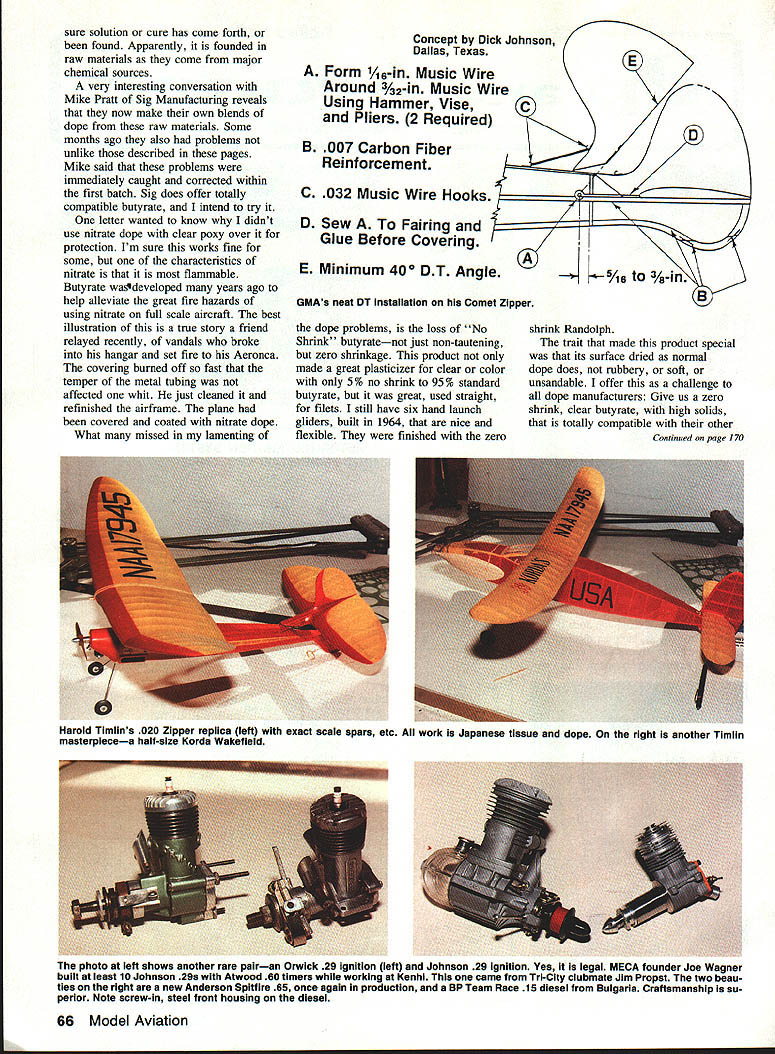
Since several letters asked about how I set up the DT on the Zipper, I've made a sketch that I hope makes it clear. The carbon-fiber reinforcement is very important to strengthening the structure so that it doesn't break up when making a hard landing.
This Zipper has a particular history that some may find interesting—especially those who knew Howard Timlin. Howard was my oldest friend. We met through modeling when we were just 10 or 11 years old. From rival towns, we competed in tennis where he beat me in the district finals. When I moved to San Antonio in 1959 Howard was already here.
He won FAI at the 1959 Nats with my Oliver Tiger in his first Saturn. Later I sprayed his first Solar in my shop. For those of you who don't know Howard, he was a consummate talent. He had more talent than most in every area. When he started designing aircraft color schemes, I loaned him my airbrush. In two days he produced something stunning.
Years later, Howard came over in his new Rolls to borrow my Zipper kit. A month or so later he was back with the kit and had added a Zipper framed up that he said was the best he'd built. Howard had plotted every part, cut them out and built it all from scratch.
When I first heard Howard had cancer, we sat outside on the deck above his tennis courts. I promised him then that I would repair his old models for the AMA Museum and finish the Zipper.
We had both worked on a DT idea we had seen first on a Comet Mercury that Dick Johnson (Dallas, Texas) built. So I had only to enlarge the system's music wire. We worked on it without a flaw.
More stunt history. By 1953 I was working at Temco Aircraft and living in Dallas. The Nobler I was finishing had been started almost a year before and had the best finish of any model I had ever built.
The late Leo Holiday and I left for Philly on a Friday afternoon. I had $67 in my pocket and a 1952 Ford with a leaking head gasket and cracked water jacket. We drove in to the Willow Grove NAS about 9:00 p.m. Sunday night. Matty Sullivan registered us in; he was the Nats' manager!
As I remember, stunt was flown in three days that year—for Junior, Senior, and Open—and did not fly in front of the same judges on the same day as it did in 1952. Here I was with a new model, untested, untrimmed, and tail-heavy. This was long before adjustable lead-out guides, and I had to cut into that hand rubber-band joint to move the lead-outs forward. Finally, on the afternoon before the Senior event was to be flown, the model started to groove. But it was 53 oz. and still a tad tail-heavy. How I wished for the old original.
Three things stand out about the flying that day. I hit the vertical climb and dive right on; and all three vertical eights were exactly in the same place (within an inch, anyway). The model was so heavy that in order to not take the ship behind vertical, the pull-outs were only an inch off the concrete. Later, the head judge told me he would really have docked me a lot of points if I hadn't put all three one inch off.
The third memory was of Buzz Ferguson doing a wingover straight into the wind and planting his pretty, semi-scale Shoestring straight into the concrete.
Later that day I let a great Old Time Free-Flighter try my Nobler. Jerry Broffman was going to kit my design, and he said he could fly clockwise with no problem. Exactly one lap later he stuck my hand-rubbed model into the pavement within three feet of my feet! I've tried to find Jerry for years (no malice intended) but to no avail. He ran Enterprise Models for years, and then just faded away. Does anyone know of his location these days? I want to discuss his classic Sunduster design with him.
Anyway, the Atlanta gang, headed by Bob Elliott, won both Jr. and Open that year, I think. I know Bob won the Walker Trophy flying his Black Tiger that was later kitted by Berkeley. But the main point is that the Walker scores came from flights made on different days.
Many have called or written wanting plans for the DI-Doe, but I do not have full-size plans for it. John Miske, 415 Clifton Blvd., Clifton, New Jersey 07013, may have the plan for sale. Certain key dimensions should give the scratch builder enough to go on. Top wing span is 28 in. and the bottom wing is 24 in. The wings are spaced 4 in. apart, center line to center line, which gives the fuselage height. Of course you can always try John Pond Plan Service, P.O. Box 90310, San Jose, California 95109-3310. John is the godfather of our OT/Vintage game and stocks a wealth of designs for every phase.
In answer to other letters about Rislone, it is an oil additive, not an upper-cylinder lube as I first mentioned. This is my error. I've been buying it a long time, and I hadn't looked at the label in years. Just buy the small can that says "concentrate."
There is another question that I have to answer so much I could probably have a rubber stamp made and save a lot of time. It seems many still do not understand the difference in firing of our engines: spark ignition or glow. My Webster's dictionary gives the following definitions: ignition—act of firing; a setting on fire; means of igniting. Detonate— to explode with sudden violence; to thunder.
In other words, these two words mean basically the same. Without detonation you cannot have ignition, or vice versa, and our engines could not run.
The problem so many write to me about is termed pre-detonation or pre-ignition, which is the act of firing too soon or out of timing with normal, smooth ignition.
With glow ignition a number of things can cause pre-detonation: head-to-piston clearance, compression ratio, heat range of the glow plug, nitro content, plug heat range, not to mention humidity. When you hear a low, pinging crackle, and it tends to overheat, you have passed the point of compromise. That is, you must reduce nitro, or increase head clearance, or use any one of the various combinations possible.
For highest performance, as in CL Speed or AMA FF, it's a matter of what your pocketbook can stand. With a given head chamber design and nitro content, successive test runs can be made, raising the head clearance with a shim with each run until the rpm starts to fall off.
Example: with the use of .003 shims the engine runs fastest with 5 shims or .015. If one more shim is added, rpm drops 200 revs. Quite often this gives the ideal clearance since that .003 extra head clearance allows the engine to unload more in the air.
This method will work with any nitro-content fuel. Note that when over 50% nitro is used, the head-chamber surface will often appear to have been sandblasted. This is the glow element vaporizing due to high nitro/compression and also to some extent the phenomenon that platinum hates aluminum!
Just as alcohol forms a true catalytic reaction with platinum—the major component in glow-plug elements (which can cause a hot engine to start without the battery being connected)—platinum is allergic to aluminum. This explains quite often the blown plug in a new engine, even when it's been run rich.
Some of the more exotic racing engines today now sport either chrome or electroless nickel-plated back plates to lessen the chance of flying aluminum particles getting to the plug.
Once the optimum head clearance is found, it must be remembered that it can change with the weather. If the original settings were made in cool, dry weather, be prepared to add more shims or drop the nitro if it's 90° and humid.
These are the extremes of setting the head clearance for minimum pre-detonation versus maximum performance for a given engine.
For an ignition engine it's very easy to advance or retard the spark to get optimum performance. Here is an easy way to check the timing for an ignition engine. With the piston at TDC (top dead center at top of the stroke), set the points so that any further rotation will cause the points to open. This setting is the fully-retarded position.
An ignition engine can also show signs of being over-compressed in a manner not quite the same as a glow engine. With a gasoline-based fuel, an overly compressed engine, or one that is too tight, may slow down, sag, and overheat when the spark is advanced. The normal sounds we relate to pre-detonation will seldom apply here. The noise is almost a wheeze, and the overheating will make you bring the timer advance arm down in a hurry! For example, an Orwick .64 with something like a 12:1 compression ratio has only about 20° of spark-advance travel. The Super Cycle at something less than 7:1 has over 80° of travel. Each individual engine design will have its own limits.
For those of you who have written and sent SASEs, you know I answer my mail. You're welcome to write or call (before 10:00 p.m. CST), and I have added a FAX machine (512-656-2021). It will answer after six rings. Hang up after five and you won't be charged. Send letters to: 12822 Tarrytown, San Antonio, Texas 78233.
Early last summer I opened the gate to our flying field. It was 4:45 a.m. I drove down to my favorite spot for trimming and sat alone, sipping coffee while I waited for the sun to rise. At gray light I opened the van and put the Zipper together. It was a breathless morning, fresh hay bales littered the field, and a heavy, pungent, fresh-cut grass aroma hung in the humidity.
Howard and I trimmed the Zipper in seven flights—it was a fine morning.
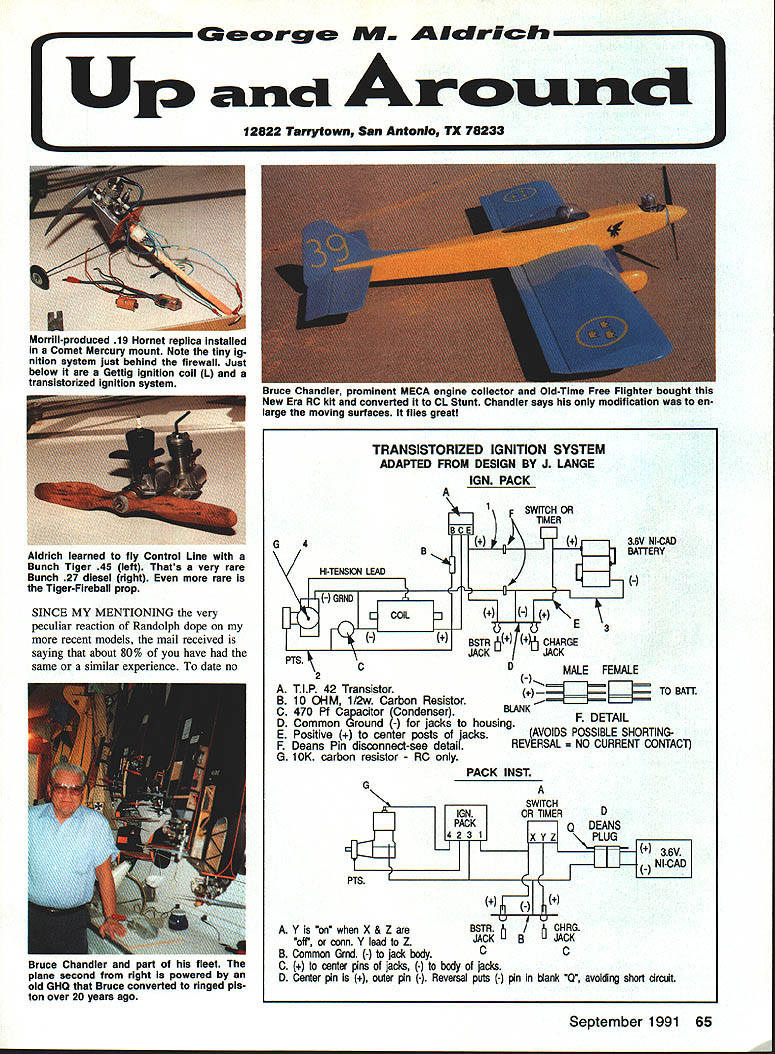
Transistorized Ignition System (adapted from design by J. Lange)
- A. T.I.P. 42 transistor
- B. 10 ohm, 1/2 W carbon resistor
- C. 470 pF capacitor (condenser)
- D. Common ground (-) for jacks to housing
- E. Positive (+) to center posts of jacks
- F. Deans pin disconnect — see detail
- G. 10K carbon resistor — RC only
Pack installation notes
- A. Y is "on" when X & Z are "off", or connect Y lead to Z.
- B. Common ground (-) to jack body.
- C. (+) to center pins of jacks, (-) to body of jacks.
- D. Center pin is (+), outer pin (-). Reversal puts (-) pin in blank "Q", avoiding short circuit.
Transcribed from original scans by AI. Minor OCR errors may remain.

