
Up and Around
George M. Aldrich
12822 Tarrytown, San Antonio, TX 78233
My first engine was a Super Atom, found under our Christmas tree in 1941. My fifth-grade class had sold magazine subscriptions throughout the school year to earn points toward a multitude of prizes. Alas, I had come up the equivalent of $1.75 short of my choice between the Atom or a Brownie .29. In the waning of those Depression years, $1.75 could just as well have been $17.50. As mothers will, mine arranged with the principal at my school to make up the difference. I got the little Atom to run and later built an American Ace .33 for it, but at 10 years old, and in a small town, I never flew it.
With the war years over, I finally got my first successful flights with a Spearhead Jr. That was 1946. Years later, when the Old-Timer movement evolved and SAM (Society of Antique Modelers) was formed, the first model I thought of was the Spearhead Jr. It was disappointing to find that this design was not legal as an Old-Timer since it wasn't kitted until after the cutoff date of December 31, 1942. Over the years a number of designs were put on the approved list after their designers came forward and substantiated that the model had been built and flown before that date.
With this in mind, I set out to find Jerry Stoloff, the designer of the Spearhead. It took almost a year, but I found Jerry in Florida. Jerry was able to prove its legality and both the Spearheads (Jr. and Sr.), plus a design called Yehudi that no one seemed to know existed, are now legal in SAM events. It was my great pleasure to meet and visit with Jerry Stoloff in Jean, Nevada at the 1991 SAM Champs and to see him inducted into the SAM Hall of Fame.
I was deeply involved in Free Flight, and it was also in 1946 that I saw my first CL contest and the first loop! Boy was I hooked. This was in Laredo, Texas, and I'd hitched a ride with the older guys—the ones 19 and 20 years old.
Now there was this older guy with a "goat." In those days, a goat was a Free Flight model that had been converted to U‑Control (CL), a la Jimmy Walker's Fireball. As a 14-year-old, I stood in awe as the guy flipped the prop on his Contestor D60R‑powered goat, took off, and did a real loop. I was really bitten, and I just had to do it, too!
That "older guy" turned out to be Russell Snyder, and he went on to win Senior Stunt at the 1946 Nationals. Russ went off to work at Northrop in 1946, but by 1949 he was in Olathe, Kansas with the Inglewood Flightmasters, the national champion club that year.
The 1949 Nationals was my first, and I naturally gravitated toward Russ. We wound up pitting for each other—he taking a third in Senior Stunt with little or no practice. The winner that year in Senior was Don Still. As I've said before, Don would have been the winner of the Walker Trophy had not the Novelty Stunt points been averaged with the Precision scores.
Both these fine pioneer stunt fliers flew their own designs, which, under our present method of recognition, are not legal for Old-Timer Stunt events. Surely it would be in order for our PAMPA organization to establish a design committee like that of SAM in order to (at least) consider documented designs for admittance to the Old-Timer Stunt list.
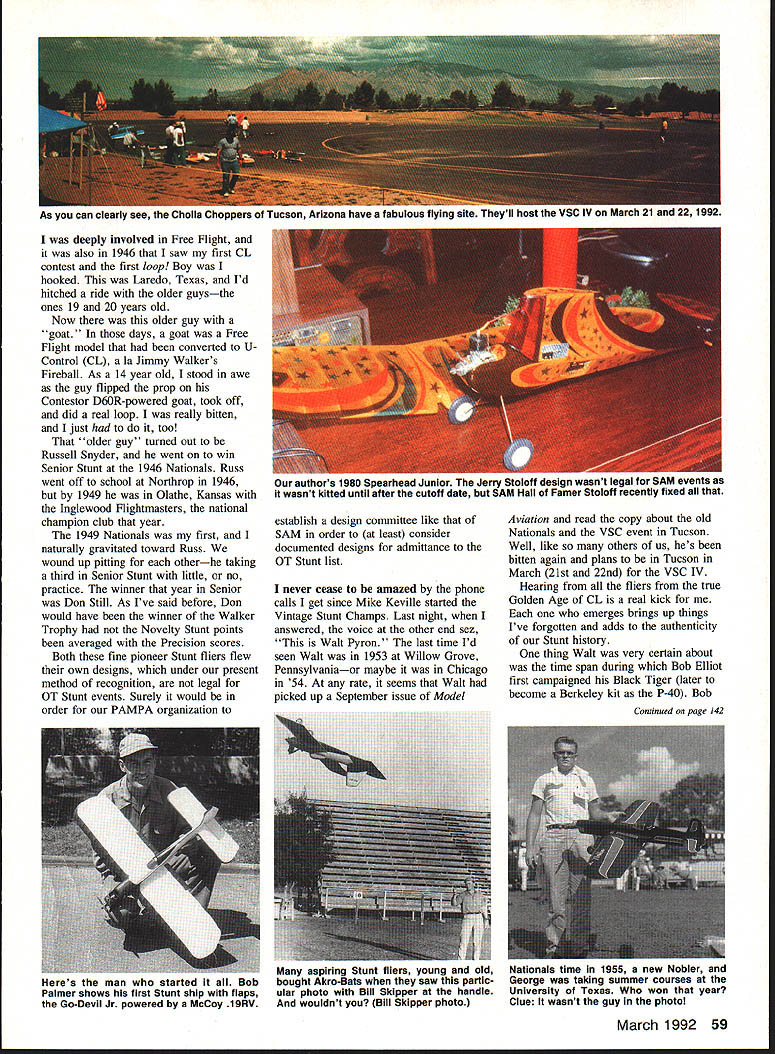
I never cease to be amazed by the phone calls I get since Mike Keville started the Vintage Stunt Champs. Last night, when I answered, the voice at the other end said, "This is Walt Pyron." The last time I'd seen Walt was in 1953 at Willow Grove, Pennsylvania—or maybe it was in Chicago in '54. At any rate, it seems that Walt had picked up a September issue of Model Aviation and read the copy about the old Nationals and the VSC event in Tucson. Well, like so many others of us, he's been bitten again and plans to be in Tucson in March (21st and 22nd) for VSC IV.
Hearing from all the fliers from the true Golden Age of CL is a real kick for me. Each one who emerges brings up things I've forgotten and adds to the authenticity of our stunt history. One thing Walt was very certain about was the time span during which Bob Elliot first campaigned his Black Tiger (later to become the Berkeley kit P‑40).
I started to suffer from the Nationals itch about June of 1955, and, even though I had a new ship, California was out of the question.
This particular Nationals was probably the only one for which a set of rules lasted only one year. I have no idea how it came to pass, but a spot landing was written into the rules. It only lasted that one year, for by 1956 it had been removed. If anyone recalls how all this came to pass, would you please share it with us?
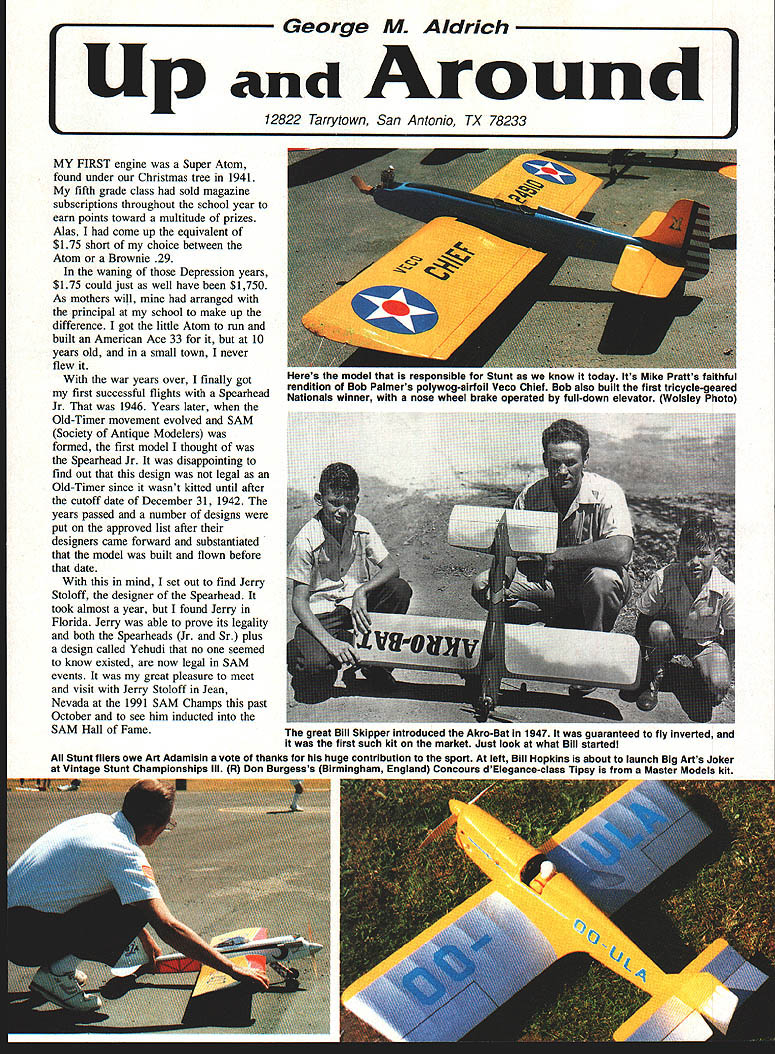
The great Bob Palmer was never one to pass up an opportunity. Bob built the first tricycle‑geared Nationals winner—with a nose wheel brake operated by full‑down elevator. He would paint that slick Thunderbird on the deck, roll it around and pop full down right on the spot.
I'm not sure what the points were, but Bob beat Joe Sabatini by 11 points and Clarence Lee, who was third, by 21 points. John Lenderman came in fourth at 331.3.
Bill Cummings won Senior that year flying his Nobler. I know it was a Nobler; I carried his cowling for him in 1954, and Bill only built one. He was still flying it in 1958! Bill won by 14.1 points over Larry Phillips and 36.1 points over James Ebenger, who was third.
A young man named Walton Pyron came in fifth—only 34.4 points behind. Walt is 53 now, and it was great to hear from him. I hope he brings a Blackhawk to Tucson.
Little Eddie May, Jr., came all the way from North Carolina to win Junior flying a Fox .35‑powered Thunderbird. He beat Rich Renwald by only 0.7 points!
One of Don Still's proteges, Cliff Woodruff from Beaumont, Texas, was third flying a Stuka kit with a Fox .29.
Probably no one else has done as much research on the history of our Stunt event as Wynn Paul. My sincere thanks to Wynn for forwarding copies of data he spent many years accumulating.
A great deal of my mail expresses more than a little consternation over the engines available today and how to select one for a given event or class. If there is enough interest, perhaps I could elaborate on how timing affects power and its intended use.
Contrary to what many seem to believe, a Schnuerle‑ported design can deliver more than just high speed or racing performance.
Organizations and Membership
- Model Engine Collectors Association (MECA), 3007 Travis, West Lake, LA 70669; $15/yr. U.S. and Canada; others $22 (U.S. dollars).
- Precision Aerobatics Model Pilots' Association (PAMPA), 1019 Creek Trail, Anniston, AL 36206; $15/yr. U.S.; Canada $20; others $25 (U.S. dollars).
- Society of Antique Modelers (SAM), Bob Dodds, 200 Summerside Ln., Encinitas, CA 92024; $15/yr., U.S. and all other countries; life $150.
For those of you who write and want a reply, please enclose a SASE. If you do, I will always answer. I also accept phone calls.
Transcribed from original scans by AI. Minor OCR errors may remain.

