
Up and Around
George M. Aldrich 12822 Tarrytown, San Antonio, TX 78233
Terminology: detonation, pre-ignition, pre-detonation
Several months ago I sort of redefined the wording used in most engine books to describe misfiring in our engines. Years ago, when I first started to study two-cycle design, the use of the term "detonation" for early firing of an engine bothered me. The word "detonation" means "to explode," and when the topic is "firing too soon," I prefer to use "pre-detonation" or "pre-ignition." According to engineering texts, those who disagree with me (only one person wrote about it) are technically correct. For our purposes, however, the phrases pre-detonation or pre-ignition are descriptive. Perhaps an English teacher among our readers will enlighten us as to which term is grammatically correct. I believe it was Churchill who said that England and America are bound together by an uncommon language!
Stunt engine setup — general assumptions
This is all leading up to a discussion about a couple of ways to set up a Stunt engine. I am assuming the engine under discussion is designed to provide the type of performance we want for Stunt—i.e., low blow-down timing and maximum hp/torque output at the lower rpm range.
Many such engines are made in countries that do not use nitromethane in their fuel. To get power from non-nitro fuels, these engines usually have wide squish bands, small combustion chambers, and high-compression heads. This sort of setup, coupled with a rather small venturi opening, usually produces adequate power without engine runaway.
Using nitro fuels may require adding head shims to help stop pre-ignition or cackle. Because various climatic conditions can also adversely affect this high-compression arrangement, some adjustment will be required as the weather varies. Such an engine will also run very hard because of its higher compression ratio.
The same engine can be set up to give adequate power while running easier and steadier, and it will be less likely to suffer the intolerable "runaway" we all try to avoid.
Squish band, compression and venturi tuning
Narrowing the squish band to something like .070–.080 in. enlarges the combustion chamber and reduces the compression ratio. That will steady the rundown and make the engine less sensitive to needle-valve settings, fuel, and weather changes. To regain the power lost by reducing compression, the venturi opening can be increased until the necessary power is obtained.
A little simple math can be used to determine the area of the venturi bore and allow adjustment/tuning to an optimum dimension. Engines set up in this manner will tend to run on four-cycle through the whole pattern, providing plenty of steady power. However, if an engine breaks into four-cycle mode at the wrong moment, it can cause the rounds to look like eggs.
Chrome-plated cylinders, pistons, and clearances
Several recent conversations have made me aware of a common misconception about chrome-plated cylinders and pistons. Many people seem to think chrome will run cooler because it is hard and slick. The opposite is true: a chromed cylinder set up with the same tolerances as a plain liner will run hotter.
In the old days a McCoy .60 used .0035 in. piston clearance. Chroming the cylinder while keeping the same tolerances would guarantee a 1,500-rpm loss. By increasing the piston clearance to .0045 in., one could achieve the power of a new engine and maintain that power much longer in service.
Today's metallurgy, with high-silicon alloys, has allowed manufacturers to close up these clearances. A ringed .60 will now come with as little as .0020 in. piston-to-cylinder clearance—unchromed. Chrome it, and it should become .001 in. larger.
Of course we're speaking of ringed engines here. The same concerns apply to ring-end gap:
- Standard setup: ring-end gap should be no less than .003 in.
- This tight setting requires very slow, careful break-in for the first hour of operation.
- Chrome-plated liner: ring-end gap should be at least .006 in.
- Again, run very carefully at first. Failure to open the end gap will result in the ring ends chipping in the ports or actually breaking in the ring groove.
Nobler, Flite Streak and the 1956–57 season
Drafting the Nobler kit
So much happened in the late 1956–1957 period that it's hard to remember the exact sequence of events. By August 1956 I was well into doing the complete drawings for the Nobler kit for Top Flite. As a layout draftsman, I drew all day, came home, and drew until midnight every night. This was the kit that was produced exactly as drawn by the designer.
In late September, just as I was finishing the final die layouts, Carl Wheeler called from AMA. It was a real SOS call: Carl needed someone to clean up the CL Precision Aerobatics rules for publication in December. Citing my heavy workload, I declined. Well, two calls later, Carl still had no one, and I relented. The next two nights went into the wee hours.
On the first night, I took out every loophole and replaced every "should" with "will" and every "could" with "shall." On the second night, I set the maneuvers and the sequence still in use today. Three glaring errors were neglected: we had no video cameras in those days, the square corner radii were left unchanged (the hourglass was impossible to perform as written), and I wrote the scoring as 0–40 points, not 10–40 as printed. My reasoning then, as today, is that a judge should be able to award as little as one point if a minimal attempt is made to perform a maneuver. But we'll play with that topic another time.
In December the first kit die cuttings arrived. A display model was built immediately and sent off to Chicago for photographs.
Flite Streak and early flight
Then Sid Axelrod called to ask whether I had something else they could kit. "Well, Sid, how about a simple model to compete with the Ringmaster business?" Sid said, "Have at it!" Thus the first Flite Streak was flown in January 1957. Since the plane was a bit nose-heavy, I went home and moved the wing forward one inch. I began a new version, but the drawings were shipped to Chicago before it was flown.
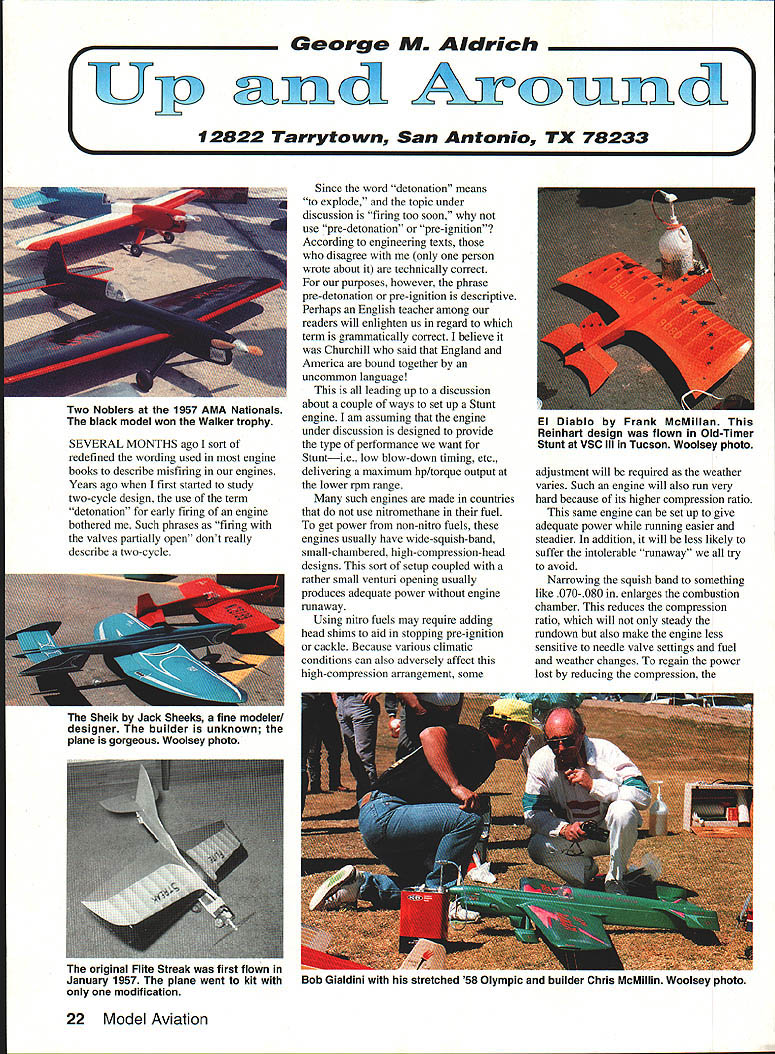
By April I was well into two new Noblers for the 1957 AMA Nationals. The planes were built from kit parts; the only changes I made were light blocks—carved and hollowed—used to replace the top and bottom sheeting.
Practice routine
May and June were practice time. My schedule was as follows:
- Get home by 5:30, load the car, and head to the park flying field.
- Try for 10 flights before dark; picnic suppers at dusk.
- Weekends: shoot for 50 flights a day; sometimes settle for 40.
- Go to sleep doing the pattern in your mind.
Modelers sometimes tend to be a little crazy.
The Nationals and the Walker trophy flyoff
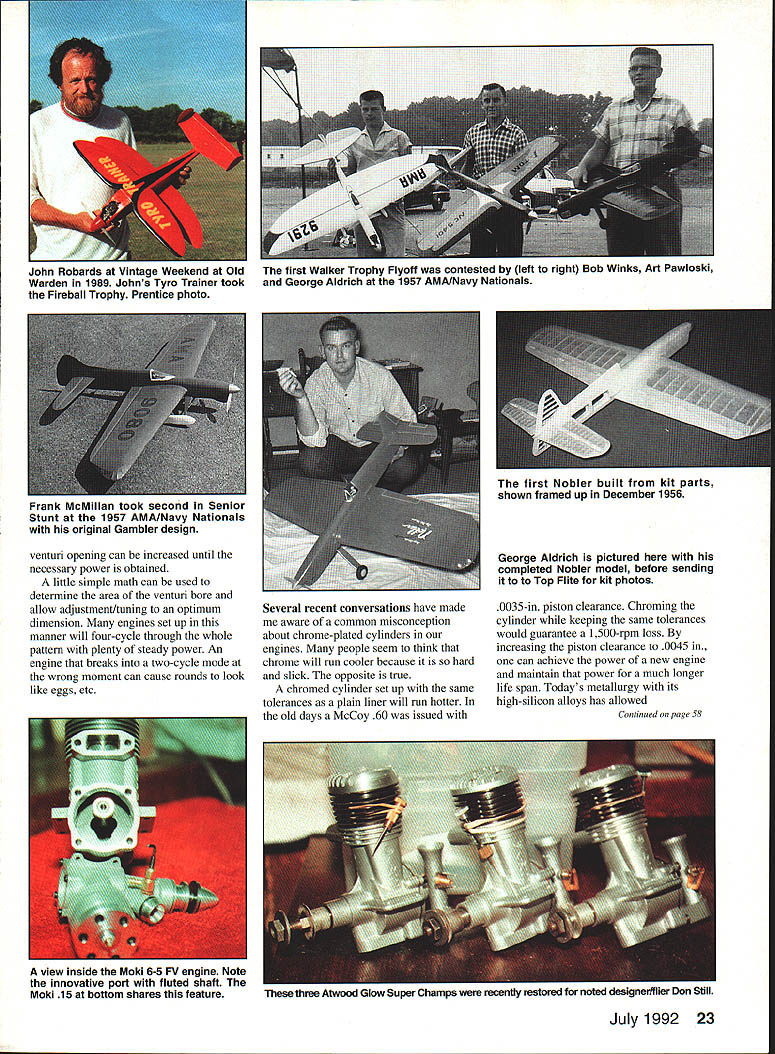
By July we arrived at Willow Grove NAS in Philadelphia. About midmorning I received word that the Nationals director, Maurice Teter, wanted to talk to me. He wanted to know if there was anything I could suggest on running the Stunt event. Thinking back to 1952, when all fliers flew in front of the same judges on the same day, and to 1956, when we didn't, you can guess my suggestion.
Maurice said, "We can't do that; we have too many in Junior, Senior, and Open." From this initial discussion came the first Walker trophy flyoff. Since the Open event was on Friday, it was decided that the winner from each age group would fly on Saturday morning to decide the National Stunt Champion.
During that entire week I burned most of a gallon of Fox Superfuel each day, and each night Sid would come by with a fresh gallon. I was torn between my two ships. The black-trimmed red model grooved better, but each landing was a panic situation. The gold, white, and red ship flew reasonably well, but landings were unbelievable: I could bring it in slow, flare a bit, and the wheels would just start rolling.
That night in Rollie McDonald's motel room, I decided on the black Nobler. Rollie had experienced motor run problems that day, so while he repaired the canopy on my model, I built a tank for his model.
During the week, Pete Peters brought the Navy officer judges out to watch various practice flights while he trained them. On one of the days, I suggested they walk out into the circle and see a pattern from the pilot's view. This proved a revelation to them, as they seemed to understand so much better after just one flight.
Open Stunt day proved not unlike many others in subsequent years. One circle was considerably higher in scoring than the other. In those days the best single flight won, so you'd do better not to blow it on the high circle. All the hard work paid off, however, as we scored highest on both circles. I say "we" in truth, for a young senior contestant named Frank McMillan came out to practice each day with me. We critiqued each other all week, and he helped a lot in my shaping of the new hourglass maneuver.
Gerald Wagner placed a close second, scoring 610 points to my 618. Gerry flew a modified Chief called Black Midnight, with a Torp .35 up front. Rolland McDonald was a solid third with his big Strathmore.
Frank went on to place just behind Senior winner Art Pawloski. Art flew his own Detroiter-influenced Atom design, while Frank had his original Gambler, later to be published in Model Airplane News. Bob Winks topped all in the Junior event flying a modified Palmer Thunderbird.
We arrived at the Stunt circles Saturday morning to misting rain. As I remember, Art Pawloski was first up and the rain increased during that first flight. About the only thing I recall, other than winning my second Walker trophy, was using my finger as a windshield wiper to clear the water from my glasses.
My decision to fly the black Nobler proved more than correct—it was fated. On Sunday, while I was flying a demonstration before thousands of spectators, the bellcrank in my other model came loose and it smashed into the concrete!
Final notes and contact
When you write and want a reply, please enclose a SASE. If this is done, I will always answer. I will accept phone calls, but please don't call if writing will suffice—I do have a business to run.
Address: 12822 Tarrytown, San Antonio, Texas 78233 Phone: (512) 656-2021 The fax answers after six rings.
Transcribed from original scans by AI. Minor OCR errors may remain.

