
Up and Around
George M. Aldrich 12822 Tarrytown, San Antonio, TX 78233
Dreamland for modelers
Many things can jog modelers' memory banks and send them off into dreamlands of fond memories. Nothing does it quicker for this pilot than thumbing through old model magazines.
Because of the thoughtfulness of a very kind reader, I recently received a large box of old mags dating from 1936 through 1944:
- Popular Aviation with Lindbergh's Hughes Racer
- Air Trails with Carl Goldberg's Valkyrie
- Model Airplane News with Sal Taibi's Powerhouse
What a trip! But it's the musty aroma that wafts up with every page you turn that sets it all off. In retrospect, I can only think of how fortunate I am to have been associated for more than a half-century with an avocation that has such a positive image.
During these more than 50 modeling years, your scribe has come to realize that — more than the flying, more than the prizes won, more than anything else — the people I have met along the way count most of all. For without the people in your life, what would any of it mean?
The Adamisin family
Which brings me to the 1964 AMA Nationals, where I was Event Director for Precision Aerobatics. I was approached by the father of one of the Junior contestants with a question about the rules. After I had explained the particular point, he seemed satisfied, and off they went.
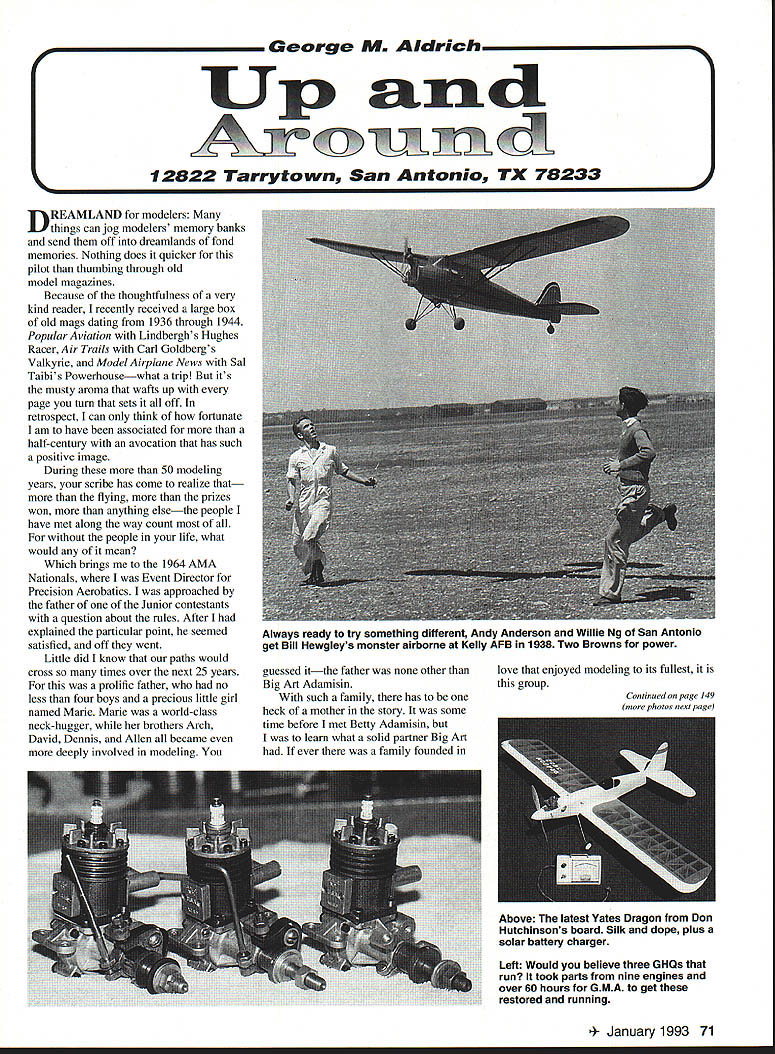
Little did I know that our paths would cross so many times over the next 25 years. For this was a prolific father, who had no less than four boys and a precious little girl named Marie. Marie was a world-class neck-hugger, while her brothers Arch, David, Dennis, and Allen all became even more deeply involved in modeling. You guessed it — the father was none other than Big Art Adamisin.
With such a family, there has to be one heck of a mother in the story. It was some time before I met Betty Adamisin, but I was to learn what a solid partner Big Art had. If ever there was a family founded in love that enjoyed modeling to its fullest, it is this group.
Their contributions and accomplishments are legend, but Big Art didn't have to make me feel so old. Somewhere in these pages you will find a photo of Archie Adamisin III — yes, Big Art's grandson — with his first-place Advanced-class Nationals winner. It's hard to believe that little Junior of 1964 spawned such a model. I know there is another good mother there, too!
Control-line resurgence
These past few months, the mail has included comments from many who have just returned to control line. For whatever reason, their recent return, when added to those of us who have endured, leads me to believe that there is a large, often quiet, but ever-growing contingent among us.
What has brought about this resurgence? Looking back at my own experiences over the past years brought these observations. From the neophyte years of learning patience with 1/16-sq strips to the WWII years of rationing and scarcity of materials; then the early postwar years — every corner you turned was a pioneering experience. Since there was no previous history to draw upon, almost everything was totally off the wall.
In Stunt this atmosphere continued well into the late 1950s. As the models became more sophisticated and some builders spent an entire year finishing one model, interest began to wane. Whether it was the pressure of trying to contend with those fabulous finishes, the ever-increasing demands of family and job, or the entry of dependable RC equipment, CL activity dropped off.
Today, few major manufacturers still offer CL kits, and those that do are forced to charge 10 times the original price because of the low volume. Fortunately, stunt fliers have PAMPA (Precision Aerobatic Model Pilots Association), which publishes Stunt News. Dues are $15 per year U.S., $20 Canada, $25 other nations; the address is 1019 Creek Trail, Anniston, AL 36206. Almost all cottage industries that have products or services to offer advertise in this publication.
What has brought about the renewed interest in CL? A few key factors:
- John Miske, of the Garden State Circle Burners, started the revival early on.
- Mike Keville's idea of a Vintage Stunt Championships got things going on a national basis.
But just having a contest doesn't account for the numbers, worldwide, who have cleared off the building board to build CL models again. There can be no single reason, but certainly sharing a common interest in a simpler, less complicated activity is an added incentive for so many of various ages to become involved.
Lest you think that PAMPA is only for the elite competitor, take heart, for over 50% belong simply because they love CL Stunt. Whatever your inclination, the best way to describe Stunt News is "Stunt spoken here"!
As with any organization, you get out of it in direct proportion to what you put into it. If everyone just talks and never contributes, the source will eventually run dry; this applies to our government, our AMA, or anything that affects you. If you don't like something that is occurring, don't just gripe — get involved and offer something constructive.
To your writer, the last reason to belong to your AMA is to obtain insurance. It is so many other things to each of us, but most of all it is our "Voice of Model Aviation" to our country and the rest of the world. If you don't care for what is being said, speak to your elected officer. If nothing else works, vote him out or run for office yourself. But get involved!
Ignition and batteries — basics
So many either phone or write asking questions about the operation of an engine or spark ignition that perhaps a discussion of some basics is in order. The biggest single source of trouble is not having fresh batteries.
Unless you can start your engine in one or two flips, plan on using a booster system for starting. It's your choice whether to use Ni-Cds or regular dry cells. The initial cost of Ni-Cds is considerably higher, but they offer a greater degree of flexibility. If you use a transistorized circuit, Ni-Cds offer an added advantage.
With the Lange System ("Up and Around," in the September '91 MA), the T.I.P. 42 transistor knocks the 3.6V going in to about 2.8V coming out to the coil. This is an added safety factor for coils designed for 3V maximum. Using only two Ni-Cds (2.4V) is marginal power, and if your choice is to use only two cells, it is best to stay with dry cells.
To save weight, I use a three-pack of half-A-size Ni-Cds, which will run an engine about 30 minutes from a fresh charge after it is started. I also use a booster battery made up of three C-size Ni-Cds to start my engines. When the points are closed and the system is turned on (i.e., booster connected or switch/timer on), the coil and batteries are in a direct short. Leaving the system on with the points closed will result, at the least, in the batteries being drained, and more than likely in the coil being burned up.
Another thing about Ni-Cd batteries is how to charge them. Ni-Cds are charged at a rate of 10% of the cell rating. My half-A-size Ni-Cds are considered to have a 250-milliamp (mA) rating; therefore they are charged at a 25-mA rate for 24 hours.
Fast charging at the field
Another method of charging Ni-Cds has proven invaluable to the flying field. Some years ago — at the DCRC Symposium, I think — a paper was presented that indicated that almost any Ni-Cd battery could withstand high charge-impulse rates of DC without damage.
Since that time a number of chargers have been offered that utilize such a system. However, most of these are set to rates that correspond to the battery packs in RC units, too high for our setup. To date, the only fast charger I know of is the TRC Impulse II unit.
TRC engineering, P.O. Box 10972, 10th St., Grand Rapids, MI 49504; tel.: (616) 453-8527.
The TRC charger allows you to charge any Ni-Cd or lead-acid battery, from 1.2V to 14V, to within 90% of capacity in a very short time. The unit comes with a plug for your car cigarette lighter.
My flying box has such a receptacle mounted on it so that I can use my 12V starter battery to recharge my Ni-Cds on the field. Another problem that gave me trouble for a long time is the old aluminum battery boxes — don't use them; they short out very easily. When I come in from flying, the first thing I do is put my Ni-Cds on the slow charger so that they are brought up to full capacity. Also, batteries are heat sensitive. They are a lot happier if kept cool.
Troubleshooting spark and starting
Considering that I now have a good battery source, why in the heck won't my engine start? The first thing to do is take the spark plug out and reconnect the high-tension lead. Now lay it on top of the cylinder head, and turn the prop over briskly. You should be able to see the plug spark with every rotation. If it doesn't, make sure the points are closing and clean them. If this doesn't present a spark at the plug with every rotation, change to a new plug.
Any further failure leaves the coil or condenser suspect. With a transistorized circuit like the Lange, the condenser cannot be the problem, as it is in the circuit only to meet the SAM rules that require a coil and condenser.
Failing to get your engine running after all the above procedures? Just screw in a glow plug! Even with 2:1 or 3:1 gas and oil (70-wt. oil), an engine will run on a glow plug if the battery is connected. Often, finding the correct mixture setting, with a glow plug/battery assist, solves all the problems.
A strange transistor/plug issue
There is a freak occurrence, with the Lange transistor system at least, for which I can find no reason or solution. It occurs only with the large NGK CM-6 plug, not with the old Champion V plugs. This is the situation as I have found it: my Anderson Spitfire will not start until I advance the spark past the 45° position, and my Orwick .64s won't start at all. This occurs with the CM-6 plug only. I can replace it with a Champion plug, and both engines start immediately.
Of course the major problem is that my old Champion plugs are so old that they are dying. And the NGK CM-6 is a super plug, being very resistant to fouling. My solution to the Anderson problem is just to lock the points in the full-advance position and use an electric starter. For the Orwicks, which are not engines to use an electric starter on anyway, I use a standard ignition setup. There has been no problem using the transistor system with engines that use the smaller V-3 or V-2 sizes. If any of you electrical whizzes can explain this problem or offer a solution, it would be a big help to us all.
In memoriam
Many of us who have been in the hobby for a long time are familiar with the Hot Rock CL Handle and E-Z Just motor mount made for many years by Red Phillips. I learned only recently that Red has passed on to the land of tight lines and calm breezes. How well I remember Red at the '49 Nationals pointing out that my Stuntwagon .30 was too darned heavy. Red hauled young modelers to contests in those days, with no thought of remuneration.
I was also recently informed of the passing of Bill Cummings in a forklift accident this past year. A great stunt flier, Bill won the Walker Trophy in 1956.
Events and products
Once again, Rosie Reinartz and I made the trek across most of five states to attend the Five Flags meet in Pensacola, Florida, last June 20–21. Tom McLaughlin, Bob Junk, Norm Byrd, Olin Tisdale, and the rest of their group put on what is my choice as the most pleasant competition I've ever flown in. Having a square mile of mowed grass and perfect weather doesn't hurt, either. Great job, guys!
Did you ever hear of water-based epoxy paint? Well, I hadn't, but I intend to try it.
John Ramsden of RAM Model Products, 730 Badger Drive NE, Palm Bay, FL 32905, has a wide variety of colors and can mix any color you want. What really got my attention, though, is that after 72 hours you can put any kind of clear coat over it, and it will not peel or separate. I have a Custom Models (5515 Bridgeton Dr., Arlington, TX 76018) profile Nobler that is almost ready to paint with the RAM epoxy, and I'll report on it in a future issue. What's really interesting is that you can thin it with up to 10% water and use water to clean up the spray gun.
Contact
For those of you who have written and sent SASEs, you know I answer my mail. I have added a fax machine at (512) 656-2021. It will answer after six rings; hang up after five, and you won't be charged if I'm away.
Transcribed from original scans by AI. Minor OCR errors may remain.

