
Another Approach to Engine Starting
By Al Lidberg
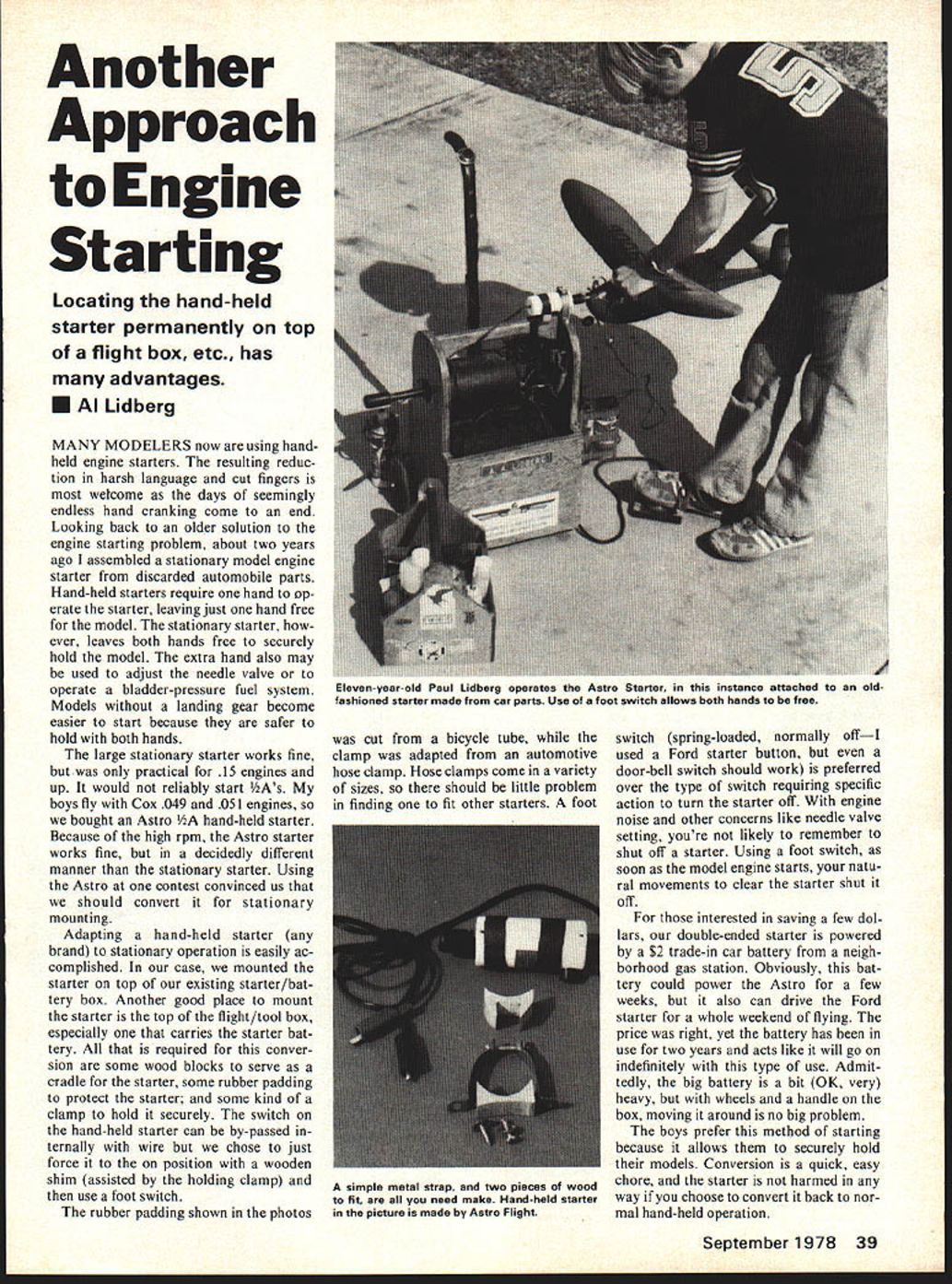
Many modelers now are using hand-held engine starters. The resulting reduction in harsh language and cut fingers is most welcome as the days of endless hand cranking come to an end. Looking back to an older solution to the engine-starting problem, about two years ago I assembled a stationary model engine starter from discarded automobile parts.
Hand-held starters require one hand to operate the starter, leaving just one hand free for the model. A stationary starter, however, leaves both hands free to securely hold the model. The extra hand may also be used to adjust the needle valve or to operate a bladder-pressure fuel system. Models without landing gear become easier to start because they are safer to hold with both hands.
The large stationary starter I originally built works fine, but was only practical for .15 engines and up; it would not reliably start 1/2A engines. My boys fly with Cox .049 and .051 engines, so we bought an Astro A2A hand-held starter. Because of the high rpm, the Astro starter works fine, but in a decidedly different manner than the stationary starter. Using the Astro at one contest convinced us that we should convert it for stationary mounting.
Converting a hand-held starter to stationary use
Adapting a hand-held starter (any brand) to stationary operation is easily accomplished. In our case, we mounted the starter on top of our existing starter/battery box. Another good place to mount the starter is the top of the flight/tool box, especially one that carries the starter battery.
Required for the conversion:
- Wood blocks to serve as a cradle for the starter
- Rubber padding to protect the starter
- A clamp to hold it securely
All that is required for this conversion are some wood blocks to serve as a cradle for the starter, some rubber padding to protect the starter, and some kind of clamp to hold it securely. The switch on the hand-held starter can be bypassed internally with wire, but we chose to force it to the ON position with a wooden shim (assisted by the holding clamp) and then use a foot switch.
The rubber padding shown in the photos was cut from a bicycle tube, while the clamp was adapted from an automotive hose clamp. Hose clamps come in a variety of sizes, so there should be little problem finding one to fit other starters.
Foot switch and operation
A foot switch (spring-loaded, normally off — I used a Ford starter button, but even a door-bell switch should work) is preferred over the type of switch that requires a specific action to turn the starter off. With engine noise and other concerns like needle-valve setting, you're not likely to remember to shut off a starter. Using a foot switch, as soon as the model engine starts, your natural movements to clear the starter shut it off.
Power source
For those interested in saving a few dollars, our double-ended starter is powered by a $2 trade-in car battery from a neighborhood gas station. Obviously, this battery could power the Astro for a few weeks, but it also can drive the Ford starter for a whole weekend of flying. The price was right; yet the battery has been in use for two years and seems likely to go on indefinitely with this type of use. Admittedly, the big battery is a bit (OK, very) heavy, but with wheels and a handle on the box, moving it around is no big problem.
The boys prefer this method of starting because it allows them to securely hold their models. Conversion is a quick, easy chore, and the starter is not harmed in any way if you choose to convert it back to normal hand-held operation.
Transcribed from original scans by AI. Minor OCR errors may remain.

