
Anyone for Autogiros?
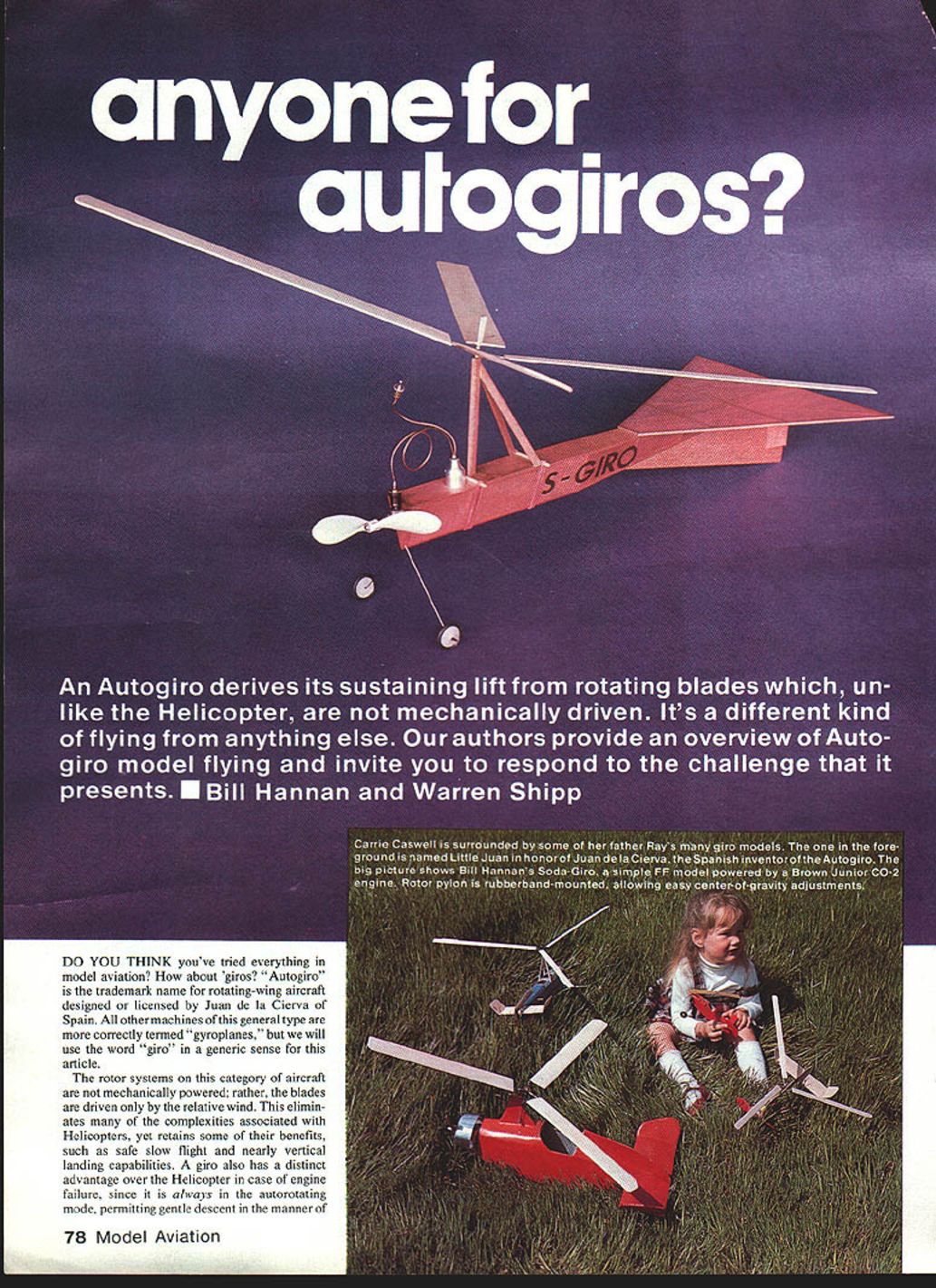
An Autogiro derives its sustaining lift from rotating blades which, unlike the helicopter, are not mechanically driven. It's a different kind of flying from anything else. Our authors provide an overview of Autogiro model flying and invite you to respond to the challenge that it presents. — Bill Hannan and Warren Shipp
Do you think you've tried everything in model aviation? How about "giros"? "Autogiro" is the trademark name for rotating-wing aircraft designed or licensed by Juan de la Cierva of Spain. All other machines of this general type are more correctly termed "gyroplanes," but we will use the word "giro" in a generic sense for this article.
The rotor systems on this category of aircraft are not mechanically powered; rather, the blades are driven only by the relative wind. This eliminates many of the complexities associated with helicopters, yet retains some of their benefits, such as safe slow flight and nearly vertical landing capabilities. A giro also has a distinct advantage over the helicopter in case of engine failure, since it is always in the autorotating mode, permitting gentle descent in the manner of a parachute almost automatically.
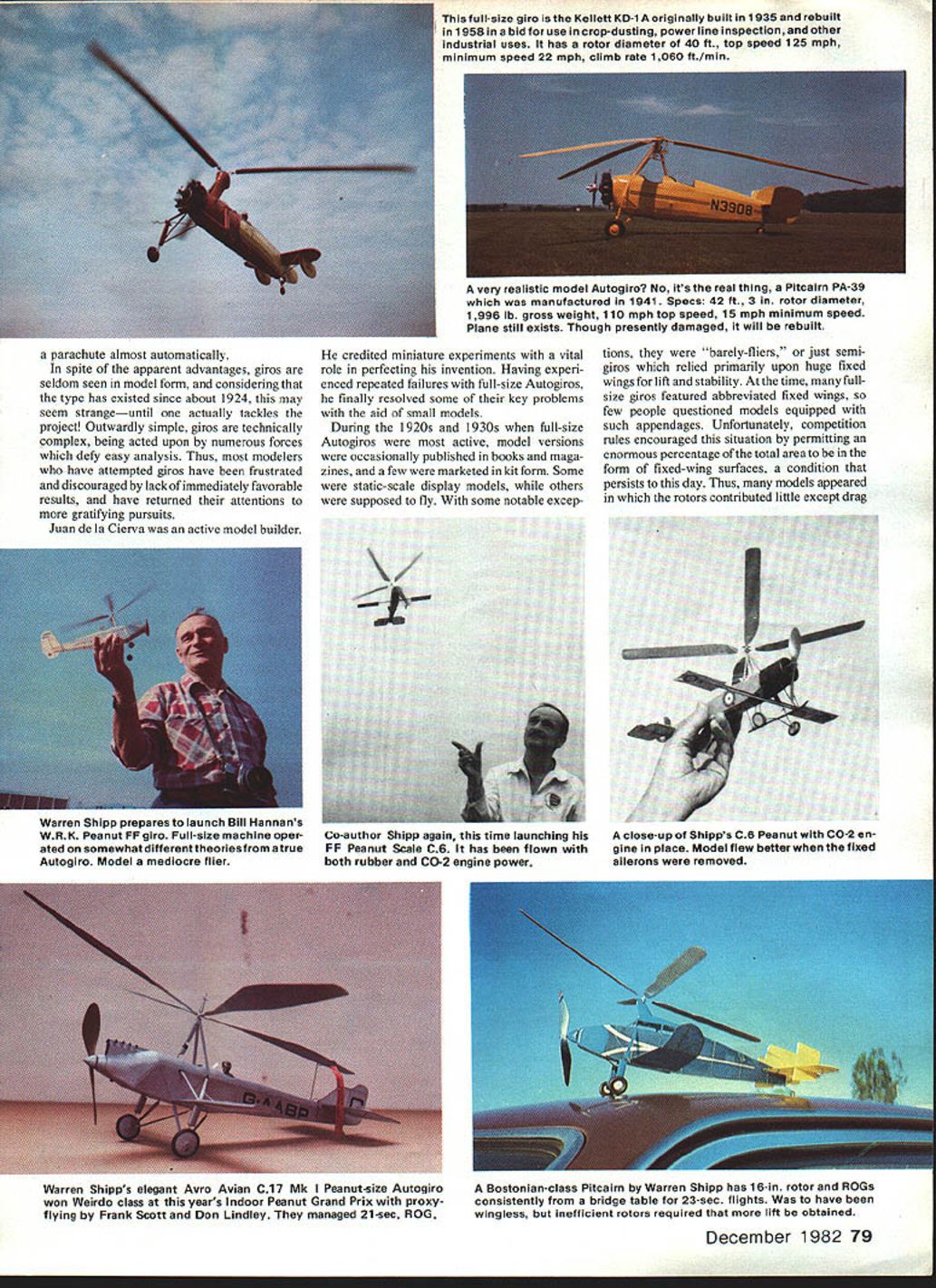
In spite of the apparent advantages, giros are seldom seen in model form, and considering that the type has existed since about 1924, this may seem strange—until one actually tackles the project! Outwardly simple, giros are technically complex, being acted upon by numerous forces which defy easy analysis. Thus, most modelers who have attempted giros have been frustrated and discouraged by lack of immediately favorable results, and have returned their attentions to more gratifying pursuits.
Juan de la Cierva was an active model builder. He credited miniature experiments with a vital role in perfecting his invention. Having experienced repeated failures with full-size Autogiros, he finally resolved some of their key problems with the aid of small models.
During the 1920s and 1930s, when full-size Autogiros were most active, model versions were occasionally published in books and magazines, and a few were marketed in kit form. Some were static-scale display models, while others were supposed to fly. With some notable exceptions, they were "barely-fliers," or just semi-giros which relied primarily upon huge fixed wings for lift and stability. At the time, many full-size giros featured abbreviated fixed wings, so few people questioned models equipped with such appendages. Unfortunately, competition rules encouraged this situation by permitting an enormous percentage of the total area to be in the form of fixed-wing surfaces, a condition that persists to this day. Thus, many models appeared in which the rotors contributed little except drag.
Wingless giro models did come forth from time to time, but they apparently became lost in the shuffle. It remained for Louis Garami, one of the most versatile model designers of all time, to openly blow the whistle on the long-term semi-giro sham. Garami bluntly pointed out in his 1946 Air Trails Model Annual article that some record-holding models would fly with their rotors removed, but not without their fixed wings! He then proceeded to explain and demonstrate the efficiency of his wingless example.
Other wingless giros have been published since then, but when was the last time you saw one at your local flying site? Doubtless giros are more difficult to understand and adjust than conventional models, but they can be tamed, and they do offer great fun and satisfaction in the process. Besides, the "non-successes" may help to keep us humble!
We don't pretend to have all of the answers—or even all of the questions; we cannot present iron-clad success formulas, but only opinions. However, we have managed to achieve satisfactory flights with a variety of designs, and have compared notes with several other giro enthusiasts. May we share our experience and encourage you to try giros?
One should not expect "instant gratification" with a first attempt, but a patient, willing experimenter can be amply rewarded for his efforts in learning about the breed. You may care to consider one or more of the following categories:
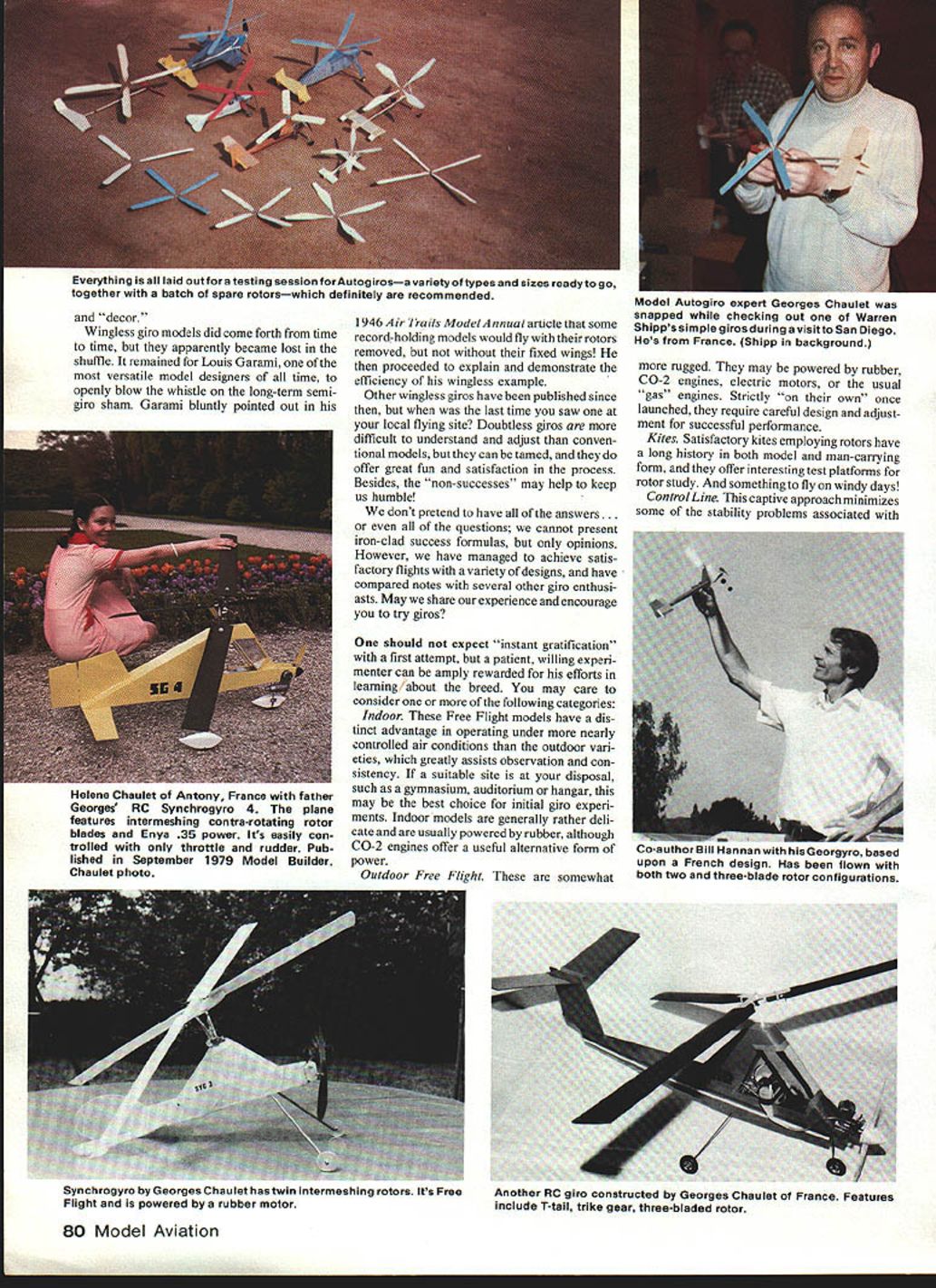
- Indoor. These free-flight models have a distinct advantage in operating under more nearly controlled air conditions than the outdoor varieties, which greatly assists observation and consistency. If a suitable site is at your disposal, such as a gymnasium, auditorium, or hangar, this may be the best choice for initial giro experiments. Indoor models are generally rather delicate and are usually powered by rubber, although CO₂ engines offer a useful alternative form of power.
- Outdoor Free Flight. These are somewhat more rugged. They may be powered by rubber, CO₂ engines, electric motors, or the usual "gas" engines. Strictly "on their own" once launched, they require careful design and adjustment for successful performance.
- Kites. Satisfactory kites employing rotors have a long history in both model and man-carrying form, and they offer interesting test platforms for rotor study. And something to fly on windy days!
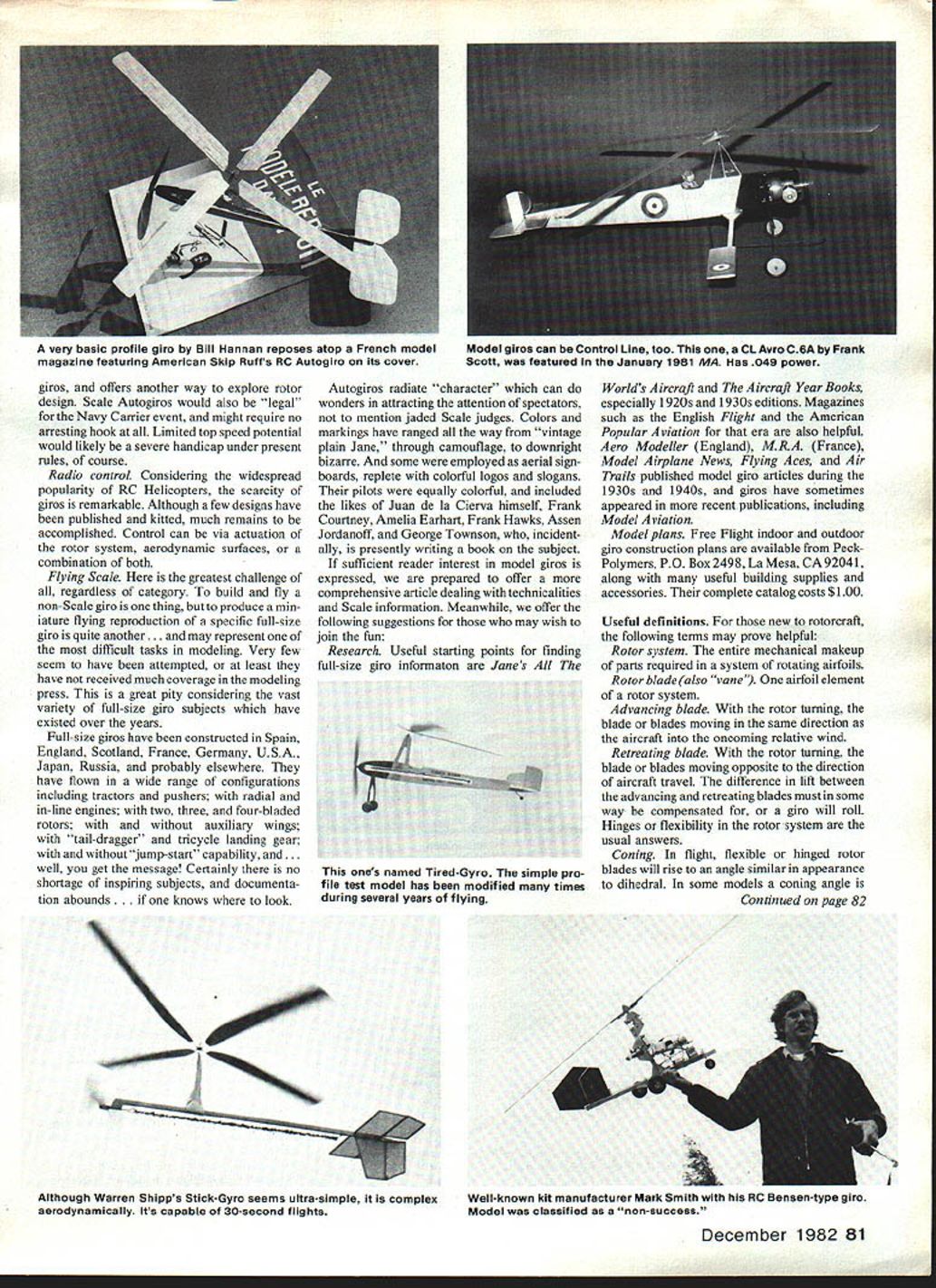
- Control Line. This captive approach minimizes some of the stability problems associated with radio-control giros, and offers another way to explore rotor design. Scale Autogiros would also be "legal" for the Navy Carrier event, and might require no arresting hook at all. Limited top speed potential would likely be a severe handicap under present rules, of course.
Radio control
Considering the widespread popularity of RC helicopters, the scarcity of giros is remarkable. Although a few designs have been published and kitted, much remains to be accomplished. Control can be via actuation of the rotor system, aerodynamic surfaces, or a combination of both.
Flying scale
Here is the greatest challenge of all, regardless of category. To build and fly a non-scale giro is one thing, but to produce a miniature flying reproduction of a specific full-size giro is quite another—and may represent one of the most difficult tasks in modeling. Very few seem to have been attempted, or at least they have not received much coverage in the modeling press. This is a great pity considering the vast variety of full-size giro subjects which have existed over the years.
Full-size giros have been constructed in Spain, England, Scotland, France, Germany, the U.S.A., Japan, Russia, and probably elsewhere. They have flown in a wide range of configurations including tractors and pushers; with radial and in-line engines; with two-, three-, and four-bladed rotors; with and without auxiliary wings; with "tail-dragger" and tricycle landing gear; with and without "jump-start" capability; and more. Certainly there is no shortage of inspiring subjects, and documentation abounds—if one knows where to look.
Autogiros radiate "character" which can do wonders in attracting the attention of spectators, not to mention jaded scale judges. Colors and markings have ranged all the way from "vintage plain-Jane," through camouflage, to downright bizarre. And some were employed as aerial signboards, replete with colorful logos and slogans. Their pilots were equally colorful, and included the likes of Juan de la Cierva himself, Frank Courtney, Amelia Earhart, Frank Hawks, Assen Jordanoff, and George Townson, who, incidentally, is presently writing a book on the subject.
If sufficient reader interest in model giros is expressed, we are prepared to offer a more comprehensive article dealing with technicalities and scale information. Meanwhile, we offer the following suggestions for those who may wish to join the fun:
Research
Useful starting points for finding full-size giro information are Jane's All the World's Aircraft and The Aircraft Year Books, especially 1920s and 1930s editions. Magazines such as Flight (England) and Popular Aviation (U.S.) for that era are also helpful. Aero Modeller (England), M.R.A. (France), Model Airplane News, Flying Aces, and Air Trails published model giro articles during the 1930s and 1940s, and giros have sometimes appeared in more recent publications, including Model Aviation.
Model plans
Free-flight indoor and outdoor giro construction plans are available from Peck-Polymers, P.O. Box 2498, La Mesa, CA 92041, along with many useful building supplies and accessories. Their complete catalog costs $1.00.
Useful definitions
- Rotor system: The entire mechanical makeup of the parts required in a system of rotating airfoils.
- Rotor blade (also "vane"): One airfoil element of a rotor system.
- Advancing blade: With the rotor turning, the blade or blades moving in the same direction as the aircraft into the oncoming relative wind.
- Retreating blade: With the rotor turning, the blade or blades moving opposite to the direction of aircraft travel. The difference in lift between the advancing and retreating blades must in some way be compensated for, or a giro will roll. Hinges or flexibility in the rotor system are the usual answers.
- Coning: In flight, flexible or hinged rotor blades will rise to an angle similar in appearance to dihedral. In some models a coning angle is built into the rotor system.
Blade incidence
The chord-wise angular setting of each rotor blade. Although full-size giros employ slight positive incidence, model giros generally require negative blade incidence (leading edges lower than trailing edges).
Rotor disc incidence
The angular setting of the entire rotor system. In model form, the disc is generally tipped slightly rearward.
Disc area
In full-size giro engineering computations, the entire area swept by the rotor blades is considered lifting surface.
Solidity factor
The total area of the rotor blades relative to the disc area. It would appear that the area of the blades is of much greater importance in model giros than in full-size practice.
Model objectives
The development of successful model giros in which the following goals are met:
- Stability and lift are obtained from unpowered rotor systems.
- The craft should be stable in all conditions of flight.
- It should be consistent in performance, with a predictable pattern of flight.
- Duration should be ample for adequate flight evaluation.
- Model should be relatively easy to construct and adjust.
- Models should be easy to repair. (They will crash.)
Suggestions: 1) Start small; 2) Stay simple; 3) Build light; 4) Be patient and persistent; 5) Keep records.
Power
Dependability will greatly simplify experiments. Here is our order of preference:
- Rubber
- CO₂
- Electric
- Diesel
- Glow
Suggested design parameters
- Models employing two separate rotor systems are easier to fly, but single-rotor-system models are more challenging to the imagination. Also, the vast majority of full-size giros have employed a single-rotor system.
- Short rotor diameter relative to overall model length seems easier to adjust and fly.
- Although stiff rotor systems can be made to work, flexible or hinged systems are most frequently employed.
- Flat or flat-bottom airfoil rotor blades are suitable. (Small models can employ simple sheet-balsa blades.)
- Four-blade systems are easier to fly than three-blade layouts; three-bladers are much easier to fly than two-bladers.
Mechanical considerations
- Design to permit ease of adjustments.
- Arrange for easy parts replacement, especially rotor components.
Initial trim setup
Virtually any model giro will undergo adjustments before it will fly satisfactorily (some never do!). But these "ball-park" settings may serve as useful starting points:
- Rotor blades: 2° to 4° negative incidence.
- Rotor mast axle angle: 4° to 10° aft of vertical (2° to 3° of side tilt may also be employed in some instances).
- Center of gravity: located at or near a line projected downward along rotor axle axis.
- Stabilizer: set at 0° or slight "down" elevator (a lifting-section stabilizer is sometimes employed).
- Propeller thrust line: at 0° or 2° to 3° downthrust. If rotor turns clockwise (as viewed from the top), adjust model for right-hand flight circle. If rotor turns counterclockwise, adjust model for left-hand flight circle. Although some builders feel strongly one way or the other, we have successfully flown models of both types.
Testing (relatively small models only)
Start a test glide by walking into the wind (if any) with the model's nose held high. When rotor has reached high rpm, level the model and drop it (don't throw). It should settle nearly vertically. For power tests, start with fairly low power, walk to bring rotor up to flying speed, level model and gently launch. Rotor must have sufficient rpm to generate proper lift and roll resistance. Rise-off-ground starts are difficult even when the model has been properly adjusted—very unlikely to be successful in an untrimmed model.
Possible adjustments
To increase rotor rpm, try:
- More negative blade incidence.
- Greater mast angle.
- Different blade airfoil.
Thrust-line offsets and rudder angles may be used to assist turn-circle adjustment, although in some designs rudder adjustment may have little effect. Elevators may be used as ailerons to help resist roll and to help adjust model's turn circle.
Changes in propeller diameter and pitch can have profound effects on both stability and performance. Low-pitch props are generally preferred.
Center-of-gravity changes can be useful "cures," including offset weight, such as ballast added to a landing-gear leg, to assist turn.
Important: Not all "experts" agree. Often there are several possible solutions to a trim problem, so don't be afraid to experiment! But make only one adjustment at a time. Cures which work for your conventional models may not always do the job with giros. And contrary to some expressed opinions, giros can stall and spiral-dive. Above all, try not to become discouraged—failures can be educational, too. There are many question marks, contradicting theories, and missing links in the model giro field.
Grateful thanks to the following individuals who have contributed either directly or indirectly to this undertaking: Georges Chaulet (France); P.T. Capon and John Blagg (England); Ray Caswell, Fred Weitzel, Skipp Ruff, and Jack Headley (U.S.A.); and the late J.D. Gillies of Scotland.
We hope that some of you readers will respond to the challenge, produce some fresh answers, and let your comrades in the whirly world of giros know of your successes and failures. Come, let us go forth and break blades together!
Transcribed from original scans by AI. Minor OCR errors may remain.

