
Anything Can Fly (Given Half a Chance)
Duke Iden
Ducks, surfboards, irons, and shirts—Glenn Stucker can make anything but a pterodactyl fly. Our author tells us how it's done.
The Man and His Machines
Say, fellow RC flier, do you really want to prove a point to the guy in your club who believes you must have only AAA contest balsa in a master craftsman kit, as well as a multi‑cylinder four‑cycle engine and a computer radio that takes an engineering degree from MIT, in order to have something to fly? You say you really want to show this yuppie/hobbyist what the basics are all about? Show him that even the outhouse door can fly? Well, read on.
A man in Westchester, Ohio has been doing this for the past 10 years, and he's enjoyed every minute of it.
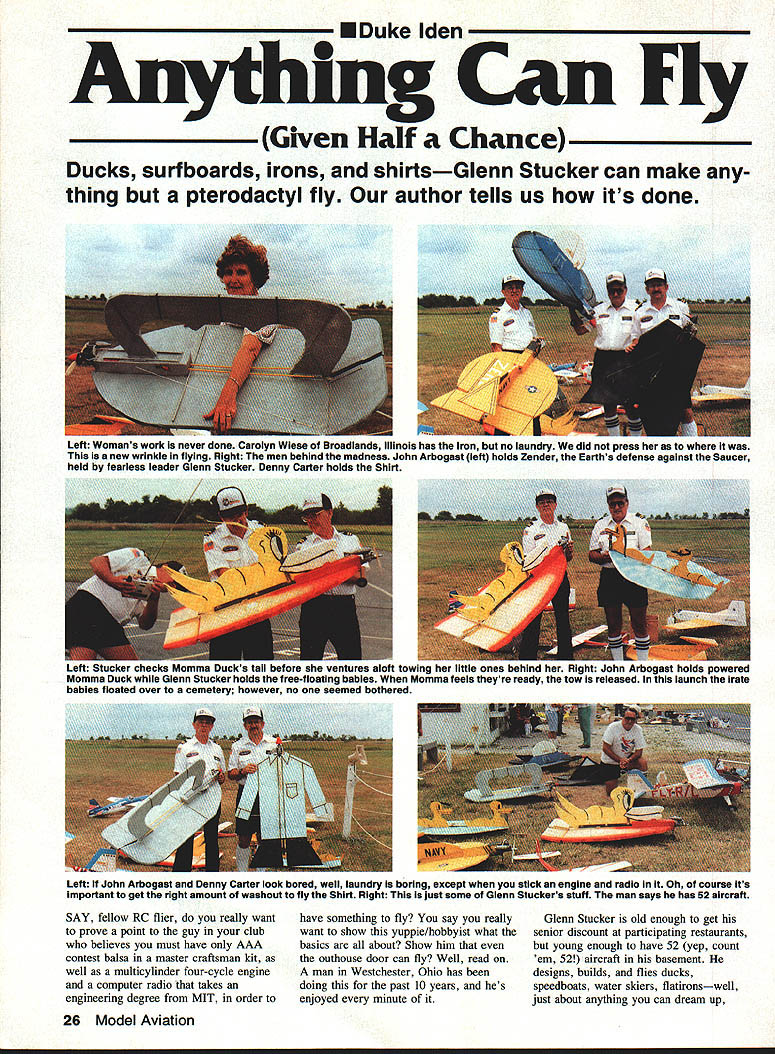
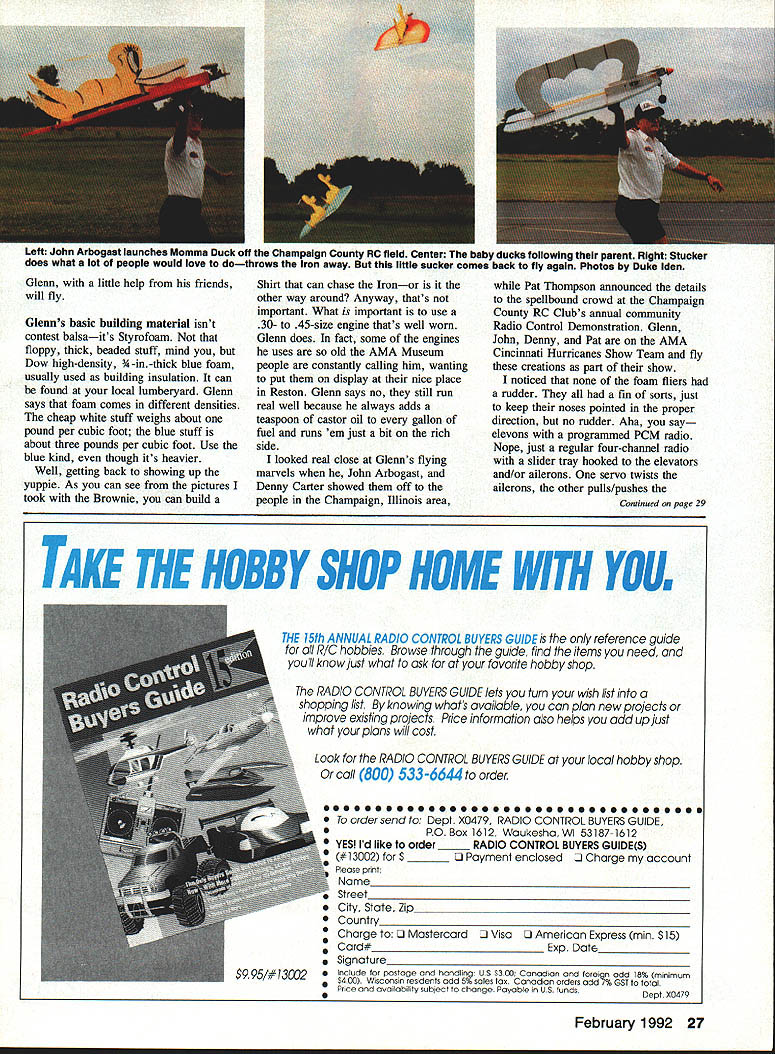
Glenn Stucker is old enough to get his senior discount at participating restaurants, but young enough to have 52 (yep, count 'em, 52) aircraft in his basement. He designs, builds, and flies ducks, speedboats, water skiers, flatirons—well, just about anything you can dream up. Glenn, with a little help from his friends, will fly it.
I looked real close at Glenn's flying marvels when he, John Arbogast, and Denny Carter showed them off to the people in the Champaign, Illinois area, while Pat Thompson announced the details to the spellbound crowd at the Champaign County RC Club's annual community Radio Control Demonstration. Glenn, John, Denny, and Pat are on the AMA Cincinnati Hurricanes Show Team and fly these creations as part of their show.
Building Material
Glenn's basic building material isn't contest balsa—it's Styrofoam. Not that floppy, thick, beaded stuff, mind you, but Dow high‑density, 3/4‑inch‑thick blue foam, usually used as building insulation. It can be found at your local lumberyard. Glenn says that foam comes in different densities. The cheap white stuff weighs about one pound per cubic foot; the blue stuff is about three pounds per cubic foot. Use the blue kind, even though it's heavier.
Engines and Running
As you can see from the pictures I took with the Brownie, you can build a shirt that can chase the iron—or is it the other way around? Anyway, that's not important. What is important is to use a .30- to .45‑size engine that's well worn. Glenn does. In fact, some of the engines he uses are so old the AMA Museum people are constantly calling him, wanting to put them on display at their nice place in Reston. Glenn says no; they still run real well because he always adds a teaspoon of castor oil to every gallon of fuel and runs 'em just a bit on the rich side.
Controls and Flight
I noticed that none of the foam fliers had a rudder. They all had a fin of sorts, just to keep their noses pointed in the proper direction, but no rudder. Aha, you say—elevons with a programmed PCM radio. Nope, just a regular four‑channel radio with a slider tray hooked to the elevators and/or ailerons. One servo twists the ailerons, the other pulls/pushes the elevators and changes the attitude of the craft. The third channel oversees the throttle and—there you have it—you don't even need the fourth channel.
Design Ground Rules
If you want to try your own design, here are some ground rules:
- Width: 28 inches, because you use two 14‑1/2‑inch‑wide sheets of foam glued together.
- Length: about 4 to 4‑1/2 feet is plenty long enough.
- Size: don't make your design too big. Glenn said the first foam fliers he saw were 7 or 8 feet long, and they didn't fly too well—you needed to use the pickup every time you went flying.
- Structure: use at least two crosspieces across the platform. These can be 3/4‑inch birch dowels or hard balsa squares.
- Stiffener: run another stiffener down the full length of the beast. This can go underneath so you can stick a landing gear near the nose, just to keep the prop in one piece.
- Landing gear: since these things are hand‑launched, they don't need more than one wheel.
- Balance: get your design balanced at about one‑fourth back (18% to 25% from the front).
You won't take first place in a pylon race, and we won't even talk about a pattern event; but those things do fly.
What Flies and What Doesn't
However, not everything Glenn comes up with flies. He can't quite get a pterodactyl to fly, but then they haven't flown for about 30 million years and have probably forgotten how. Glenn has a Bat Plane that he says flies great, but his Starship Enterprise flies just fair.
Inspiration
What do you think you can make fly? I'm inspired! I'm planning to go right out, rip the door off the old outhouse, dig out the old Max .35, and find three servos. Jimmy Doolittle said, "Give me enough horsepower, and I can fly a barn door." That is what inspires Glenn Stucker.
Transcribed from original scans by AI. Minor OCR errors may remain.

