
Apollo Lorans
Jerry Smith
Introduction
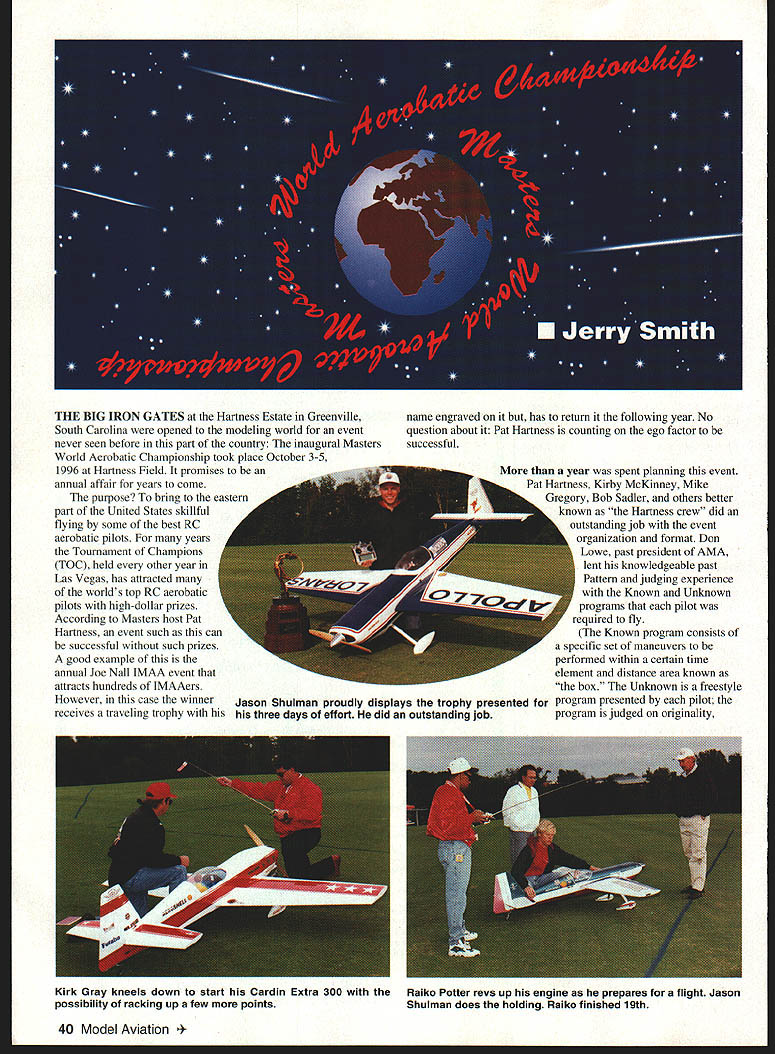
The big iron gates at the Hartness Estate in Greenville, South Carolina, were opened to the modeling world for an event never seen before in this part of the country: the inaugural Masters World Aerobatic Championship, held October 3–5, 1996, at Hartness Field. The event promises to become an annual affair.
The purpose was to bring skillful flying by some of the best RC aerobatic pilots to the eastern United States. For many years the Tournament of Champions (TOC) in Las Vegas has drawn the world's top RC aerobatic pilots with large cash prizes. According to Masters host Pat Hartness, an event such as this can be successful without such prizes. The winner receives a traveling trophy with his name engraved on it and must return it the following year; Pat Hartness is counting on the ego factor to make the event successful.
Organization and Format
More than a year was spent planning this event. Pat Hartness, Kirby McKinney, Mike Gregory, Bob Sadler, and others—better known as "the Hartness crew"—did an outstanding job with organization and format. Don Lowe, past president of AMA, lent his knowledge of Pattern and judging for the Known and Unknown programs that each pilot was required to fly.
Known and Unknown Programs
- Known: A specific set of maneuvers to be performed within a certain time element and inside a distance area known as "the box."
- Unknown: A freestyle program presented by each pilot and judged on originality, execution, and presentation.
The Weather
October in South Carolina is unpredictable. Thursday was superb—light winds, partly cloudy, and temperatures in the high 70s. A cold front passed through Thursday night; by Saturday the temperature had dropped about 15 degrees below normal. Saturday was cold and windy but sunny. Don Lowe reportedly never stopped shaking.
Judges
Six judges, respected for their Pattern judging experience, officiated:
- Dave Brown (current AMA president)
- Don Lowe (past AMA president)
- Ron Chidgey
- Al Tuttle
- Don Peck
- Dick Smith
They dedicated themselves to the task despite the cold and bright sun.
Aircraft, Engines, and Equipment
Most airplanes flown were Extra 300s, with a few Extra 260s, Laser 200s, and three 46% Giles 200s. An unusual airplane noted was a 35% German Staudacher powered by a 3W-80 (flown by David Hoppes).
The majority of engines used were German 3W-70, 3W-80, and 3W-120, depending on airplane size. Menz wooden propellers were almost universally used.
The First Two Days
Thursday and Friday, 20 pilots flew four Known and two Unknown elimination programs. Operations ran smoothly: only one airplane was in the air at a time so there was no need for transmitter impound. Pilots used a pin board to control frequencies and drew numbers to determine flight order; the flight line was redone after each round.
As elimination scores were posted, the finalists for Saturday's flyoff became clear. The seven finalists were:
- Jason Shulman
- Chip Hyde
- Frank Noll Jr.
- Kirk Gray
- Gerald Neel
- Robert Elliot
- Dean Koger
These finalists represented a combined 158 years of flying experience.
Notable Aircraft and Pilots During Eliminations
- Frank Noll Jr. flew a 46% scale Giles 200 and would finish highly in the event; he has 32 years of flying experience.
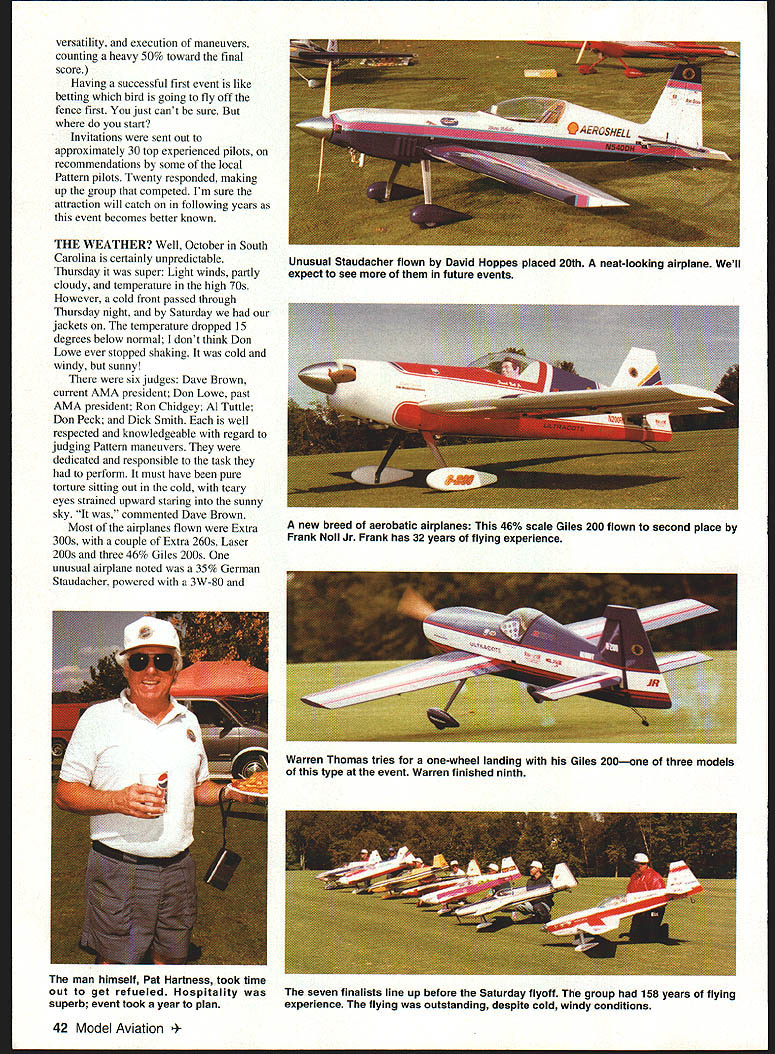
- Gerald Neel flew a Cardin Extra 300 and performed slow, low knife-edge passes during his Unknown programs.
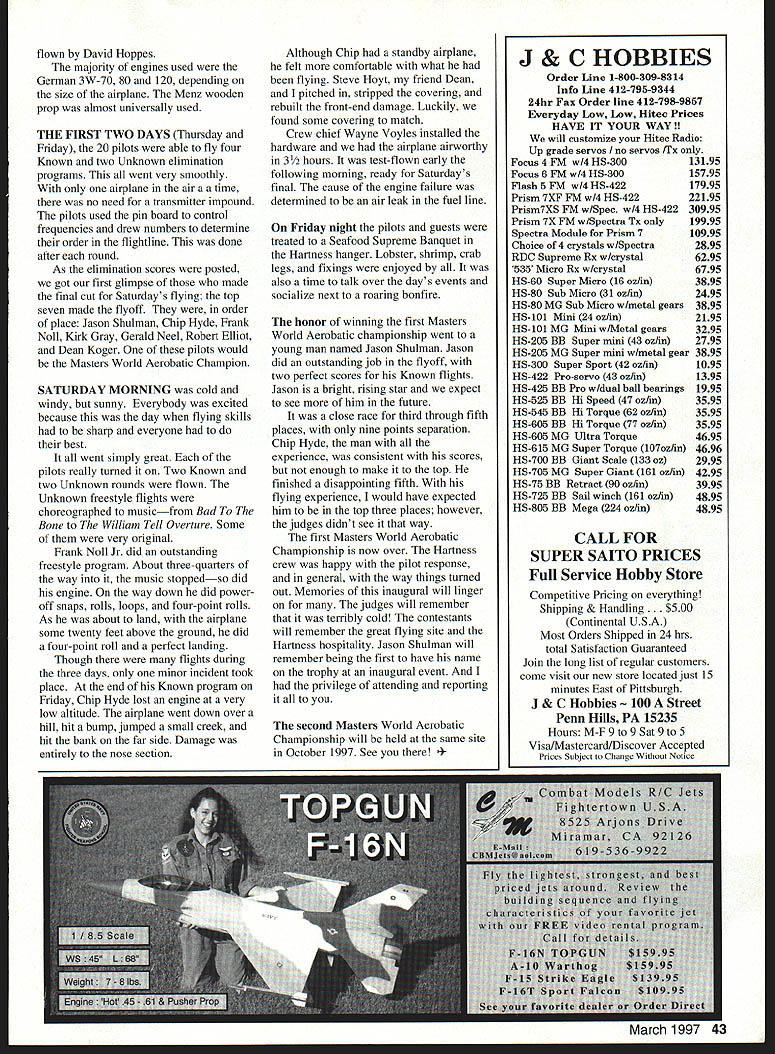
- Chip Hyde flew a Lanier Extra 300; his nose section was rebuilt on site after damage from a fuel line air leak.
Versatility and execution of maneuvers counted heavily—50% toward the final score.
Saturday Morning and the Flyoff
Saturday was cold and windy, but sunny. Seven finalists flew two Known and two Unknown rounds. The Unknown freestyle flights were choreographed to music ranging from "Bad to the Bone" to "The William Tell Overture"; many programs were very original.
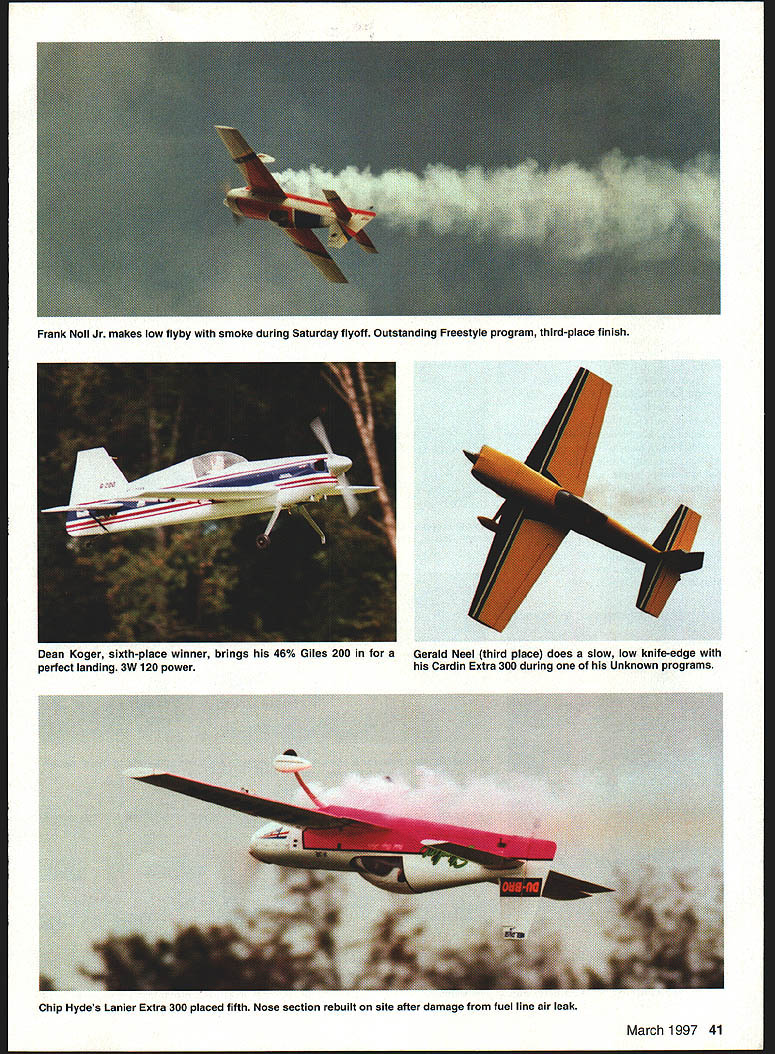
Frank Noll Jr. delivered an outstanding freestyle. About three-quarters of the way into his program, the music stopped—so did his engine. He continued with power-off snaps, rolls, loops, and four-point rolls, and as he approached the landing at about twenty feet above ground he executed a four-point roll and a perfect landing.
Incidents and Repairs
Only one minor incident occurred during the three days. At the end of his Known program on Friday, Chip Hyde experienced an engine failure at very low altitude. The airplane went down over a hill, jumped a small creek, and struck the far bank; damage was confined to the nose section.
Although Chip had a standby airplane, he preferred the one he had been flying. Steve Hoyt, Dean Koger, and I stripped the covering and rebuilt the front-end damage on site. Crew chief Wayne Voyles installed the wheel, and the airplane was made airworthy in about 3½ hours. It was test-flown early Saturday and ready for the final. The engine failure was traced to an air leak in the fuel line.
Social Events
On Friday night pilots and guests were treated to a Seafood Supreme banquet at the Hartness hangar—lobster, shrimp, crab legs, and other fixings accompanied conversation around a roaring bonfire.
Results and Awards
The honor of winning the first Masters World Aerobatic Championship went to Jason Shulman, who did an outstanding job in the flyoff and earned two perfect scores for his Known flights. Jason is a rising star.
Other confirmed placings include:
- 2nd place: Frank Noll Jr.
- 3rd place: Gerald Neel
- 5th place: Chip Hyde
- 6th place: Dean Koger
- 9th place: Warren Thomas
The competition for third through fifth places was close, with only nine points separating them.
Conclusion and Looking Ahead
The Hartness crew was pleased with the pilot response and the overall outcome. Memories of the inaugural event will linger: judges will remember how cold it was, contestants will remember the great flying site and Hartness hospitality, and Jason Shulman will remember being the first to have his name engraved on the traveling trophy.
The second Masters World Aerobatic Championship is scheduled to be held at the same site in October 1997. See you there!
Transcribed from original scans by AI. Minor OCR errors may remain.

