
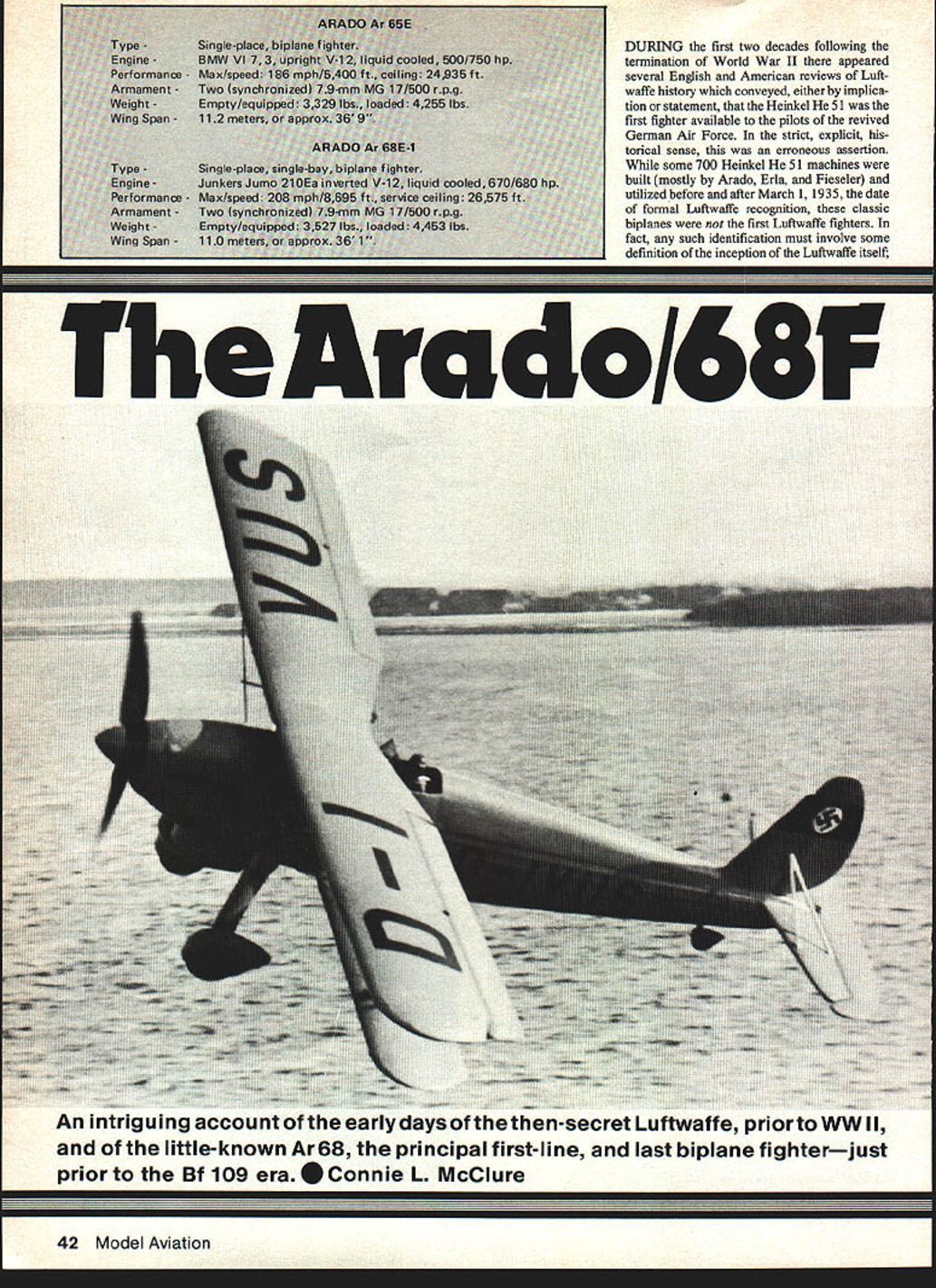
The Arado/68F
Arado Ar 65E
- Type: Single-place biplane fighter
- Engine: BMW VI 7.3 upright V-12, liquid-cooled — 500 hp continuous / 750 hp one‑minute rating
- Performance: Max speed 186 mph at 6,400 ft; service ceiling 24,935 ft
- Armament: Two synchronized 7.9 mm MG 17 (500 rpm)
- Weight: Empty/equipped 3,329 lb; loaded 4,255 lb
- Wingspan: 11.2 m (approx. 36 ft 9 in)
Arado Ar 68E-1
- Type: Single-place, single-bay biplane fighter
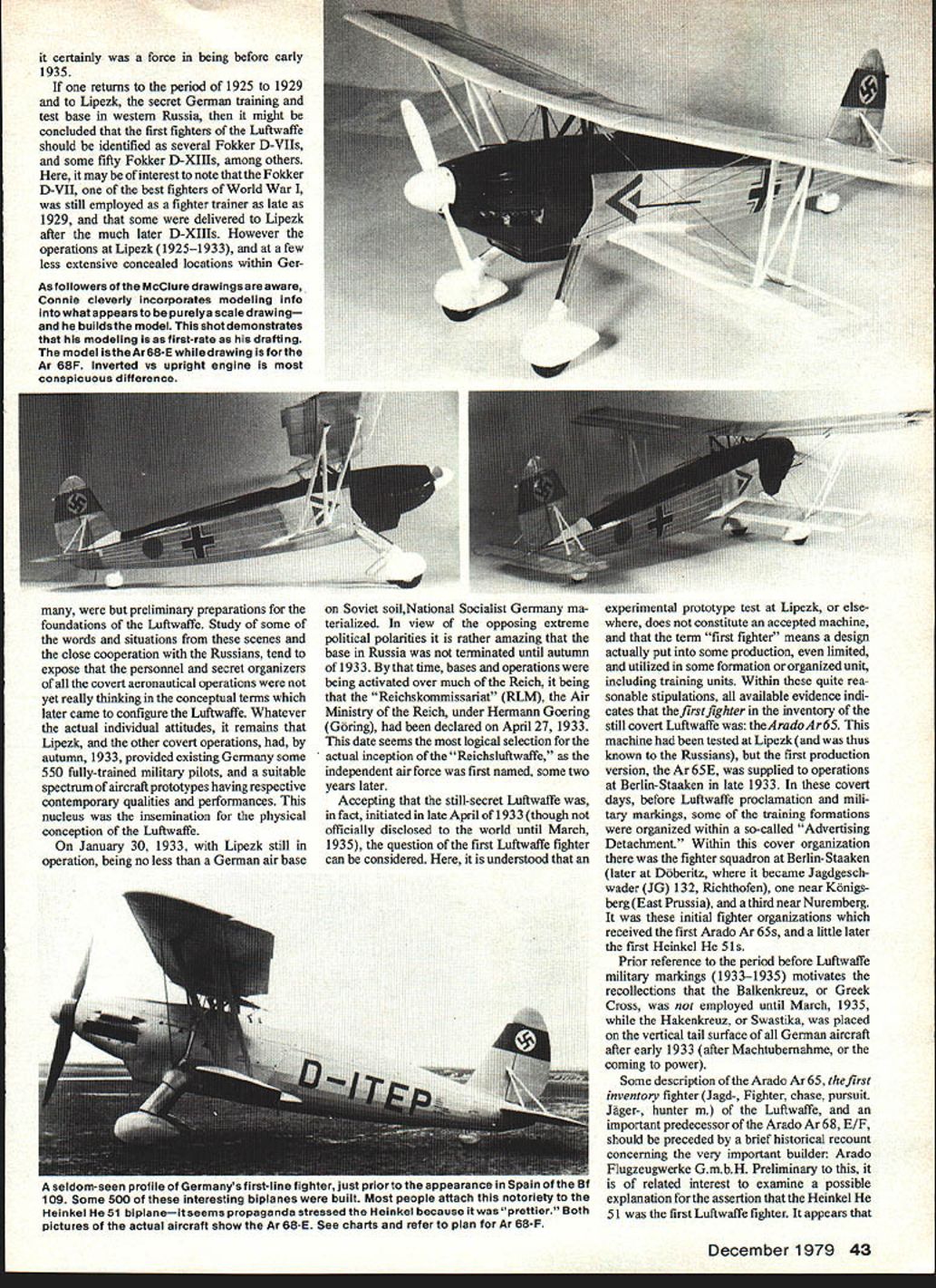
- Engine: Junkers Jumo 210Ea inverted V-12, liquid-cooled — approx. 670–680 hp
- Performance: Max speed 208 mph at 8,695 ft; service ceiling 26,575 ft
- Armament: Two synchronized 7.9 mm MG 17 (500 rpm)
- Weight: Empty/equipped 3,527 lb; loaded 4,453 lb
- Wingspan: 11.0 m (approx. 36 ft 1 in)
Historical background
The question of the "first" Luftwaffe fighter
- Postwar English- and American-language reviews sometimes stated or implied that the Heinkel He 51 was the first fighter available to the revived German air arm. In a strict historical sense this is incorrect.
- Covert German aviation activity in the 1920s and early 1930s — notably at the Lipetsk training and test base in the Soviet Union (operated c. 1925–1933) — furnished Germany with prototypes, trained personnel, and experience well before official public recognition of the Luftwaffe.
- By autumn 1933 covert operations had provided about 550 fully trained military pilots and a range of aircraft used to seed the new service.
- The Reich Aviation Ministry (Reichsluftfahrtministerium, RLM) was declared on 27 April 1933 under Hermann Göring; the Luftwaffe was formally revealed to the world in March 1935. Definitions of "first fighter" therefore depend on whether one counts prototypes tested covertly or the first designs put into production and unit use.
- Under the reasonable definition of the first design produced and used by organized units (including training formations), the Arado Ar 65 was the first inventory fighter of the still‑covert Luftwaffe. The Ar 65E was supplied to operations at Berlin‑Staaken in late 1933 and equipped early fighter squadrons that later became units such as JG 132 "Richthofen."
Why the He 51 is often credited
- The Heinkel He 51 was visually impressive and Heinkel publicity was energetic; these factors contributed to the common belief that it was the first Luftwaffe fighter.
- In reality more He 51 airframes were built overall (some 700 are often cited), but the Arado Ar 65 preceded it in production delivery to the covert Luftwaffe and played a key early role, especially as a fighter-trainer.
Arado Flugzeugwerke — brief company history
- Arado Flugzeugwerke G.m.b.H. evolved from the Warnemünde plant of Flugzeugbau Friedrichshafen (WWI). Warnemünde, on the Baltic coast north of Rostock, was an important early German aviation center.
- Hugo Stinnes acquired the plant in 1921; it initially built furniture and small boats while retaining the intent to resume aircraft production.
- Walter Rethel left Fokker in 1924 to join Stinnes at Warnemünde and became chief engineer when the Arado name was adopted around 1925. Rethel later moved to Bayerische Flugzeugwerke (Messerschmitt) and played a major role in the Bf 109’s development.
- Under Rethel and successors the Arado design bureau produced several interwar fighter prototypes (SD‑1, SD‑2, SD‑3, SSD‑1), leading to the Ar 64 and then the Ar 65 and Ar 68 families.
- Arado became a G.m.b.H. on 4 March 1933 and, after financial injections from the new government, came under RLM control.
Development and design of the Ar 64 → Ar 65 → Ar 68
Ar 64 and Ar 65
- The Ar 64 (prototype 1930) was a single-seat biplane powered by a Siemens‑Halske–built Bristol Jupiter radial (~450 hp). Reported max speed ~149 mph; service ceiling ~6,000 m (≈19,680 ft). It served as a design and production step toward the Ar 65.
- The Ar 65a prototype was completed in 1931, powered by the BMW VI upright V-12 (500/750 hp), and showed much improved performance. Several design iterations produced the Ar 65d and later production Ar 65E/F variants.
- Construction used mixed materials: welded steel tubing fuselage, wood and plywood wings, light metal sheetwork and fabric covering — typical transitional construction of the era.
- The most‑produced Ar 65 was the Ar 65F (similar to the E, with minor equipment changes and ~90 lb higher empty weight). Production ran until early 1936, with a total of about 170 machines. The Ar 65’s enduring value was as a fighter‑trainer; many served in training roles for years afterward.
Ar 68 development and variants
- The Ar 68, designed under chief engineer Walter Blume, became the principal first‑line (and ultimately the last) Luftwaffe biplane fighter before the Bf 109 era. It was developed in parallel with the smaller Ar 67 (the Ar 67 was discontinued after a single prototype).
- Engine selection was central to Ar 68 development. Early prototypes used BMW VI engines; the intended engine was the new Junkers Jumo 210 inverted V‑12 (also planned for early Bf 109s).
- Notable prototypes and milestones:
- Ar 68a (V1): BMW engine, flight-tested early summer 1934, demonstrated excellent handling and a robust structure.
- Ar 68c (third prototype): first to be fitted with two synchronized 7.9 mm MG 17 guns.
- Ar 68V4: BMW‑powered prototype given a Versuchs (V) number.
- Ar 68V5: Jumo 210Da–powered prototype (two‑speed supercharger, ~680 hp takeoff) — became the production prototype for the Ar 68E‑1.
- Ar 68E-1: the Jumo‑powered production form that satisfied initial requirements. After Ernst Udet demonstrated the Ar 68’s superiority over the He 51 in mock combat, a production order followed. However, priorities for Jumo engines shifted toward the Bf 109, leading to a temporary return to BMW‑powered models.
- Ar 68F-1: redesign to incorporate the BMW VI 7.3Z upright V‑12. The F series saw operational use; some F‑1s served as night fighters into 1940.
- Ar 68H: final development prototype (spring 1937) with a BMW 132Da nine‑cylinder radial (850 hp takeoff), enclosed cockpit and four MG 17 guns (two in the upper wing). Projected performance included a top speed ~250 mph and service ceiling ~30,000 ft; few examples were built.
Production and service
- Production figures are somewhat conflicting, but roughly 500 Ar 68 machines were built in total.
- The Ar 68E was the principal first‑line fighter of several Jagdgruppen from about mid‑1937 until mid‑1938, when the Bf 109 era overtook biplane fighters.
- Only a small number of Ar 68s saw service in the Spanish Civil War (two Ar 68E fighters actually reached Spain); the Condor Legion’s air superiority was assured largely by Bf 109s supplied by Bayerische Flugzeugwerke as Jumo engine production expanded.
- By 1 September 1939 there still remained Ar 68s in service; Ar 68 variants continued as night fighters and in training roles into 1940 and later. Ultimately, all biplane fighters (Arado, Heinkel, etc.) were relegated to schools, with some surviving in training use until 1945.
Design characteristics
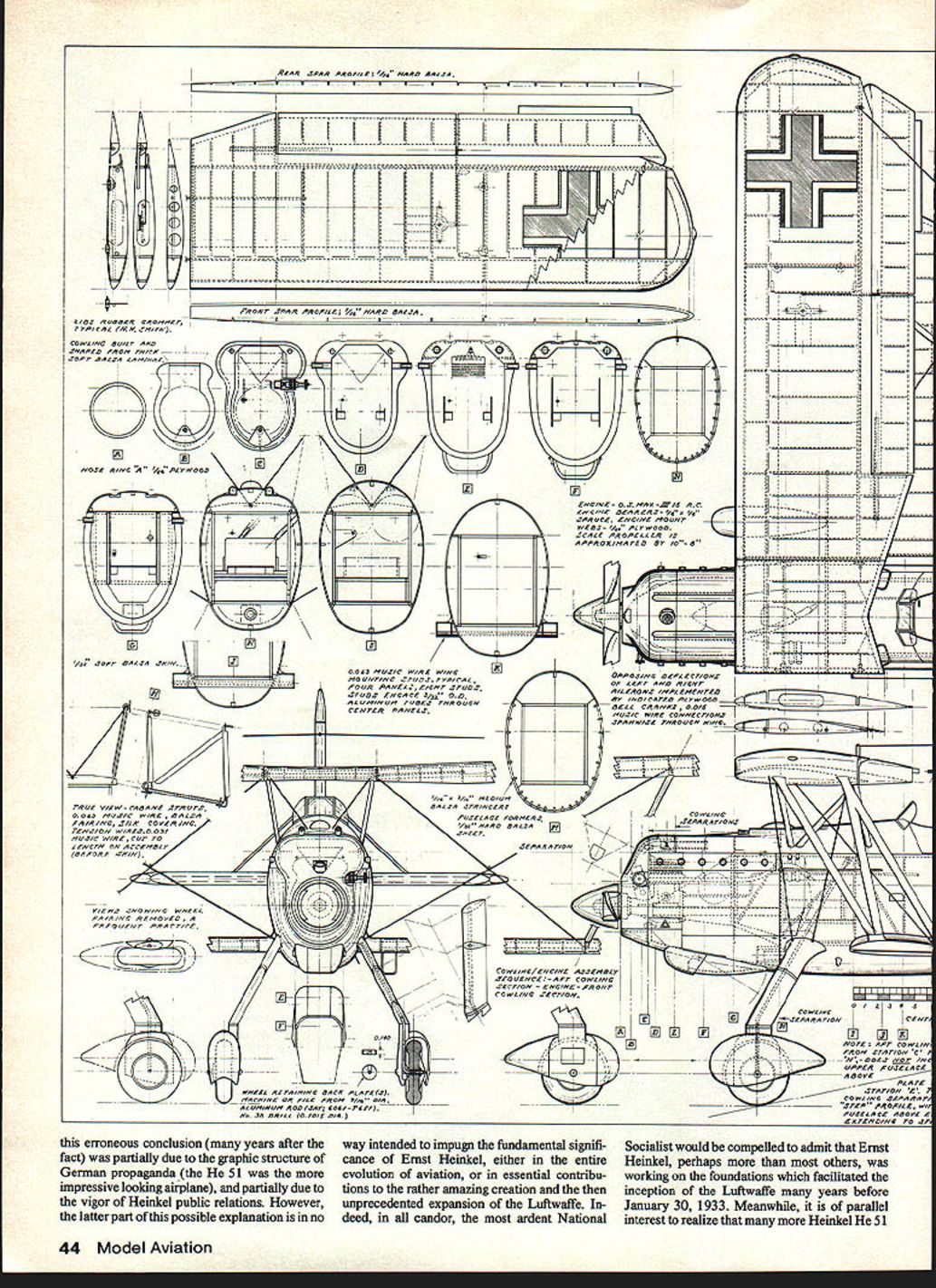
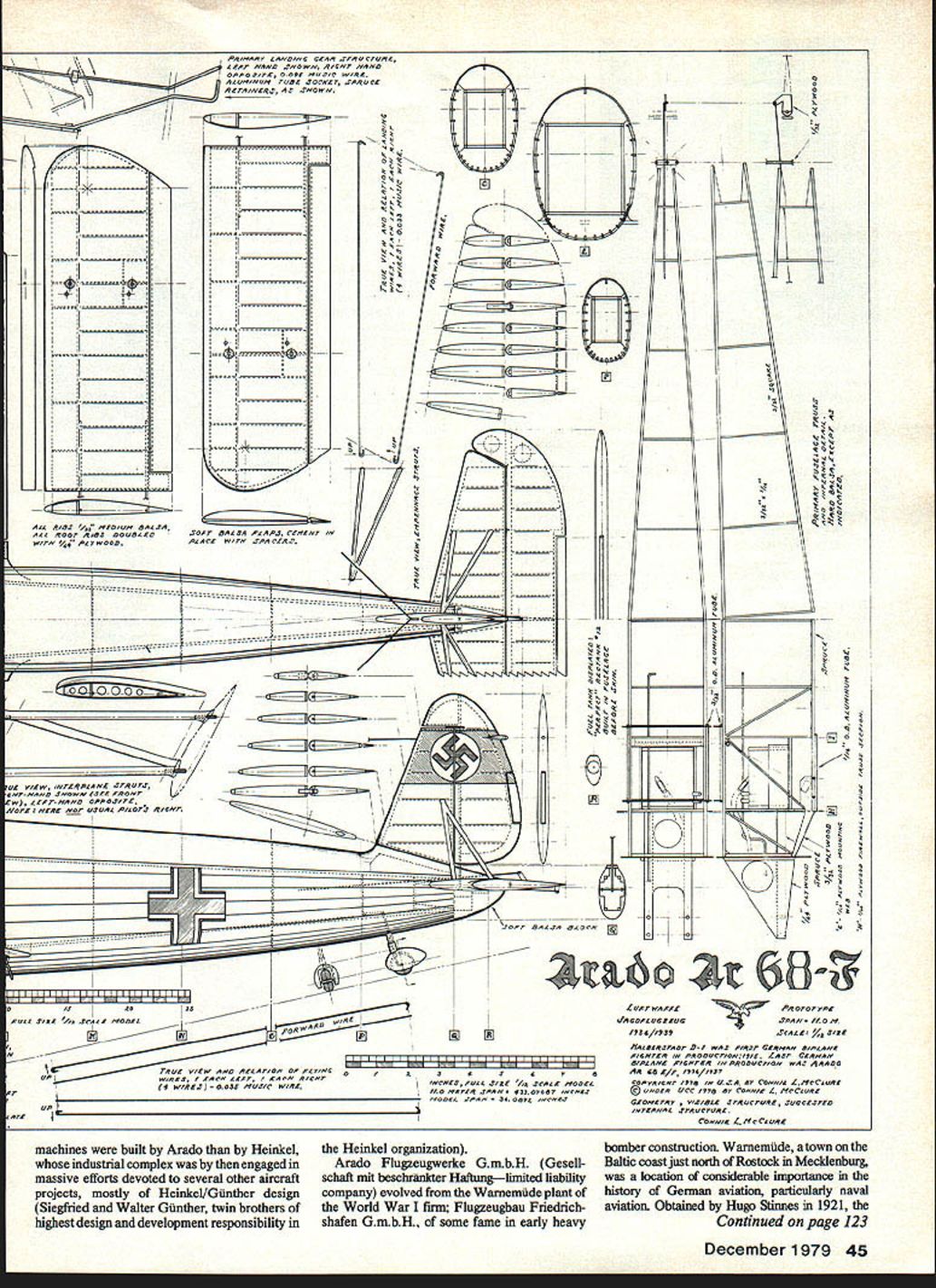
- Mixed‑material construction: welded steel tube fuselage with light‑metal forward decking and stringered aft sections; wooden, plywood‑covered wings (upper wing often fabric covered); light‑metal tail surfaces and fabric control surfaces.
- Robust internal structure: rectangular-section welded steel tube frames integrated with engine mounts, cabane struts, lower wing roots, gun mounts and landing gear.
- Typical propeller: fully faired two‑blade fixed‑pitch wooden Heine propeller on many production examples.
Miscellanea and legacy
- Connie L. McClure’s Ar 68‑E drawing and model (Model Aviation, May 1935) provided valuable modeling information and demonstrated excellent drafting and model-building scholarship; McClure’s drawing is often reproduced in Ar 68 references.
- The Ar 68 represents the culmination of German biplane fighter design: a robust, well‑handled fighter that bridged the gap between the early 1930s biplane era and the all‑metal monoplane fighters that followed.
- The Avia B‑534 (Czechoslovak) deserves mention as one of the last biplane fighters used by the Luftwaffe after the annexation of Czechoslovakia; Avia machines later saw limited combat use in the desperate late‑war defense of Balkan resources.
Transcribed from original scans by AI. Minor OCR errors may remain.

