
ARIA: The Long Wing
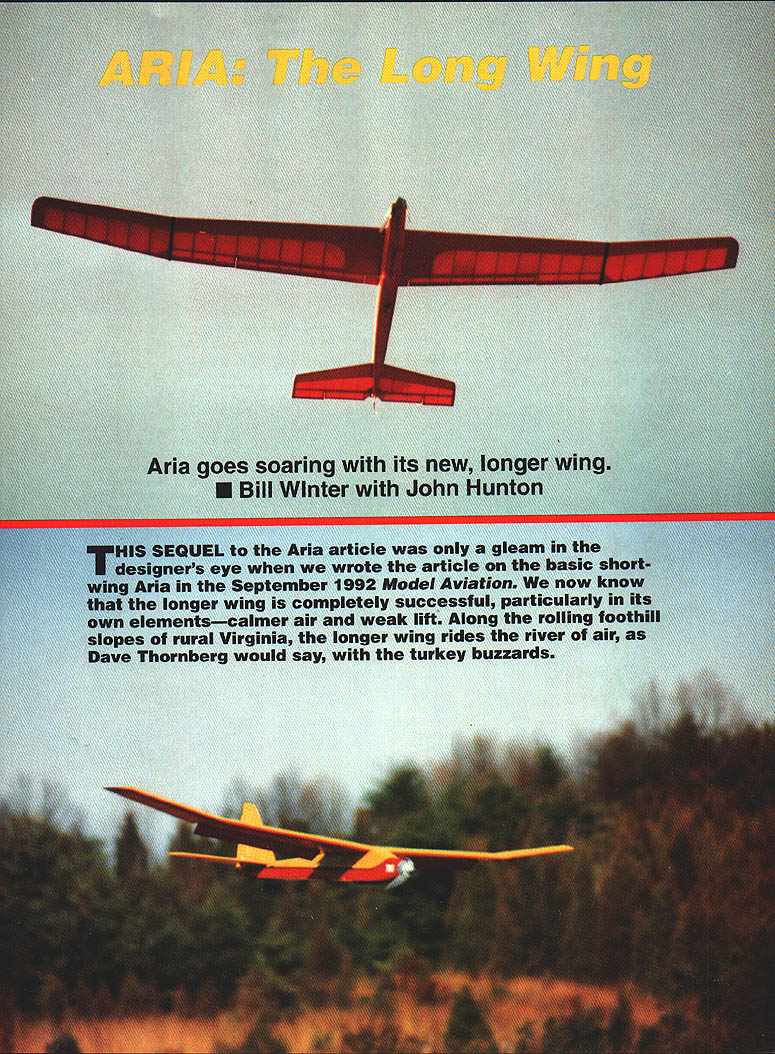
Aria goes soaring with its new, longer wing. Bill Winter with John Hunton
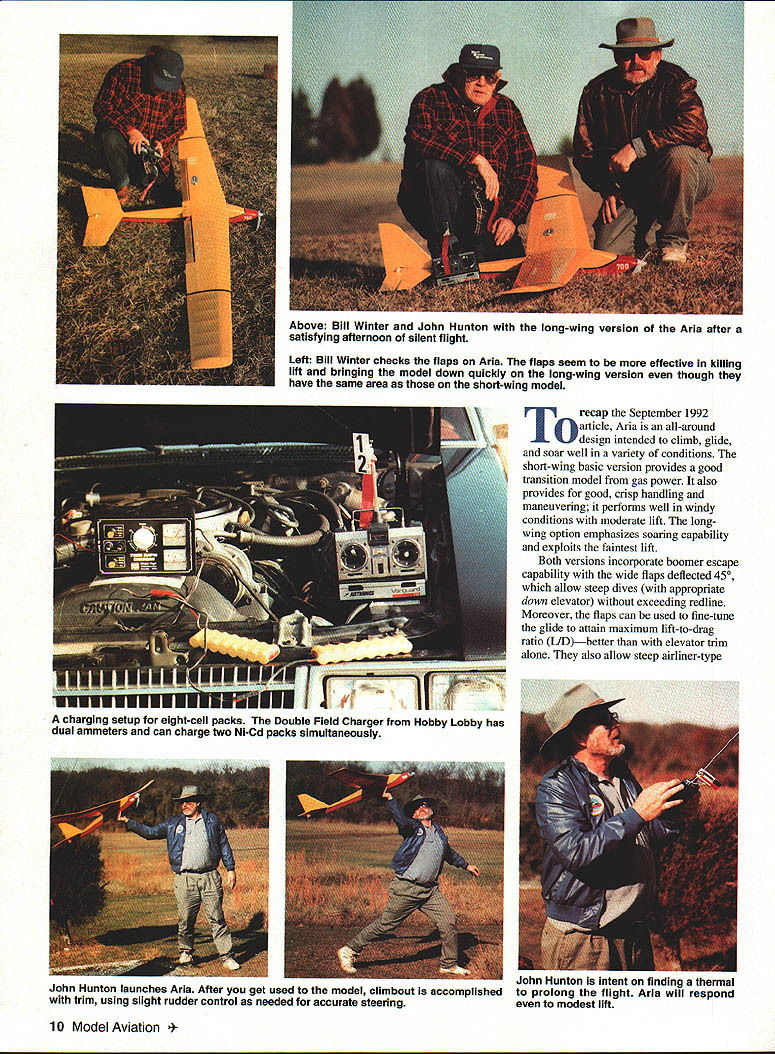
This sequel to the Aria article was only a gleam in the designer's eye when we wrote about the basic short-wing Aria in the September 1992 Model Aviation. We now know that the longer wing is completely successful, particularly in its intended elements—calmer air and weak lift. Along the rolling foothill slopes of rural Virginia, the longer wing rides the river of air, as Dave Thornberg would say, with the turkey buzzards.
To recap the September 1992 article, Aria is an all-around design intended to climb, glide, and soar well in a variety of conditions. The short-wing basic version provides a good transition model from gas power: it offers crisp handling and maneuvering and performs well in windy conditions with moderate lift. The long-wing option emphasizes soaring capability and exploits the faintest lift.
Both versions incorporate boomer-escape capability with wide flaps (deflected 45°), which allow steep dives (with appropriate down elevator) without exceeding redline. The flaps can also be used to fine-tune the glide to attain maximum lift-to-drag ratio (L/D)—better than with elevator trim alone—and to allow steep airliner-type approaches followed by slow touchdowns with little runout.
Both versions benefit from using the economical Hobby Lobby Graupner Speed 700 Turbo electric motor. This direct-drive motor is large and powerful for the Speed family and weighs about 1.5 ounces bare. It generates excellent thrust; Graupner Scimitar folding props (10x6, 11x6) give run times of three to four minutes depending on prop/battery combinations. Since thrust and rpm change as the propeller becomes unloaded in flight, the static thrust rpm shown in the September issue are valid for comparative purposes only.
The September issue reported using a 25-amp fuse for 8-cell packs and a 30-amp for 10 cells. Most recently we have been using a 30-amp fuse for both 8- and 10-cell packs for the sake of commonality. The motor can handle 12 cells too, but performance with 8–10 cells is all anyone could want. An on-off motor controller is fine. A battery-eliminator circuit (BEC) should be used to set glide-time limits (for example, 10 minutes). Use a separate battery pack for the receiver, which we recommend; for extended soaring, a 250-mAh receiver pack or larger is useful.
Considering both sizes, Aria's performance capability seems comparable to models using 15- to 25-size cobalt motors. The short-wing version is maneuverable and fast enough to fly with gas models; its crisp climb capability sometimes outclimbs other models. The long-wing version, though still maneuverable for an ultra–high-aspect-ratio ship, lands better than garden-variety floaters and transforms Aria into a serious soaring ship at the cost of a modest weight and handling penalty.
Specifications (based on eight-cell packs):
- Short-wing Aria: span 69 inches, area 580 square inches, weight 60 ounces, aspect ratio 8.1:1.
- Long-wing Aria: span 99 inches, area 840 square inches, weight 63 ounces, aspect ratio 11.6:1.
John Hunton reports that the long-wing Aria climbed boldly and needed no trim. Testing the long-wing version raised few questions—it would certainly fly. The center of gravity (CG) should be close to the recommended location for excellent controllability; Aria's stability is not adversely affected.
Test flights and handling On the test day we first flew the short wing to establish trim. The pull-pull control system seemed dimensionally stable and needed no trimming. The long wing looked disproportionate and gliderlike, but after adding three ounces (bringing total weight to 63 ounces) it still power-launched and climbed briskly with the ball-bearing Speed 700 Turbo and eight cells. The first flight required no trim, suggesting the model has a wide range of acceptable balance and control parameters.
Differences with the long wing:
- Slightly greater inertia about the vertical axis; somewhat more rudder input is required for turning.
- Climb rate is not significantly different from the short-wing Aria despite the weight penalty.
- Glide performance is noticeably better: slower, more controlled approaches, shorter touchdown rollouts, extended soaring in weak lift, and a very low sink rate.
- The long wing tends to make flatter turns and lower bank angles, contributing to increased flight time.
- The model responds to faint lift and will tend to turn to lift on its own; it is an aggressive soarer and a thermal seeker.
- Flap effectiveness is increased; on full flaps the model may pitch over more steeply (almost to vertical on full down during tests). Increased elevator effectiveness with the proportionately smaller empennage likely accounts for this steeper descent. Recovery must be made smoothly and gradually: level out first, then reduce flaps if desired. Do not do a steep dive intentionally without flaps.
Flying technique and trim
- Trim the model in climb (under power), then steer with slight rudder pressures only. Exaggerated control input increases drag and shortens flight.
- After transition to glide, add flap angle proportionate to the day: slight deflection for gusty conditions and good penetration, up to half flaps for light winds and light lift. Some up-elevator trim may be necessary to achieve ideal glide velocity.
- Best flights are obtained by trimming the model in climb and using light control pressures for steering.
Preflight checklist (refer to the "RC Aria" article in the September 1992 issue for related details):
- Flap control to down (throttle stick toward you; motor-off safety).
- Check and set trims with throttle trim toward you (trim may vary by pilot).
- Transmitter on.
- Receiver on.
- Check control motion and direction (always—instant-reverse servos exist).
- Assume launching position.
- Flaps up (throttle stick away from you).
- Check wind and other models.
- Motor on and launch (flaps go to full up when motor comes on).
- Upon landing, keep flaps down for safety and reset throttle trim to low.
Safety note:
- Always stay clear of the propeller when switching it on or off.
- When using dual action on the throttle, remember the flap must be full up for the motor to be turned on with throttle trim. This is a built-in safety feature.
Construction
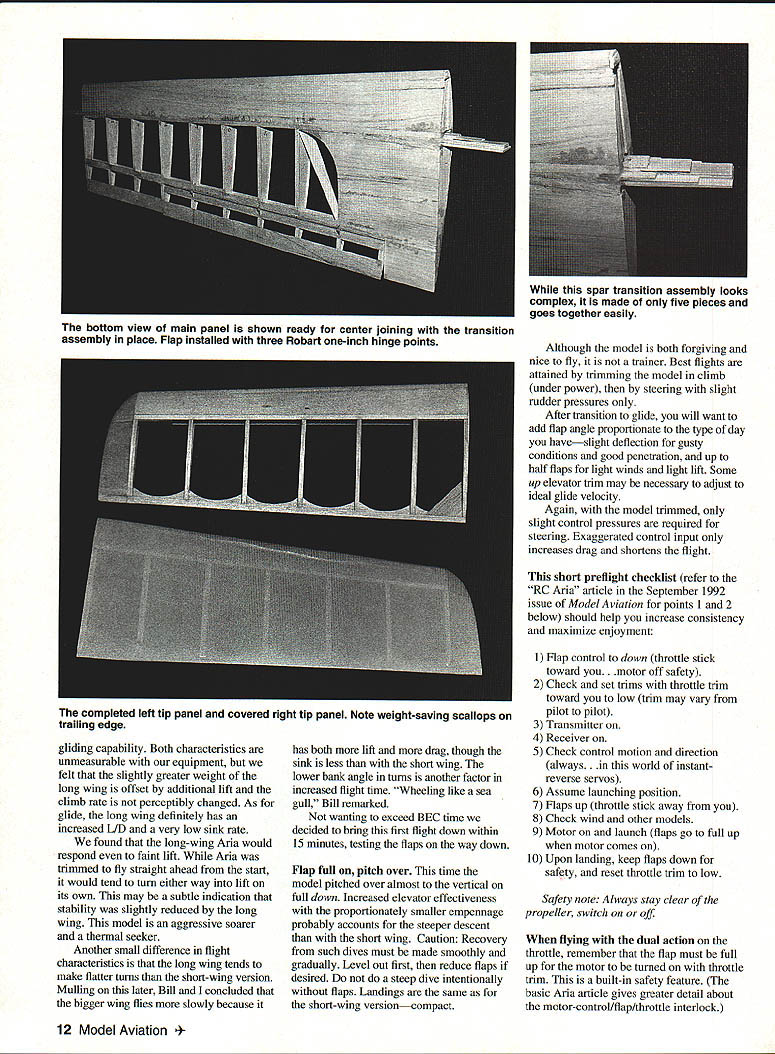
Construction of the long wing is basically the same as for the short wing described in the September issue, with the exception of some additional ribs and different thickness for the plywood spar-root transition parts. Using removable wing tips is highly recommended for an eight-foot-plus wing to ease transportation.
We elected not to break the wing at the root (which would be more complicated and heavier). Little needs to be added to the construction procedures except how to mate the second wing to the existing wing seat—this requires careful attention.
Important assembly notes:
- Do not drill the 1/4-inch dowel hole in the leading edge plywood part until after the wing is fully assembled, sanded, and covered. Do not drill the trailing-edge hold-down screw holes until instructed below.
- Fit the new wing fore and aft to the seat carefully before covering.
- After covering, put a small plug of modeling clay into the wing hold-down dowel hole in the fuselage former. Put a dab of cyanoacrylate (CyA) glue on the wing leading edge plywood, then shove the wing into place on the seat. Allow a little time for the glue to adhere, then remove the wing. You should have a perfect impression of the dowel location stuck to your leading edge. Mark this hole and drill it, then install the dowel.
- Use the same method for the rear hold-down holes: clay on the holes, CyA on the wing, mate checking alignment carefully, then part and drill.
- Check alignment carefully from the front. Ensure the wing is level with the stabilizer and shim or trim as necessary for good accuracy.
Covering: For the long wing we used Coverite's 21st Century Space Age Film. This material is different from FilmKote: it is easier to work with, handles curves better, and has a brighter, more solid appearance. Follow the printed directions carefully. Final shrinking is different—when you add heat it reacts slowly and initially loosens; stick with the process and it will tighten. Our long wing has been through drastic temperature changes without needing retightening.
Notes on assembly visuals:
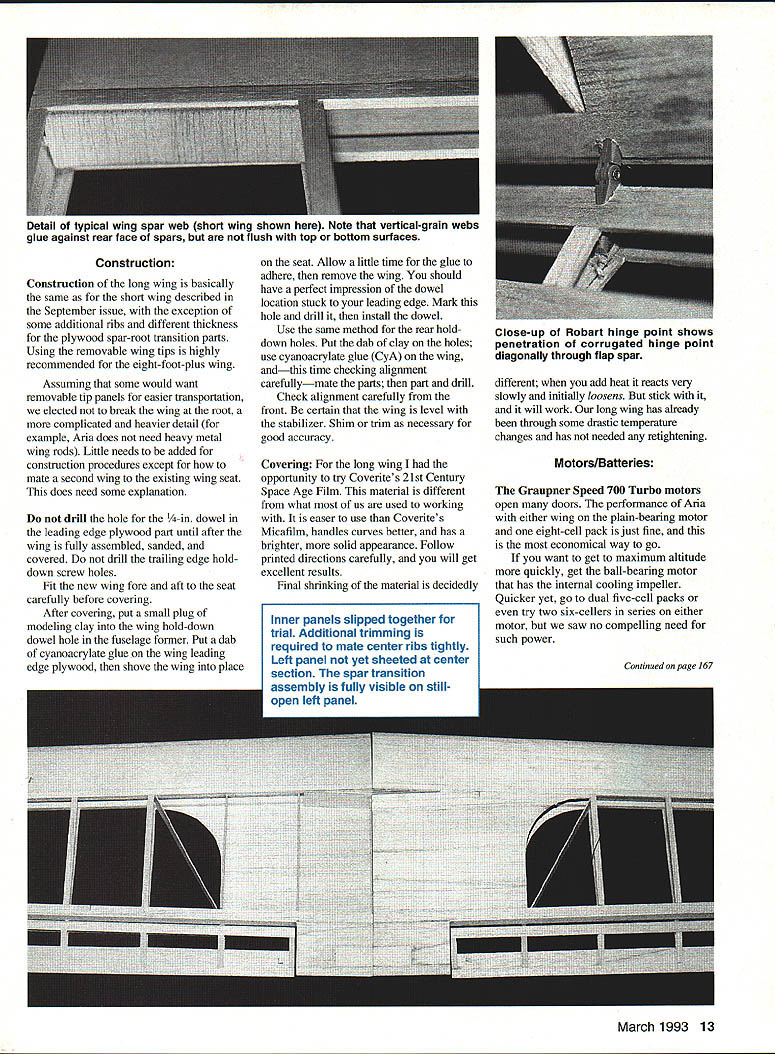
- Inner panels can be slipped together for trial; additional trimming may be required to mate center ribs tightly.
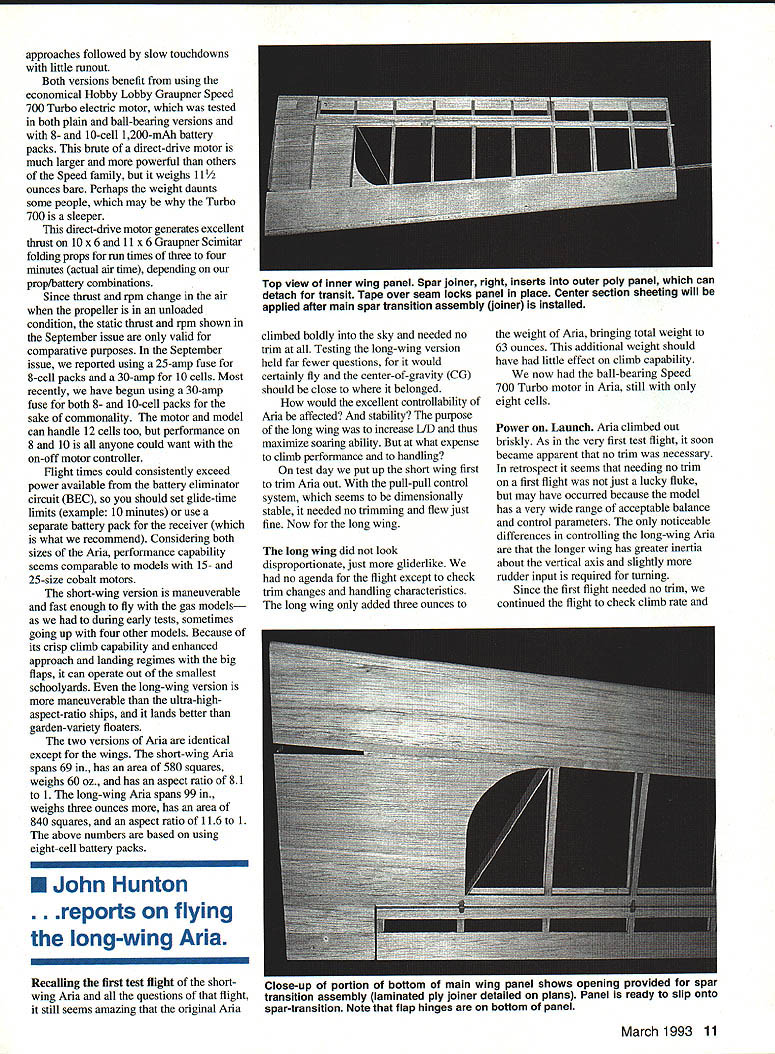
- The spar transition assembly is visible while the left panel is still open.
Motors/Batteries
The Graupner Speed 700 Turbo motors open many doors for Aria. Performance with either wing on the plain-bearing motor and a single eight-cell pack is satisfactory and is the most economical option. If you want quicker climbs, the ball-bearing (BB) motor with internal cooling impeller gives better performance.
Recommended propellers and packs:
- Props: Graupner Scimitar folding props 10x6 and 11x6.
- Packs: 8–10 cells (1,200-mAh commonly tested) give excellent performance. The motor can handle 12 cells, but 8–10 is sufficient for most needs.
- Fuse: 30-amp for both 8- and 10-cell packs (for commonality).
- Charger: a dual charger is convenient for dual packs (charges two packs simultaneously).
Options:
- Dual five-cell packs or two six-cellers in series will increase climb performance, but we saw no compelling need for such power.
- For extended soaring and to avoid being limited by a BEC, use a separate receiver battery pack (250 mAh or larger recommended).
- A battery-eliminator circuit (BEC) can be used to enforce glide-time limits (for example, 10 minutes).
Considering packs and motor choices, Aria's performance is comparable to models using 15–25-size cobalt motors.
Perspective
The short-wing Aria is more compatible with power models at a typical mixed-use flying field. It is excellent for transitioning from power to electric, penetrates and handles strong wind, and reacts to thermals. Its flight characteristics help pilots adjust to electric where much of the flight regime is out, high, and far away.
After you have transitioned and wish to expand your soaring experience, the long wing provides much better response to even weak lift and enables extended flights. Because BEC can become a time-limiting factor, a separate receiver pack is advisable to exploit the long wing's full potential.
Build both wings and you have the optimum setup for all occasions and moods: interchangeable wings and battery packs. Either Aria can be flown out of and back into a pea patch and will give you plenty of solid, environmentally compatible enjoyment.
Transcribed from original scans by AI. Minor OCR errors may remain.

