
The Art and Science of Pseudoaerodynamics
By Barnaby Wainfan
Illustrations by John Hunton
Have you ever wondered why basically similar model aircraft fly so differently? Our author takes an in-depth look at this and related subjects. His results may startle you.
Modelers, like all airplane designers, are perpetually exploring the fascinating gray area between art and science. There is much of both in the process of creating a model that is attractive and flies well.
The science of aerodynamics is well documented elsewhere. It is the purpose of this article to shed some light on the less well documented forces affecting the model airplane.
Much of airplane and model design is rigidly scientific. The configuration of an airplane is determined by its design mission. That mission specifies the size, wing loading, airfoil characteristics, etc., which the airplane must have in order to do its job.
As any aerodynamicist can tell you, the performance of an airplane is determined by such parameters as:
- wing loading
- aspect ratio
- lift coefficient
- Reynolds number
- span efficiency
- and many others
The effects of all of these scientifically determined quantities can be written down in the form of graphs and tables. From these, the performance of the airplane can be determined. What the graphs say, the airplane will do.
Modelers are instinctively dissatisfied with this rigid, analytical view of their craft. There is something aesthetically displeasing about this mechanistic point of view. If all you need to design a good model is a set of tables and graphs, then there is no room for the individual self-expression that is so much a part of the enjoyment of modeling. There is no room for innovation and no room for art.
A modeler tends to look at things in a more subjective way. He will tell you, "If it looks right, it will fly right." Usually it does. Nicely proportioned models with balanced, eye-pleasing lines usually fly very well. On the other hand, ugly, awkward ships rarely do. None of this can be determined by consulting the tables and graphs.
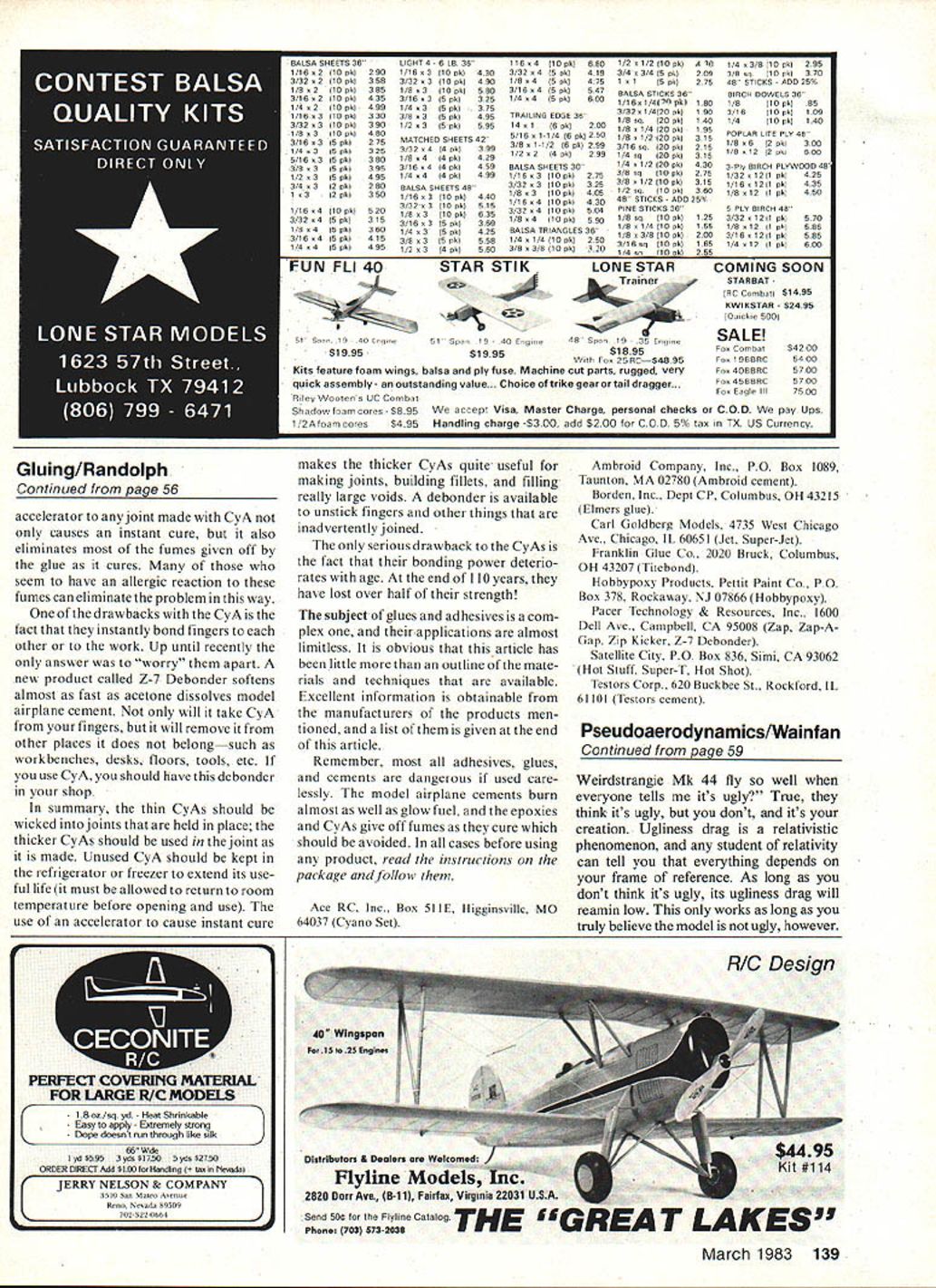
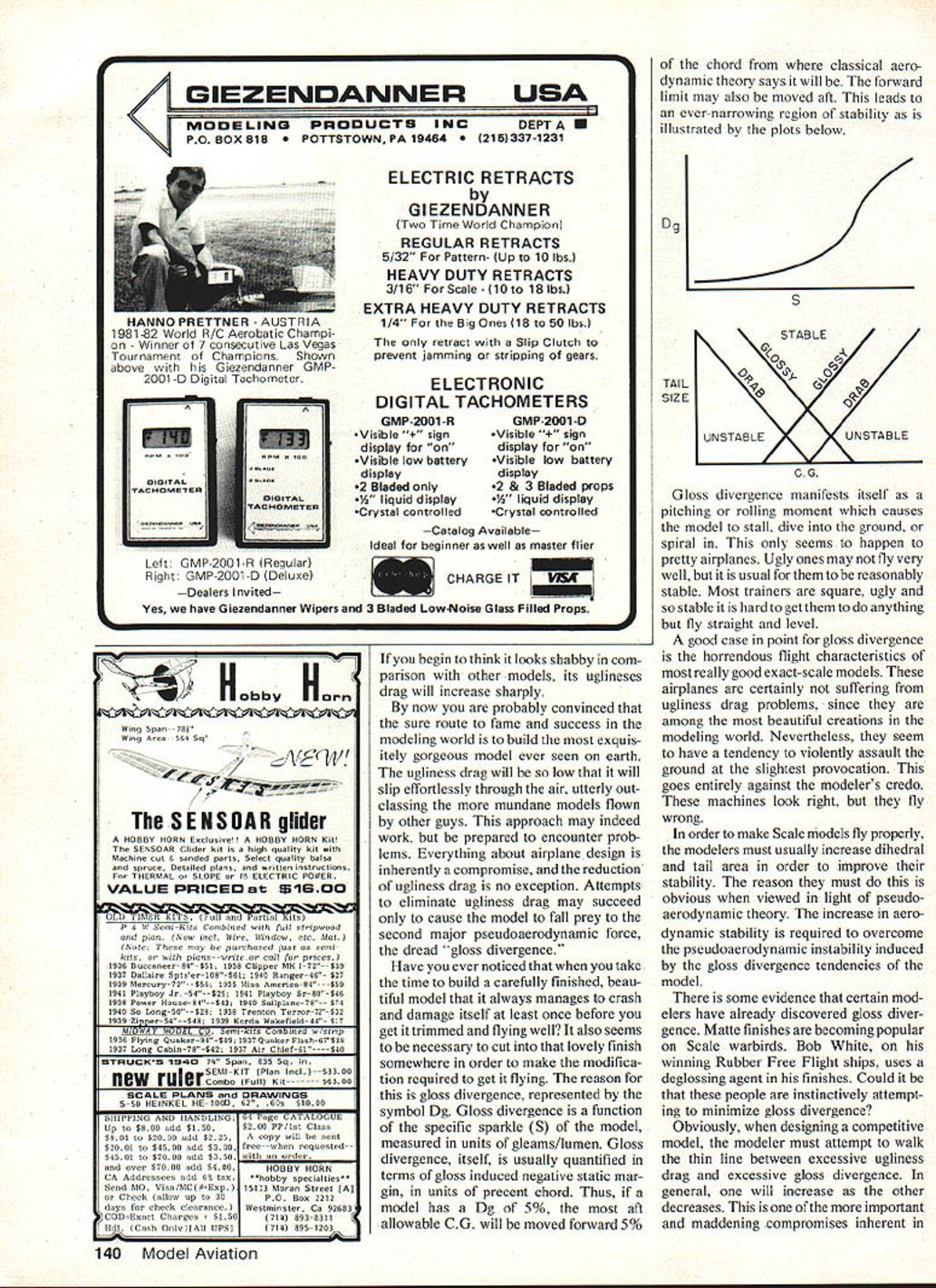
An even more perplexing effect may be observed when two modelers build machines of the same design. From the aerodynamicist's point of view the two planes are theoretically identical and should fly identically. They don't. The prettier model always seems to fly better than the drab one. Obviously, the aerodynamicists have overlooked something.
Pseudoaerodynamics and Ugliness Drag
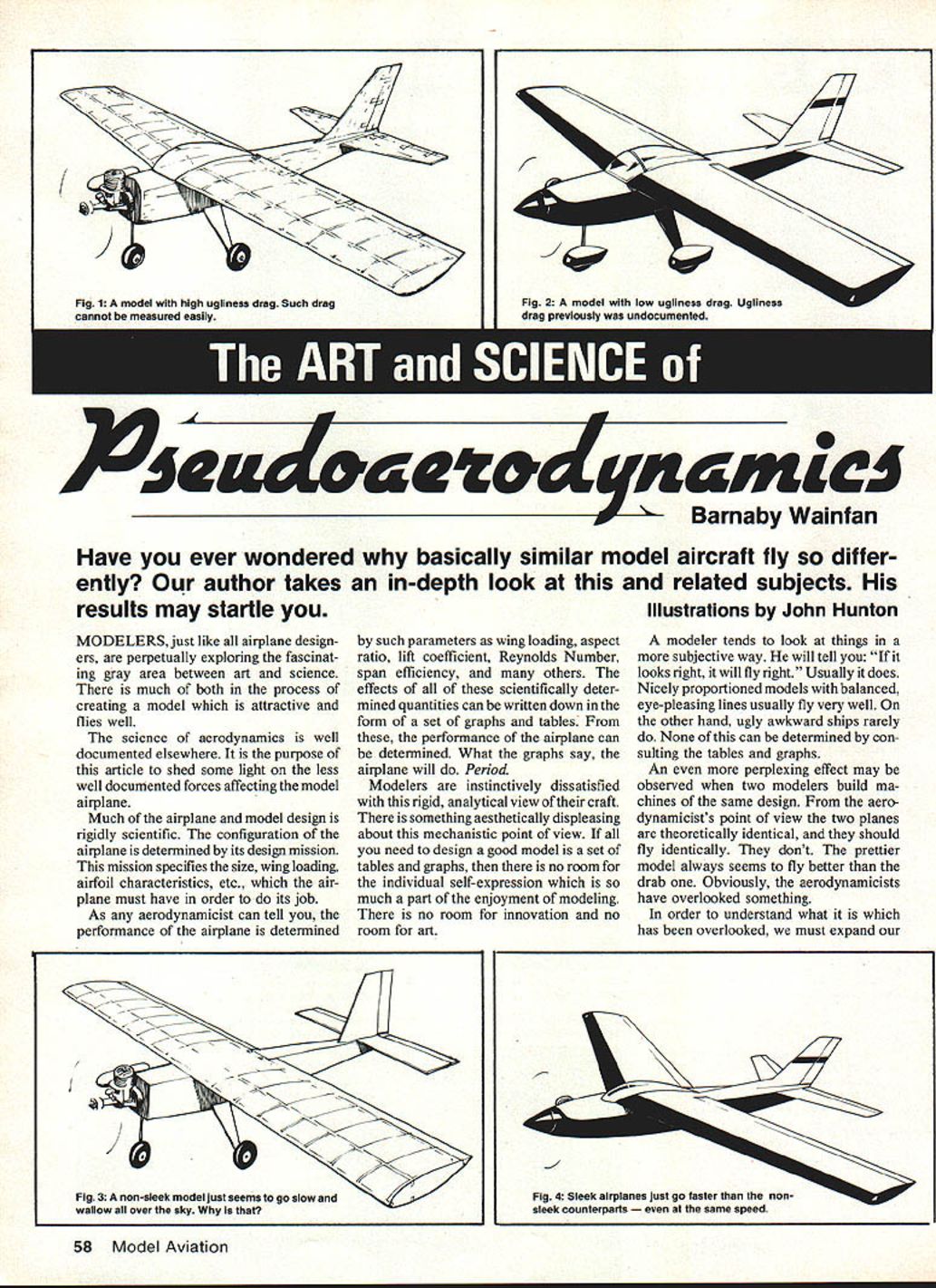
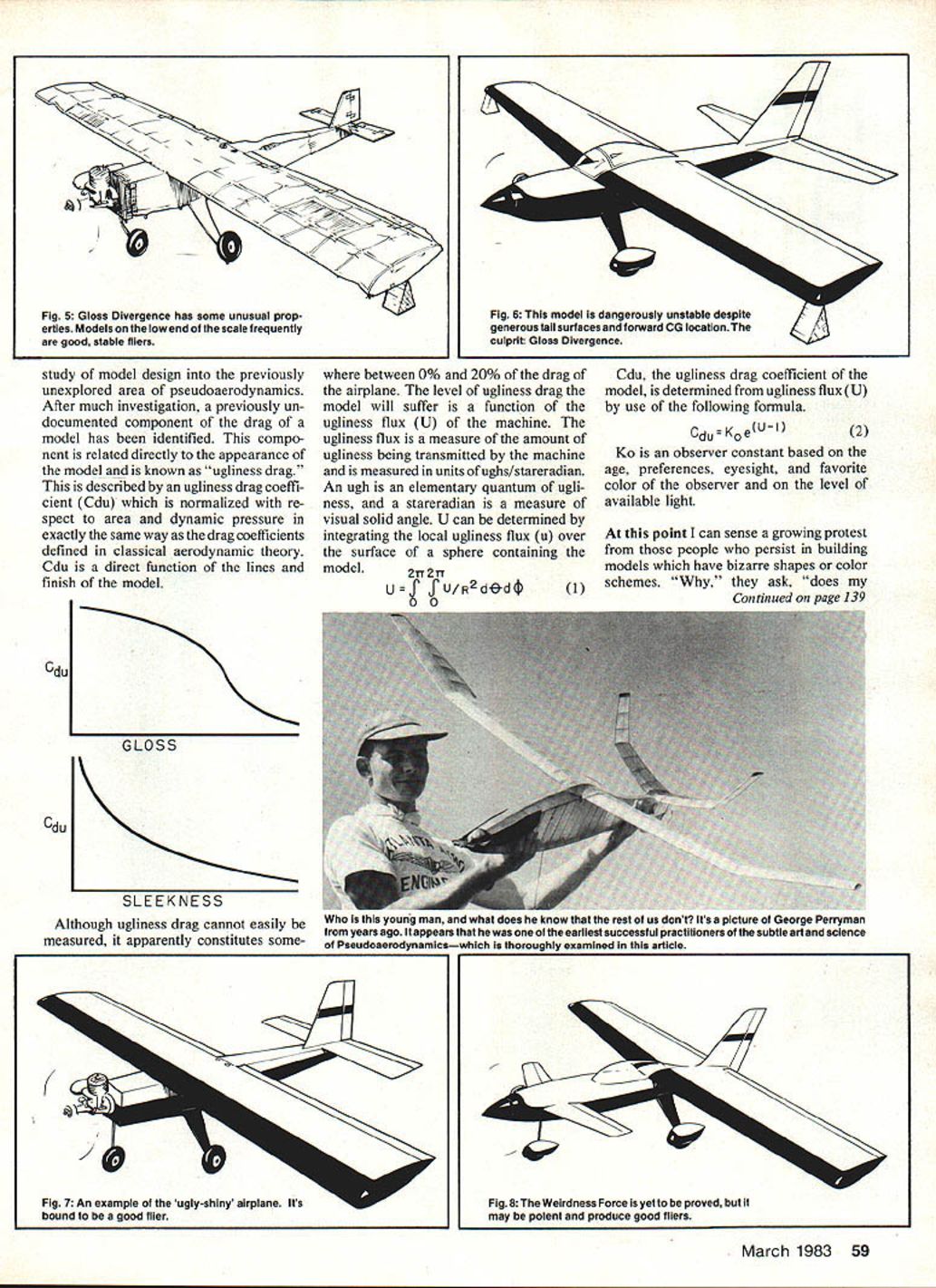
To understand what has been overlooked, we must expand our study of model design into the previously unexplored area of pseudoaerodynamics. After much investigation, a previously undocumented component of the drag of a model has been identified. This component is related directly to the appearance of the model and is known as "ugliness drag."
Ugliness drag is described by an ugliness drag coefficient (Cdu), which is normalized with respect to area and dynamic pressure in exactly the same way as the drag coefficients defined in classical aerodynamic theory. Cdu is a direct function of the lines and finish of the model.
Although ugliness drag cannot easily be measured, it apparently constitutes somewhere between 0% and 20% of the drag of the airplane. The level of ugliness drag the model will suffer is a function of the ugliness flux (U) of the machine. The ugliness flux is a measure of the amount of ugliness being transmitted by the machine and is measured in units of ughs/stareradian. An ugh is an elementary quantum of ugliness, and a stareradian is a measure of visual solid angle. U can be determined by integrating the local ugliness flux (u) over the surface of a sphere containing the model:
U = ∫_0^{2π} ∫_0^{π} (u / R^2) sin θ dθ dφ (1)
Cdu, the ugliness drag coefficient of the model, is determined from ugliness flux (U) by the following formula:
Cdu = Ko e^(U − 1) (2)
Ko is an observer constant based on the age, preferences, eyesight, and favorite color of the observer and on the level of available light.
Ugliness drag is also a relativistic phenomenon. If you do not believe a model is ugly, its ugliness drag remains low. As soon as you begin to think it looks shabby in comparison with other models, its ugliness drag will increase sharply. Thus ugliness drag depends on the observer's frame of reference — and, in practice, on the observer's opinion of the model.
Gloss Divergence
It might seem that the sure route to superior performance is to build the most exquisitely gorgeous model ever seen. The ugliness drag would be so low that it would slip effortlessly through the air, outclassing more mundane models. This approach may indeed work, but be prepared to encounter problems. Everything about airplane design is inherently a compromise, and the reduction of ugliness drag is no exception. Attempts to eliminate ugliness drag may succeed only to cause the model to fall prey to the second major pseudoaerodynamic force: the dread "gloss divergence."
Have you ever noticed that when you take the time to build a carefully finished, beautiful model it often manages to crash and damage itself at least once before you get it trimmed and flying well? It also seems necessary to cut into that lovely finish somewhere to make the modification required to get it flying. The reason for this is gloss divergence, represented by the symbol Dg.
Gloss divergence is a function of the specific sparkle (S) of the model, measured in units of gleams/lumen. Gloss divergence itself is usually quantified in terms of gloss-induced negative static margin, in units of percent chord. Thus, if a model has a Dg of 5%, the most aft allowable center of gravity will be moved forward 5% of the chord from where classical aerodynamic theory says it will. The forward limit may also be moved aft. This leads to an ever-narrowing region of stability, as would be illustrated by typical stability plots.
Gloss divergence manifests itself as a pitching or rolling moment which causes the model to stall, dive into the ground, or spiral in. This only seems to happen to pretty airplanes. Ugly ones may not fly very well, but they are usually reasonably stable. Most trainers are square, ugly, and so stable it is hard to get them to do anything but fly straight and level.
A good case in point is the horrendous flight characteristics of many really good exact-scale models. These airplanes are certainly not suffering from ugliness drag problems, since they are among the most beautiful creations in the modeling world. Nevertheless, they seem to have a tendency to violently assault the ground at the slightest provocation. These machines look right, but they fly wrong.
To make scale models fly properly, the modeler must usually increase dihedral and tail area to improve stability. The increase in aerodynamic stability is required to overcome the pseudoaerodynamic instability induced by gloss divergence tendencies.
There is some evidence that certain modelers have already discovered gloss divergence. Matte finishes are becoming popular on scale warbirds. Bob White, on his winning rubber free-flight ships, uses a deglossing agent in his finishes. Could it be that these people are instinctively attempting to minimize gloss divergence?
Balancing Ugliness Drag and Gloss Divergence
When designing a competitive model, the modeler must attempt to walk the thin line between excessive ugliness drag and excessive gloss divergence. In general, one will increase as the other decreases. This is one of the more important and maddening compromises inherent in model airplane design. There is always a desire to make a model beautiful even if its beauty turns out to be a fatal flaw.
Of course, if one is really a masochist he can build an ugly, shiny airplane and get zapped from both sides. The optimization of the airplane requires that we take into account ugliness drag, gloss divergence, and any configuration changes required to compensate for them. Typically, increasing gloss divergence requires an increase in tail size. This increase in tail size will be the gloss-divergence-driven correction to the model's instability at a cost in increased skin-friction drag. At the same time, the increase in gloss will cause the ugliness drag of the model to decrease.
The curve of total aircraft drag versus specific sparkle becomes concave, displaying a clearly defined optimum point — if the plot is made at a constant stability margin, taking into account the variation of tail size with specific sparkle. The designer must usually approach this optimum empirically, since pseudoaerodynamic parameters are extremely difficult to measure quantitatively and even harder to predict with any reasonable degree of accuracy.
Weirdness Force
Some modelers (the author included) believe that unconventional configurations may lead to higher performance. This belief has led to the postulation of a third, as yet hypothetical, pseudoaerodynamic quantity: "weirdness force."
As postulated, weirdness force is directly proportional to the strangeness of the model (measured in boggles/glance) and may act in almost any direction. Weirdness forces may help fight ugliness drag, gloss divergence, or both. The existence of the weirdness force has yet to be rigorously proven, although ongoing research has shown promising results.
There are many oddball models that fly very well despite their bizarre appearance. It would seem likely that some unknown effect is helping them along. George Perryman is probably the first modeler to make a sustained effort to exploit the weirdness force in competition.
Conclusion
Pseudoaerodynamics is a real phenomenon with practical implications. Modelers who are aware of ugliness drag, gloss divergence, and the possible effects of weirdness force — and who apply careful empirical testing — will be better equipped to balance aesthetics and performance. Aerodynamics is an area that must be much more thoroughly investigated and understood before modelers can build the truly ultimate machine.
Transcribed from original scans by AI. Minor OCR errors may remain.

