
The Art of Thinking Big
The world of the big airplane is entirely different. It must be built differently—from different materials and with different powerplants. And it must be flown differently. Here is a meaningful briefing by big-model pilot, Lee Taylor.
ONE OF THE things modelers have always dreamed of was the big, beautiful scale model. Picture, for example, a one-third life-size Stearman sailing overhead. Sunlight sparkles off the huge wings and the steadily spinning prop. The big biplane pulls up and gracefully completes a loop. It rolls majestically. A dream? Not any longer. The day of the big model has finally arrived.
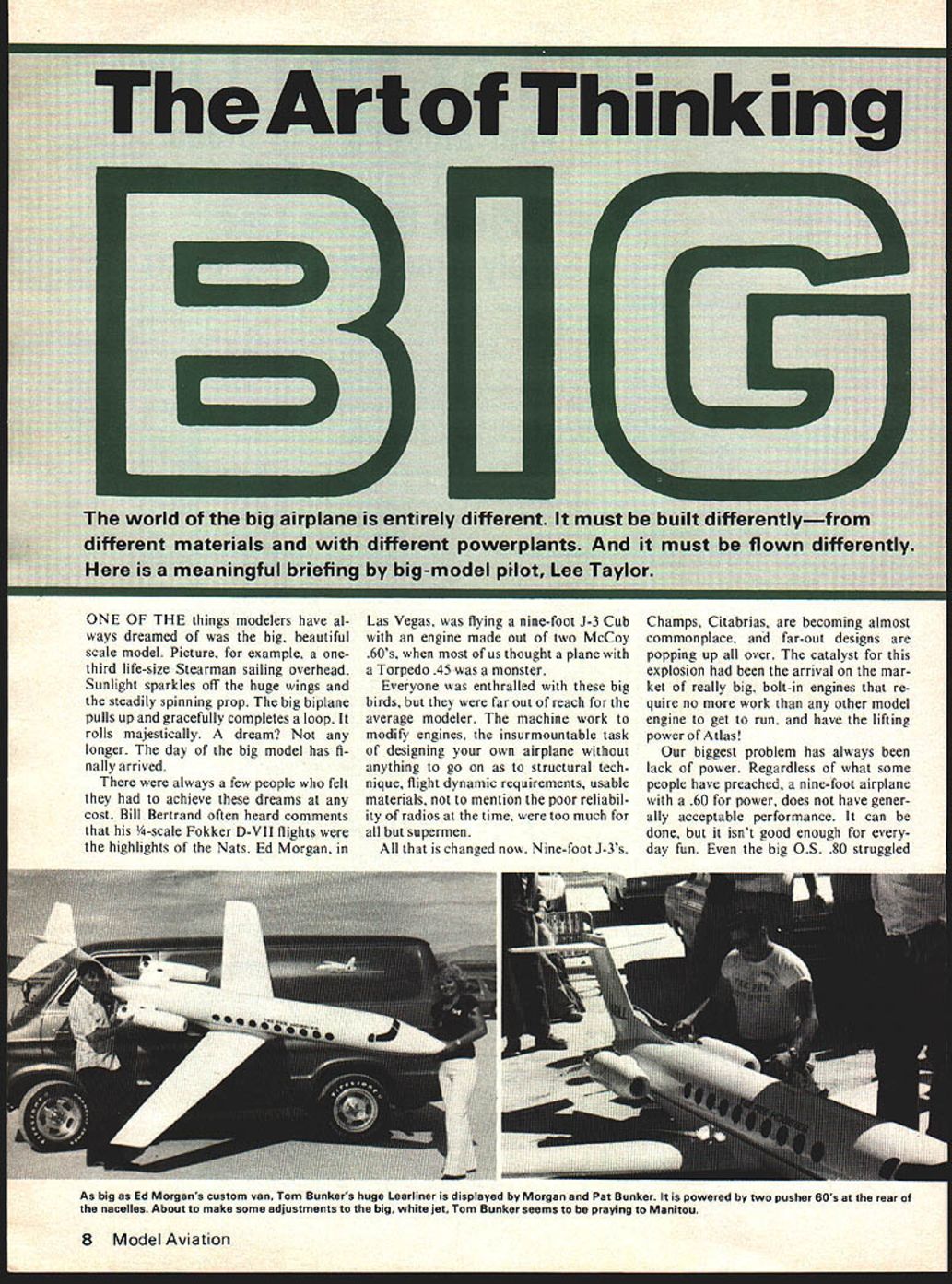
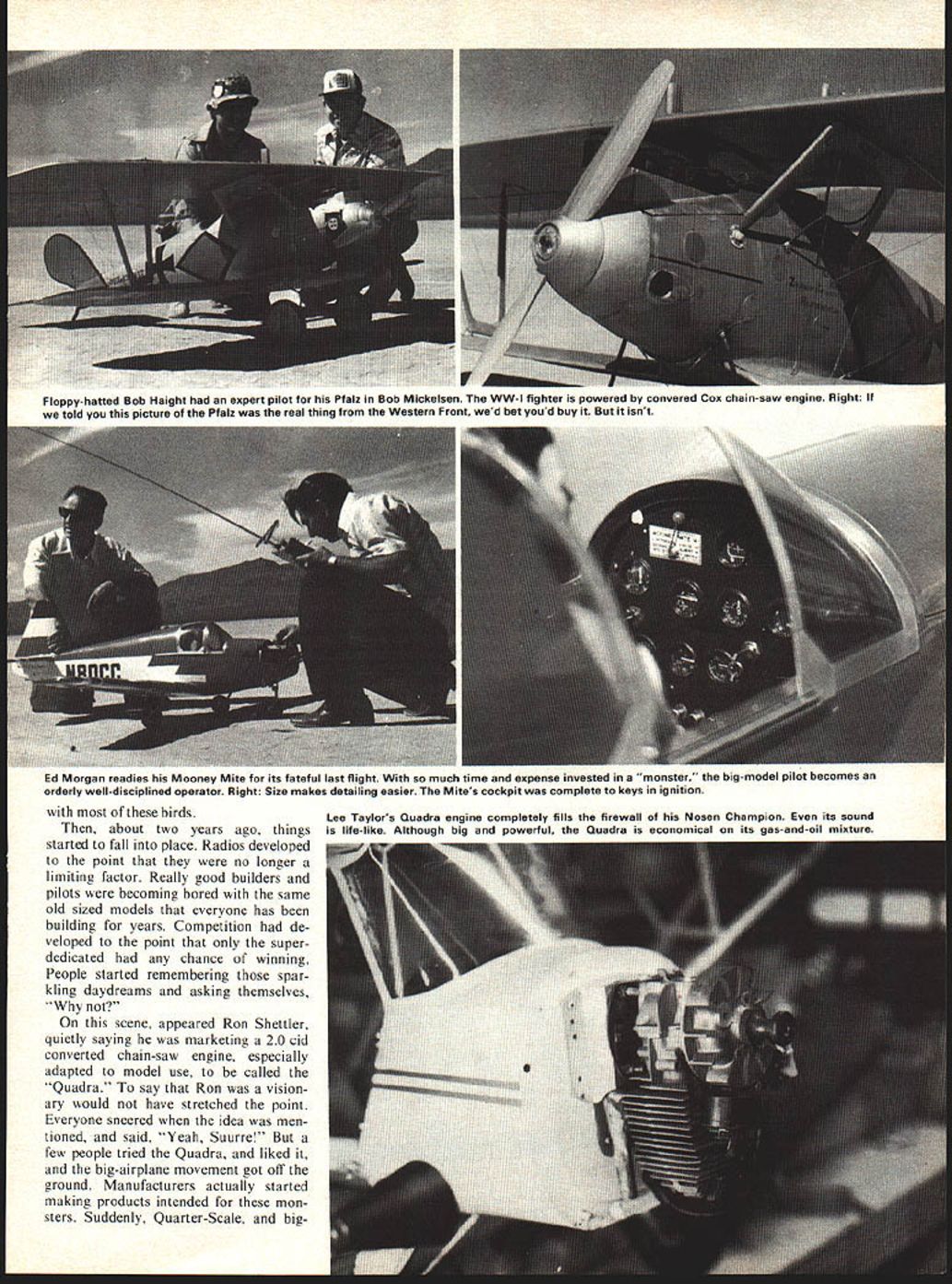
There were always a few people who felt they had to achieve these dreams at any cost. Bill Bertrand often heard comments that his 1/4-scale Fokker D-VII flights were the highlights of the Nats. Ed Morgan, in Las Vegas, was flying a nine-foot J-3 Cub with an engine made out of two McCoy .60's, when most of us thought a plane with a Torpedo .45 was a monster.
Everyone was enthralled with these big birds, but they were far out of reach for the average modeler. The machine work to modify engines, the insurmountable task of designing your own airplane without anything to go on as to structural technique, flight dynamic requirements, usable materials, not to mention the poor reliability of radios at the time, were too much for all but supermen.
All that is changed now. Nine-foot J-3's, Champs, Citabrias, are becoming almost commonplace, and far-out designs are popping up all over. The catalyst for this explosion had been the arrival on the market of really big, bolt-in engines that require no more work than any other model engine to get to run, and have the lifting power of Atlas!
Our biggest problem has always been lack of power. Regardless of what some people have preached, a nine-foot airplane with a .60 for power does not have generally acceptable performance. It can be done, but it isn't good enough for every-day fun. Even the big O.S. .80 struggled. with most of these birds.
Then, about two years ago, things started to fall into place. Radios developed to the point that they were no longer a limiting factor. Really good builders and pilots were becoming bored with the same old sized models that everyone has been building for years. Competition had developed to the point that only the super-dedicated had any chance of winning. People started remembering those sparkling daydreams and asking themselves, "Why not?"
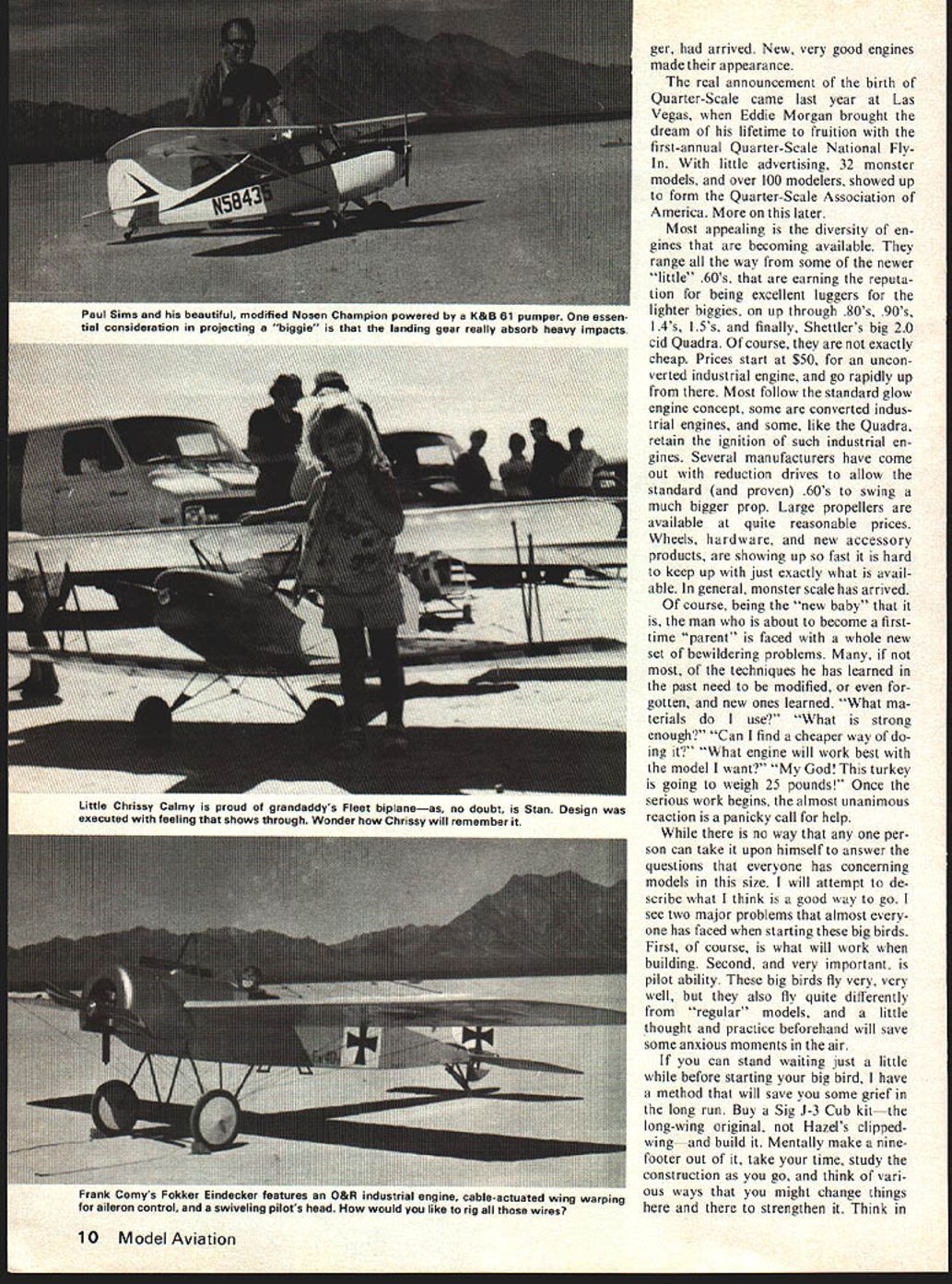
On this scene appeared Ron Shettler, quietly saying he was marketing a 2.0 cid converted chain-saw engine, especially adapted to model use, to be called the "Quadra." To say that Ron was a visionary would not have stretched the point. Everyone sneered when the idea was mentioned, and said, "Yeah, Sure!" But a few people tried the Quadra, and liked it, and the big-airplane movement got off the ground. Manufacturers actually started making products intended for these monsters. Suddenly, Quarter-Scale, and big- ger, had arrived. New, very good engines made their appearance.
The real announcement of the birth of Quarter-Scale came last year at Las Vegas, when Eddie Morgan brought the dream of his lifetime to fruition with the first-annual Quarter-Scale National Fly-In. With little advertising, 32 monster models, and over 100 modelers, showed up to form the Quarter-Scale Association of America. More on this later.
Most appealing is the diversity of engines that are becoming available. They range all the way from some of the newer "little" .60's, that are earning the reputation for being excellent luggers for the lighter biggies, on up through .80's, .90's, 1.4's, 1.5's, and finally, Shettler's big 2.0 cid Quadra. Of course, they are not exactly cheap. Prices start at $50, for an unconverted industrial engine, and go rapidly up from there. Most follow the standard glow engine concept, some are converted industrial engines, and some, like the Quadra, retain the ignition of such industrial engines. Several manufacturers have come out with reduction drives to allow the standard (and proven) .60's to swing a much bigger prop. Large propellers are available at quite reasonable prices. Wheels, hardware, and new accessory products, are showing up so fast it is hard to keep up with just exactly what is available. In general, monster scale has arrived.
Of course, being the "new baby" that it is, the man who is about to become a first-time "parent" is faced with a whole new set of bewildering problems. Many, if not most, of the techniques he has learned in the past need to be modified, or even forgotten, and new ones learned. "What materials do I use?" "What is strong enough?" "Can I find a cheaper way of doing it?" "What engine will work best with the model I want?" "My God! This turkey is going to weigh 25 pounds!" Once the serious work begins, the almost unanimous reaction is a panicky call for help.
While there is no way that any one person can take it upon himself to answer the questions that everyone has concerning models in this size, I will attempt to describe what I think is a good way to go. I see two major problems that almost everyone has faced when starting these big birds. First, of course, is what will work when building. Second, and very important, is pilot ability. These big birds fly very, very well, but they also fly quite differently from "regular" models, and a little thought and practice beforehand will save some anxious moments in the air.
If you can stand waiting just a little while before starting your big bird, I have a method that will save you some grief in the long run. Buy a Sig J-3 Cub kit — the long-wing original, not Hazel's clipped-wing — and build it. Mentally make a nine-footer out of it, take your time, study the construction as you go, and think of various ways that you might change things here and there to strengthen it. Think in terms of thin plywood instead of balsa. The Cub was designed many years ago. Its construction is very similar to what is used on most of the biggies, and you can visualize many of the problem areas that might crop up later with your biggie.
For example, if you look closely at the kit and analyze it, you might see that the corner longerons are balsa, and are exposed to bumps or bangs. Wouldn't those be better if made from small hardwood dowel, so that they might not break so easily? And what about that wing strut attachment? Sure, it was good enough when this plane flew virtually free flight with an .09, but will it stand up to the stresses of a modern-day engine pulling it through snap rolls and spins? That cabin structure looks flimsy; all those windows make for very little structure to hold the wing to the fuselage. Dowels spliced into all the window posts, running all the way up into the wing root area, and down into the fuselage to tie everything together, will add immeasurably to the strength. The tubing structure in the windshield can be made out of wire, running down deep into the corners to help tie the front cabin together, and helping a lot in the structural rigidity of the forward section.
A quick reminder here. As you are doing this experimental building with the little J-3, be sure mentally to blow it up to monster size. Get used to thinking about what kind of forces and strengths you shortly will be dealing with. Remember, you will no longer be dealing with just fairly moderate forces. The engines you will use put out fearsome power. They are big, heavy, and when you get that much metal charging up and down in a cylinder, swinging 16, 18, or 20" props, the vibrations and stresses are no longer something that simple balsawood and model cement can handle! You have to start thinking about how your structure can be designed to help out, and, for once, you aren't going to be worrying that much about weight, at least in the nose.
Cover the model with silk or double-covered Silkspan. Get used to the idea of building and covering a model again, rather than just wrapping it up like a package in plastic wrap. Many of the bigger birds, and the little J-3 also, are designed with the covering in mind to add structural strength and rigidity. The plastic films do not do this, and if you use them on the biggie, you are going to lose a great deal of the strength that was designed into the model.
As you are doing the covering and painting, be aware of what you are doing. This is the point where you can really pile on the pounds if you become sloppy. The point here is to get a good finish with the bare minimum number of coats. Start with the structure very well finished, without bumps or dents you will need to fill later with lead putty. Put the covering on smoothly and evenly, taking time to pull out wrinkles and smooth out all seams. A little extra time here will save hours of sanding and filling, and more importantly, pounds of weight. What is a brush stroke on this Cub model will be a bottle of paint on the biggie! Practice doing things right the first time, so that you don't have to worry about repairing the goofs later.
Plan on powering this plane with a good .19 or .25. I can recommend either the O.S. .25, or the Fox .25. Do not use more power than this. If you do, you will negate many of the training aspects of this bird. Use a full 4-channel radio, with the normal controls. Stick a parachute drop for fun.
Now comes the fun part, but some of the hardest work. You must learn to fly this beast. Remember that stick that controls the rudder? Yeah, the one that you use for steering on the ground, but have always forgotten about once in the air. From now on you cannot forget about it in the air. It is going to become just as important as the elevator, and more important than the ailerons. Yep, you will have to learn to fly both sticks, all of the time. That is why you built the little J-3.
It is an excellent trainer for our purpose. and is one bird that flies rather poorly if you don't do it properly. You will start to learn about taildraggers, and nice, gentle landings. Any other kind will get you in much trouble. In the little bird, a muffled landing will only bruise your ego, assuming you did all that beefing up we talked about earlier. In the biggies, with 15-30 pounds crashing into the ground, you will bend something major if you blow a landing. Even something as minor as a nose-up becomes a catastrophe in a biggie. Those big props cost a minimum of $4 each! (One friend of mine wiped out $36 worth of props making two flights!)
I'll tell you a little secret I have used for several years. If you will learn how to wheel-land that J-3, and will use that knowledge on the biggies, your landings will be much less of a sweaty proposition than if you use the standard full-stall touch-down. Reason? In the full-stall landing, control is lost at the moment of stall, hopefully at the exact same instant that the wheels hit the ground. If that timing doesn't happen, and it is rare that it does, you are left with a bird in a ticklish attitude, out of control, and with no airspeed. A really super pilot can sometimes recover from this situation. Mostly, the poor plane is on its own, to flop down any way it can.
If you will wheel-land the bird, the plane literally is flown down to the ground. Airspeed is maintained all the way through the touch-down, even through the initial part of the roll-out. Therefore, should things get out of whack at the last second, you still have airspeed in the bank, and can use that speed to give you an extra edge to get out of trouble. I'm not saying that you now can get out of any situation. You still have to have a cool head, but at least you have a little something extra to work with.
The secret to a good wheel landing is a little extra airspeed. Carry that airspeed right down to the flare, and instead of trying to hold the plane off, concentrate on getting it into a level attitude just about an inch off the ground. In other words, instead of flaring, just break the glide at ground level. Now comes the scary part and the need for skill. With the plane at one-inch altitude, and in a level attitude, tap in about a quarter-inch of down elevator, and hold it until the plane loses flying speed. If everything works out right, the plane will just gently tap its wheels down, and the down elevator will glue it onto the runway. As the speed drops off, come back easily to full up elevator to avoid nosing over.
Practice this maneuver over and over with the Cub, and the skills developed will stand you in good stead for the rest of your flying career. Fail to do so, as most people do, and when you get serious with taildraggers, especially the biggies, you will spend more time repairing than flying. The full-stall landing is an airplane killer. That's why in full-scale flying the perfect three-point landing is considered so beautiful. It is darned hard to do! The wheel landing is much safer, and the tail-high rollout is the thing that turns on the crowds.
OK, you've built the little one, learning all about the basic techniques of this type of model. You've mentally prepared yourself for the engineering and beef required on the powerful biggie. Your flying is so beautiful that every time you show up at the field your buddies put away their planes in shame, and you're hot to trot! What are you going to build?
Here, I'm afraid that I have to turn you loose. So far, there just aren't many kits available, and only a few plans. A very few of these are actually designed for the kind of power that we will be using. As a matter of fact, there are only three sets of plans currently available and specifically designed for big engines that I know of. They are Andy Sheber's Pitts Special, and Kraft Super-Fli plans, available in both 1/4- and 1/2-scale, and Jim Follin's 1/4-scale, Quadra-designed PT-19. Jim's plans are available from me. Andy's address is at the end of the article. There are many kits and plans on the way, and I'm sure I'm going to be taken to task by the time this is printed, but right now, those are the only products that are specific to our new powerplants.
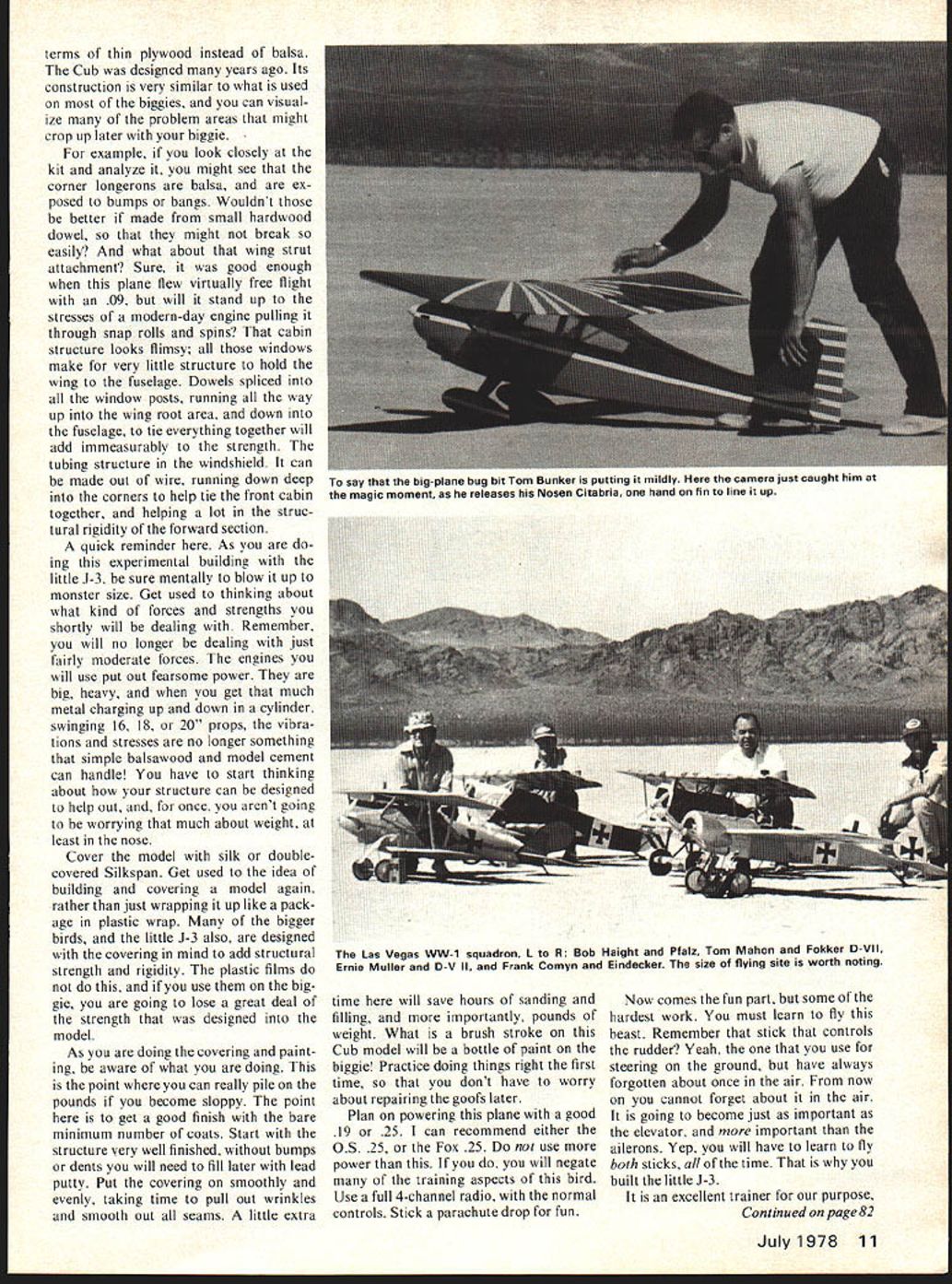
I have seen almost all of the Nosen kits, and am flying a heavily-modified Nosen Champ. They are very good starting points for anyone. However, be advised that all of Bud's kits were designed to fly with a maximum of an .80 engine (one that doesn't put out the power of a good Schnuerle .60), and consequently, they are very light in construction for the kind of power that is now the norm. They all fly very well, and are good, basic kits. They do require considerable beefing-up and some outright redesign for the big engines.
Since almost everyone starts with one of Bud's kits, I will go out on a limb to mention some of the things that we have all done in flying those models with the bigger powerplants. First off, on all of the Nosen planes that have wing struts, the design is inadequate (for big engines), and is just about the single most important change you can make. These struts virtually take the full load of the airplane. Redesign them with this in mind. Metal fittings on each strut end, bolted to strong metal attach points at both the wing and fuselage, is the only way to go. My struts have the metal cable shackle ends tied together with 1/8" music wire running the length of the struts. That is a little overkill, but I have no compunction about snap-rolling and spinning my 18-lb. bird.
Second, you would be well advised to replace all the fuselage longerons with 1/4" hardwood dowel. The balsawood structure just won't take the banging the heavier birds invariably get, and repairing them is a major project.
The nose area isn't too bad, but still needs all you can do to stiffen it up. Look over carefully the wood supplied for this section, and replace any soft pieces with wood of a good, hard density. My bird is covered inside and out with a layer of 8-oz. fiberglass, back to the rear of the landing gear on the outside. Since I cut out the door to make it operational, I stiffened the cabin area to replace the strength lost by this mod. The biggest things I did were to imbed 3/8" wire into all the door and window posts, and to make forward pipe structure in the windshield from brass tubing, with wire splice pieces soldered into the joints, and all ends tied heavily into the structure. The latter mod alone greatly stiffened up the nose-cabin-wing area.
The landing gear has to have some provision for flexing. As designed, it is almost totally rigid. Since the gear can't flex, every hard landing will bend something. The wheels alone aren't sufficient to absorb the shock. This is something that we haven't fully cured yet. There are several solutions that work, but are still not the ultimate. I have to leave this one to you; just make some modification so that you do have some flex in the gear.
I don't like acetate windows. A trip to your local plastics store (ours here is Tap's Plastics) will net you 1/16" plexiglass. Careful cutting and RC-56 glue will get you some very nice windows that are even scale thickness! While you're there, pick up some very thick acetate or butyrate sheet (.040 or thereabouts) for the front windshield. Use RC-56 glue on this also.
Now, as to engine choice. This is one area where I can really howl, because there isn't anyone I know of that really has broad experience. I have a Quadra and access to the 1.5 cid Moki. I have seen the DuBro belt drive run, but not in a plane. Therefore, be advised that what I am about to say is open to controversy. But I have been at this modeling business for quite a while, and I think the ideas are valid.
In general, there are two types of engines available today. These are the glow engines that follow the standard modeling layout, and the converted industrial engines. I'm going out on a limb to make two statements.
First, the glow engines that follow standard model design are not much different from the engines we have all grown to know and love, just bigger. From what I have seen of them, they are all very powerful, swing big props, and scream! They are best suited for the smaller biggies, and the ones that are the more modern, faster planes. There is no reason that they can't be used in the older, bigger planes, but they don't match the character of those planes.
The very light biggies, such as the Nosen J-3 and Champ, will be most satisfactory with one of the smaller glow engines, such as the Webra 90, or one of the reduction drive units, of which there are several. Really good .60's give solid, extremely scale-like performance with these planes, keeping in mind that the real planes' engines also howled out their guts to fly. Most people will opt for something that provides a little extra to spare.
The bigger glow engines are usable in the lighter biggies, but are most at home in something like a Nosen Citabria, or 1/4-Pitts. I would be very interested to see how they would perform in something like Nosen's new Mustang. That is the kind of plane and performance they were designed for, howling high speed.
Then, secondly, we come to the pièce de résistance, the Quadra class. The big, hulking, monster prop-swingers. The Quadra can be used in virtually any airplane, but is most at home in a plane that matches its own bulk, such as the Nosen Mr. Mulligan, or a 1/3rd Pitts. One of the most impressive sights I have seen was Jim Jacobson's 23-lb. Mr. Mulligan taking off on its maiden flight with that big Quadra growling away up front. That airplane rolled about 75 feet, pointed its snout up at about a 30° angle, and just scratched and clawed its way, growling, into the sky. There wasn't any real speed, just an awesome feeling of power. The closest comparison I can make was a 3000-hp Beecraft snarling away from the Reno runway. That is the kind of bird the Quadra was born for. It sounds so good!
I have a Quadra in my Champ, and it flies the plane very well. However, the engine completely fills the firewall, and the cowling is slightly oversize for scale. There are engines that would be a better match. I just don't have one.
There is one class of engines I haven't mentioned, the new multi-cylinder engines. I have seen the Hargrave Radials, offered by Model Builder magazine, but have not seen any of the multi-cylinder engines run.
Opinion. I don't think any of these engines are going to be adaptable to our size models. Their total displacement is not huge, and I shudder to think of sticking $1000 on the front of any airplane! The Hargrave, by the way, is a gorgeous piece of work.
Now I'm going to talk briefly about something that has become near and dear to me, and that is the Quarter-Scale Association of America. A group that was formed at the first Las Vegas National Fly-In last October, we are devoted to the building and flying of Quarter-Scale, or very large, models. We believe that each and every huge model that is built is unique, and special unto itself, and that therefore competition between them would be a sacrilege. Competition automatically implies rules, rules are restrictive, and we don't want any restrictions on what we do with these beasts. Basically, we are a band of rugged individualists who wish to build what we want, how we want to, and to get together with others to share the joy of achievement, and to pick each other's brains. We don't want those efforts formally judged, because every one of us is a winner in our own minds.
Our primary purpose is to provide a rallying point where anyone interested can get information, and share that which he has. We want to get together for fly-ins, Q.S. picnics, and barbecues, have a blast with our biggies, and enjoy the company of others with similar interests.
SOME SUPPLY SOURCES
Kits
- (J-3, Champs, Citabria, Mr. Mulligan, several others)
- Bud Nosen Models
P.O. Box 105 Two Harbors, MN 55616
- (Several WW-I types)
- Aeroace Model Engineering Co.
Box 111 Lincroft, NY 10540
Engines
- Quadra 20 cid, converted chainsaw engine, ignition. (Most hobby shops can order.)
- Five Star Specialties
3125 Wilkins Way Carmichael, CA 95608
- EWH Specialties, Inc.
607 E. Abrams, Suite #10 Arlington, TX 76010
- MRC-Suiza 125 cc (.15 cid). (Most hobby shops can order.)
- MRC
2500 Woodbridge Ave. Edison, NJ 08817
- MOKI 250 cc. (Most hobby shops can order — imported by Polis Hobbies.)
- Five Star Specialties (see address above)
Planes and parts
- (Specifically designed for large engines — also many parts, accessories, and Quadra engines and accessories.)
- Big Art's Models
2062 Emmet
Transcribed from original scans by AI. Minor OCR errors may remain.

