
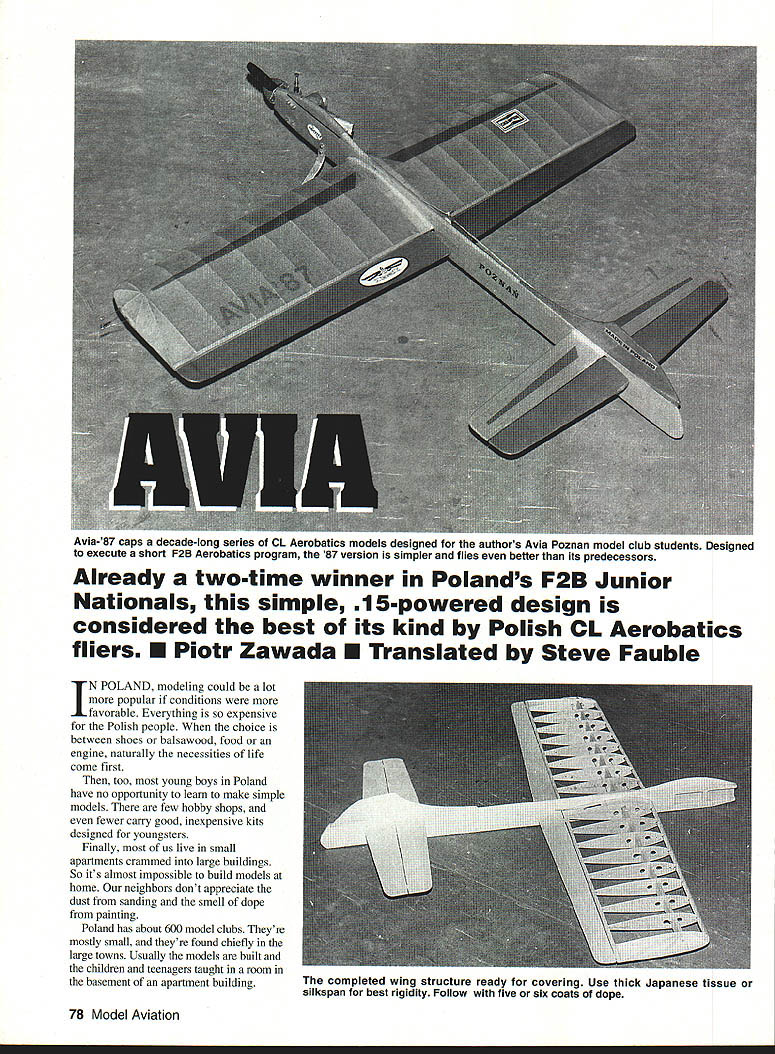
Avia
Already a two-time winner in Poland's F2B Junior Nationals, this simple, .15-powered design is considered the best of its kind by Polish control-line aerobatics fliers. Piotr Zawada. Translated by Steve Fauble.
Background: modeling in Poland and the Avia Poznań club
Modeling in Poland could be more popular if conditions were more favorable. Everything is expensive for Polish families; when the choice is between shoes or balsa wood, food or an engine, necessities come first. Most young boys have little opportunity to learn model building: there are few hobby shops and even fewer inexpensive, youth-friendly kits. Many families live in small apartments, so building at home is difficult — neighbors dislike sanding dust and the smell of dope.
Poland has about 600 model clubs, mostly small and concentrated in large towns. Often models are built and children taught in a basement room of an apartment building. In the Poznań district, modeling is usually possible only in clubs like Avia Poznań.
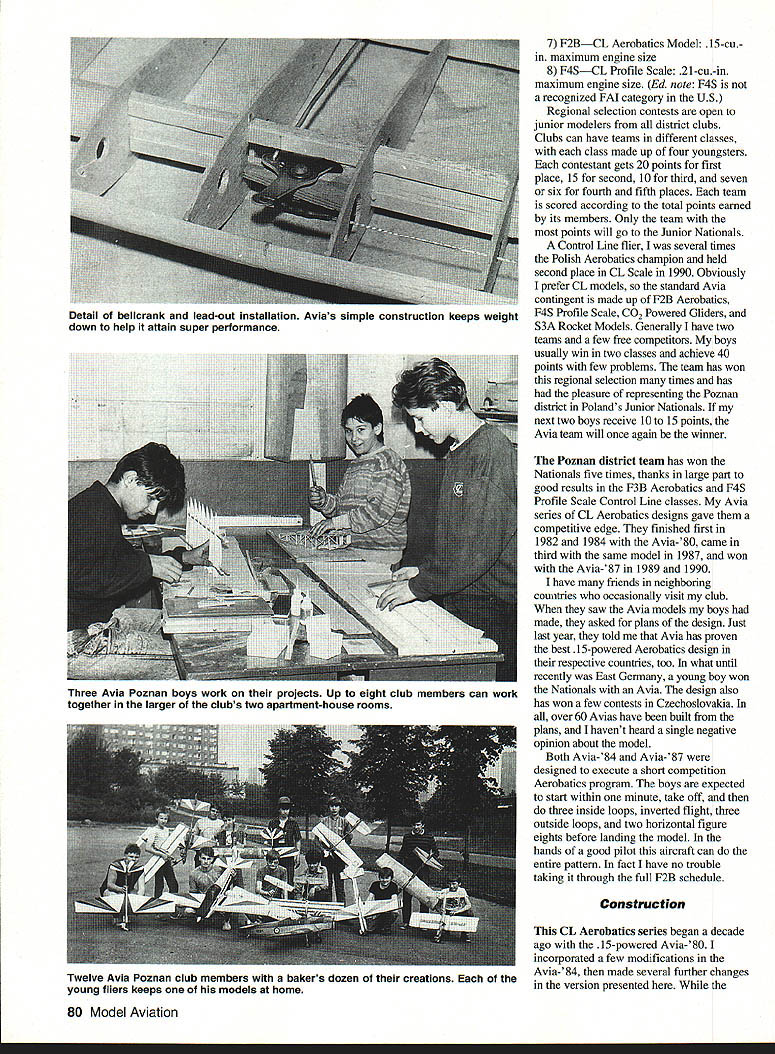
The Poznań district has 16 small clubs with roughly 40 senior members and about 300 younger modelers. The Avia club has three seniors and 16 boys who make models. Each year the clubs hold a large contest for youngsters under 17 for the Poznań district championship. The regional contest determines the winning team, which represents Poznań at the national junior championships. Usually about 25 district teams compete at the national level.
Junior competition classes
Children can compete in eight classes:
- F1A — 1/2A Small Gliders: 155–186 sq in total area; 5-oz minimum weight
- F1H — Gliders: 280 sq in maximum total area; 8-oz minimum weight
- F1G — Rubber Powered: 2.5-oz minimum weight; 1-3/8-oz maximum rubber weight
- F1C — 1.5 cc Power Models: .09 cu in maximum engine size; 10.5-oz minimum weight; 7-sec engine run
- CO2 Powered Gliders — standard CO2 engine (0.16 cu in), commonly made in Czechoslovakia or the former Soviet Union
- S3A — Space Rocket Models: 5-sec maximum engine run; 1.2-in minimum diameter; model must have a parachute for landing
- F2B — Control-Line Aerobatics: 15-cu in maximum engine size
- F4S — Control-Line Profile Scale: 21-cu in maximum engine size
Ed. note: F4S is a recognized FAI category. U.S. regional selection contests open to junior modelers are organized by district clubs. Clubs may field teams in different classes. A team is made up of four youngsters. Contest scoring: 20 points for first place, 15 for second, 10 for third, 7 for fourth, 6 for fifth, and 5 for sixth. A team’s score is the total points earned by its members. Only team points go on to the Junior Nationals.
Avia Poznań competition record
Our control-line fliers have been several-times Polish Aerobatics champions and placed second in CL Scale in 1990. Avia’s standard contingent commonly fields F2B Aerobatics, F4S Profile Scale, CO2 Powered Gliders, and S3A Rocket Models. Typically we enter two teams and a few individual competitors. The boys usually win two classes and achieve about 40 points; with few problems the team has repeatedly won regional selection and represented Poznań at the Junior Nationals.
The Poznań district team has won the Nationals five times, largely due to strong results in the F2B Aerobatics and F4S Profile Scale classes. My Avia series of CL aerobatics designs gave the teams a competitive edge: first in 1982 and 1984 with the Avia-’80, third in 1987 with the same model, and wins in 1989 and 1990 with the Avia-’87.
When visiting friends from neighboring countries saw the Avia models, they asked for plans. Over 60 Avias have been built from the plans; the model has won contests in East Germany and Czechoslovakia and earned positive reviews everywhere I’ve heard from.
A model’s success depends on the pilot’s know-how and many hours of practice as much as on the model itself. A good model combined with a skilled pilot makes a winning team.
Construction
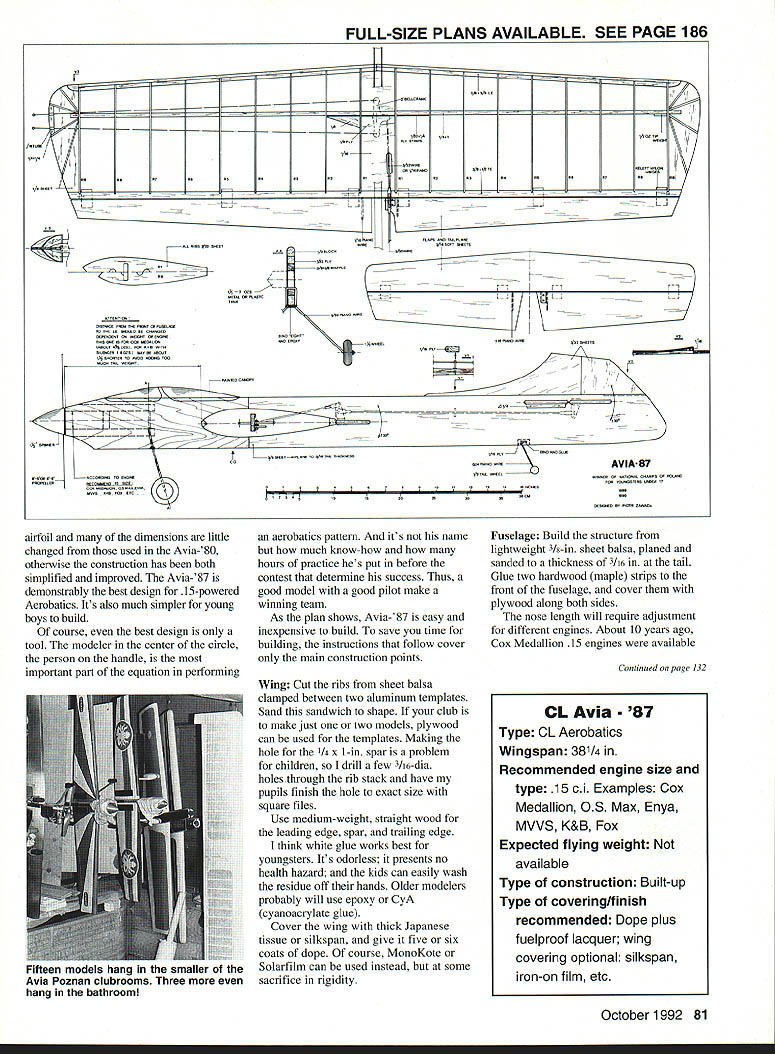
This control-line aerobatics series began a decade ago with the .15-powered Avia-’80. I made a few modifications for the Avia-’84 and several further changes for the Avia-’87 presented here. The design is easy and inexpensive to build. The following instructions cover the main construction points only.
Materials and covering
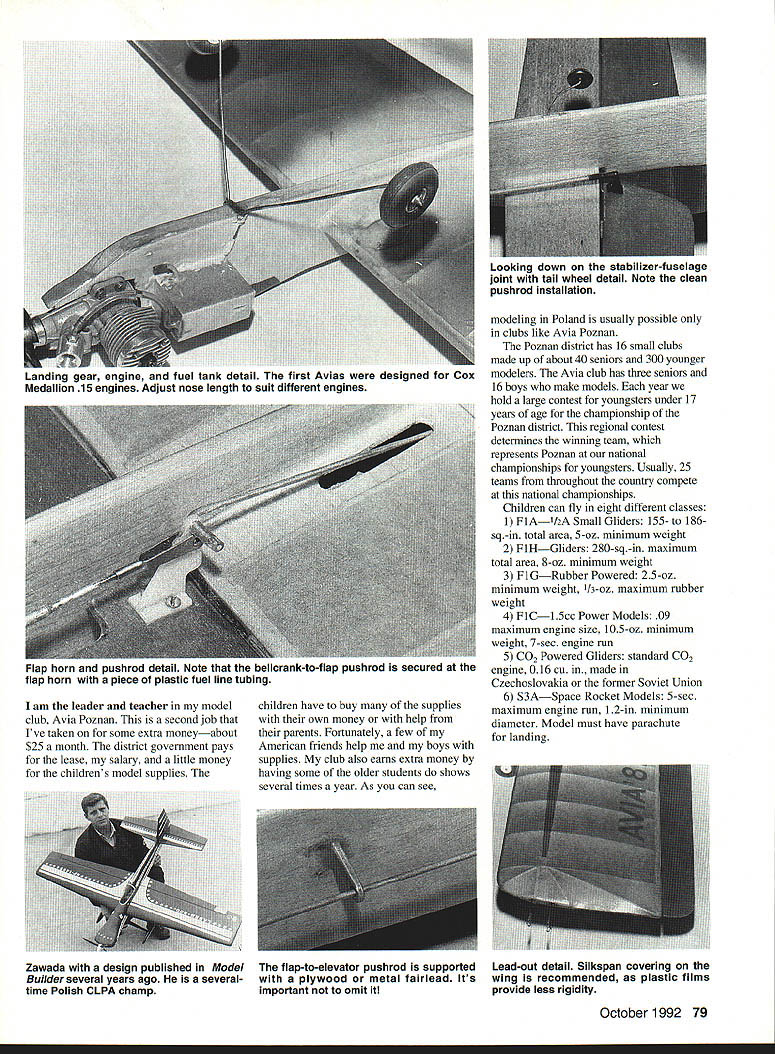
- Use thick Japanese tissue (Silkspan) for best rigidity when covering the completed wing structure; apply five or six coats of dope. MonoKote or Solarfilm may be used but will reduce rigidity.
- For adhesives, white glue (PVA) is preferable for youngsters — odorless, nonhazardous, and easy to wash off. Older modelers may prefer epoxy or cyanoacrylate (CyA).
- Use medium-weight, straight balsa for the leading edge, spar, and trailing edge. Use hardwood (maple) strips for the front fuselage reinforcements and plywood for doubler plates where shown.
Wing
- Cut the ribs from sheet balsa while clamped between two aluminum templates; sand the stack to shape. For small production, plywood templates are acceptable.
- To make the hole for the 1/4 x 1-in. spar, drill a few 3/16-in. holes through the rib stack and have pupils finish the hole to exact size with square files.
- Use straight medium-weight wood for leading edge, spar, and TE; glue ribs with white glue for youth workshops.
- Cover with thick Japanese tissue (Silkspan) and apply five or six coats of dope.
Fuselage
- Build the fuselage from lightweight 3/16-in. sheet balsa, planed and sanded to 3/16 in. at the tail.
- Glue two hardwood (maple) strips to the front of the fuselage and cover both sides with plywood as shown on the plan.
- Nose length will require adjustment for different engines; adjust to achieve correct center of gravity rather than adding tail weight. Each club model can be built to suit a specific engine.
Note: About 10 years ago Cox Medallion .15 engines were readily available and inexpensive; my club purchased 10 to loan to active boys. More recently American friends have contributed several engines of varying weights, necessitating nose-length adjustments for balance.
Tail surfaces
- Cut the tailplane and rudder from balsa as shown on the plan.
- Make the small holes for the 1/16-in. music-wire U-connectors to join flap and elevator halves at the same time the wing and stabilizer holes are drilled in the fuselage.
- Make certain the wing, stabilizer, and engine are all at 0° with respect to one another — all must be parallel. Recheck alignment, tack-glue parts with five-minute epoxy, then recheck when dry.
Landing gear
- While some pupils make the landing gear from 1/16-in. aluminum, wire as shown on the plan is better: lighter and easier to bend.
Covering and finishing
- Paint the fuselage, tailplane, rudder, and flaps with a few coats of dope. Lightly sand and finish with a coat of fuelproof lacquer.
- The model flies very well on 45-foot lines. With a .15 engine and an 8x6 or 9x5 propeller it can fly the entire F2B schedule.
Specifications
- Type: CL Avia-’87
- Role: Control-line aerobatics
- Wingspan: 38-1/4 in.
- Recommended engine size/type: .15 cu in (examples: Cox Medallion, O.S. Max, Enya, MVVS, K&B, Fox)
- Expected flying weight: not specified
- Construction: built-up balsa and plywood structure
- Covering/finish: dope plus fuelproof lacquer; wing covering optional: Silkspan (recommended) or iron-on film
Notes on club and training
I am the leader and teacher of the Avia Poznań model club. I also work a second job to supplement the meager district salary; with the extra income I try to buy supplies for the boys when possible. Children usually must buy supplies themselves or get parental help. A few American friends assist with supplies; the club also raises funds by having older students perform shows several times a year. When a member turns 17 he sometimes gives his model and engine to a younger pupil. Older boys progress to larger models or often to F4S Profile Scale designs; our club won every junior Scale contest in Poland in 1990.
If you have spares, questions, or comments about the Avia-’87, please write to:
Piotr Zawada Osiedle Przyjaźni 22 m. 141 61-680 Poznań Poland
Transcribed from original scans by AI. Minor OCR errors may remain.

