
B-25 Mitchell
The lure of multi-engine models is legendary. This small profile-scale control-line model for two .049 engines captures the essence without much difficulty or cost. — Bill Michaels
Historical background: the Doolittle Tokyo Raid
In the spring of 1942, the war in the Pacific was going badly for the U.S. As victory followed victory for the Japanese, the Americans wanted desperately to strike back to revive morale. Someone proposed finding a long-range bomber that could take off from a carrier at a safe distance, bomb Japan, and continue on to land in China. Lt. Col. James H. Doolittle was assigned to work out the details, beginning the famous Doolittle Tokyo Raid.
The plane chosen was the North American B-25 Mitchell. It was the only plane available that could be modified to fly all the way to China after bombing Tokyo while being able to fit on a carrier deck. Modifications included:
- removing the belly turrets and heavy radios,
- installing extra fuel tanks,
- other changes to reduce weight and extend range.
Twenty-four B-25Bs were outfitted for the raid; the plan was to use 16 for the raid and keep six as spares. The aircraft were loaded aboard the carrier U.S.S. Hornet. Because they were too large for the hangar-deck elevators, they had to be secured to the flight deck during the voyage. The carrier Enterprise accompanied Hornet to provide cover.
Two carriers sailed to a point roughly 400 miles off the coast of Japan—about twice the standard carrier-based air strike range. The voyage was uneventful until a Japanese patrol boat discovered the task force about 600 miles off Japan. Once sighted, it was too risky to move closer; the decision was made to launch the B-25s early. The best 16 planes were launched and headed for their targets in Japan. The raid went well: the targets were bombed and no planes were lost over Japan. The raid proved the Japanese home islands were vulnerable to air attack and provided a much-needed boost to American morale.
The continuing flight to landing fields in China did not go smoothly. Weather worsened as the bombers approached the China coast, making it impossible for many of the B-25s to land safely. Eleven crews bailed out over China when they ran out of gas, four planes were ditched at sea, and one crew landed in the Soviet Union and was interned. Some crews were aided by Chinese civilians and soldiers, while others were captured by the Japanese.
Model overview
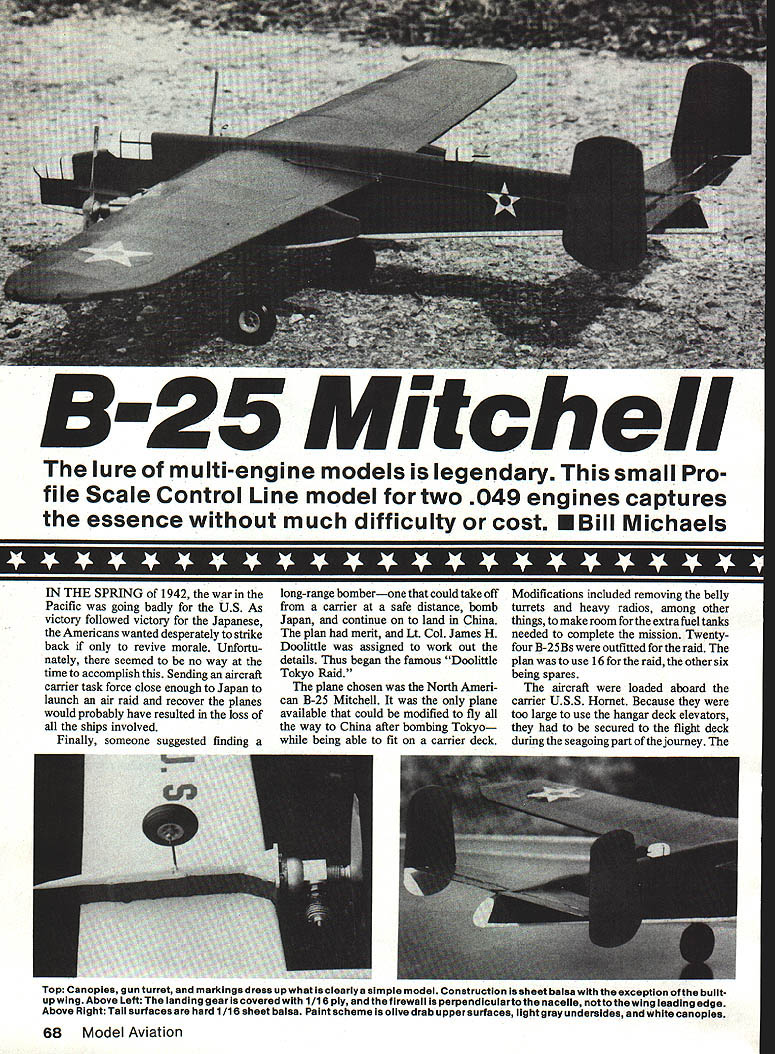
This profile model of the B-25B was designed to provide an interesting project for a pair of .049 engines. It is also a logical step up for a beginner who has mastered single-engine profile models and wants to experiment with a twin-engine model that doesn't require complicated construction.
- All pieces except the wing are solid balsa.
- The built-up wing has no dihedral, is planked with balsa out to the nacelles, and is covered with silkspan.
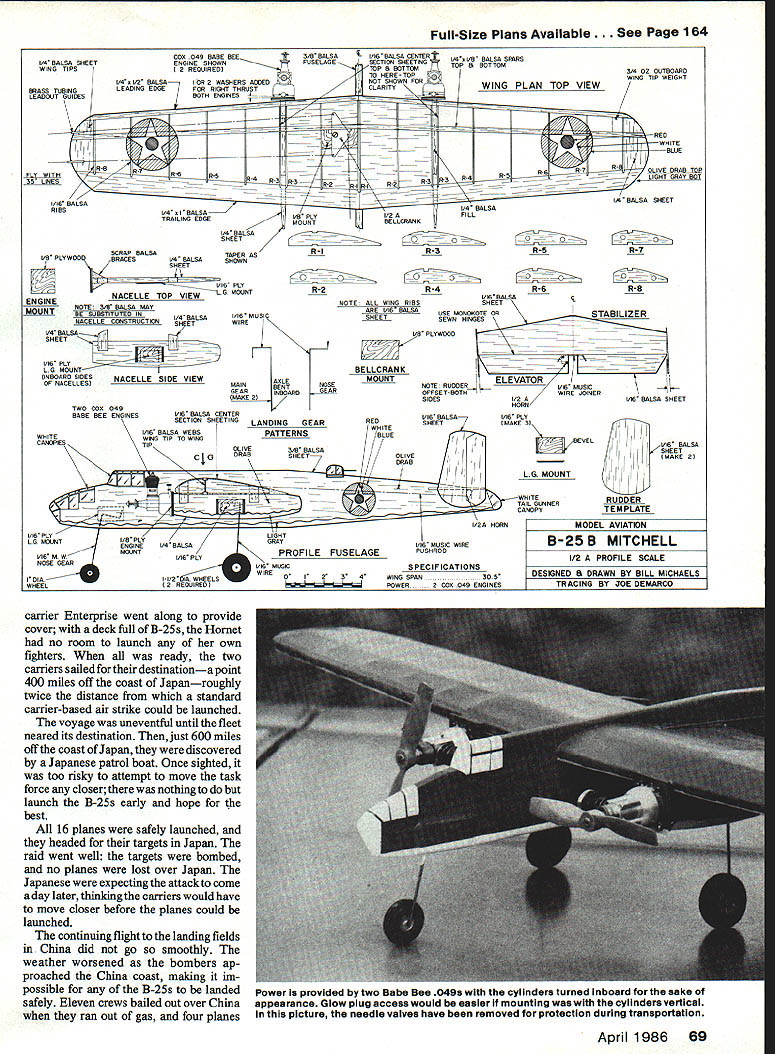
- The nacelles can be built from scrap or cut from 1/4-in. hard balsa sheeting (the plan shows 1/4-in. sheeting).
- Adjust R-3 rib spacing according to the size of sheeting used.
Construction
Fuselage
- Cut the fuselage from a 3/8 x 3 x 36 balsa plank.
- The nacelles can be built from leftovers or 1/4-in. sheeting; adjust rib spacing as needed.
- On the author's model, a section of the fuselage directly above the wing was cut out for wing positioning and mounting (instead of a narrow airfoil-shaped slot). The wing-to-fuselage joint might be a bit stronger with the slot cutout, although the author had no trouble with the full cutout method.
- Sand the corners round.
- Mount the nose gear after the wing and tail have been glued on.
Wing
- Make a wing “kit” and assemble the pieces. Only the ribs and trailing edges require significant work; other parts can be cut to length from the appropriate stock.
- The tapered wing with progressively smaller ribs looks better than a squared-off wing, though it requires more work.
Ribs
- Cut ribs from 1/16-in. sheet balsa.
- To produce accurate duplicates, photocopy the rib templates, hold the template over the wood, and carefully draw around it. Cut the balsa staying on or outside the line.
- Use the first rib to draw the matching rib for the other wing panel.
- Glue two identical ribs together with a tiny amount of cyanoacrylate (CyA) such as Zap or Jet, sand them to match the template, then separate the two identical ribs.
Small details
- Add small details such as the pitot tube and antenna as desired.
Finishing and engines
- Finish and paint the model as desired.
- When attaching the engines, be sure to put the offset washers under both engines (as per the plans) to assure proper line tension.
- If uncertain about engine power, place the stronger engine on the inboard side.
- After mounting the engines, check balance at the CG point shown on the plans. Nose-heaviness (balance in front of the CG) is acceptable; add nose weight if the model balances aft of the CG (tail-heaviness).
This model is designed to use two .049 Cox Babe Bee engines, though other Cox .049 variants can be substituted. On the first day of test flying, the author experienced a fuel leak in one Babe Bee and replaced both Babe Bees with a Cox Black Widow and a Dragonfly. The replacements provided extra power and longer run times, though the plane would likely fly nearly as well with the Babe Bees.
Flying
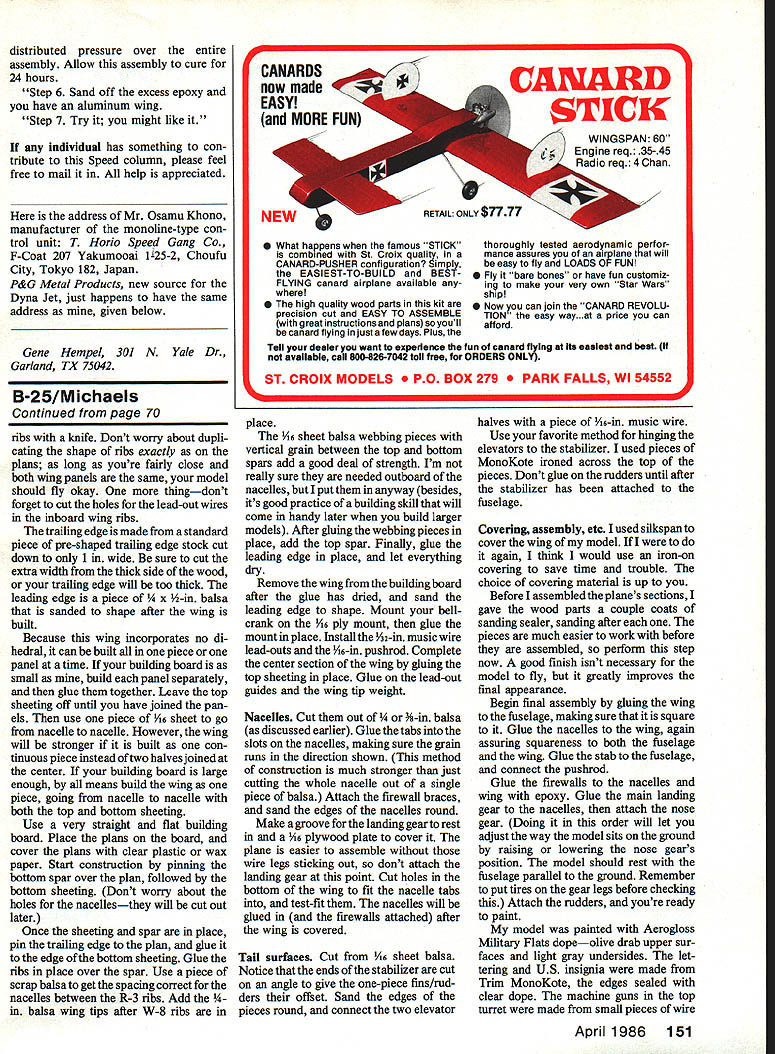
- Use 35-ft steel lines.
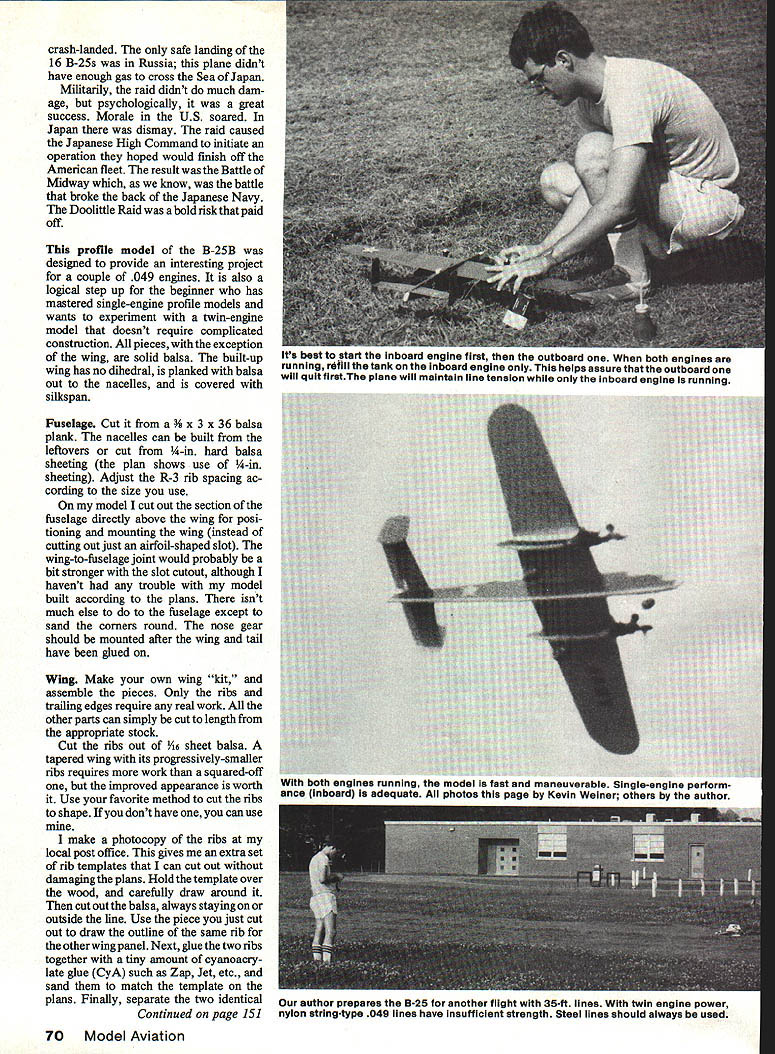
- Start the inboard engine first, then the outboard engine.
- It can help to run the outboard engine a bit rich. With both engines running, top off the fuel on the inboard engine only (this helps ensure the outboard engine will run out of fuel first).
- With both engines running, the model will jump into the air after a short takeoff run. It flies fairly fast and is reasonably maneuverable.
- The model can fly on one engine, but avoid attempting maneuvers with one engine stopped.
Conclusion
This model met the author's expectations. The sound of the two engines in sync and the ability to make fast laps by holding down-elevator before takeoff make it enjoyable. Twins are a lot of fun, and this model is an easy way to try a twin-engine control-line model with minimum investment.
Transcribed from original scans by AI. Minor OCR errors may remain.

