
A-B Astrostar
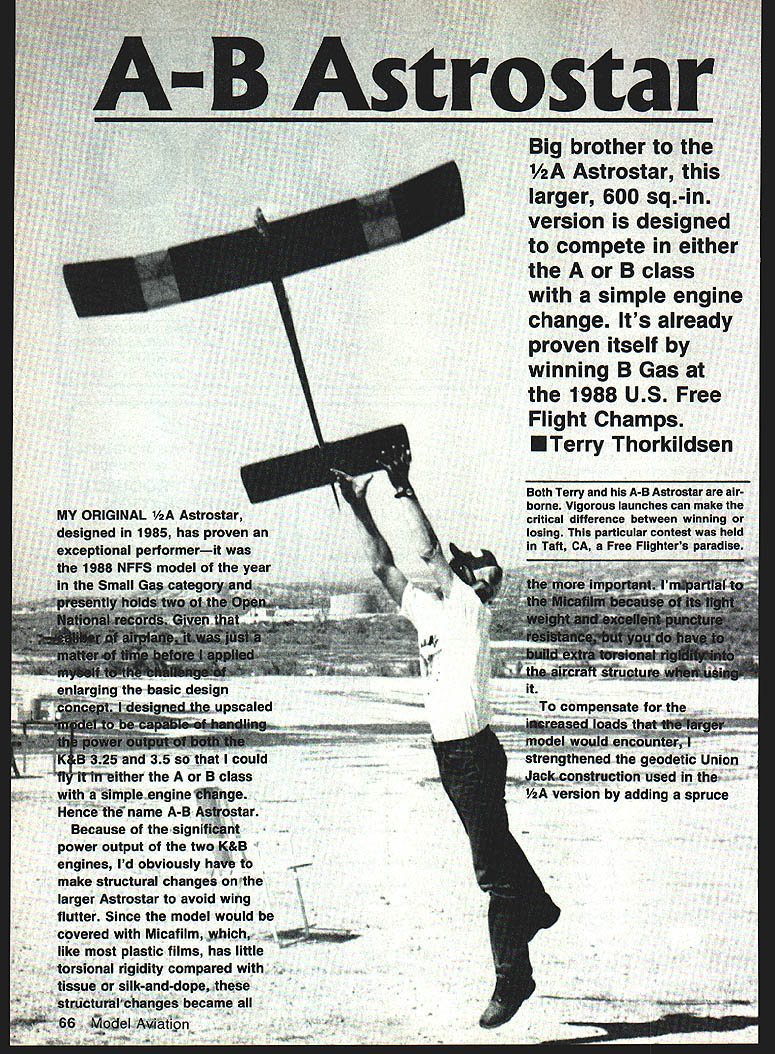
Big brother to the ½A Astrostar, this larger 600 sq. in. version is designed to compete in either the A or B class with a simple engine change. It proved itself by winning B Gas at the 1988 U.S. Free Flight Championships. — Terry Thorkildsen
Overview
The original ½A Astrostar (designed 1985) was an exceptional performer. The A-B Astrostar is a scaled-up version intended to handle the power of the K&B 3.25 and 3.5 Schnürle engines so it can be flown in A or B class with minimal changes. Scaling up required significant structural changes to prevent wing flutter, particularly because the model is covered with Micafilm, a lightweight plastic film that has relatively low torsional rigidity compared with tissue or silk-and-dope.
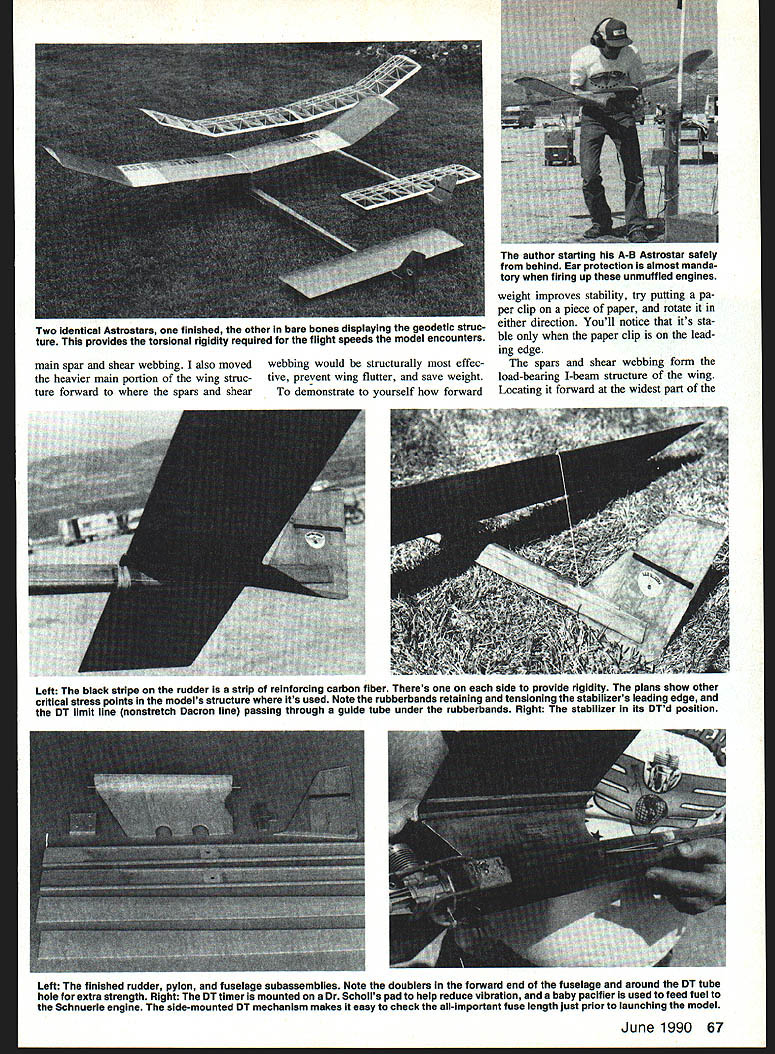
To compensate for increased loads, the geodetic "Union Jack" construction of the ½A version was strengthened by adding a spruce main spar shear web and moving the heavier portion of the wing structure forward. These changes provide a structurally effective, lightweight I-beam wing that resists flutter.
Target all-up weight: 20–23 oz (600 sq. in.). The model flies consistently in a range of site categories; fly to the recommended weight for Category Three sites.
Design and Structure
- Geodetic (Union Jack) wing construction for light, warp-free structure.
- Spruce main spar and shear webbing added to prevent wing flutter.
- Shear webbing centered and extended toward tips where effective; use very lightweight 1/16-in. balsa for webbing.
- Carbon fiber (.007-in.) used to reinforce all dihedral breaks and top spars at the center (protects against DT landings). Carbon fiber is also used on the rudder. Avoid boron for health reasons.
- Center dihedral break backed up with 1/32-in. plywood full-depth center brace.
- Small reinforcing gusset under stabilizer platform ribs increases I-beam strength.
- Rear rudder used for a more consistent power pattern; stabilizer alignment is less critical with rear rudder.
Key setup numbers and features:
- Wing built flat except for ~3/32 in. wash-in on the right main panel (build it in, do not warp it later).
- No wash-out in tips.
- Center of gravity (CG): 76% of mean aerodynamic chord without fuel.
- Thrust: 1.5° left thrust (no downthrust used).
- Recommended glide circle: 25–35 seconds.
- Typical engines: K&B 3.25 or K&B 3.5 Schnürle (back-mounted).
Construction (general)
Build to an approximate all-up weight of 20–23 oz for best performance. Use straight, light wood and keep finishes light. Build on a perfectly flat surface to ensure warp-free assembly. Recommended care in wood selection, finishes, and glues will keep the model competitive without excessive fragility.
Important tips:
- Nothing is given a free ride: avoid heavy components (a standard aluminum engine mount can add ~0.75 oz). A lightweight aluminum back mount is detailed on the plans.
- Use Micafilm for covering (lightweight, fuel-proof, puncture resistant) or silk/tissue with dope for greater torsional rigidity.
- Align wing and stabilizer precisely. Dowels at the center dihedral breaks aid drag-free flying and can pop out if you hit an obstruction.
- Pylon is glued on after assembly to establish correct CG; add 1/8-in. sq. spruce at the front of the pylon to prevent nicks and stress cracks.
Recommended sheet-stock weights and densities (examples)
- 3/32-in. sheet balsa (ribs): density ~4.4–5.2 lb/ft³. A 3 x 36-in. sheet should weigh about 11.5–13.5 g.
- 1/16-in. sheet (geodetic ribs): a 1/16 x 3 x 36-in. sheet should weigh about 6–9 g.
- 3/32-in. balsa body stock (3 x 48 in. to avoid splices): should weigh ~23–24 g.
Wing
- Build all panels flat except the right main panel, which should have ~3/32 in. wash-in at the outer dihedral break (built in, not warped later).
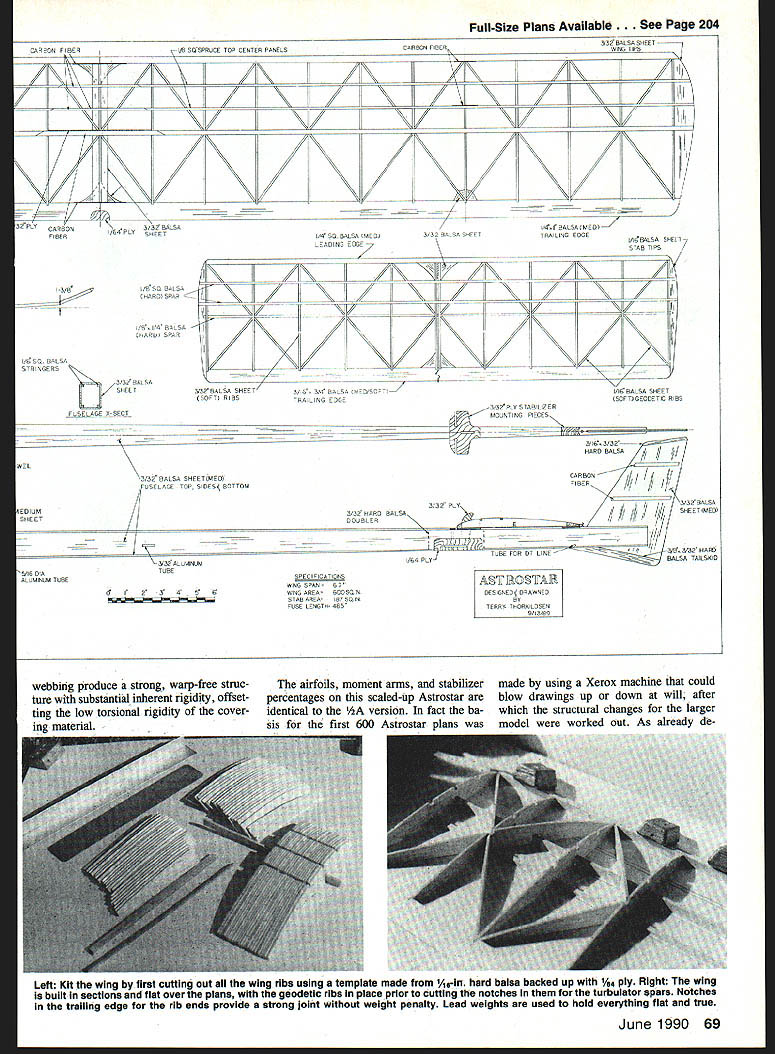
- Cut all ribs before starting. Use lightweight 3/32-in. sheet balsa (B or C grain preferred).
- Make a rib template from a hard balsa outline backed with 1/64 plywood.
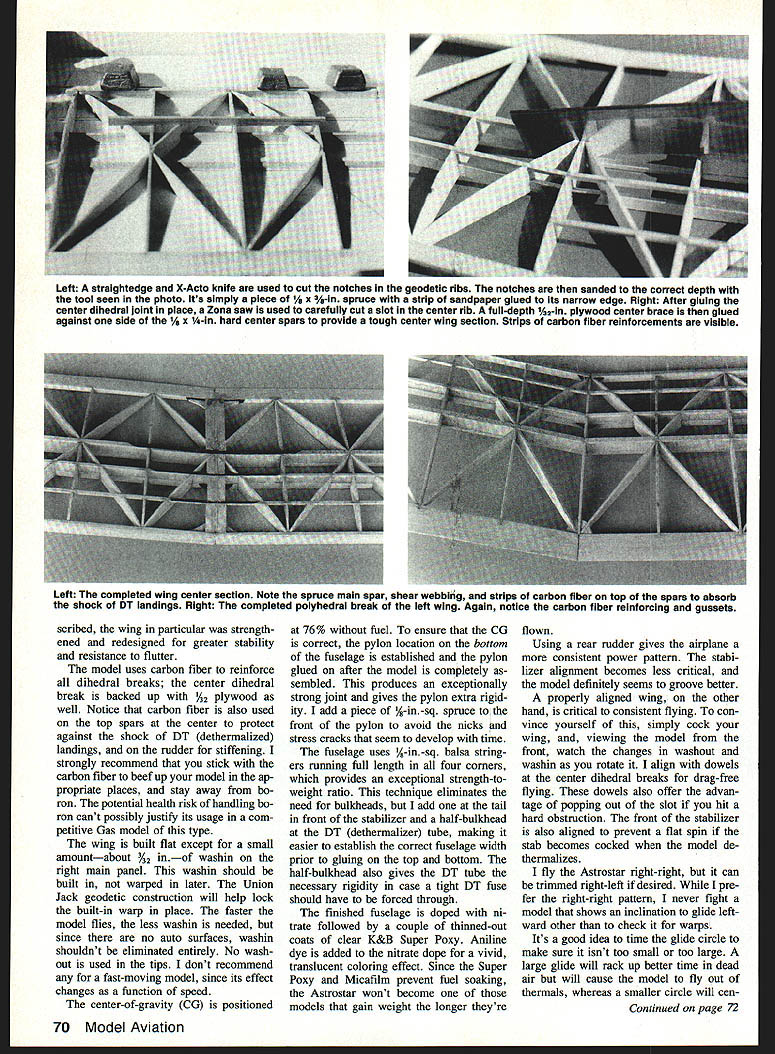
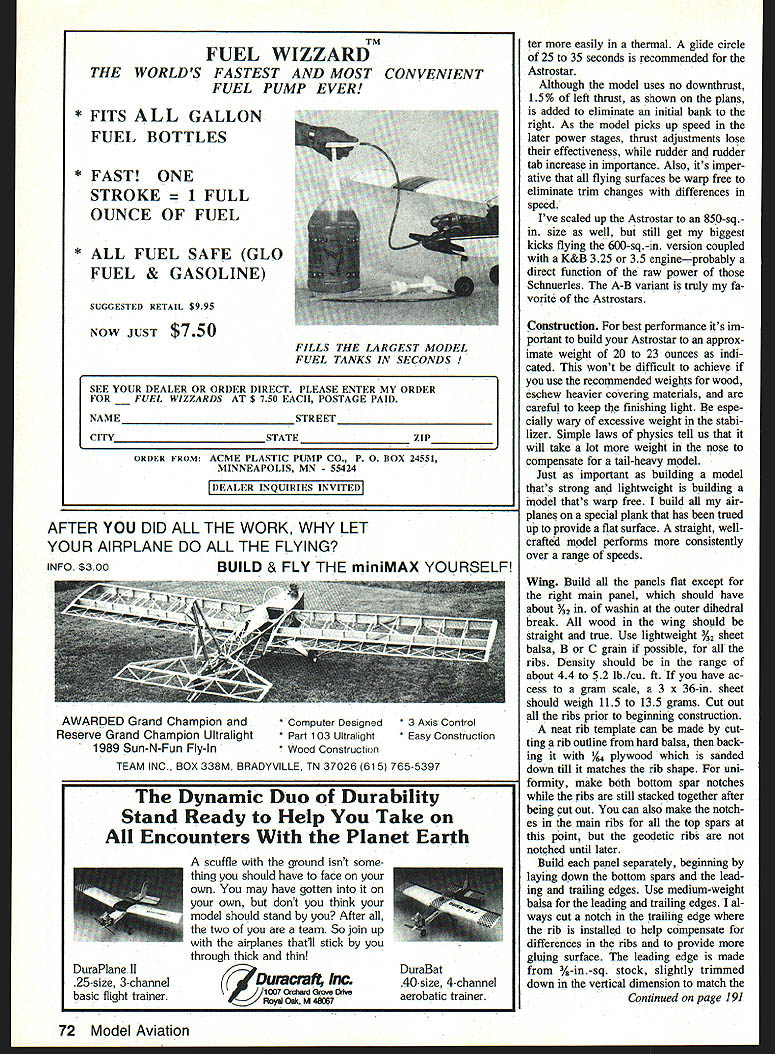
- Make both bottom spar notches while ribs are stacked for uniformity. Main ribs for top spars may be pre-notched; geodetic ribs are not notched until later.
- Layout order: bottom spars → leading and trailing edges → main ribs → geodetic ribs → turbolator/turbulator spars → shear webbing → top spars.
- Leading edge: medium-weight 3/8-in. sq. stock, slightly trimmed vertically to match airfoil. Cut a notch in the trailing edge where the rib is installed for better gluing surface.
- Spars: use hard, straight wood. Use spruce for center panel turbolator spars and hard balsa in outer tips where shown.
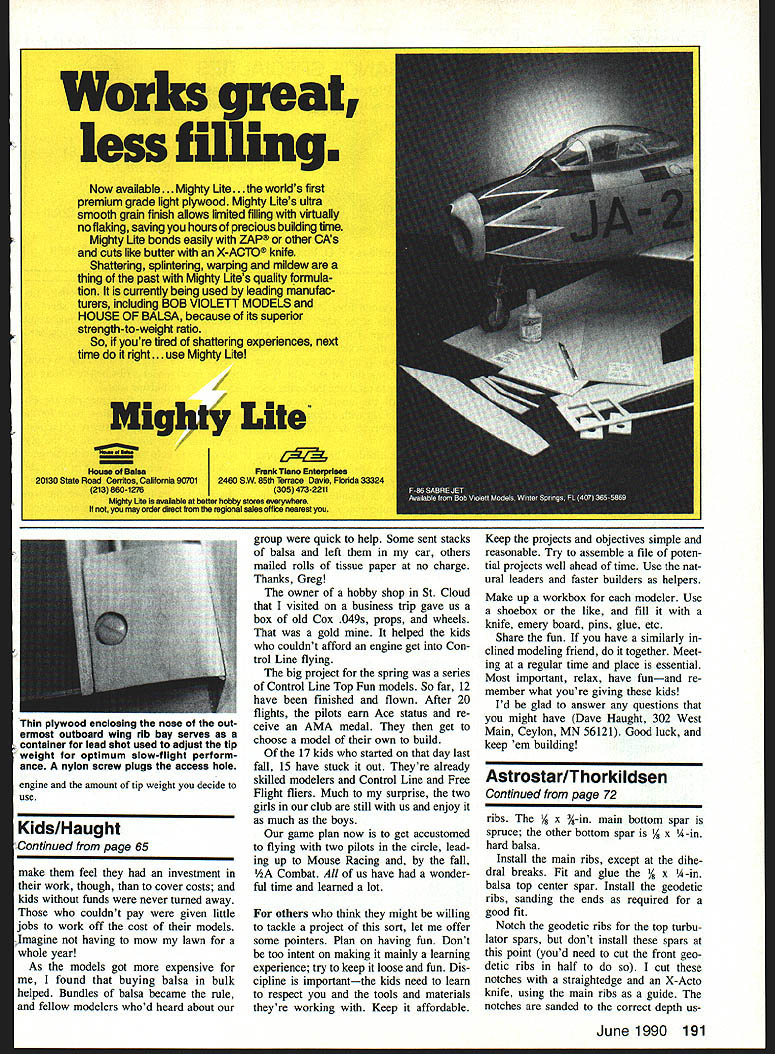
- Shear webbing: use lightweight 1/16-in. balsa, center pieces between spars with grain vertical. Extend webbing out to tips except between spruce main spar and the last rib bay.
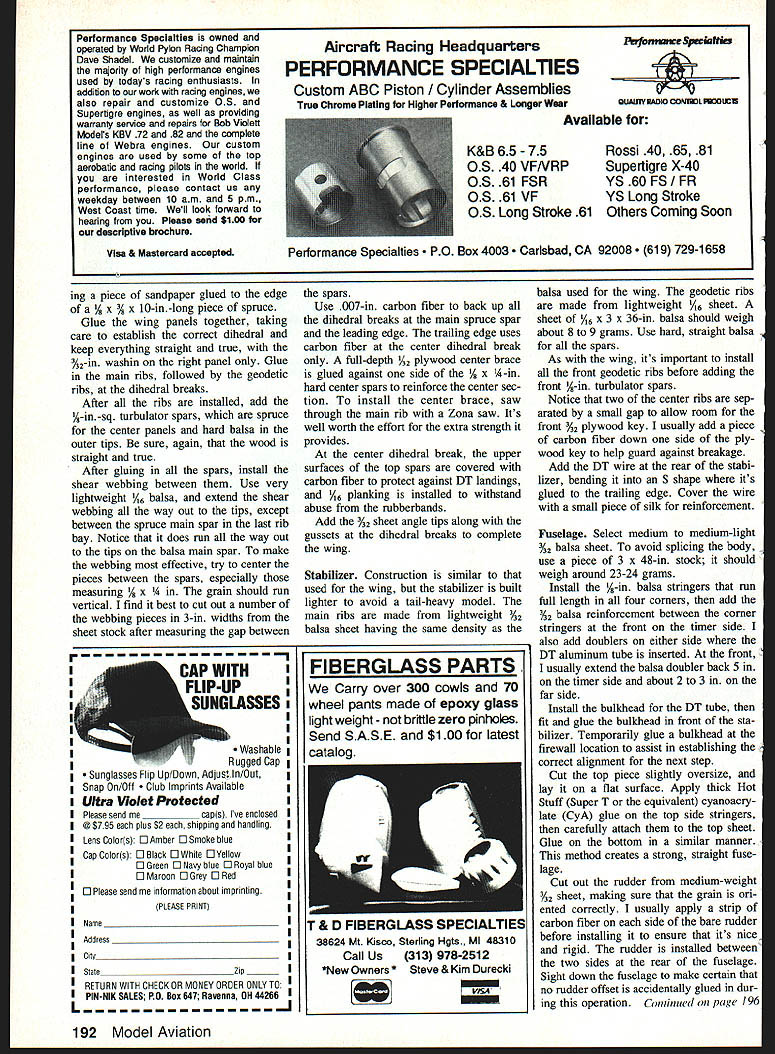
- Dihedral: back up dihedral breaks with carbon fiber (.007 in.) at main spruce spar and leading edge. Trailing edge carbon only at center break. Glue a 1/32-in. plywood center brace against one side of the 1/8 x 1/4-in. hard center spars (install by sawing through the main rib).
- Top spars at center: cover upper surfaces with carbon fiber to protect against DT landings. Add 1/16-in. planking at center to withstand rubberband loads.
- Add 3/32-in. sheet angle tips and gussets at dihedral breaks to complete wing.
Stabilizer
- Built similarly to the wing but lighter to avoid tail-heaviness.
- Use lightweight 3/32-in. balsa for main ribs; 1/16-in. geodetic ribs where shown.
- DT limit line: non-stretch Dacron line through a guide tube under rubberbands.
- Add DT wire at the rear of the stabilizer, bent into an S shape where glued to the trailing edge; cover with small silk patch for reinforcement.
- Sight down the fuselage while installing the rudder to avoid inadvertent offset.
Fuselage
- Use medium-light 3/32-in. balsa sheet; use a single 3 x 48-in. sheet to avoid splices if possible.
- Install 1/8-in. sq. balsa stringers running full length in all four corners for high strength-to-weight ratio; this can eliminate bulkheads except:
- Add one bulkhead at the tail in front of stabilizer.
- Add a half-bulkhead at the DT tube for alignment and DT tube rigidity.
- Install a 3/32-in. balsa reinforcement between corner stringers at the front on the timer side; add doublers where the DT aluminum tube is inserted.
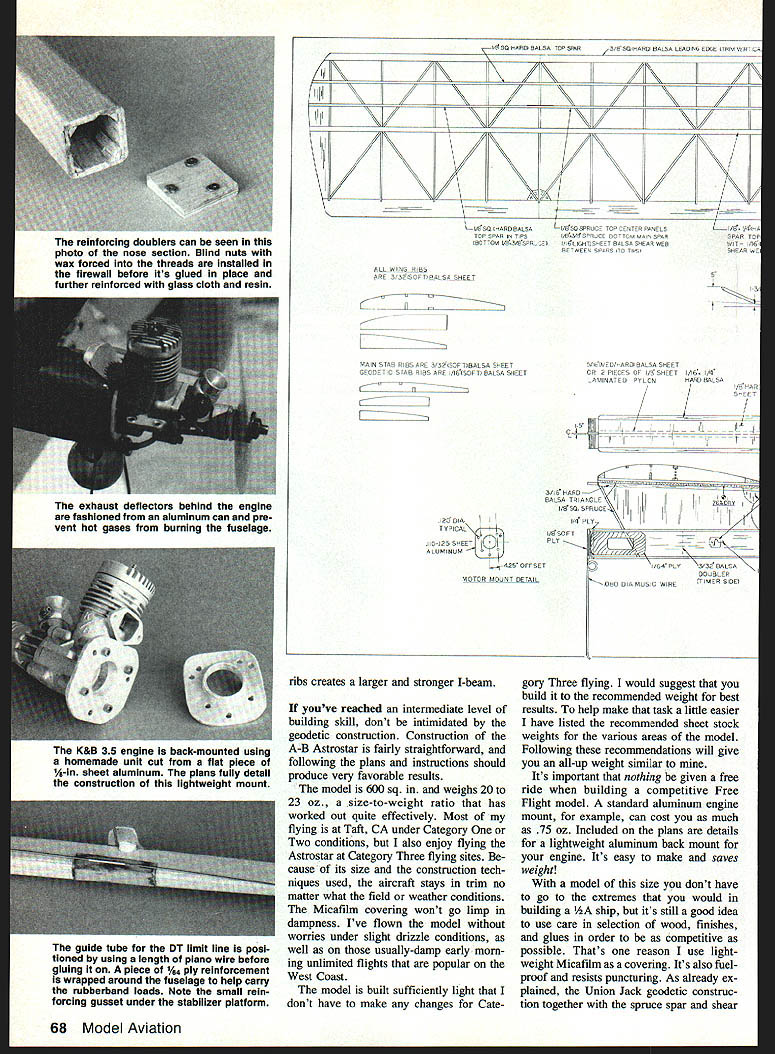
- Glue the firewall in place with thick CyA and reinforce inner side with 1/8-in. plywood and 0.5-oz. glass cloth extending back ~1 in. Install blind nuts in firewall (use candle wax to keep glue out of threads).
- Top and bottom are glued to stringers using thick CyA on stringers; glue to a slightly oversize top piece on a flat surface for a straight fuselage.
- Pylon: laminated from two 1/8-in. medium-hard balsa sheets for 1/4-in. thickness; reinforce wing-platform joint with 1/16-in. triangles and silk at corners to prevent stress cracks. Trial-fit and sight down rear to ensure alignment before gluing pylon on—pylon is glued after final assembly to set CG at 76% (no fuel).
- Add a 1/32-ply reinforcement wrapped around the fuselage to carry rubberband loads.
Engine and Mounting
- Designed for K&B 3.25 or 3.5 Schnürle engines. Engine is back-mounted using a lightweight homemade mount cut from 1/16-in. sheet aluminum. Plans provide full details.
- Guide tube and DT limit line positioned using a length of piano wire before gluing.
- Side-mounted Schnürle engine DT mechanism allows easy checking of fuselage length before launch.
- Use Dr. Scholl’s pad to reduce vibration; a baby pacifier can act as a fuel feed/primer support if desired.
- Install blind nuts in firewall for mount fasteners.
Covering and Finishing
Micafilm covering:
- Apply thinned Balsarite glue on ribs and spars; use 3M 77 spray adhesive on leading and trailing edges (stays tacky longer).
- Cover bottom of wing first; top covering should overlap bottom by ~1/8 in. Seal overlap with Balsarite or thin CyA.
- Iron: medium setting first, then hottest setting, and go over panel again to ensure tightness and adhesion. Tight covering helps prevent wing flutter.
- Micafilm advantages: light, fuel-proof, puncture resistant, won’t go limp in damp conditions.
Alternative coverings:
- Silk or tissue with three to four coats of thinned nitrate dope, followed by one to two coats fuel-proofer or butyrate dope. Double-cover with Japanese tissue is an option. Use a throwaway foam brush for silk dope applications.
Finish protection:
- Fuselage dope: nitrate dope followed by a couple of thinned coats of clear K&B Super Epoxy with aniline dye for translucent color. Epoxy + Micafilm help prevent fuel soaking.
Flying, Trim, and Handling
- CG: 76% without fuel. Establish CG using pylon placement; glue pylon after assembly for a strong joint.
- Thrust and trims:
- 1.5° left thrust to eliminate an initial right bank.
- No downthrust used.
- As speed increases in later power stages, rudder/rudder tab adjustments become more important than thrust.
- Pattern:
- Right-right pattern preferred by the designer; can be trimmed right-left if desired.
- Time glide circle: 25–35 seconds recommended. Large circles favor dead-air time but risk flying out of thermals; small circles center thermals better.
- Stability demonstration: placing a small weight (paper clip) forward on a rotating paper shape shows improved stability when weight is on the leading edge.
- Keep all flying surfaces warp-free to avoid trim changes with speed.
Safety and Starting
- Always start the A-B Astrostar behind ear protection (unmuffled engines can be loud).
- Use dowels at center dihedral breaks—the dowels can pop out if you hit an obstruction, reducing damage.
- Reinforce rudder with carbon fiber strips before installation to ensure rigidity.
- Use silk patches and small gussets at high-load or stress-prone locations.
Notes and Recommendations
- Avoid boron for reinforcements due to potential health risks; use carbon fiber where specified.
- The A-B Astrostar also exists in an 850 sq. in. version, but the 600 sq. in. with K&B 3.25/3.5 remains the designer’s favorite.
- Follow plans closely for the lightweight mount and DT guide tube arrangements; the plans include details for a lightweight aluminum back mount to save weight.
- Keep finishes light and avoid heavy hardware to maintain the 20–23 oz target weight.
Transcribed from original scans by AI. Minor OCR errors may remain.

