
A-B-C Toothpicks
By Gil Morris
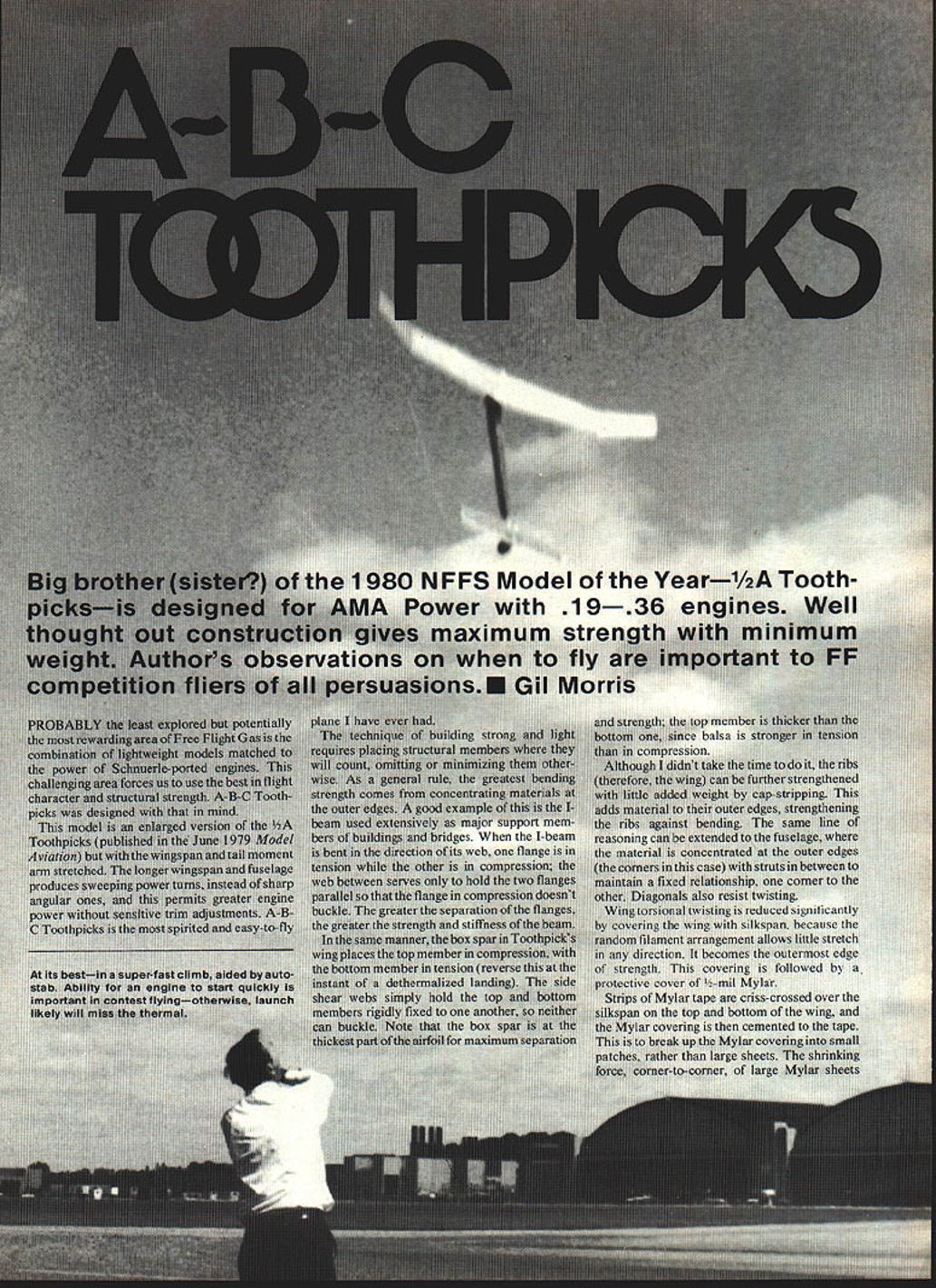
Big brother (sister?) of the 1980 NFFS Model of the Year—1/2A Toothpicks—A-B-C Toothpicks is designed for AMA Power with .19–.36 engines. Well thought-out construction gives maximum strength with minimum weight. The longer wingspan and stretched tail moment arm produce sweeping power turns instead of sharp angular ones and permit greater engine power without sensitive trim changes. A-B-C Toothpicks is spirited and easy to fly.
Probably the least explored but potentially the most rewarding area of Free Flight Gas is the use of lightweight models matched to the power of Schnuerle-ported engines. This challenges the builder to achieve the best flight characteristics and structural strength with minimum weight. The technique is to place structural members where they count and omit or minimize them elsewhere.
Structure and strength
- Greatest bending strength comes from concentrating material at the outer edges. The I-beam principle applies: flanges at the outer edges resist tension and compression while the web keeps them parallel.
- The wing's box spar follows this idea: the top member takes compression, the bottom member tension. Side shear webs hold the top and bottom rigidly so neither can buckle. The box spar is placed at the thickest part of the airfoil for maximum separation and strength; the top member is thicker than the bottom because balsa is stronger in tension than in compression.
- Ribs (and thus the wing) can be further strengthened with cap-stripping, which adds material to outer edges to resist bending.
- The fuselage concentrates material at the outer edges (corners) with struts between to maintain geometry; diagonals resist twisting.
- Wing torsional rigidity is increased by covering with silkspan (random filament orientation resists stretch). Cover silkspan with 1/4-mil Mylar for protection.
- Criss-cross strips of Mylar tape on top and bottom of the wing, with the Mylar sheeting cemented to that tape, break the Mylar into small patches so shrinking forces are localized and warps are reduced.
Important: cement Mylar applied to the fuselage or stabilizer to the structural members it contacts (formers, diagonals, ribs, spars) rather than only around the edges. If torsional strength is a concern, consider using silkspan on fuselage or stabilizer despite its added weight.
Hazards and stress recognition
There is a danger in going too light and building too weak. A lighter plane accelerates faster and will climb more quickly under power; since lift and drag scale with the square of velocity, stresses that are proportional to lift and drag increase with the square of velocity. In short, lighter planes need to be stronger. For example, a 20-oz plane accelerates upward about 50% faster than the same plane at 26 oz when both are based on the same thrust.
Recognize critical flight stresses:
- The wing is most vulnerable because most lift and drag forces act on it. Flexural (bending), torsional (twisting), flutter (oscillatory), or fixed divergence can occur.
- Flexural motion (change in dihedral) is resisted by wing spars; torsional motion is resisted by geodetic ribs and covering.
- The trailing half of the airfoil is thinner and inherently weaker than the leading half. The neutral bending axis is typically inclined slightly downward toward the front; when the wing flexes toward dihedral it tends toward washout and can induce a diving tendency at high speed.
- If the stabilizer flexes a similar amount to the wing, their effects tend to neutralize and maintain a constant angular difference. Therefore, wing and stabilizer should have approximately matching stiffnesses.
Since forces on the stabilizer are relatively low (stab lift and drag per square inch is less than half that of the wing), the stabilizer should be much lighter than the wing. A light stabilizer:
- Permits a short nose moment and allows the engine to be tucked up under the wing leading edge for stability under power.
- Reduces the plane's moment of inertia, improving glide and responsiveness in choppy air.
Construction
Wing
- Build the wing in two halves. The top piece forms the box spar. Leave turbulator spars off inboard panels and omit the five center ribs initially.
- Join the two halves with two diamond-shaped 1/64" plywood pieces—one on top and one on the bottom. Epoxy the halves together at the proper angle.
- After the epoxy sets, add the lower 1/64" plywood piece, then the five center ribs in the center webs and the upper 1/64" plywood piece. Finally add the top pieces and the box spar side webs to complete the box.
- Cover the wing with medium-weight silkspan and apply three coats of dope. It helps to rig the wing with the intended wash-in and washout during doping (paper clips and string from the ceiling, and weights while doping).
- Criss-cross the top and bottom of the wing with 1/8" Mylar tape following the geodetic rib pattern.
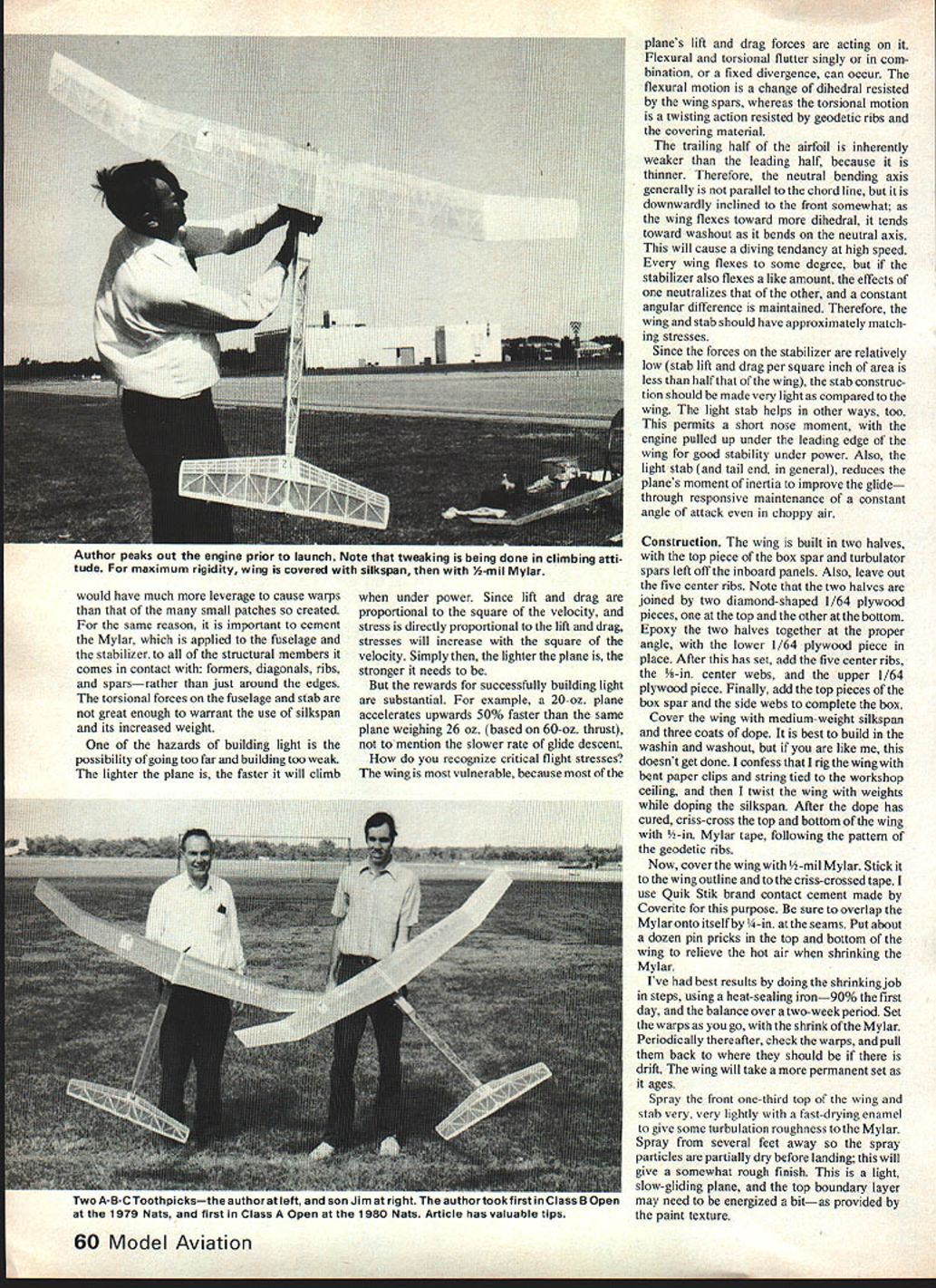
- Cover the wing with 1/4-mil Mylar, sticking it to the criss-crossed tape and wing outline. Use a contact cement such as Quik Stik (made for Coverite). Overlap Mylar seams 1/8".
- Put about a dozen pin pricks in the top and bottom of the wing to relieve hot-air shrinking stress.
- Shrink in stages with a heat-sealing iron: about 90% the first day, and complete the balance over a two-week period. Set warps as you go; allow the wing to take a permanent set with age.
- Spray the front one-third of the top of the wing and the stabilizer very lightly with fast-drying enamel from several feet away to provide a slightly rough turbulation to the Mylar (energizes the top boundary layer for a light, slow-gliding plane).
Note: Tweaking (final adjustments) is done for climbing attitude. For maximum rigidity, the wing is covered with medium-weight silkspan and 1/4-mil Mylar.
Fuselage and tail
- Build the bottom fuselage surface first, pinned directly to the plans. Add the formers.
- Off to the side, cut the top two longerons, taper the rear ends where they join, and cement them together at the rear. Place this sub-assembly onto the formers, pulling the longerons to the same contour as the bottom, and cement them to the top corners of the formers.
- Install diagonals after removing the assembly from the board.
- Use slow-curing epoxy for: wing center section joint, firewall and the 1/64" plywood shield around it, the 1/16" plywood stab rest, and the 1/8" dowel on the back of the stabilizer. All other joins may be done with standard model airplane glue.
- I prefer to eyeball wing and stabilizer alignment before each flight rather than keying them for permanent alignment.
Hardware and power
- With a K&B .35 or .36 (or K&B 3.25 or 3.5 in original practice), use an 8x4 Zinger (old style) or Master Screw prop and about 60% nitro fuel.
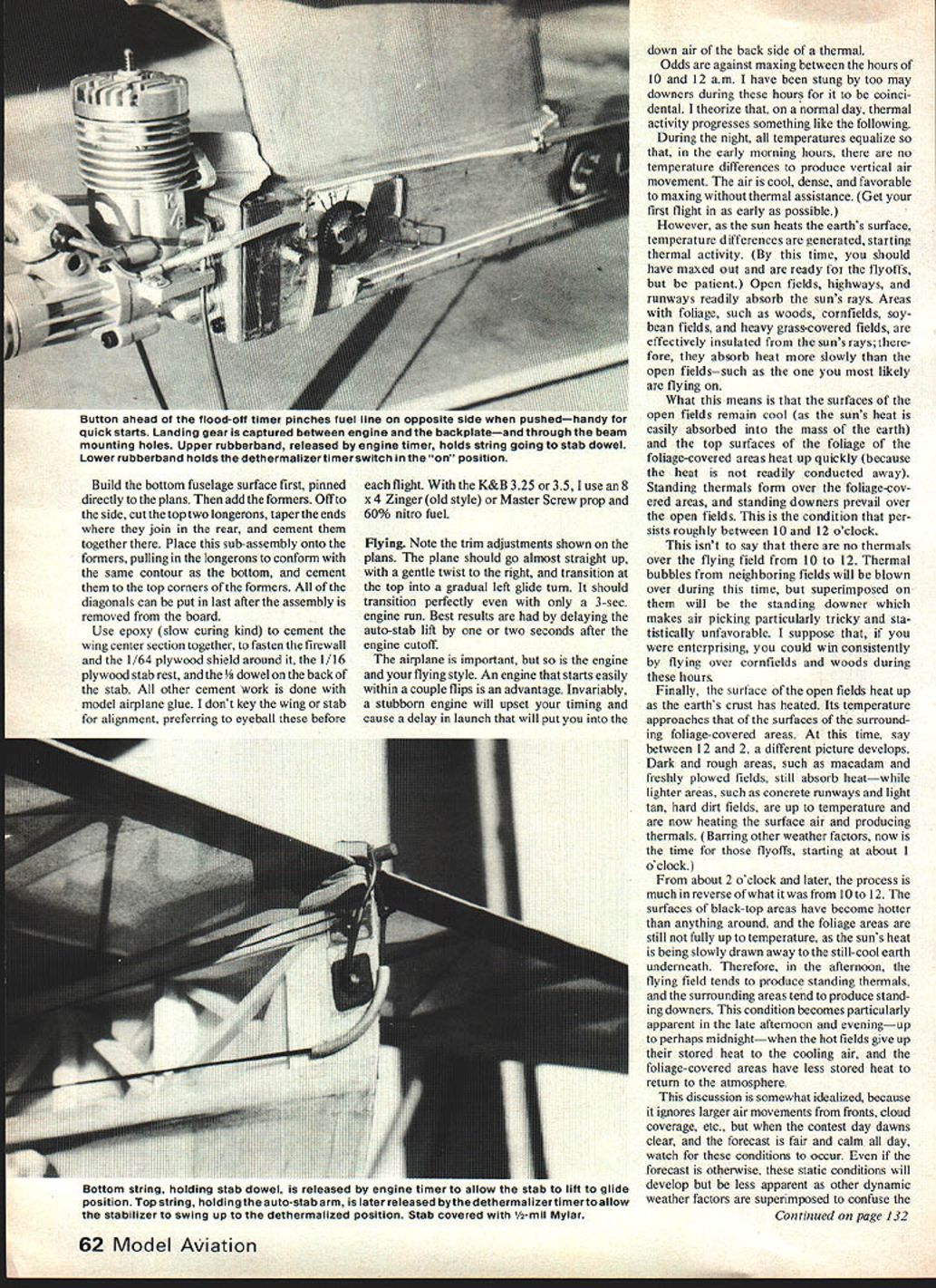
- Use reliable engine installation and prop choices; an engine that starts easily within a couple of flips helps maintain launch timing.
Flying
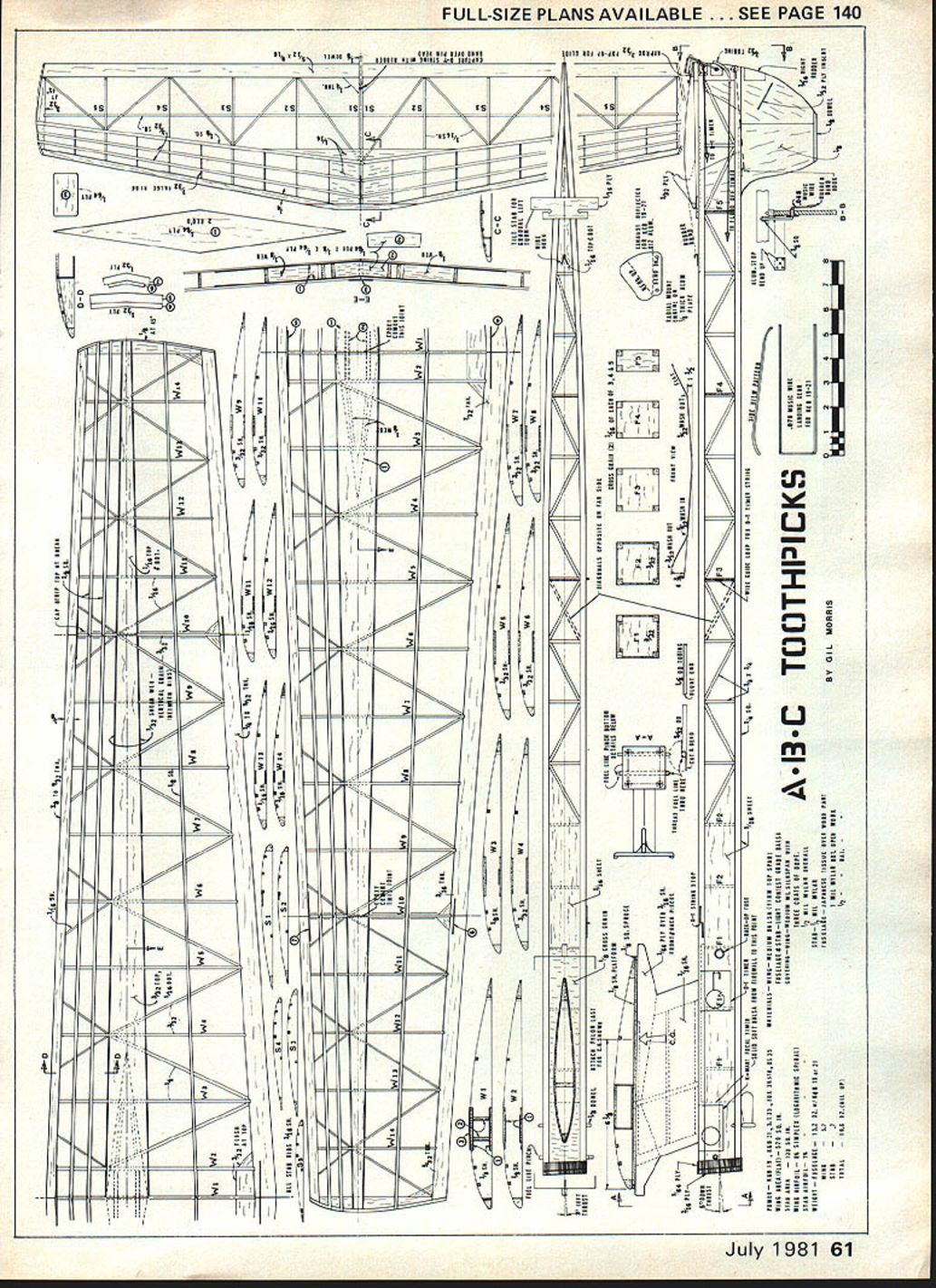
- Follow the trim adjustments shown on the plans. The plane should go almost straight up with a gentle twist to the right and transition at the top into a gradual left glide turn.
- It should transition cleanly even with only a 3-second engine run. Best results are obtained by delaying the auto-stab lift by one or two seconds after the engine cutoff.
- Engine reliability and pilot timing are critical. A stubborn engine that requires many flips can upset your launch timing and put you into downdrafts.
Weather and timing
Odds are against maxing between about 10:00 and 12:00 noon in typical fair-weather conditions. Thermal activity tends to progress through the day as follows:
- Early morning: Temperatures equalize overnight, so there are few temperature differences to produce vertical air movement. Air is cool and dense, favorable to maxing without thermal assistance. Get your first flights in early.
- Mid-morning (around 10:00–12:00): The sun heats the surface unevenly. Open fields, highways, and runways absorb heat into the ground and remain relatively cool on the surface; areas with foliage (woods, cornfields, soybean fields, heavy grass) heat at the tops and produce standing thermals. Standing downers often prevail over open fields during this period, making air picking tricky and unfavorable.
- Early afternoon (roughly 12:00–2:00): The open fields warm up; dark and rough areas (macadam, freshly plowed fields) still absorb heat and produce thermals while light areas (concrete runways, light hard dirt) come up to temperature. This is often a good window for flyoffs—around 1:00 p.m. is frequently favorable.
- Late afternoon and evening (2:00 onward): Dark-top areas become much hotter than surrounding areas and produce standing thermals; foliage areas lag behind in temperature and often produce downers. This situation can persist into the evening as hot fields give up stored heat to the cooling air.
These are idealized patterns and can be modified by fronts, cloud cover, wind, and other dynamic weather factors. On clear, calm contest days, however, these static patterns are commonly observed.
Weather folklore and guides
A few traditional sayings that can be helpful:
- "Red at night, sailor's delight. Red in morning, sailors take warning."
- "Rain before 7 ends before 11."
- "When smoke descends, good weather ends."
- "Sharp horns (unusually clear points on a partial moon) do threaten high winds."
- "Rain long foretold, long last; short notice, soon past."
Fair-weather indicators:
- Rising smoke indicates high barometric pressure—clear weather.
- Dew in the morning is a sign of a fair day.
- High clouds alone rarely produce rain.
Foul-weather indicators:
- Sun or moon halos often precede rain.
- Leaves turning over to show their backs can signal an approaching storm.
- Storm clouds from the west or northwest usually indicate a storm that will reach you; storms to the south often pass by.
Put together, plane, engine, and flying style make a strong competitor—but it takes time. Allow a year or more to bring a new plane to full potential.
Happy landings!
Transcribed from original scans by AI. Minor OCR errors may remain.

