
Baby Rog
Return with us to those thrilling days of yesteryear when there were no kits to speak of and very few magazines on the subject of aeromodeling. — George Clapp
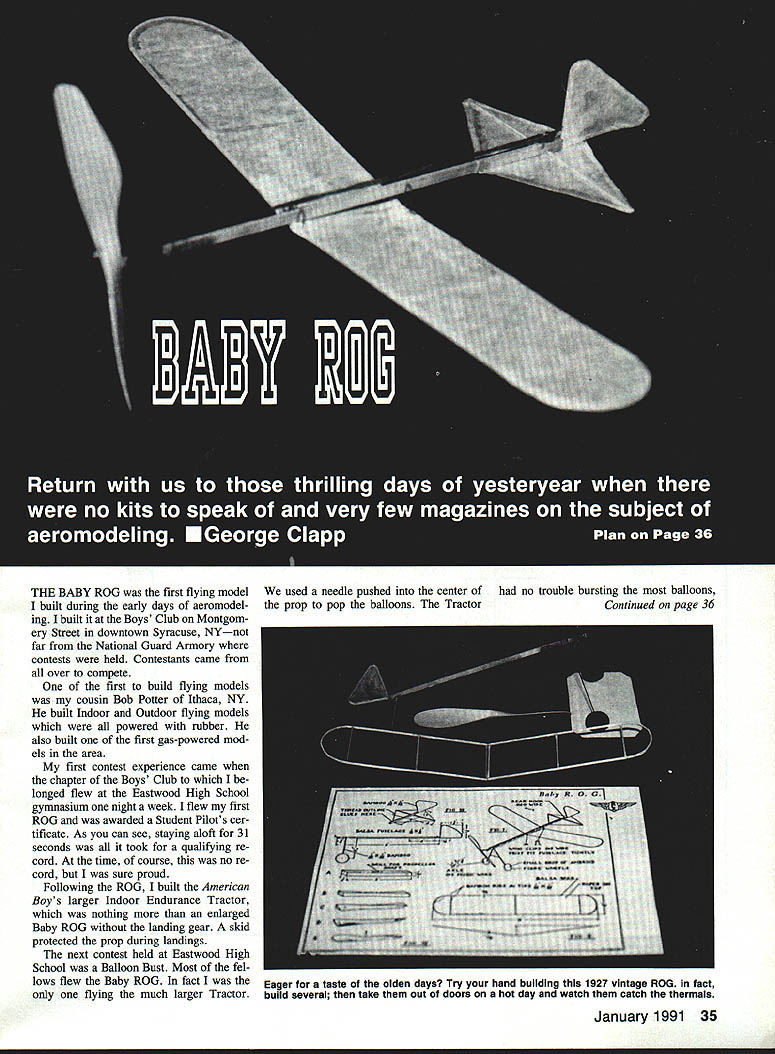
The Baby ROG was the first flying model I built during the early days of aeromodeling. I built it at the Boys' Club on Montgomery Street in downtown Syracuse, N.Y., not far from the National Guard Armory where contests were held. Contestants came from all over to compete.
One of the first to build flying models was my cousin Bob Potter of Ithaca, N.Y. He built indoor and outdoor flying models powered with rubber and also built one of the first gas‑powered models in the area.
My first contest experience came when the chapter of the Boys' Club to which I belonged flew at the Eastwood High School gymnasium one night a week. I flew my first ROG and was awarded a Student Pilot's certificate. Staying aloft for 31 seconds was all it took for a qualifying record. At the time this was no great record, but I was sure proud.
Following the ROG, I built the American Boy's larger indoor endurance Tractor, which was essentially an enlarged Baby ROG without landing gear; a skid protected the prop during landings. At the next contest, a Balloon Bust held at Eastwood High School, most of the fellows flew the Baby ROG. I was the only one flying the much larger Tractor. We used a needle pushed into the center of the prop to pop the balloons — the Tractor had no trouble bursting the most balloons, and winning the contest was a real feather in my young cap.
During these years I built many ROGs and the one Tractor, but I also built a Stinson Detroiter, a plane featured in Frank Zaic's Model Airplanes and The American Boy magazine (1927–1934). Frank researched those magazines with the help of many old-timers and published a wonderful record of the era. The cover shows a boy launching a twin pusher, one of the first twin‑motored models available and a great flier.
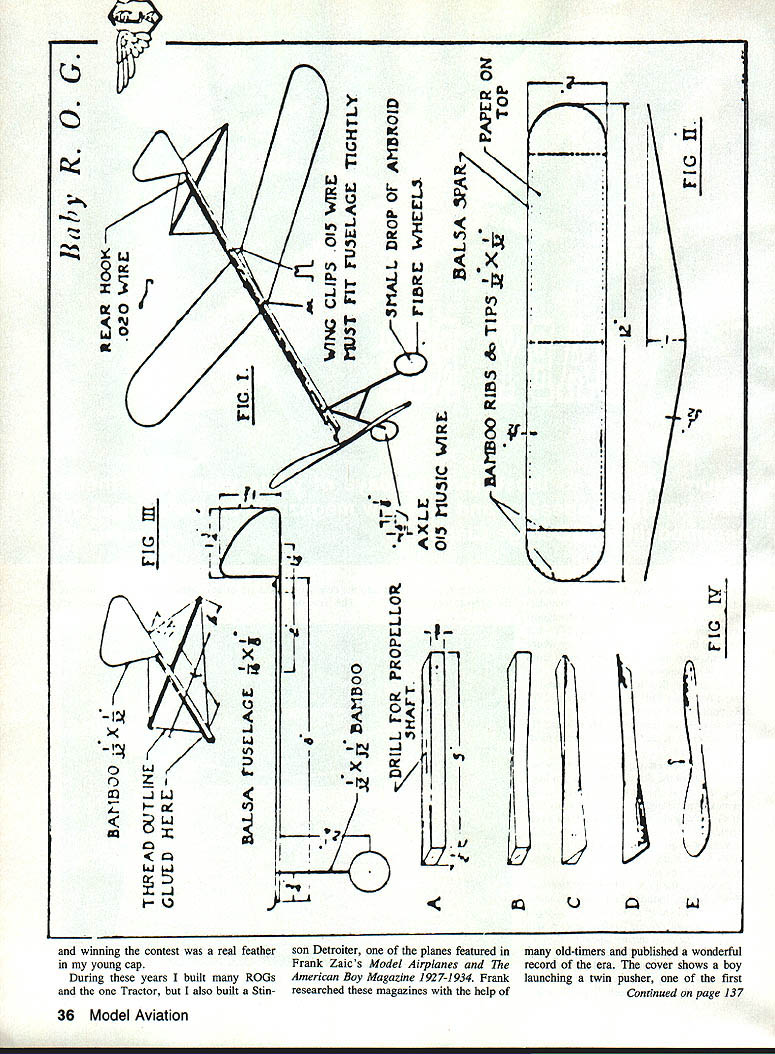
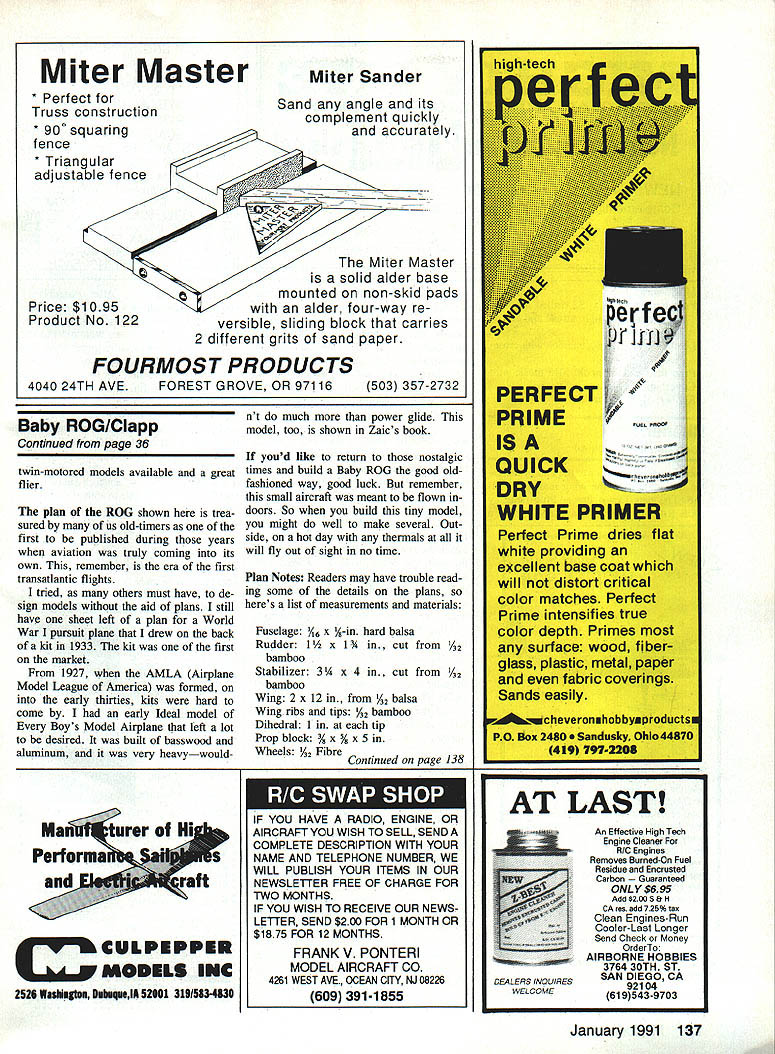
The plan of the ROG shown here is treasured by many old‑timers as one of the first to be published during those years when aviation was truly coming into its own — remember, this is the era of the first transatlantic flights.
I also tried, as many others must have, to design models without the aid of plans. I still have one sheet left of a plan for a World War I pursuit plane that I drew on the back of a kit in 1933. The kit was one of the first on the market.
From 1927, when the AMLA (Airplane Model League of America) was formed, into the early thirties, kits were hard to come by. I had an early Ideal kit, Every Boy's Model Airplane, that left a lot to be desired. It was built of basswood and aluminum and was very heavy — it wouldn’t do much more than power‑glide. This model, too, is shown in Zaic’s book.
If you’d like to return to those nostalgic times and build a Baby ROG the good old‑fashioned way, good luck. But remember, this small aircraft was meant to be flown indoors. When you build this tiny model you might do well to make several; outside, on a hot day with any thermals at all, it will fly out of sight in no time.
Plan Notes
Readers may have trouble reading some of the details on the plans, so here’s a list of measurements and materials:
- Fuselage: 1/16 x 5/16 in. hard balsa
- Rudder: 1/8 x 1-1/4 in., cut from 1/32-in. bamboo
- Stabilizer: 3/4 x 4 in., cut from 1/32-in. bamboo
- Wing: 2 x 12 in., from 1/32-in. balsa
- Wing ribs and tips: 1/32-in. bamboo
- Dihedral: 1 in. at each tip
- Prop block: 3/8 x 3/8 x 5/8 in.
- Wheels: 1/2-in. fibre
Transcribed from original scans by AI. Minor OCR errors may remain.

