
Chris Lella
Balancing for Roll on CL Stunt Ships
Some valuable tips which will make your model fly better in both level flight, upright and inverted, and during maneuvers.
WHEN GETTING into discussions about various characteristics of ships with many modelers, I find that most people have a hard time expressing themselves. Also, many fliers have vague ideas and a lack of understanding why their planes fly the way they do, or even why they build them in a certain way. I think the reason for this is because in modeling, there is not a complete universal language due to a certain unfamiliarity with aeronautics—both terms and physics. However, one does not have to be a mathematical whiz to become acquainted with the laws and terms of flight. As a matter of fact, in most cases the mere ability to add, subtract, multiply and divide is all that is necessary to make the world of aeronautics much more intelligible in modeling than what it presently is.
Anyone knows that in anything, some people advance quicker than others, and sometimes the difference is really extreme. Some fliers send in 20 ships before they can do two maneuvers. Others learn the Stunt Pattern in a year, but find they can just do the pattern without perfecting it to an average competitive level. And then, others win Nationals, but it takes ten to 20 years to do it. The hangups anyone has in any of these levels cannot be pointed out too specifically, but the requirements necessary for anyone to advance in modeling can. Putting any psychological reasons aside there are three basic requirements:
- Flying ability itself (eye-hand coordination);
- Building skills (carpentry, finishing, etc.);
- The basic knowledge about the thing that the person is building and flying.
The third is usually overlooked or taken for granted because you can't touch it with your hands like you can the ship or the controls themselves, and also because a lot of this is usually taken care of in kitted plans.
Some modelers build with near perfection, but also they can and sometimes do build a ship perfectly wrong. Many also take a year to find out what could have been learned in a week. This is because whimsical theories fly quicker than the ships themselves at the flying field, and any particular aspect that may be discussed can have ten interpretations. Some novice may hear these, spend a year trying to abstract the best one, and possibly find out that they were all wrong.
Then, there are the builders who put big efforts into the trial-and-error method of discovery, which is fine for the advanced modeler because his ideas are most likely new and unique. Even then, part of an expert's ideas have roots in what he already knew.
Given the opportunity, I would like to explain the balance situation on CL stunt ships. It is probably the most significant aspect that concerns us in miniature air machines and how they fly. Because I will be using some aeronautical terms and physics, I hope to broaden the basic knowledge I have just been speaking of. Some fliers will want in-depth physical analyses; I will deal only with abstractions and basic explanations of what is required, particularly in CL stunt flying. So, a foreword: physics should not scare anyone. It's like maintaining one's own car. A person can understand automobiles and efficiently maintain his own car without being an automotive engineer.
This will be a three-part series: Balancing — Roll, Yaw, Pitch. I chose the order out of respect for intelligibility. I think Roll is the easiest to understand, Pitch the hardest. However, don't confuse simplicity of understanding with trimming: Pitch is the easiest to trim, Roll the hardest. Balancing for Roll is the best way to start explaining exactly what a plane is. This may sound a little too basic, but see where it leads; you'll understand that a plane, as a vehicle, requires three-dimensional control.
I'd like to elaborate on these three dimensions which make this vehicle unique. Think of simpler vehicles first: a train, for instance, is the simplest vehicle because its directional control is always constant. Only its speed is directly controlled. Any right-left (lateral) and up-down (vertical) movement is determined by the fixed rail. A car's vertical movement is constrained by the fixed road; the driver controls speed and also right-left direction. Unlike a train. Now as we know, a plane can move freely up and down, so it must be controlled that way. However, the addition of movement vertically makes the air vehicle even more complex because it allows it to roll. Therefore it is controlled around all three dimensional axes, unlike the car which is controlled around one, and the train which is controlled around none.
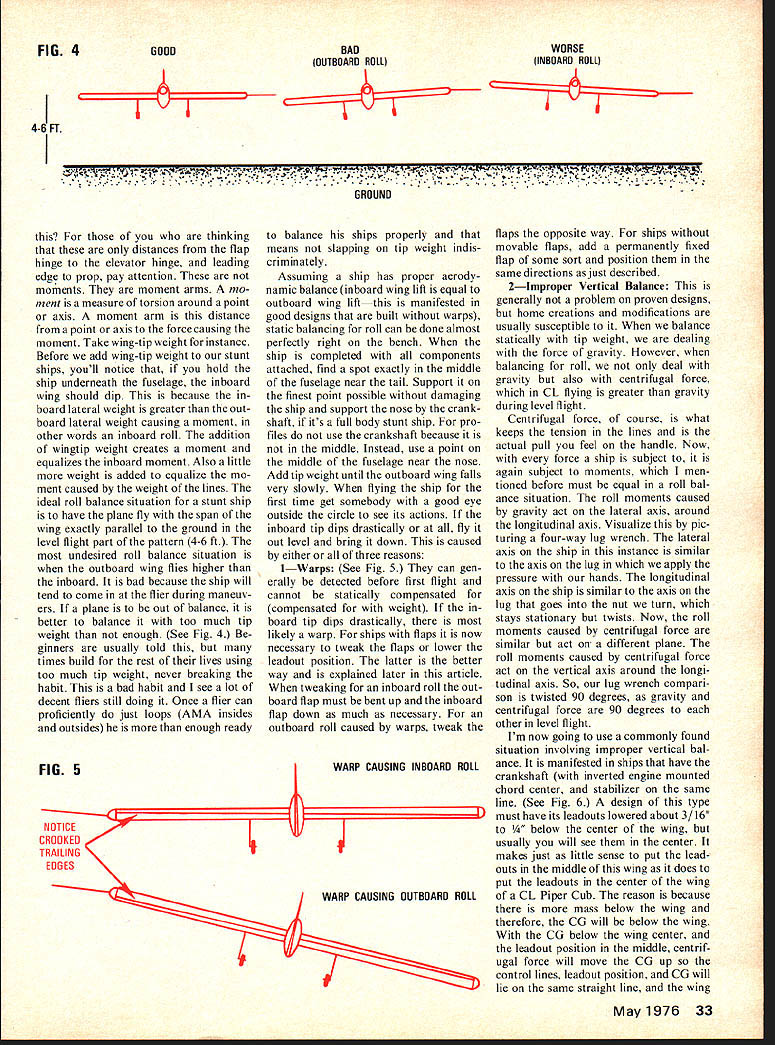
Now think of the plane's three axes. The axis that goes through the fuselage is the longitudinal axis, and movement around this axis is called Roll. (See Fig. 1.)
The axis that goes vertically through the fuselage is the vertical axis, and movement around this axis is called Yaw. (See Fig. 2.)
The axis that goes laterally through the wingspan is the lateral axis, and movement around this axis is called Pitch. (See Fig. 3.)
Obviously, in CL flying we only control directly the plane's pitch, while roll and yaw are (should be) held constant. However, to have a good flying plane (particularly a stuntship) roll and yaw must be held at an ideal constant. In other words, the ship must be properly balanced. The ship can and must be balanced two ways. One is static balance, which is the use of weights. The other is aerodynamic balance. An example of aerodynamic balance is rudder offset and flap tweaking.
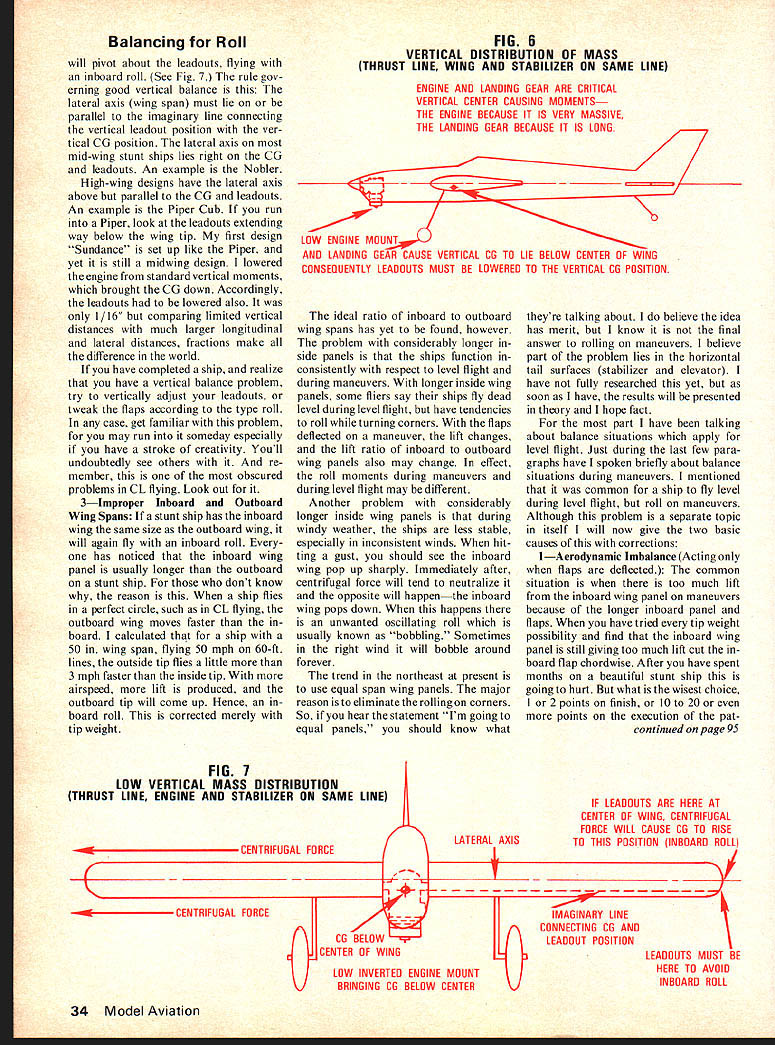
I'll now explain balancing for roll in detail. A stunt ship is perfectly balanced for roll when the sum of all the moments around the longitudinal axis is equal to zero at all attitudes in flight. You see a new word comes into the picture—moments. How many times have you heard this? For those of you who are thinking that these are only distances from the flap hinge to the trailing edge, and leading edge to prop, pay attention. These are not moments. They are moment arms. A moment is a measure of torsion around a point or axis. A moment arm is this distance from a point or axis to the force causing the moment. Take wing-tip weight for instance. Before we add wing-tip weight to our stunt ships, you'll notice that, if you hold the ship underneath the fuselage, the inboard wing should dip. This is because the inboard lateral weight is greater than the outboard lateral weight causing a moment, in other words an inboard roll. The addition of wingtip weight creates a moment and equalizes the inboard moment. Also a little more weight is added to equalize the movement caused by the weight of the lines. The ideal roll balance situation for a stunt ship is to have the plane fly with the span of the wing exactly parallel to the ground in the level flight part of the pattern (4-6 ft.). The most undesired roll balance situation is when the outboard wing flies higher than the inboard. It is bad because the ship will tend to come in at the flier during maneuvers. If a plane is to be cut or balance, it is better to balance it with too much tip weight than not enough. (See Fig. 4.) Beginners are usually told this, but many times build for the rest of their lives using too much tip weight, never breaking the habit. This is a bad habit and I see a lot of decent fliers still doing it. Once a flier can proficiently do just loops (AMA insides and outsides) he is more than enough ready to balance his ships properly and that means not slapping on tip weight indiscriminately.
Assuming a ship has proper aerodynamic balance (inboard wing lift is equal to outboard wing lift — this is manifested in good designs that are built without warps), static balancing for roll can be done almost perfectly right on the bench. When the ship is completed with all components attached, find a spot exactly in the middle of the fuselage near the tail. Support it on the finest point possible without damaging the ship and support the nose by the crankshaft, if it's a full body stunt ship. For profiles do not use the crankshaft because it is not in the middle. Instead, use a point on the middle of the fuselage near the nose. Add tip weight until the outboard wing falls very slowly. When flying the ship for the first time get somebody with a good eye outside the circle to see its actions. If the outboard tip dips drastically or at all, fly it out level and bring it down. This is caused by either or all three reasons:
1 — Warps: (See Fig. 5.) They can generally be detected before first flight and cannot be statically compensated for (compensated for with weight). If the inboard tip dips drastically, there is most likely a warp. For ships with flaps it is now necessary to tweak the flaps or lower the leadout position. The latter is the better way and is explained later in this article. When tweaking for an inboard roll the outboard flap must be bent up and the inboard flap down as much as necessary. For an outboard roll caused by warps, tweak the flaps the opposite way. For ships without movable flaps, add a permanently fixed flap of some sort and position them in the same directions as just described.
2 — Improper Vertical Balance: This is generally not a problem on proven designs, but home creations and modifications are usually susceptible to it. When we balance statically with tip weight, we are dealing with the force of gravity. However, when balancing for roll, we not only deal with gravity but also with centrifugal force, which in CL flying is greater than gravity during level flight.
Centrifugal force, of course, is what keeps the tension in the lines and is the actual pull you feel on the handle. Now, with every force a ship is subject to, it is again subject to moments, which I mentioned before must be equal in a roll balance situation. The roll moments caused by gravity act on the lateral axis of the longitudinal axis. Visualize this by picturing a four-way lug wrench. The lateral axis on the ship in this instance is similar to the axis on the lug in which we apply pressure with our hands. The longitudinal axis on the ship is similar to the axis on the lug that goes into the nut we turn, which stays stationary but twists. Now, the roll moments caused by centrifugal force are similar but act on a different plane. The roll moments caused by centrifugal force act on the vertical axis around the longitudinal axis. Our lug wrench comparison is twisted 90 degrees, as gravity and centrifugal force are 90 degrees to each other in level flight.
I'm now going to use a commonly found situation involving improper vertical balance. It is manifested in ships that have the crankshaft (with inverted engine mounted under center, and stabilizer on the same line. (See Fig. 6.) A design of this type must have its leadouts lowered about 3/16" to 1/4" below the center of the wing, but usually you will see them in the center. It makes just as little sense to put the leadouts in the middle of this wing as it does to put the leadouts in the center of the wing of a CL Piper Cub. The reason is because there is more mass below the wing and therefore, the CG will be below the wing. With the CG below the wing center, and the leadout position in the middle, centrifugal force will move the CG up so the control lines, leadout position, and CG will lie on the same straight line, and the wing will pivot about the leadouts, flying with an inboard roll. (See Fig. 7.) The rule governing good vertical balance is this: The lateral axis (wing span) must lie on or be parallel to the imaginary line connecting the vertical leadout position with the vertical CG position. The lateral axis on most mid-wing stunt ships lies right on the CG and leadouts. An example is the Nobler.
High-wing designs may use the lateral axis above but parallel to the CG and leadouts. An example is the Piper Cub. If you run into a Piper, look at the leadouts extending way below the wing tip. My first design "Sundance" is set up like the Piper, and yet it is still a midwing design. I lowered the engine from standard vertical moments, which brought the CG down. Accordingly, the leadouts had to be lowered also. It was only 1/16" but comparing limited vertical distances with much larger longitudinal and lateral distances, fractions make all the difference in the world.
If you have completed a ship, and realize that you have a vertical balance problem, try to vertically adjust your leadouts, or tweak the flaps according to the type roll. In any case, get familiar with this problem, for you may run into it someday especially if you have a stroke of creativity. You'll undoubtedly see others with it. And remember, this is one of the most obscured problems in CL flying. Look out for it.
3—Improper Inboard and Outboard Wing Spans:
If a stunt ship has the inboard wing the same size as the outboard wing, it will again fly with an inboard roll. Everyone has noticed that the inboard wing panel is usually longer than the outboard on a stunt ship. For those who don't know why, the reason is this. When a ship flies in a perfect circle, such as in CL flying, the outboard wing moves faster than the inboard. I calculated that for a ship with a 50 in. wing span, flying 50 mph on 60-ft. lines, the outside tip flies a little more than 3 mph faster than the inside tip. With more airspeed, more lift is produced, and the outboard tip will come up. Hence, an inboard roll. This is corrected merely with tip weight.
The ideal ratio of inboard to outboard wing spans has yet to be found, however. The problem with considerably longer inside panels is that the ships function inconsistently with respect to level flight and during maneuvers. With longer inside wing panels, some fliers say their ships fly dead level during level flight, but have tendencies to roll while turning corners. With the flaps deflected on a maneuver, the lift changes, and the lift ratio of inboard to outboard wing panels also may change. In effect, the roll moments during maneuvers and during level flight may be different.
Another problem with considerably longer inside panels is that during windy weather, the ships are less stable, especially in inconsistent winds. When hitting a gust, you should see the inboard wing pop up sharply. Immediately after, centrifugal force will tend to neutralize it and the opposite will happen—the inboard wing pops down. When this happens there is an unwanted oscillating roll which is usually known as "bobbling." Sometimes in the right wind it will bobble around forever.
The trend in the northeast at present is to use equal span wing panels. The major reason is to eliminate the rolling corners. So, if you hear the statement "I'm going to equal panels," you should know what they're talking about. I do believe the idea has merit, but I know it is not the final answer to rolling on maneuvers. I believe part of the problem lies in the horizontal tail surfaces (stabilizer and elevator). I have not fully researched this yet, but as soon as I have, the results will be presented in theory and I hope fact.
For the most part I have been talking about balance situations which apply for level flight. Just during the last few paragraphs have I spoken briefly about balance situations during maneuvers. I mentioned that it was common for a ship to fly level during level flight, but roll on maneuvers. Although this problem is a separate topic in itself I will now give the two basic causes of this with corrections.
1—Aerodynamic Imbalance (Acting only when flaps are deflected.):
The common situation is when there is too much lift from the inboard wing on maneuvers because of the larger inboard panel and flaps. When you have tried every tip weight possibility and find that the inboard wing panel is still giving too much lift, the only cure is to board flap chordwise. After you have spent months on a beautiful stunt ship this is going to hurt. But what is the wisest choice? 1 or 2 points on finish, or 10 to 20 or even more points on the execution of the pattern. 2—Dynamic Imbalance (During Maneuvers): Your stunt ship can fly dead level and still have too much or too little tip weight. If this is so, you'll see it on maneuvers. Variations in tip weight will not make a difference sometimes during level flight because of centrifugal force, especially with a ship that is well balanced vertically.
Centrifugal force is greater than gravity during level flight, and can cancel out imbalances susceptible to gravity such as tip weight. However, on maneuvers, particularly sharp corners, centrifugal force is not the major force. Gravitational forces combined with momentum are. Take for instance, a ship coming out of a wingover. Just before it pulls out, it is moving at the fastest speed it ever will in the pattern. Mass and speed combine and the product is what is known as momentum.
Without getting into Physics I'll describe momentum. It is the thing that makes you feel like you weigh more when a descending elevator comes to a stop. A ship pulling out of a wingover is in the same exact situation. With respect to its downward vertical movement, it is coming to a stop. Like the person in the elevator it weighs more and any of its imbalances in weight also are magnified. So, if you have a half oz. too much tip weight, it will become many ounces too much tip weight on the pullout, and the ship will have an aileron board roll (outboard tip dipping), until centrifugal force neutralizes it again in level flight when the momentum from the wingover is gone.
I have just presented roll problems and their causes. Now here's a summary of them showing the symptoms and how to correct them. These can be referred to like a chart.
A ship should first be tested for roll in level and inverted flight. Forget about its characteristics during maneuvers until the problems here are resolved. If it is not balanced correctly here, it will never fly correctly during maneuvers. The ship should be flown level and inverted at the same height as your control hand. For most fliers this is between four and five feet. Someone with a good eye, preferably another stunt flier, should watch the ship from outside of the circle. Then, compare with and follow these procedures:
Roll Symptoms and Corrections for Level and Inverted Flight
Inboard Roll (Outboard tip up in level flight) with Outboard Roll (Outboard tip down in inverted flight): This is an aerodynamic problem, probably a warp, and you must tweak the flaps—outboard flap up, inboard flap down. Tweak as much as necessary to get the wing flying parallel to the ground. Tweaking is not the best solution, although it is the easiest. Tweaked flaps do the job only at one speed. At increased speeds the ship will roll more in the direction it is tweaked, and at lower speeds it is not enough to compensate for the initial imbalance. Also it means flying level with deflected flaps, and this induces drag which reduces lift. The better solution is to lower the leadout position if possible. By doing this you encounter the aerodynamic imbalance with an equal and opposite vertical imbalance, and no drag is induced. The problem here is that vertical imbalance fluctuates on maneuvers because of fluctuating centrifugal force. The best solution is to build straight to begin with.
Outboard Roll (Outboard tip down in level flight) with Inboard Roll (Outboard tip up in inverted flight): This is the opposite of the previous problem. Tweak the flaps in the opposite direction or raise the leadouts if possible. You can also add weight to the landing gear at the bottom of the strut creating a counterbalancing vertical moment. This is easier than changing the leadout position and does the same thing. I suggest this rather than tweaking.
Outboard Roll (in both level and inverted flight): This is merely a tip-weight problem. Simply add tip weight until the wing flies parallel to the ground.
Balancing for Roll (continued)
flight): There is too much tip weight here. Simply remove weight from the outboard tip if you have any. If not, by all means add some weight to the inboard tip. This rarely happens on full-body stunt ships, but is very common on profiles because the engine and tank are on the right side. Also because modelers usually put the heaviest wood on the outboard wing panel and then slap on excessive tip weight. This is one of the age old bad habits in modeling. Please!
If you need weight on the inboard tip, use it. Also, while you are constructing a ship, you can gouge weight from bulky leading and trailing edges that usually come in profile kits.
Keep in mind now that these symptoms and corrections apply to the ship as it is flying in level and inverted flight, and the ship is static with regard to vertical movement. During maneuvers it is in a dynamic situation (forces are constantly changing) and may be out of balance during maneuvers, particularly squares. I touched on this a bit in this article, but it needs its own space for explanation.
However, what I have just presented is the heart of most roll balance problems, so if you understand and apply what has been said, you'll wind up with a good performing ship in this respect. Keep in mind also that these situations are isolated, and it is very possible and probable that you will have a combination of these problems, perhaps all of them.
If something isn't clear, read it again and think about what is being said. If it's still not clear, ask questions. My address is 2850 E. 196 St., Bronx, NY 10461. Until next month... fly Stunt.
(Next month the author discusses Balancing for Yaw.)
Transcribed from original scans by AI. Minor OCR errors may remain.

