
Bargain Showcase
Bill Hannan
ARE YOU a collector? Most modelers seem to be. Even those of us who are not organized collectors often have a variety of model engines tucked away in a drawer or toolbox. Why not clean them up and put them on display? Or, perhaps you enjoy 1/72-scale plastic models. With these, there is the ever-present danger of damage from inquisitive fingers. Then too, if you are competition-minded, you may have garnered some trophies, medals and ribbons over the years. Such items always seem to need dusting, as any housewife will attest. Putting such collections under glass may be the best answer. However, commercially marketed showcases usually are quite costly. And, constructing your own from scratch would be a painstaking and time-consuming proposition.
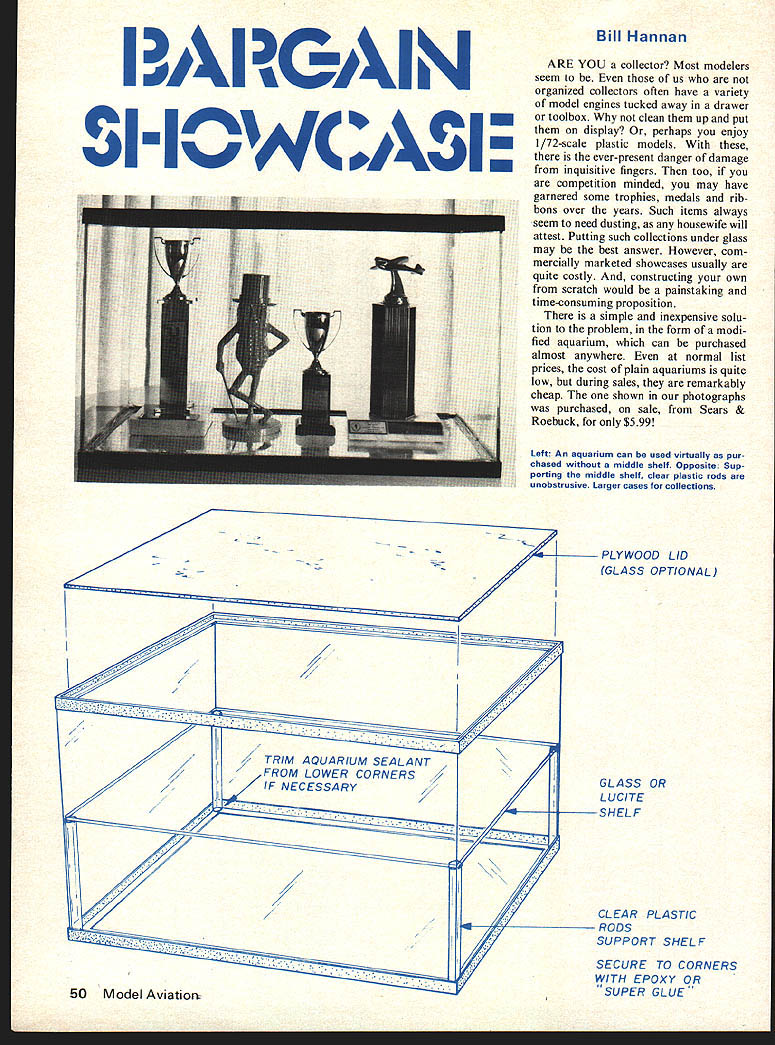
There is a simple and inexpensive solution to the problem, in the form of a modified aquarium, which can be purchased almost anywhere. Even at normal list prices, the cost of plain aquariums is quite low, but during sales they are remarkably cheap. The one shown in our photographs was purchased, on sale, from Sears & Roebuck, for only $5.99!
If you'd like to display trophies or keepsakes, inexpensive aquariums may easily be converted. Used aquariums can sometimes be found at Goodwill Industries, Salvation Army stores and other places. When selecting an aquarium, keep in mind the objects you intend to display; for example, trophies might fit best in a tall narrow case. Also, some aquariums look too "fishy" — you may convert them to visually satisfying showcases according to personal aesthetic tastes. For trophy-display purposes some aquariums can be utilized almost as purchased.
In addition, accessory aquarium tops are available fitted with lights, which suggests the possibility of an illuminated showcase. I chose to make a plywood top covered with contact paper — a simple, inexpensive finish. Such paper is available in an impressive array of colors and textures, including wood grains. When cutting the top panel allow enough edge clearance for the contact paper. If a transparent top is preferred, either glass or clear plastic could be substituted; this is desirable if the showcase is intended to display short objects such as model engines or small aircraft.
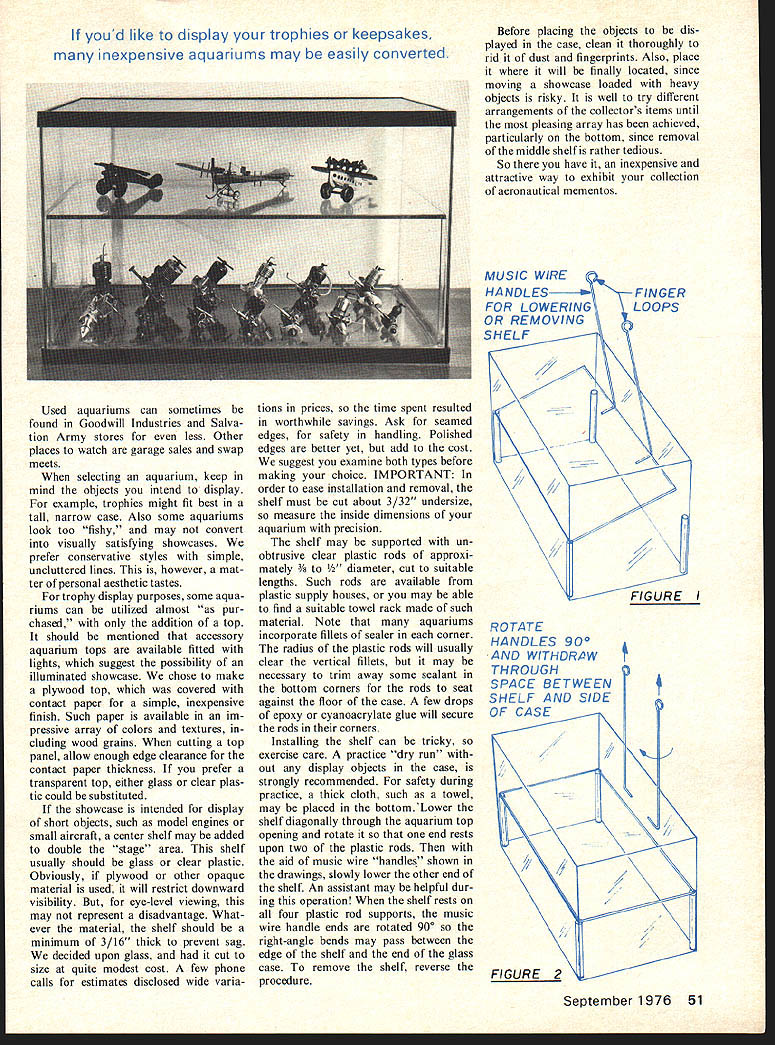
A center shelf may be added to double the stage area. The shelf usually should be glass or clear plastic. Obviously, plywood or other opaque material will restrict downward visibility; eye-level viewing may represent a disadvantage. Whatever material is chosen, the shelf should be a minimum 3/16" thick to prevent sag. If glass is decided upon, having it cut to size is quite modest in cost; a few phone calls for estimates disclosed wide variations in prices, and the time spent resulted in worthwhile savings. Ask for seamed edges for safety in handling. Polished edges are better yet but add cost; examine both types before making your choice.
IMPORTANT: In order to ease installation and removal, the shelf must be cut about 3/32" undersize from the inside dimensions of the aquarium. A precision shelf may be supported on unobtrusive clear plastic rods approximately 1/8" in diameter, cut to suitable lengths. Such rods are available from plastic supply houses; you may be able to find a suitable towel rack made of such material. Note that many aquariums incorporate fillets of sealer in the corner radius. Plastic rods will usually clear vertical fillets; it may be necessary to trim away some sealant in the bottom corners so the rods seat against the floor of the case. A few drops of epoxy or cyanoacrylate glue will secure the rods in the corners.
Installing the shelf can be a tricky exercise. Careful practice and a dry run with the display objects in the case are strongly recommended. For safety during practice, a thick cloth such as a towel may be placed on the bottom. Insert the lower shelf diagonally through the aquarium top opening, rotate one end so it rests upon two plastic rods, then slowly lower the other end until the shelf engages the four plastic-rod supports. Music-wire handle ends with 90° right-angle bends may be used to pass between the edge of the shelf end and the glass of the case; remove the shelf by reversing the procedure. An assistant may be helpful during the operation.
Before placing the objects in the displayed case, clean thoroughly to rid dust and fingerprints. Also place objects where they will finally be located, since moving a showcase loaded with heavy objects is risky. Try different arrangements of your collectors' items until a pleasing array has been achieved. Particularly on the bottom, since removal of the middle shelf is rather tedious.
So there you have it, an inexpensive and attractive way to exhibit your collection of aeronautical mementos.
Transcribed from original scans by AI. Minor OCR errors may remain.

