
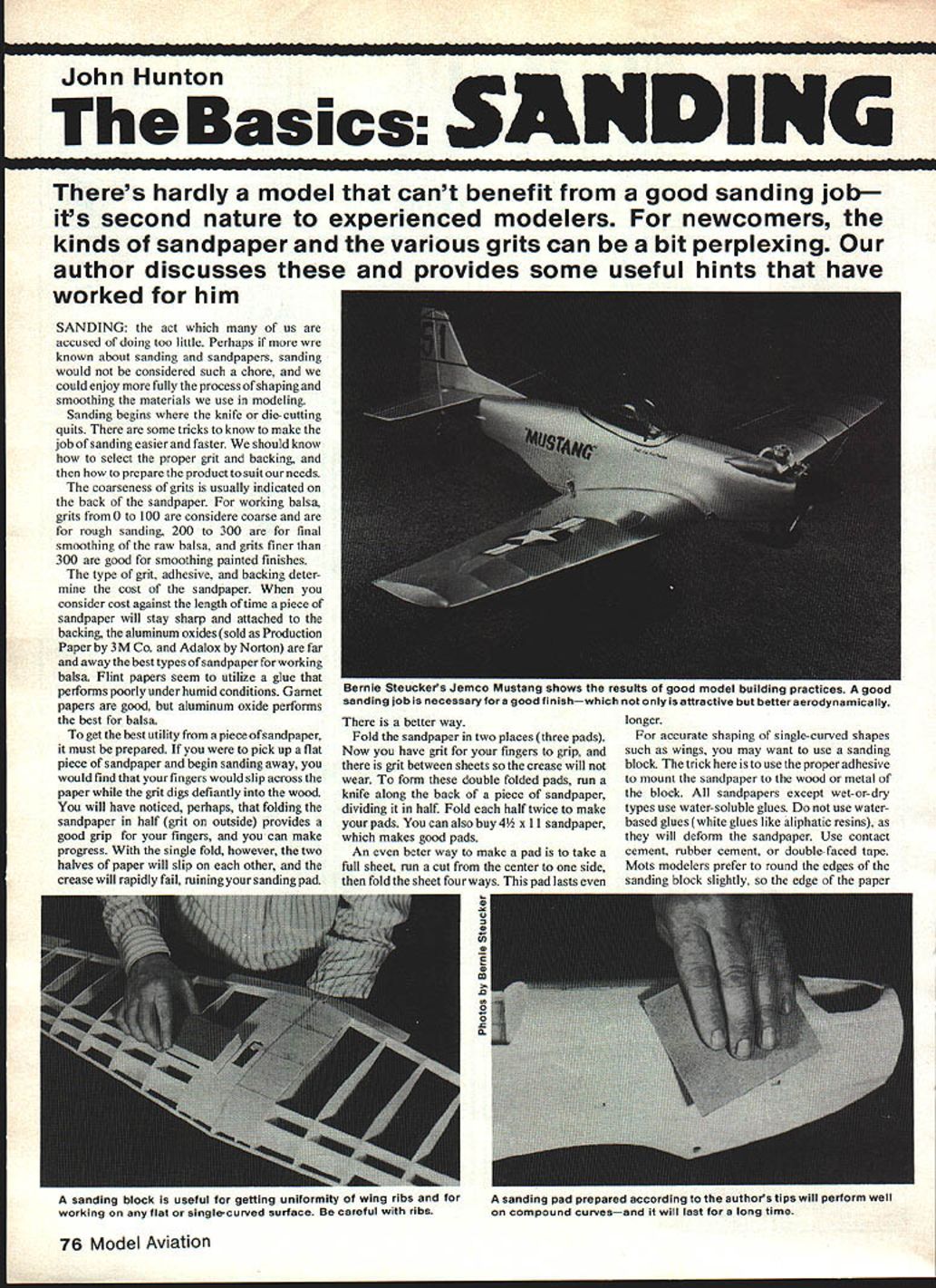
The Basics: Sanding
There's hardly a model that can't benefit from a good sanding job — it's second nature to experienced modelers. For newcomers, the kinds of sandpaper and the various grits can be a bit perplexing. This article discusses those choices and provides practical hints that work well.
Sanding begins where the knife or die-cutting quits. Knowing a few tricks makes sanding easier and faster: how to select the proper grit and backing, and how to prepare the sandpaper for the job.
Grit selection
The coarseness of grits is usually indicated on the back of the sandpaper. For working balsa:
- Grits from 0 to 100 are considered coarse and are for rough sanding.
- Grits from 200 to 300 are for final smoothing of raw balsa.
- Grits finer than 300 are good for smoothing painted finishes.
Sandpaper types and backing
The type of grit, adhesive, and backing determine the cost and usefulness of sandpaper. When you consider cost against how long a piece of sandpaper will stay sharp and attached to its backing, aluminum oxide papers (sold as Production Paper by 3M Co. and Adalox by Norton) are the best choice for working balsa. Flint papers use a glue that performs poorly under humid conditions. Garnet papers work well, but aluminum oxide performs best for balsa.
Wet-or-dry papers can be used with water to prevent clogging and are intended for smoothing painted surfaces. Do not use wet-or-dry paper wet on wood. The backing of wet-or-dry paper is brittle; these papers can be used dry but are primarily for wet use on non-wood surfaces.
Preparing sandpaper pads
If you pick up a flat piece of sandpaper and begin sanding, your fingers tend to slip across the paper while the grit digs into the wood. Folding the sandpaper helps.
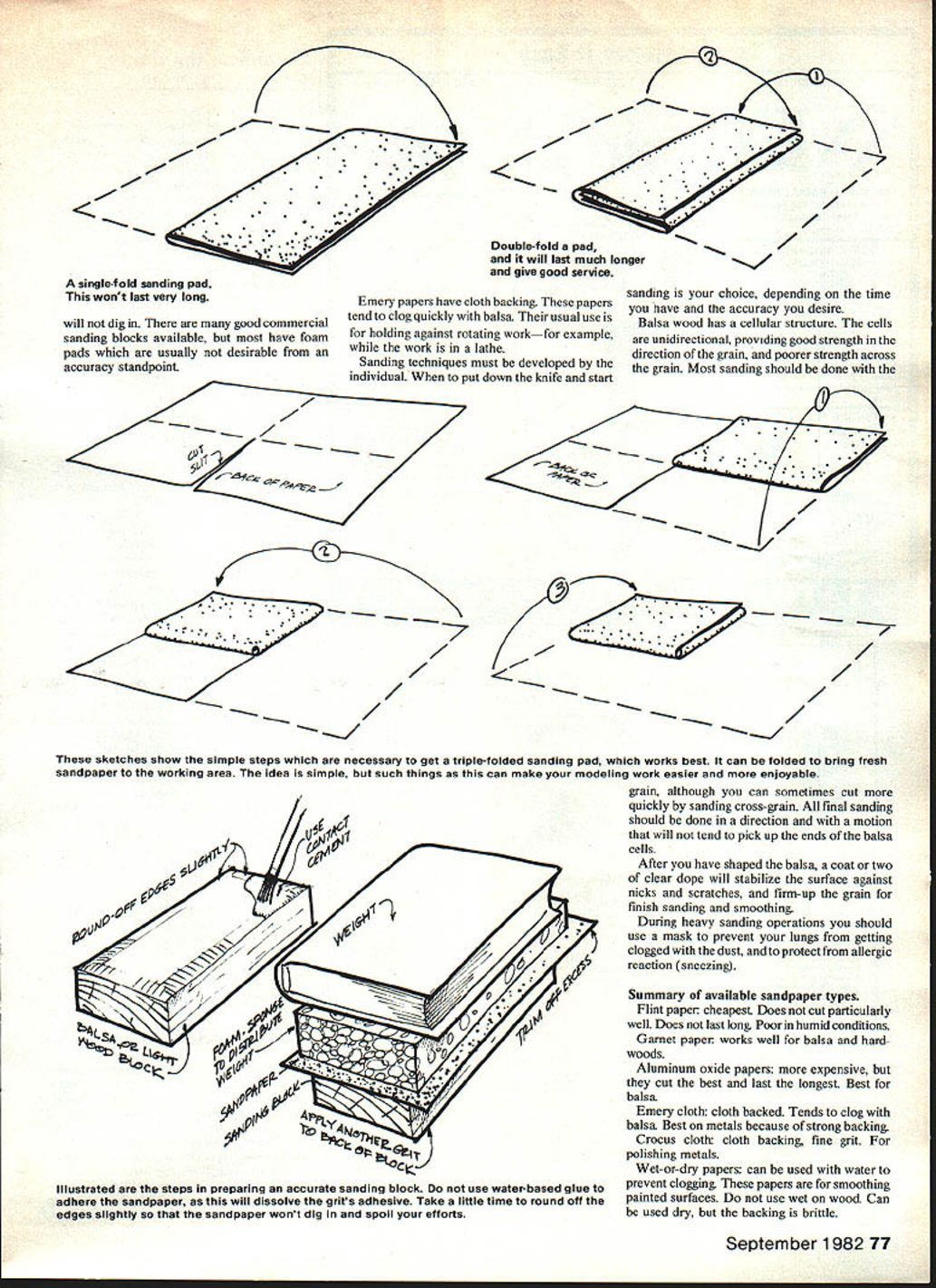
- Single fold (grit on outside) provides a better grip, but the two halves will slip on each other and the crease will wear rapidly.
- Double-fold (three pads) provides grit for your fingers and grit between sheets so the crease will not wear. To make double-fold pads: run a knife along the back of a sheet, dividing it in half. Fold each half twice to make pads. You can also buy 4-1/2 x 11 sandpaper sheets that make good pads.
- An even better pad: take a full sheet, cut from the center to one side, then fold the sheet four ways. This pad lasts even longer and can be unfolded to bring fresh sandpaper into the working area.
A single-fold sanding pad won't last very long. A double- or multiple-folded pad will last much longer and give better service.
Sanding blocks
For accurate shaping of single-curved shapes such as wings, use a sanding block. Use the proper adhesive to mount the sandpaper to the wood or metal block. All sandpapers except wet-or-dry types use water-soluble glues; do not use water-based glues (white glues like aliphatic resins), as they will deform the sandpaper. Instead use contact cement, rubber cement, or double-faced tape. Most modelers prefer to round the edges of the sanding block slightly so the edge of the paper won't dig in and spoil your work.
Sanding technique and finishing
Balsa wood has a cellular structure with cells aligned along the grain. Sand mostly with the grain. Although cross-grain sanding can remove material quickly, final sanding should be done in the direction of the grain; cross-grain sanding tends to pick up end grain of the balsa cells and can produce a poorer finish.
After shaping the balsa, coat it with two thin coats of clear dope to stabilize the surface against nicks and scratches and to firm up the grain for finish sanding and smoothing.
During heavy sanding operations, wear a mask to prevent inhalation of dust and to protect against allergic reactions or sneezing.
Summary of available sandpaper types
- Flint paper: cheapest. Does not cut particularly well and does not last long. Performs poorly in humid conditions.
- Garnet paper: works well for balsa and hardwoods.
- Aluminum oxide papers: more expensive, but cut the best and last the longest. Best for balsa.
- Emery cloth: cloth backed. Tends to clog with balsa. Best on metals because of strong backing.
- Crocus cloth: cloth backed, fine grit. For polishing metals.
- Wet-or-dry paper: can be used with water to prevent clogging; for smoothing painted surfaces. Do not use wet on wood. Can be used dry, but the backing is brittle.
Transcribed from original scans by AI. Minor OCR errors may remain.

