
How to avoid those nasty sparks
Red Scholefield | redscho@bellsouth.net
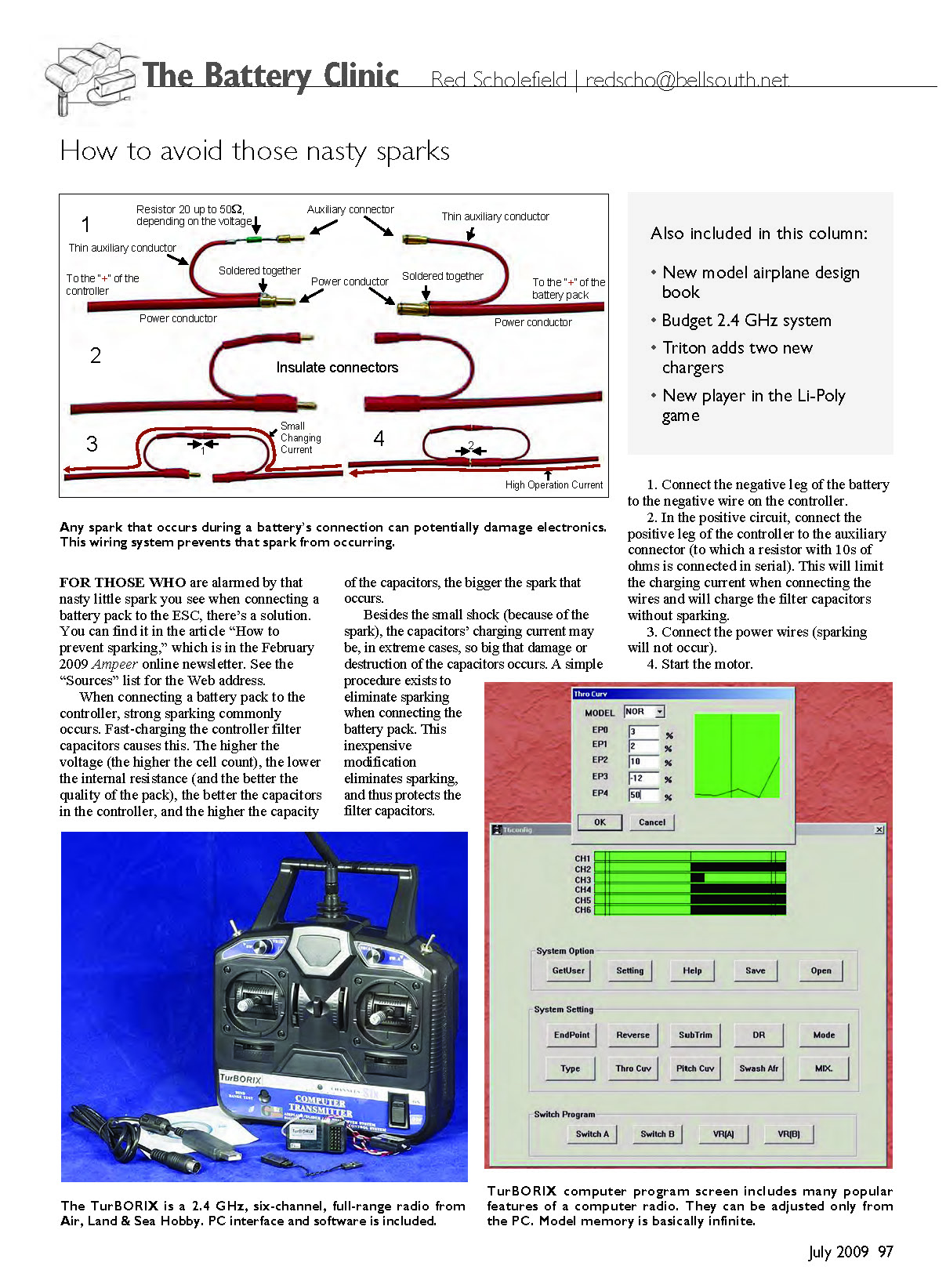
Any spark that occurs during a battery's connection can potentially damage electronics. This wiring system prevents that spark from occurring.
For those who are alarmed by that little spark you see when connecting a battery pack to the ESC, there's a solution. See the article "How to prevent sparking" in the February 2009 Ampeer online newsletter (see Sources).
When connecting a battery pack to the controller, strong sparking commonly occurs because the controller filter capacitors charge very quickly. The spark magnitude increases with higher voltage (more cells), lower internal pack resistance (better-quality pack), better capacitors in the controller, and higher capacitor capacity.
Besides the small shock from the spark, the charging current can, in extreme cases, be so large that it damages the capacitors. A simple procedure eliminates sparking when connecting the battery pack. This inexpensive modification protects the filter capacitors.
- Connect the negative lead of the battery to the negative wire on the controller.
- In the positive circuit, connect the positive lead of the controller to an auxiliary connector. In series with this auxiliary connector place a resistor of tens of ohms. This limits the charging current when connecting the wires and charges the filter capacitors without sparking.
- Connect the power wires (now sparking will not occur).
- Start the motor.
The initial charging current is small (1–2 amps) and lasts only a short time. There are no strict requirements on the resistor type: metalized 0.6 W, size 0207 (i.e., 2 mm x 7 mm) works fine. Suggested values by pack voltage:
- 4–6 cell Li-Poly: 20 ohms
- 10 cell Li-Poly: 33 ohms
- 12 cell and up: 51 ohms
Exact values are not critical because of wide variation in packs and controllers.
Procedure summary:
- Connect the new auxiliary connector through the resistor so the capacitors charge with small current and sparking will not occur.
- Connect the main power connectors; sparking will not occur.
- Leave the auxiliary leads connected. During operation, the main current to the controller and motor passes through the power connectors and conductors.
See wiring illustrations in the original article for further clarification.
RCadvisor's Model Airplane Design Made Easy
Carlos Reyes
RCadvisor's Model Airplane Design Made Easy uses straightforward explanations to teach important design tradeoffs and how to choose among them. In this 208-page book you will learn when it makes sense to use one of the innovative KFM airfoils and what that means.
The latest research and techniques are explained in clear language. Carlos explains the special challenges faced by smaller models and how to overcome them.
Carlos sets easy rules for selecting the right power system (both gas and electric), and provides pros and cons of canard and multiwing configurations. The book shows how to choose the right material for each part of the airplane and provides a step-by-step design process that includes goal setting and flight-testing.
Also included are in-depth discussions of important topics such as airfoils and wing design, sources of air drag, and how to minimize their impact.
Sources: www.rcadvisor.com/book
2.4 GHz on a Budget
There have been many low-cost 2.4 GHz systems on the market lately, particularly as part of RTF models. I found a system offered by Air Land & Sea Hobby for $67.95 including S&H. The system included a transmitter, receivers, software, and USB cable. The company sent one for review.
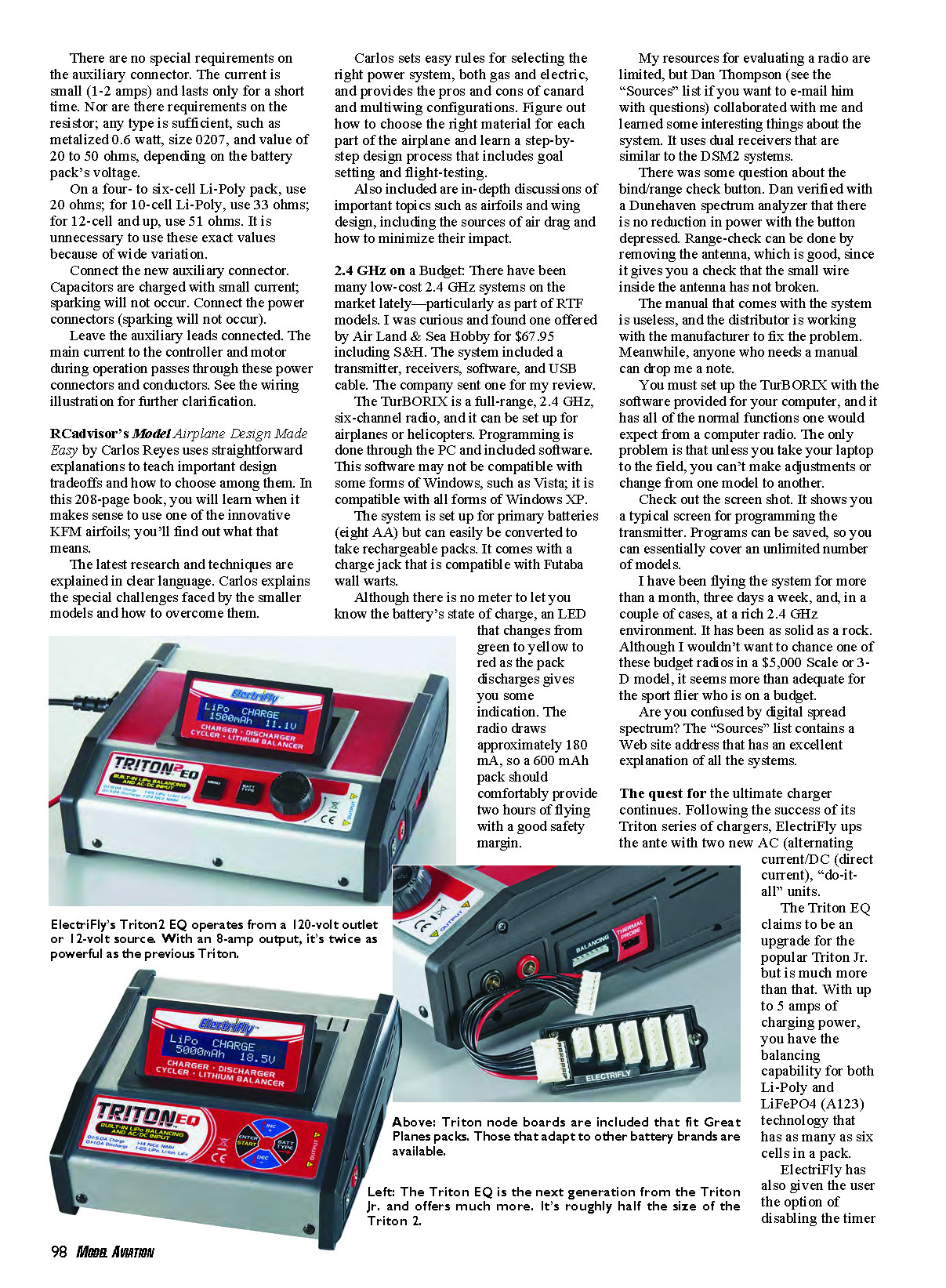
The TurBORIX is a full-range, 2.4 GHz, six-channel radio that can be set up for airplanes or helicopters. Programming is done through a PC with included software. Note: the software may not be compatible with some versions of Windows (e.g., Vista); it is compatible with Windows XP.
The system is set up for primary batteries (eight AA) but can be converted to use rechargeable packs. It comes with a charge jack compatible with Futaba wall warts.
Battery indication is via an LED that changes from green to yellow to red as the pack discharges; there is no voltage meter. The radio draws approximately 180 mA, so a 600 mAh pack should comfortably provide about two hours of flying with a safety margin.
Dan Thompson (see Sources) helped evaluate the radio and found the system uses dual receivers similar to DSM2 systems. There was a question about the bind/range-check button; Dan verified with a DuneHaven spectrum analyzer that there is no reduction in power when the button is depressed. Range-check can be done by removing the antenna, which checks that the small wire inside the antenna has not broken.
The manual that comes with the system is poor; the distributor is working with the manufacturer to fix it. If you need a manual in the meantime, contact me.
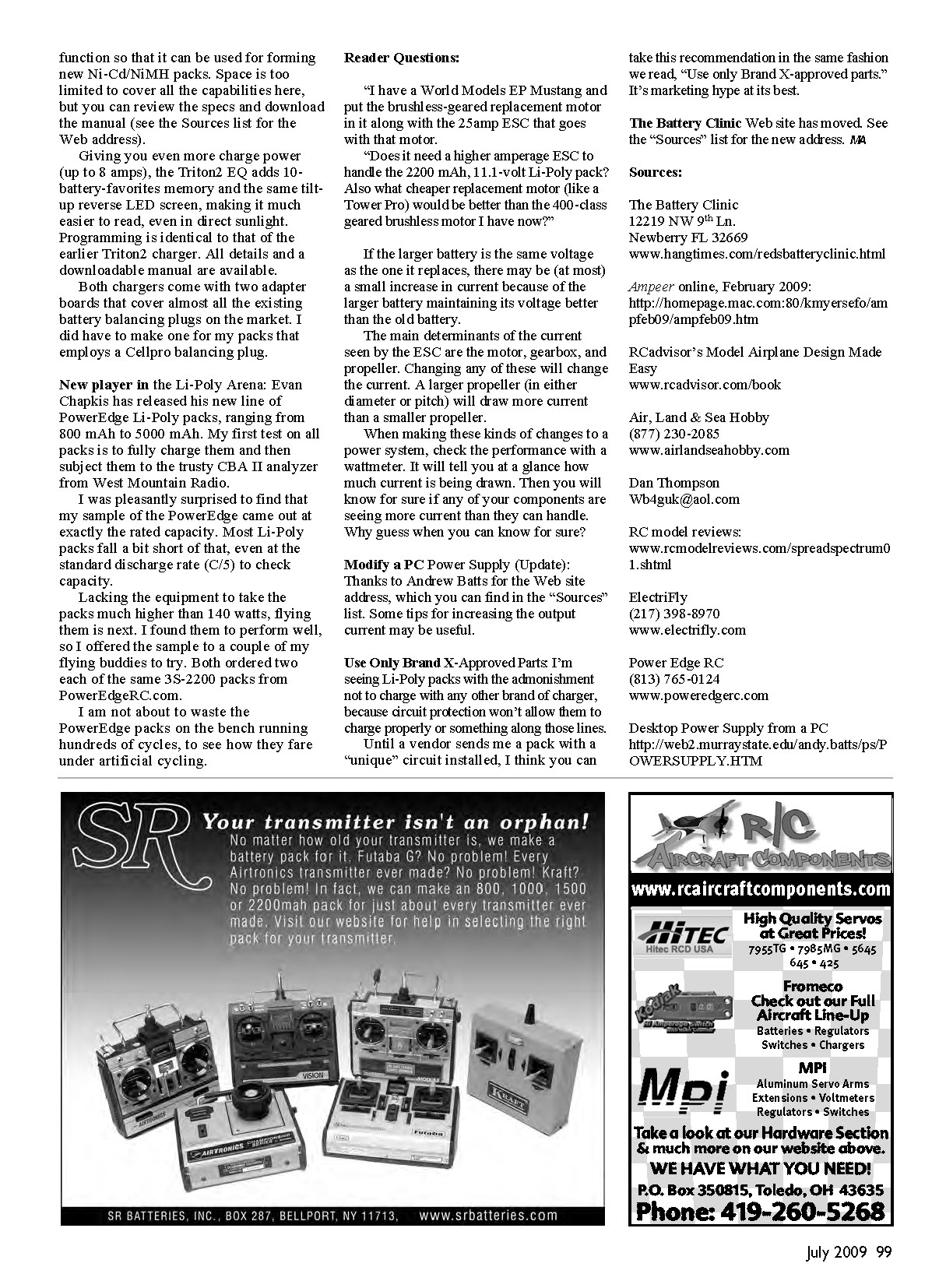
You must set up the TurBORIX using the provided software, which gives all normal functions of a computer radio. The downside is you must take a laptop to the field to make adjustments or change models. Programs can be saved, effectively allowing an unlimited number of models.
I have been flying the system for over a month, three days a week, including in dense 2.4 GHz environments. It has been very reliable. While I wouldn't risk this budget radio in a $5,000 scale or 3-D model, it seems more than adequate for the sport flier on a budget.
If you're confused by digital spread spectrum, see the Sources list for an excellent explanation of the systems.
Sources: Air, Land & Sea Hobby — (877) 230-2085, www.airlandseahobby.com RC model reviews: www.rcmodelreviews.com/spreadspectrum01.shtml Dan Thompson — wb4guk@aol.com
ElectriFly Triton Chargers
The quest for the ultimate charger continues. Following the success of its Triton series, ElectriFly offers two new AC/DC "do-it-all" units.
Triton EQ:
- Claims to be an upgrade for the Triton Jr. but is much more capable.
- Up to 5 amps of charging power.
- Balancing capability for Li-Poly and LiFePO4 (A123) packs up to six cells.
- Option to disable the timer function so the unit can be used for forming new Ni-Cd/NiMH packs.
Triton2 EQ:
- Up to 8 amps of charge power.
- Adds 10 battery-favorites memory and a tilt-up reverse LED screen (easier to read in sunlight).
- Programming is identical to the earlier Triton2 charger.
Both chargers come with two adapter boards that cover almost all battery balancing plugs on the market. I did have to make one adapter for packs that use a Cellpro balancing plug.
For full specs and manuals, see ElectriFly's web site (see Sources).
Sources: ElectriFly — (217) 398-8970, www.electrifly.com
New player in the Li-Poly Arena
Evan Chapkis has released PowerEdge Li-Poly packs ranging from 800 mAh to 5000 mAh. My first test is to fully charge them and then test capacity on the CBA II analyzer from West Mountain Radio.
My sample of PowerEdge matched its rated capacity exactly at the standard C/5 discharge rate. Many Li-Poly packs fall a bit short even at standard discharge.
I haven't subjected these packs to hundreds of artificial cycles; instead, I flew them. Performance was good, and two flying buddies ordered two each of the 3S-2200 packs from PowerEdgeRC.com.
Sources: Power Edge RC — (813) 765-0124, www.poweredgerc.com
Reader Questions
“I have a World Models EP Mustang and put the brushless-geared replacement motor in it along with the 25 amp ESC that goes with that motor.
Does it need a higher-amperage ESC to handle the 2200 mAh, 11.1-volt Li-Poly pack? Also, what cheaper replacement motor (like a Tower Pro) would be better than the 400-class geared brushless motor I have now?”
Answer: If the larger battery is the same voltage as the one it replaces, there may be, at most, a small increase in current because the larger battery maintains its voltage better under load.
The main determinants of current are the motor, gearbox, and propeller. Changing any of these changes the current draw. A larger propeller (diameter or pitch) draws more current than a smaller one.
When making changes to a power system, check performance with a wattmeter. It will tell you how much current is being drawn so you can confirm whether components are within safe limits.
Modify a PC Power Supply (Update)
Thanks to Andrew Batts for the web site address (see Sources). Some tips for increasing output current may be useful; see the linked guide for details.
Sources: Desktop Power Supply From a PC — http://web2.murraystate.edu/andy.batts/ps/POWERSUPPLY.HTM Andrew Batts — web2.murraystate.edu/andy.batts
Use Only Brand X–Approved Parts
I’m seeing Li-Poly packs that warn not to charge with any other brand of charger, claiming circuit protection won't allow proper charging.
Until a vendor sends me a pack with a truly unique circuit installed, take such warnings with skepticism. They read like "Use only Brand X–approved parts." It's marketing hype.
The Battery Clinic web site has moved
See the Sources list for the new address.
Sources
- The Battery Clinic
12219 NW 9th Ln. Newberry FL 32669 www.hangtimes.com/redsbatteryclinic.html
- Ampeer online, February 2009:
http://homepage.mac.com:80/kmyersefo/ampfeb09/ampfeb09.htm
- RCadvisor’s Model Airplane Design Made Easy:
- Air, Land & Sea Hobby — (877) 230-2085:
- Dan Thompson — wb4guk@aol.com
- RC model reviews (spread spectrum explanation):
www.rcmodelreviews.com/spreadspectrum01.shtml
- ElectriFly — (217) 398-8970:
- Power Edge RC — (813) 765-0124:
- Desktop Power Supply From a PC (Andrew Batts):
http://web2.murraystate.edu/andy.batts/ps/POWERSUPPLY.HTM
Transcribed from original scans by AI. Minor OCR errors may remain.

