
Battle for RC Frequencies
Walt Good
It now almost seems like it is a right as an American to switch on an RC transmitter and fly a plane to your heart's content, but it's not. It's a privilege, not a right, and it had to be fought for long and hard by our modeling predecessors over 40 years ago. Part one of a three-part series.
How would you like to fly Radio Control at the AMA Nationals, and upon arrival discover that there were 268 RC contestants—with over 200 of them on your frequency? That situation—at the 1958 Nats in Chicago—vividly illustrates one of the painful steps the AMA encountered in its struggle to obtain RC channels for the rapidly growing family of RC fliers.
This is the story of the early years of flying on RC frequencies, and the many battles that were fought to obtain the first RC channels from the FCC. Over a span of 40 years the Academy of Model Aeronautics has engaged in at least six confrontations with the Federal Communications Commission to acquire new RC channels, or to protect those channels already gained. Equally important, we fliers needed channels that did not require examinations for licensing.
The first battle begins with the acquisition of a single examination-free RC frequency. The last skirmish won't be over until the AMA has achieved its long-term goal—gaining 80 exclusive RC channels.
Please note that this is a personal report based on how I viewed these events, as an active participant in almost every phase portrayed. While the story is, I hope, accurate, it's undoubtedly limited by a weakening memory and hundreds of ragged and incomplete files! I gladly leave the task of filling in the many gaps to the other generous souls who participated in these efforts.
First, a look at the earliest beginnings of RC competitions.
Pre-World War II RC Contests, 1937-1941
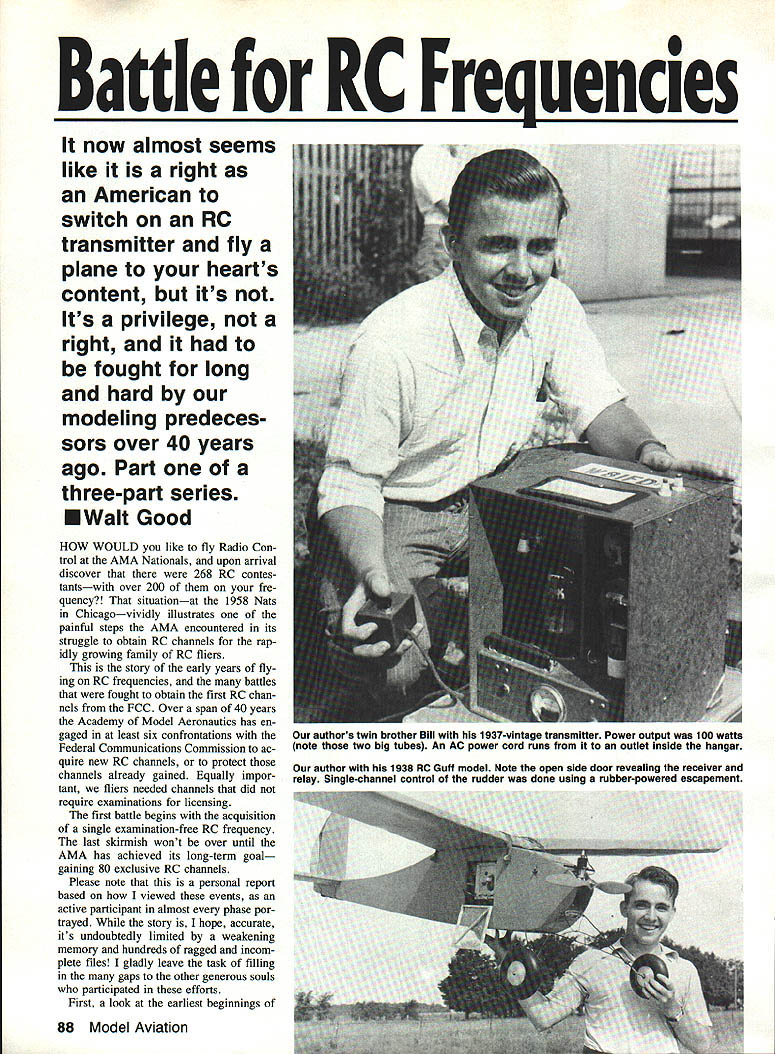
Let's step back to the years just prior to World War II and see how the early RC fliers acquired frequencies on which to fly. At the 1937 Nats in Detroit, where the first Nats RC event was held, all RC pilots used the amateur radio frequencies—primarily 56 to 60 MHz. The six Nats entries had acquired the necessary amateur (Ham) licenses, or their partners had done so.
Each transmitter was "signed on" the air by the license holder sending his call sign in Morse code before the flight, then "signed off" after the flight. During the actual flight, the model builder part of the team used the control buttons to steer his plane. Legally speaking, a non-Ham was not allowed to operate the transmitter, but that clause was overlooked in those days. More stories on that subject later.
Thus, at the five RC Nats held from 1937 through 1941 the Ham frequencies were used exclusively.
After World War II, 1946-1952
World War II shut down amateur radio entirely. From 1942 to 1946, all Ham transmitters were disabled—as was Radio Control—as a hobby. Many erstwhile RC hobbyists were engaged in military service, or working days, nights, and weekends on confidential, hush-hush projects for Uncle Sam.
In the immediate postwar years, the RC event was revived at the 1946 AMA Nats in Wichita, KS. While there were only five RC entries that year, the pilots flew with great enthusiasm. Again, amateur radio frequencies were used.
The FCC had shifted the prewar 56–60 MHz band to 54–60 MHz after the war. But the regulatory body still required a Ham license. To obtain such a license one had to pass a code test, an electronics test, and a test on radio regulations—not an easy task for a modeler who wanted simple radio equipment and a simple radio license. What we RC hobbyists needed was to be able to obtain a license exclusively for RC flying—without an examination.
Examination-free RC frequencies? In 1946 the British modelers had led the way by securing an examination-free RC license for 27 MHz and 460 MHz. This had been done by means of a simple exchange of letters between D. W. Allen of the Society of Model Aero Engineers (the British counterpart of the AMA) and the British Post Office, represented by the Engineer-in-Chief of the Radio Branch, Mr. C. E. Clarke.
Mr. Clarke's short reply to Allen, dated November 8, 1946, sanctioned the following frequencies for RC model use in Britain:
- Frequency #1 — 460.5 MHz within ±0.5 MHz.
- Frequency #2 — 27.66–28 MHz.
Additional specifications in Clarke's letter were as follows:
- Maximum input power of five watts.
- No special license is required.
- Use of this equipment for RC only and not for communication.
Modelers in the U.S. felt optimistic. If the British could obtain RC frequencies so quickly, we expected little or no delay in securing a similar response from our Federal Communications Commission (FCC). Unfortunately, we were wrong. Several years were to pass before we obtained similar RC-use frequencies in America.
The First Battle for RC Frequencies — 1946
I was living in Washington, DC in 1946. Russ Nichols was then executive director of the AMA, and I immediately discussed the modelers' RC frequency needs with him. Having worked for several government agencies before joining the AMA, Russ was familiar with some of their procedures. He suggested that we arrange a visit to the Federal Communications Commission to discuss the matter of RC frequencies face-to-face. In a January 1947 letter to the FCC, the AMA outlined its RC airplane needs, in a fashion similar to the British SMAE letter, and requested an exploratory meeting.
The first meeting was held on April 30, 1947. Eight FCC engineers representing seven FCC departments attended, with Russ and I representing the AMA. The only positive result was the FCC suggestion that a newly contemplated Citizens Radio Service might be able to offer a channel for RC. After several visits with FCC personnel over the year, Russ and I thought we were making some progress—although we still had obtained no RC frequencies.
At the 1947 Nats in Minneapolis there were seven RC entries and a number of successful flights. RC planes were growing up. However, we were still using the Ham frequencies with the concomitant requirement for an amateur license. I had just gotten my Ham license after three attempts (it was many months to pass the code test). I must admit, the thing that hurt most was watching a 17-year-old kid zip through his code test on his first try! As consolation, I finished the written parts of the electronics and regulations exams before he did!
Follow-up meetings between the FCC and AMA to discuss simple, "no exam" RC frequencies were equally unproductive, and as 1948 drew to a close we had still achieved nothing tangible. Admittedly a bit slow in learning how to deal with the FCC's bureaucratic system, we were, however, about to get some action!
RC modelers charged with FCC violations — 1948
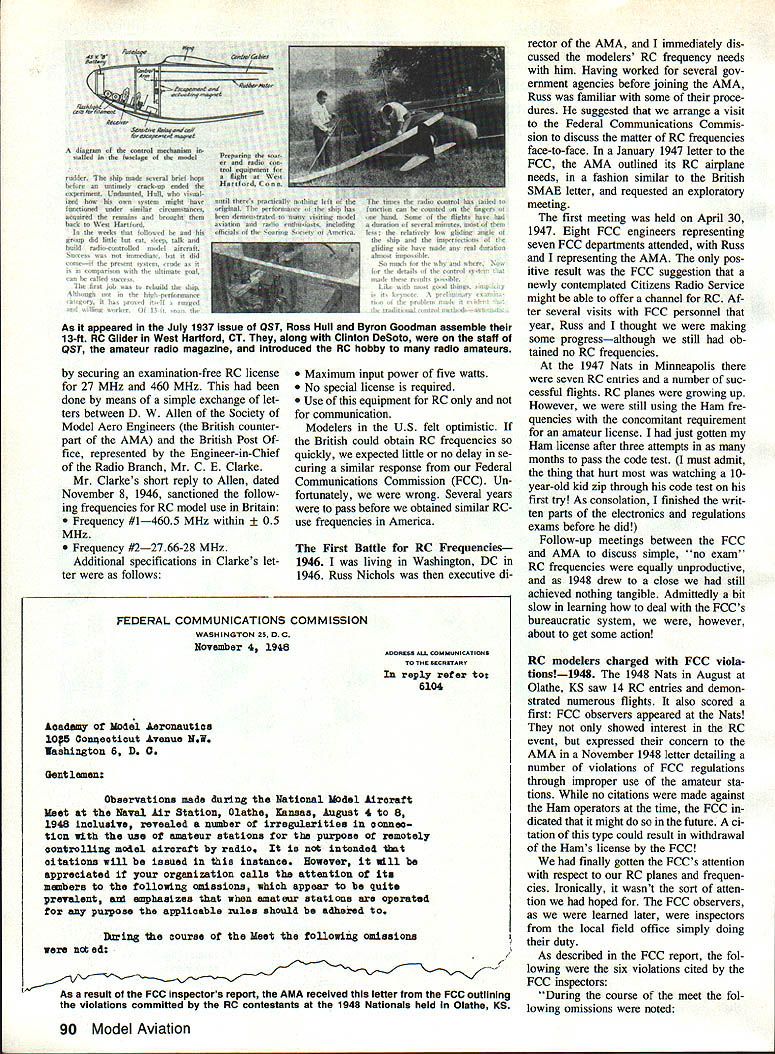
The 1948 Nats in August at Olathe, KS saw 14 RC entries and demonstrated numerous flights. It also scored a first: FCC observers appeared at the Nats! They not only showed interest in the RC event, but expressed their concern to the AMA in a November 1948 letter detailing a number of violations of FCC regulations through improper use of the amateur stations. While no citations were made against the Ham operators at the time, the FCC indicated that it might do so in the future. A citation of this type could result in withdrawal of the Ham's license by the FCC!
We had finally gotten the FCC's attention with respect to our RC planes and frequencies. Ironically, it wasn't the sort of attention we had hoped for. The FCC observers, as we were later told, were inspectors from the local field office simply doing their duty.
As described in the FCC report, the following were the six violations cited by the FCC inspectors: "During the course of the meet the following omissions were noted:"
- No provision of any kind was made for measurement of the emitted frequency. (A violation of Section 12.135 of the rules.)
- In some instances amateur stations were operated by unlicensed persons while licensed amateurs stood by, or were simply operated by unlicensed persons without a licensed operator in attendance. (A violation of Section 12.28 of the rules, in either case.)
- Failure to identify the amateur station transmitting control signals. (A violation of Section 12.159 of the rules.)
- Although the amateur stations were being operated as portable stations at Olathe, KS for an overall period of more than 48 hours, none of the licensees submitted notices of portable operation to the Commission's Engineer in Charge at Kansas City, MO. (A violation of Section 12.91 of the rules.)
- Several amateur station transmitters were observed to be operating outside of assigned amateur frequency bands. (A violation of Sections 12.111 and 12.113 of the rules.)
- Little or no effort made to maintain a proper station log. (A violation of Section 12.136 of the rules.)
The AMA took the FCC report on Ham radio violations at the 1948 Nats seriously, cautioning its Ham users of the 50 MHz band for RC to follow the stated FCC regulations. Although several of the violated rules were easily corrected, one regulation, in our opinion, was to haunt Ham RC fliers for more than 40 years—and even to the present day! That was Section 12.28 which allowed the licensed operator of a Ham voice station to hand the microphone to any person who wished to speak and transmit his voice via radio, but prohibited any other mode of emission, such as Morse code (on-off signals) and tones, to be sent by anyone other than the licensed operator. The impact on the RC flier is that, as a Ham operator, he is not permitted to hand the RC control box to anyone else—even to his own son, or a friend—for steering the plane. This rule is still in effect today!
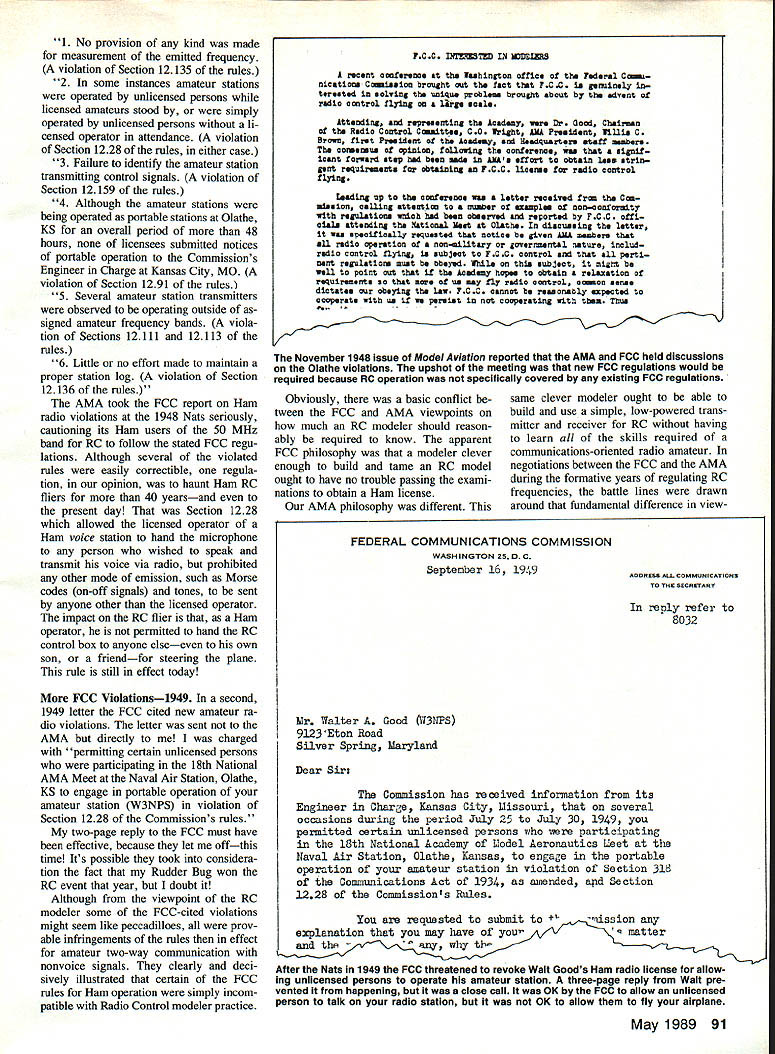
The November 1948 issue of Model Aviation reported that the AMA and FCC held discussions on the Olathe violations. The upshot of the meeting was that new FCC regulations would be required because RC operation was not specifically covered by any existing FCC regulations.
Obviously, there was a basic conflict between the FCC and AMA viewpoints on how much an RC modeler should reasonably be required to know. The apparent FCC philosophy was that a modeler clever enough to build and tame an RC model ought to have no trouble passing the examinations to obtain a Ham license.
Our AMA philosophy was different. The same clever modeler ought to be able to build and use a simple, low-powered transmitter and receiver for RC without having to learn all of the skills required of a communications-oriented radio amateur. In negotiations between the FCC and the AMA during the formative years of regulating RC frequencies, the battle lines were drawn around that fundamental difference in viewpoint.
More FCC Violations — 1949
In a second, 1949 letter the FCC cited new amateur radio violations. The letter was sent not to the AMA but directly to me! I was charged with "permitting certain unlicensed persons who were participating in the 18th National AMA Meet at the Naval Air Station, Olathe, KS to engage in portable operation of your amateur station (W3NPS) in violation of Section 12.28 of the Commission's rules."
My two-page reply to the FCC must have been effective, because they let me off—this time! It's possible they took into consideration the fact that my Rudder Bug won the RC event that year, but I doubt it!
Although from the viewpoint of the RC modeler some of the FCC-cited violations might seem like peccadillos, all were provable infringements of the rules then in effect for amateur two-way communication with nonvoice signals. They clearly and decisively illustrated that certain of the FCC rules for Ham operation were simply incompatible with Radio Control modeler practice.
After the Nats in 1949 the FCC threatened to revoke my Ham radio license for allowing unlicensed persons to operate my amateur station. A three-page reply from me prevented it from happening, but it was a close call. It was OK by the FCC to allow an unlicensed person to talk on your radio station, but it was not OK to allow them to fly your airplane.
The second AMA/FCC meeting — 1948
Within two weeks after the 1948 FCC violations letter, the AMA President-elect C. O. Wright visited Washington, DC and joined an AMA meeting with the FCC to discuss the letter. Attending from AMA were Willis Brown (first AMA president and an active Ham), Russ Nichols, and Walt Good, chairman of the AMA RC Committee.
As reported in Model Aviation, November 30, 1948: "A recent conference at the Washington office of the FCC revealed the fact that the FCC is genuinely interested in solving the unique problems brought about by the advent of Radio Control flying on a large scale."
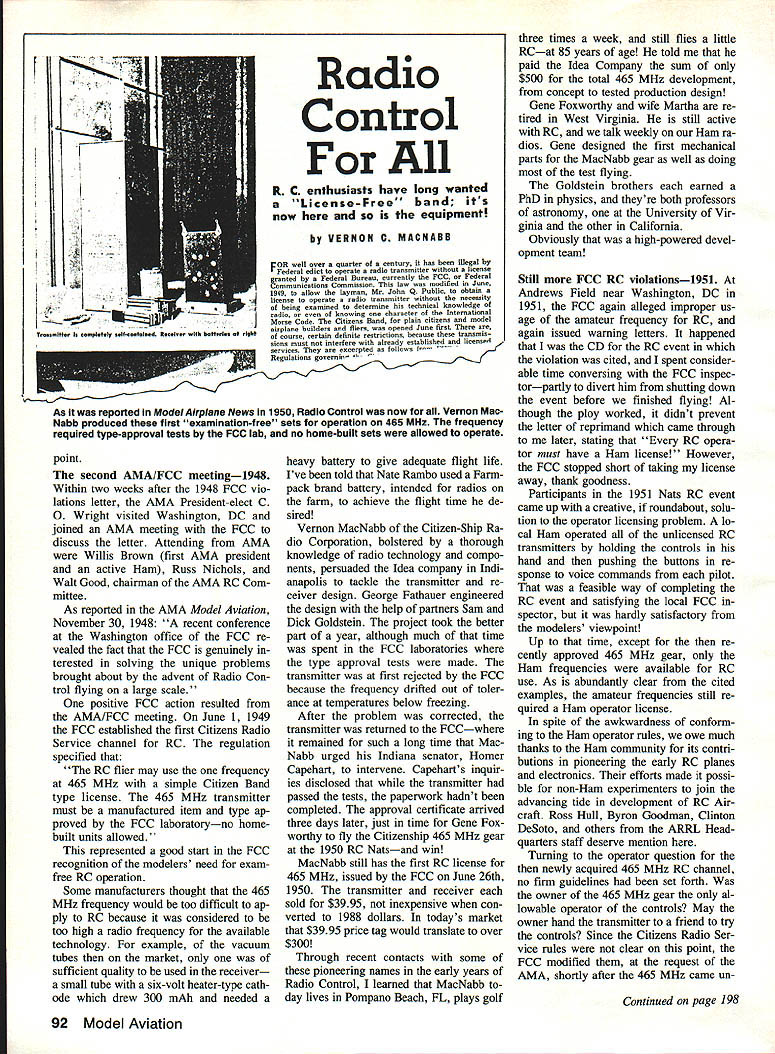
One positive FCC action resulted from the AMA/FCC meeting. On June 1, 1949 the FCC established the first Citizens Radio Service channel for RC. The regulation specified that:
"The RC flier may use the one frequency at 465 MHz with a simple Citizens Radio Service type license. The 465 MHz transmitter must be a manufactured item and type approved by the FCC laboratory—no home-built units allowed."
This represented a good start in the FCC recognition of the modelers' need for examination-free RC operation.
Some manufacturers thought that the 465 MHz frequency would be too difficult to apply to RC because it was considered too high a radio frequency for the available technology. For example, of the vacuum tubes then on the market, only one was of sufficient quality to be used in the receiver—a small tube with a six-volt heater-type cathode which drew 300 mA and needed a heavy battery to give adequate flight life. I've been told that Nate Rambo used a Farm-pack brand battery, intended for radios on the farm, to achieve the flight time he desired!
Vernon MacNabb of the Citizen-Ship Radio Corporation, bolstered by a thorough knowledge of radio technology and components, persuaded the Idea Company in Indianapolis to tackle the transmitter and receiver design. George Fathauer engineered the design with the help of partners Sam and Dick Goldstein. The project took the better part of a year, although much of that time was spent in the FCC laboratories where the type approval tests were made. The transmitter was at first rejected by the FCC because the frequency drifted out of tolerance at temperatures below freezing.
After the problem was corrected, the transmitter was returned to the FCC—where it remained for such a long time that MacNabb urged his Indiana senator, Homer Capehart, to intervene. Capehart's inquiries disclosed that while the transmitter had passed the tests, the paperwork hadn't been completed. The approval certificate arrived three days later, just in time for Gene Foxworthy to fly the Citizen-Ship 465 MHz gear at the 1950 RC Nats—and win!
MacNabb still has the first RC license for 465 MHz, issued by the FCC on June 26, 1950. The transmitter and receiver each sold for $39.95, not inexpensive when converted to 1988 dollars. In today's market that $39.95 price tag would translate to over $300!
Through recent contacts with some of these pioneering names in the early years of Radio Control, I learned that MacNabb today lives in Pompano Beach, FL, plays golf three times a week, and still flies a little RC—at 85 years of age! He told me that he paid the Idea Company the sum of only $500 for the total 465 MHz development, from concept to tested production design!
Gene Foxworthy and wife Martha are retired in West Virginia. He is still active with RC, and we talk weekly on our Ham radios. Gene designed the first mechanical parts for the MacNabb gear as well as doing most of the test flying.
The Goldstein brothers each earned a PhD in physics, and they're both professors of astronomy, one at the University of Virginia and the other in California.
Obviously that was a high-powered development team!
Still more FCC RC violations — 1951
At Andrews Field near Washington, DC in 1951, the FCC again alleged improper usage of the amateur frequency for RC, and again issued warning letters. It happened that I was the CD for the RC event in which the violation was cited, and I spent considerable time conversing with the FCC inspector—partly to divert him from shutting down the event before we finished flying! Although the ploy worked, it didn't prevent the letter of reprimand which came through to me later, stating that "Every RC operator must have a Ham license!" However, the FCC stopped short of taking my license away, thank goodness.
Participants in the 1951 Nats RC event came up with a creative, if roundabout, solution to the operator licensing problem. A local Ham operator held all of the unlicensed RC transmitters in his hand and then pushed the buttons in response to voice commands from each pilot. That was a feasible way of completing the RC event and satisfying the local FCC inspector, but it was hardly satisfactory from the modelers' viewpoint!
Up to that time, except for the then recently approved 465 MHz gear, only the Ham gear on the Ham bands was available for RC use. As is abundantly clear from the cited examples, the amateur frequencies still required a Ham operator license.
In spite of the awkwardness of conforming to the Ham operator rules, we owe much thanks to the Ham community for its contributions in pioneering the early RC planes and electronics. Their efforts made it possible for non-Ham experimenters to join the advancing tide in development of RC aircraft. Ross Hull, Byron Goodman, Clinton DeSoto, and others from the ARRL headquarters staff deserve mention here.
Turning to the operator question for the then-newly acquired 465 MHz RC channel, no firm guidelines had been set forth. Was the owner of the 465 MHz gear the only allowable operator of the controls? May the owner hand the transmitter to a friend to try the controls? Since the Citizens Radio Service rules were not clear on this point, the FCC modified them, at the request of the AMA, shortly after the 465 MHz channel came under the Citizens Radio Service (CRS) umbrella. Under the new regulations, persons other than the owner would be allowed to operate the RC transmitter with the owner's permission. That forestalled any possible repetition of the misunderstandings concerning piloting which had occurred with modelers using the amateur radio frequencies.
A frequency for home-built RC gear? — 1949-1952
Gratified though we were in 1949 to have the 465 MHz frequency approved for RC use, some of us felt strongly that it was still worthwhile to pursue a frequency allocation for simple home-built gear.
It was to be almost three years before the FCC handed us that victory in a second, favorable ruling concerning RC frequency use, permitting home-built gear and dispensing with the requirement for an examination. The story of how we achieved that goal follows:
The 27.255 MHz frequency was designated by the FCC for use in the Industrial, Scientific, Medical (ISM) band for industrial controls, scientific experiments, and medical applications such as diathermy. In practice, however, other users were not excluded—so much so that the frequency was known unofficially at the FCC as the "Garbage Band"!
We sensed that, despite the hangers-on it had already acquired, the licensing and construction requirements for the 27.255 MHz frequency would be minimal—if we could demonstrate that the channel would work for RC. After all, the British modelers had been using 27 MHz for RC since 1946—over three years!
The FCC was reluctant to consider 27.255 MHz for RC without some proof of its workability in the U.S.A. environment. To that end the FCC provided the AMA with an Experimental License KG2XDA for actual flight tests to begin in February 1950. By July of 1950, over 100 flights had been made in the Washington, DC area, with only two cases of apparent interference to the flight of the plane—and no crashes. However, unconvinced that the local tests gave a broad enough data sample, the FCC suggested that supplemental flight tests be conducted in other areas.
The agency extended the KG2XDA license, and nine AMA members across the U.S.A. provided 200 additional flights. Most of these modelers were members of AMA's first RC Committee, which covered both RC contest rules and frequencies. They were:
- Walt Good, Bethesda, MD (Chairman)
- Clay Freese, Chicago, IL
- William Stelmach, Palo Alto, CA
- Ed Roucek, Palo Alto, CA
- Dick Schumacher, Van Nuys, CA
- Warren Bartlett, Detroit, MI
- Harry Geyer, Pittsburgh, PA
- Jim Schenck, Pittsburgh, PA
- Ed Lorenz, Hyde Park, NY
By midyear in 1951, only eight of the 300 tests completed had been marred by glitches, which was considered more than reasonable proof of satisfactory RC operation on 27.255 MHz. In one test, Warren Bartlett intentionally flew near a hospital which was using diathermy equipment on the 27 MHz frequency! He established that 1,000 ft. was too close, causing glitches to the plane, while one mile proved an adequately safe distance showing no interference.
All of the experimental radio gear was homemade by the modelers using crystal control and less than five watts. In some cases it had been modified from 52 MHz RC rigs formerly used by Ham RCers.
Stepping back to early 1951 when over 200 flights had been completed, I felt at the time that the FCC engineers were being much too conservative (by asking for more test flights!), and much too slow getting started in drafting some simple 27 MHz rules.
I discussed this situation while lunching with Dave Rubenhorst at the Johns Hopkins Lab where we both worked. As both a modeler and an engineer, he clearly understood the picture. "Any suggestions, Dave?" I asked. He said yes, recommending that I go higher in the FCC organization to speak directly with one of the seven FCC commissioners, who are the final voters on FCC actions. (Note that the FCC was established by Congress in 1934 and that the seven commissioners are appointed by the U.S. President.)
"Sounds great, Dave—How do I get to speak to one of them?"
"Well," he said, "My stepfather is Senator Charles Tobey from New Hampshire, and I’m sure he can arrange it." Whereupon Dave stepped to the phone and called the senator’s office. Then he turned to me and asked, "Do you want an appointment with a commissioner this afternoon or tomorrow?" We decided on tomorrow!
That meeting with FCC Commissioner George Sterling in the spring of 1951 was to be a turning point in the acquisition of the 27.255 MHz frequency for RC.
As fellow DCRRC member Carl Cessna and I walked down the hall to the commissioner’s office, FCC staff members gawked at the RC plane we were toting. Sterling was most gracious and understanding—probably because, as we quickly learned, he had been an active Ham operator since 1912 and understood the technical radio aspects with ease. To my knowledge, he was the only FCC commissioner to hold a Ham license. Most of the appointees were more politically affiliated, or were connected with the radio broadcast industry, or both.
After carefully examining the plane’s RC gear and listening to our report of the AMA’s flight test program on 27.255 MHz, Sterling responded to the one-page summary proposal which we had been pushing with the FCC staff. His response was positive: "I believe this is a reasonable plan, maybe even more restrictive than necessary, and I will be happy to pass it along with favorable recommendations."
Shortly thereafter, the AMA received a preliminary draft of the rule-making Docket #10086, which had been modified to include the 27.255 MHz frequency for RC. Of course, the AMA commented favorably!
Simple RC rules arrive — 1952
In November 1951 the final proposal for rule-making on Docket #10086 appeared as an amendment to Part 19, Rules for the Citizens Radio Service. It included the AMA plan for adopting the 27.255 MHz frequency for RC. Since no objections were received by the FCC, the regulation became official on March 24, 1952.
It had been a long struggle, but the AMA had finally won approval for the first home-built RC frequency. The following are the regulations that applied to the new Class C stations:
- Frequency — 27.255 MHz with crystal control to assure accuracy of ±0.04%.
- Power — five watts maximum.
- Emissions — on/off carrier or tone modulation.
- Type approval is not required for crystal-controlled transmitters. Thus home-built gear is OK.
- The license is a simple FCC Form 505 which the flier sends to the nearest FCC office. No exams required!
After five years of effort on the part of the AMA and the FCC, March 24, 1952 was a great day indeed!
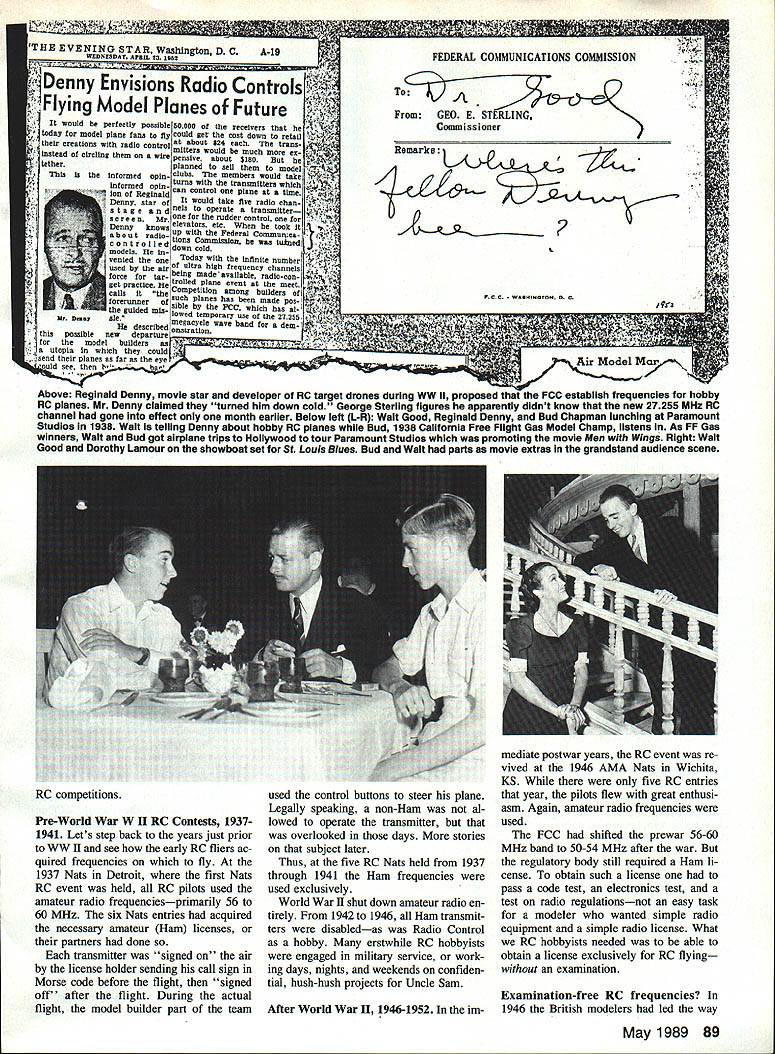
About a month after the 27.255 MHz frequency had been made available, I received a letter from FCC Commissioner Sterling. It enclosed a clipping from the Washington Evening Star newspaper about Reginald Denny, a well-known movie star who had produced many RC target drones for the U.S. military during World War II. Denny was now proposing the use of his radio equipment by RC model fliers. According to the clipping, Denny had approached the FCC and, "…he was turned down cold." Exactly why, we never found out.
On the note attached to the clipping, FCC Commissioner Sterling wrote: "Dr. Good—Where has this fellow Denny been?"
That's what I call a first-rate commissioner! We modelers owe Sterling a great debt.
The successful outcome of the First Battle had been encouraging. By 1952 we had acquired two RC channels, 465 MHz and 27.255 MHz, as well as simple, no-exam permits. It was just what we wanted! And this was only the beginning!
Transcribed from original scans by AI. Minor OCR errors may remain.

