
Battle for RC Frequencies
Walt Good
Part 2 of 3.
THE RC POPULATION grows—1952–1958
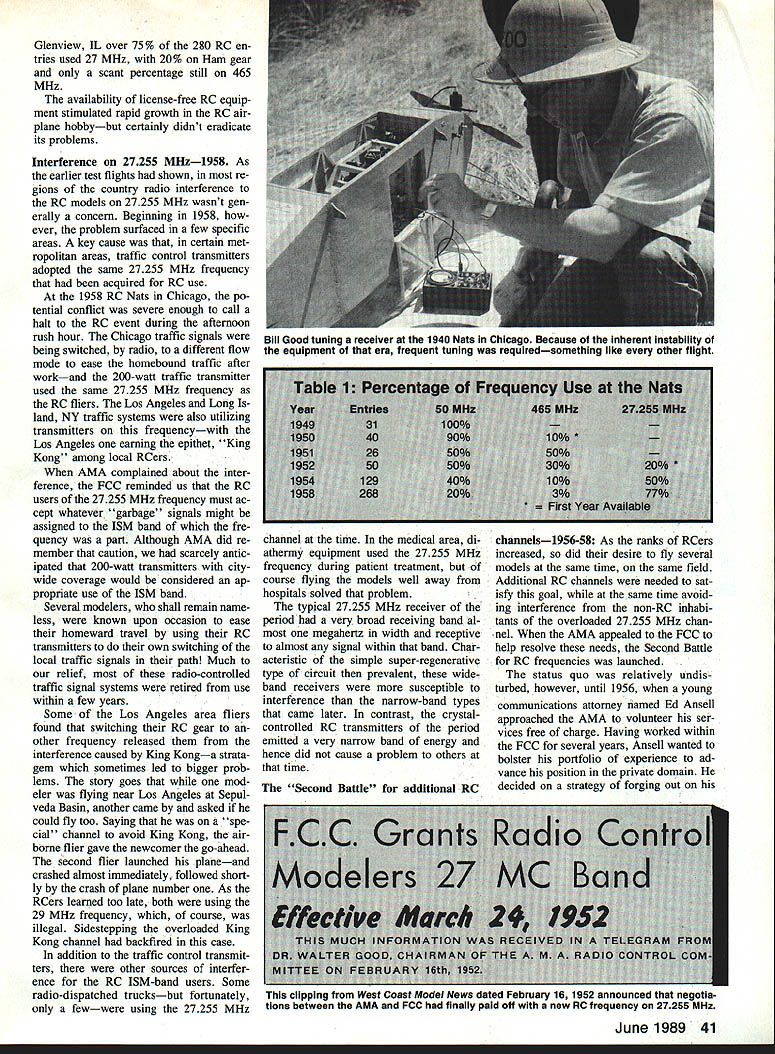
Prior to the acquisition of the two license-free RC channels, the RC Nats held in the late 1940s averaged about 30 entries, all of whom used ham frequencies in the 50 MHz band and required a ham operator license. By 1951, when new 465 MHz RC gear was available from two companies, Citizen-Ship and Babcock Models, the Nats RC entries were evenly split between the ham 50 MHz and the license-free 465 MHz frequencies.
The new 27.255 MHz RC channel was authorized by the FCC and came into use in March 1952. At that year's Nats the frequency usage distribution stood at 50% using 50 MHz, 30% using 465 MHz, and 20% flying on 27 MHz. By the 1954 Nats, 50% of the RC fliers were using the 27 MHz frequency, 40% were on the 50 MHz ham channels, and 465 MHz usage had dropped to 10%.
Babcock sales figures for a three-year period in the mid‑1950s showed 27 MHz outpacing 465 MHz units by 10 to one (actual sales: 10,000 versus 1,000 units). The lower-cost 27 MHz units, both commercial and home-built, attracted the bulk of RCers. Nevertheless, from 1950 to 1955 the 465 MHz units provided the first license-free system to serve the RC community. The availability of 465 MHz gear in 1951 spurred a rapid crossover from the 50 MHz frequency, but by 1958 inexpensive home-built gear on 27.255 MHz had taken a strong lead and 465 MHz usage had receded.
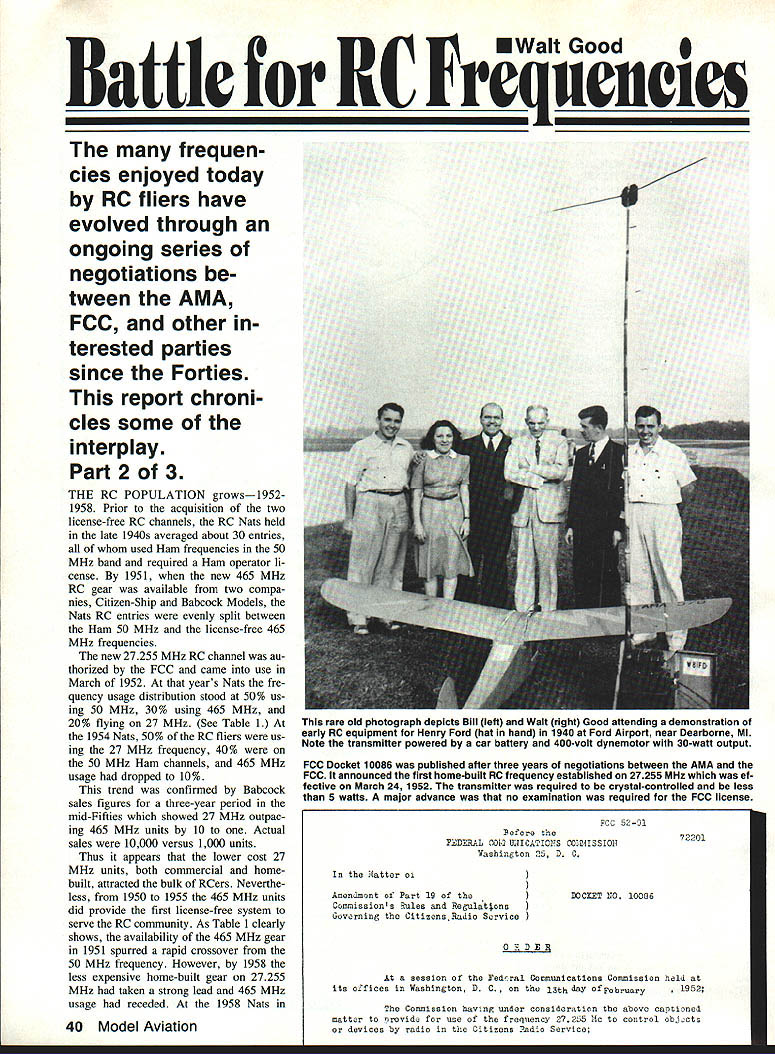
FCC Docket 10086 was published after three years of negotiations between the AMA and the FCC. It established the first home-built RC frequency at 27.255 MHz, effective March 24, 1952. The transmitter was required to be crystal-controlled and be less than 5 watts. A major advance was that no examination was required for the FCC license.
At Glenview, IL, over 75% of the 280 RC entries used 27 MHz, with 20% on ham gear and only a scant percentage still on 465 MHz. The availability of license-free RC equipment stimulated rapid growth in the RC airplane hobby—but it did not eradicate all problems.
Interference on 27.255 MHz—1958
In many regions, interference to RC models on 27.255 MHz was not initially a concern. Beginning in 1958, however, problems surfaced in several metropolitan areas. A key cause was that some traffic-control transmitters adopted the same 27.255 MHz frequency.
At the 1958 RC Nats in Chicago the conflict was severe enough to halt RC events during the afternoon rush hour: Chicago traffic signals were being switched, by radio, to a different flow mode to ease homebound traffic—and a 200-watt traffic transmitter used the same 27.255 MHz frequency as the RC fliers. Los Angeles and Long Island, NY, traffic systems were also utilizing transmitters on this frequency; the Los Angeles transmitter was nicknamed "King Kong" by local RCers.
When the AMA complained, the FCC reminded modelers that operation on 27.255 MHz meant accepting whatever extraneous signals might be present on the ISM band of which that frequency was a part. AMA had not anticipated 200‑watt, city‑wide transmitters using the band. Much relief came as these radio-controlled traffic-signal systems were retired within a few years, but some incidents and mischief by a few modelers continued to create intermittent problems.
Other sources of interference included some radio-dispatched trucks and, in medical settings, diathermy equipment using 27.255 MHz during treatment. Flying well away from hospitals usually solved that problem.
Receivers of the period were typically wideband (about one megahertz) super-regenerative designs, very receptive to any signal within that band and therefore more susceptible to interference than the later narrow-band types. In contrast, crystal-controlled RC transmitters emitted a narrow band of energy and generally did not cause interference to others.
"Second Battle" for additional RC channels—1956–58
As the ranks of RCers increased, so did the desire to fly several models at the same time on the same field. Additional RC channels were needed to support simultaneous flights and to avoid interference from non‑RC users on the overloaded 27.255 MHz channel.
When the AMA appealed to the FCC for help, the Second Battle for RC frequencies was launched. The status quo was relatively undisturbed until 1956, when a young communications attorney named Ed Ansell approached the AMA to volunteer his services free of charge. Having worked within the FCC for several years, Ansell wanted experience in the private sector. He decided on a strategy of forging out on his own to pursue the necessary petitions for additional channels.
Ansell knew the AMA's needs and was aware the FCC was preparing a docket in the Citizens Radio Service for low-power walkie-talkies. In 1956 he began drafting, with AMA assistance, an official petition for five new RC channels in the 27 MHz band. The petition became part of FCC Docket #11994 on January 23, 1957.
One month later a Washington Daily News feature ("Little Planes Hit a Bad Beep," Feb 19, 1957) described how an RC plane had been almost shot down by a radio signal from a local water tank whose level-measuring device was transmitting on the same 27.255 MHz frequency. The article underscored how various electronic applications had been swept into the derisively called "Garbage Band."
Curtis Plummer, head of the FCC's Safety and Special Radio Services, noted the growing vocalness of the AMA and the flood of letters reporting flight disasters and the inability to fly more than one plane at contests. Thanks in part to that public response, on September 11, 1958 the FCC issued five new RC channels on 27 MHz—our campaign had worked.
The NEW F.C.C. Regulations
Doris and Ed Yulke
Model Airplane News (Jan 1959) reported on the FCC's granting of five new RC frequencies in September 1958. The AMA had negotiated with the FCC for more than four years to obtain them, finally allowing average modelers to fly several RC planes at the same time.
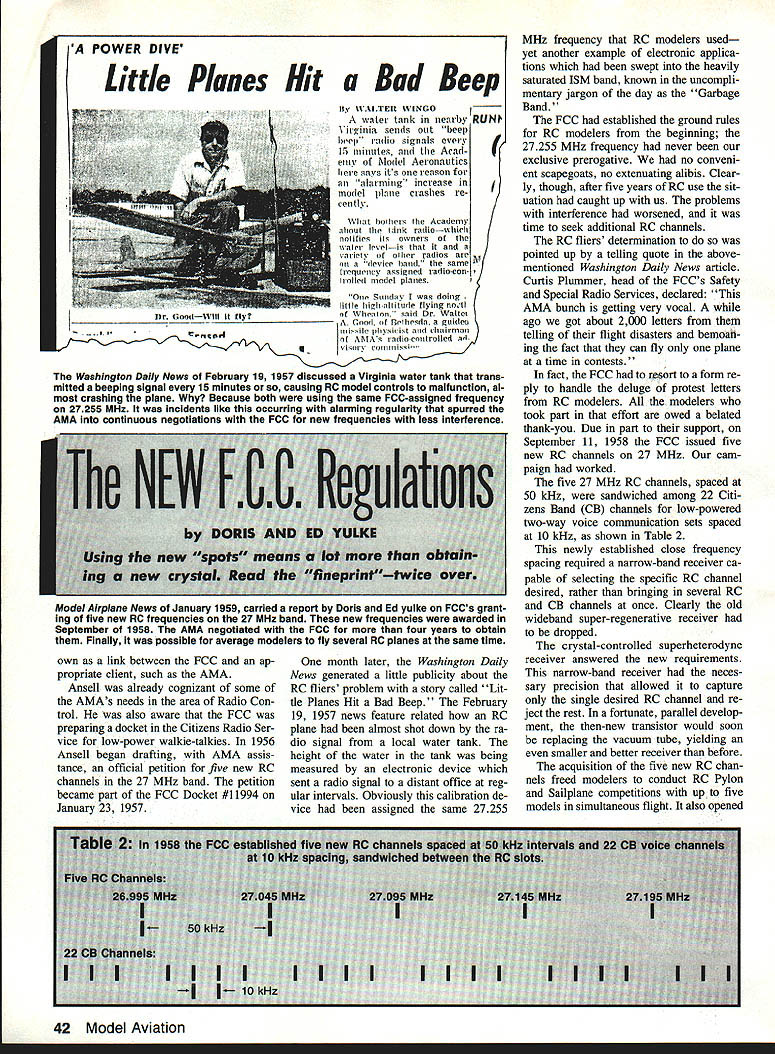
The five 27 MHz RC channels, spaced at 50 kHz, were sandwiched among 22 Citizen Band (CB) voice channels spaced at 10 kHz. This close spacing required narrow-band receivers capable of selecting a specific RC channel rather than bringing in multiple RC and CB channels at once. The wideband super-regenerative receivers had to be replaced by crystal-controlled superheterodyne receivers. The advent of transistors soon yielded smaller, better receivers.
The acquisition of the five new RC channels freed modelers to conduct RC Pylon and Sailplane competitions with up to five models in simultaneous flight and enabled multiple-plane fun-flying at local club fields. In assigning RC and CB users this portion of the 27 MHz band, the FCC took that same portion from the 11‑meter ham band—an action that left many ham operators furious, even while some accepted it graciously.
Five RC Channels (50 kHz spacing):
- 26.995 MHz
- 27.045 MHz
- 27.095 MHz
- 27.145 MHz
- 27.195 MHz
22 CB Channels:
- spaced at 10 kHz intervals between the RC slots
The Strange Invitation from the FCC — 1958
Even before the five new 27 MHz channels were activated, the FCC invited the AMA to participate in a review of all frequencies between 27 MHz and 900 MHz to forecast the needs of various potential users. The FCC intended to present this information at an international Geneva convention to help make worldwide frequency assignments cooperatively. Many countries had adopted the 27 MHz RC band; several used 465 MHz as well.
The AMA accepted and presented the overall RC frequency story at the mid‑1959 review. The review helped set the stage for future requests for additional RC channels. In the eyes of the FCC, the stature of the AMA was increasing.
The acquisition of the five new 27 MHz channels was timely. Just two months before their activation, the 1958 Nats in Chicago had 215 RC entries on the single 27.255 MHz channel. The event had branched into five categories—three Pattern contests (Rudder, Intermediate, Multi), Scale, and Pylon—with the Pattern events filling several days of qualifiers and finals.
During the early phase-in, the 50 kHz spacing worked well with new crystal-controlled transmitters and narrow-band superheterodyne receivers. Nearly half the receivers at the 1960 Nats were superheterodyne models. While home-built units were still permitted on the five new channels, factory-built units and narrow-band receivers ensured reliable multi-plane operations.
Continued interference and CB problems — late 1950s–1960
Although adjacent RC channels spaced at 50 kHz generally did not interfere with each other, glitches began to appear due to CB walkie-talkies spaced at 10 kHz. Reports came in of CB users illegally shifting their crystals to the less crowded RC channels. One documented case in California involved severe injuries when an out-of-control RC plane crashed into a spectator; a nearby CB operator had shifted to an RC channel and added a 40-watt amplifier, creating interference. The FCC prosecuted the violator after being provided evidence by the RC club.
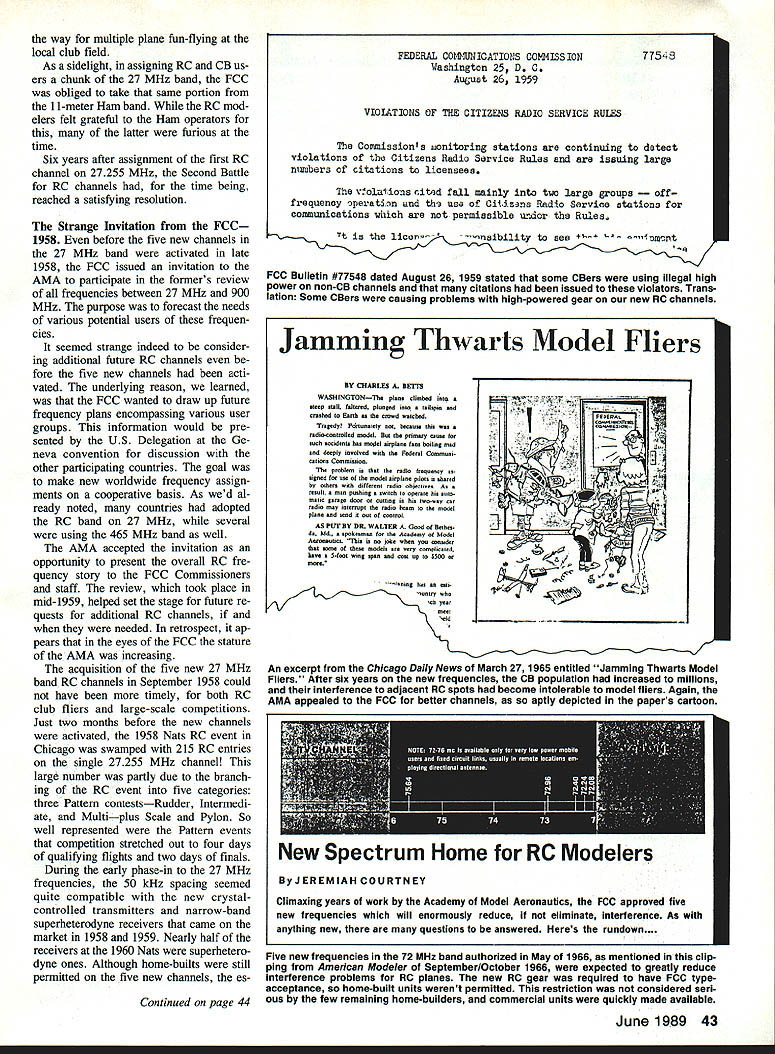
With mounting CB radio usage, interference to RC fliers increased. Many CBers emulated ham operators without the requisite skills, using illegal high-powered amplifiers and large directional antennas to make long-distance contacts. The FCC had intended the Citizen Radio Service for local, brief communications at legal power limits (five watts), not for continuous entertainment using illegal power levels.
A spectrum analyzer showed considerable RC "hash" on the 27 MHz band; when the analyzer's resolution bandwidth was widened it became evident that the interference came from CBers jumping carriers across channels. The five RC spots were often overrun with active voice modulation from CB channels.
Another problem was legitimate Part 15 devices: the regulation permitted 100 milliwatt transmissions in the 27 MHz band. Some low‑power voice users moved into the RC channels legally under Part 15, but the cumulative effect in crowded areas was severe. AMA and local clubs complained, but enforcement was difficult. Many modelers adapted by building better receivers, shifting to alternate RC channels, or moving to less crowded flying sites.
To encourage younger pilots, the minimum age for RC operators (but not CB operators) was dropped from 18 to 12 years.
As a result of CB operators' increasing numbers and some illegal practices, the 27 MHz region became saturated with nearly 15 million walkie-talkie users, prompting the realization that, even though the five RC channels had been active for only a few years, it was time to seek new RC channels in a different band.
The Third Battle—1963–66
Ed Ansell's earlier work had greatly sped the 1958 acquisition of 27 MHz channels. Having moved to California, Ansell was no longer available, and the AMA sought comparable legal help. In 1963 the AMA retained Jerry Courtney, a former Assistant General Counsel at the FCC now in private practice. Courtney quickly initiated action toward obtaining new RC frequencies in the 72 MHz band.
Courtney worked with the AMA Frequency Committee (Ed Lorenz chaired; committee members included Maynard Hill, John Phelps, Jack Post, Howard McEntee, Paul Runge, and Vernon MacNabb). The FCC allocation of five RC channels within 72 MHz faced opposition, including concerns from industrial firms that used RC-controlled equipment such as overhead cranes. Courtney and Lorenz persuaded companies that the probability of interference to cranes from RC plane signals was less than the cranes accidentally endangering RC planes. History shows industry complaints did not materialize.
After three years of concentrated effort by the AMA Frequency Committee and Courtney's law firm, the Third Battle ended with five new 72 MHz frequencies awarded to RC users. In June 1966 the FCC Commissioners approved the five new 72 MHz channels in a narrow 3-to-2 decision (two Commissioners were absent). The two dissenting Commissioners wrote that RC "appears to be an essentially trivial use which does not warrant allocation of spectrum space."
Courtney analyzed the vote and noted the split correlated with years of service: the three in favor had served 12, 15, and 21 years, while the two against had one and three years of tenure. The experience underscored the importance of continually educating public officials about the RC hobby and remaining actively involved when working with attorneys and regulators.
Transcribed from original scans by AI. Minor OCR errors may remain.

