
Battle for RC Frequencies
Walt Good
The availability of license‑free RC equipment stimulated rapid growth in the RC airplane hobby. Soon even more frequencies were needed, and those needs were obtained through AMA efforts. This article concludes a three‑part series on the long struggle to secure safe, exclusive spectrum for RC modelers.
In its fourth battle with the Federal Communications Commission (1969–71), the AMA was forced to defend the 72 MHz RC aircraft‑only channels against RC boat and car users requesting access.
RC aircraft fliers had experienced considerable interference from Citizen Band (CB) radio users on the earlier 27 MHz channels, motivating the AMA's request for FCC authorization of the 72 MHz frequencies. The five new 72 MHz channels that AMA acquired in 1966 were well received by RC modelers, and aircraft competition continued to grow rapidly and safely.
However, radio‑controlled boats and cars — authorized to use the 27 MHz channels — began to invade the 72 MHz RC aircraft‑only channels. At least some of the intrusion was considered dangerous. Since some boats weighed less than eight pounds and zoomed along at speeds up to 60 mph, RC boaters argued that CB interference could be hazardous. Consequently, in spring 1969 W. C. Young, a California RC boater, petitioned the FCC to allocate RC boat channels in the 72 MHz band.
The FCC released a rule‑making (Docket No. 18733) in November 1969 proposing that RC boats and cars share the five aircraft channels in the 72 MHz band. The AMA strongly objected to joint usage because it would eliminate the primary safety advantage gained in 1966 for RC airplanes.
In June 1970 the FCC countered with a second proposal in which three channels would be retained for aircraft‑only use, two channels would be non‑aircraft, and two additional channels would be shared. AMA objected to reducing aircraft‑only channels from five to three.
A third and final solution was adopted and became effective November 15, 1971: four channels were reserved for RC aircraft‑only use and three channels were designated as shared channels — giving RC aircraft access to seven channels and boats and cars three. That compromise was considered viable at the time and was approved by a unanimous vote of the FCC Commissioners.
AMA attorney Jerry Courtney’s efforts in working with the FCC and obtaining prior legislative action were greatly appreciated by RC aircraft modelers. In a letter dated October 6, 1971, John Worth wrote that Courtney “has indeed discharged the trust reposed in him by the aircraft modeler fraternity” by twice reversing proposed governmental actions adverse to aircraft modelers. Courtney also noted that AMA’s large membership (about 30,000) and experience with FCC procedures were helpful in defending RC interests.
The International Municipal Signal Association (IMSA) and the International Association of Fire Chiefs (IAFC) had proposed removing RC channels from the 72–76 MHz band because of possible interference with emergency call‑box operation. The FCC responded that IMSA and IAFC did not present specific evidence of harmful interference and that the Commission was unaware of harmful interference to model craft operation from other services operating on the five shared frequencies in the 72–76 MHz range over the prior five years. The possibility of increased interference to fire radio and other shared services was therefore considered minimal. This favorable finding also reflected that AMA modelers were carefully following the hard‑earned operating regulations and had gained the respect of the FCC.
Ed Lorenz recalled that the AMA Frequency Committee helped raise the then‑unheard‑of sum of $10,000 to finance legal costs in reaching accommodation with RC boat and car users. Donations came from both industry and individual modelers.
The 1974 FCC proposal to expand Citizen Band (CB) channels signaled the beginning of the Fifth Battle (1974–76). On July 31, 1974 the FCC issued Docket #20120 proposing to increase CB channels from 22 to 45 because of the huge rise in CB users. According to FCC records at the time, the number of CBers was five million and increasing rapidly.
AMA Frequency Chairman John Strong and his committee were concerned because five of the proposed new CB channels were class C (RC) slots that had been used for RC since 1958. Although many RC fliers had moved to 72 MHz, many planes, boats, cars, and inexpensive toy units still used 27 MHz. Joint use of the five targeted 27 MHz frequencies would have quickly driven RC aircraft out of that band.
The AMA counter‑proposed that the five class C slots be retained for RC usage. The television industry also opposed the CB expansion, anticipating increased TV interference from CB harmonics. The combined efforts of the AMA, Jerry Courtney, and hundreds of letters from AMA members succeeded in preserving the five imperiled 27 MHz RC channels. After several FCC modifications in 1975–76, Docket #20120 (which assigned CBers 12 new channels for a total of 40) became effective January 1, 1977. As of the time of this account, the five 27 MHz RC frequencies remained in use.
The Sixth Battle to obtain 80 channels for RC modelers — 1977–83
Even as the ink was drying on Docket #20120, other events threatened RC use of both 27 MHz and 72 MHz channels. The explosion in CB operation — from five million to 13 million between 1975 and 1978 — practically eliminated safe use of the 27 MHz slots for RC aircraft. Most RCers moved to the seven 72 MHz frequencies, but those channels were becoming increasingly cluttered with other legal users.
In some areas, a rapid upswing in radio paging system usage on 72 MHz began to interfere with RC planes. For example, the St. Petersburg, Florida, area had three paging systems each on a different RC spot, and similar situations existed elsewhere. Because RC channels were assigned secondary priority, local RCers had little recourse except to shift to another RC channel that was pager‑free.
When an RC group appealed to a regional FCC office about pagers occupying RC spots, an FCC representative said, “We don't allocate frequencies; we just process applications.” In effect, if the pager applicant had requested a non‑RC spot there would have been no conflict; the FCC’s processing procedures left RCers vulnerable to co‑channel assignments by other, higher‑priority users.
As early as 1971, at the FAI World Championship for RC Pattern models near Philadelphia, AMA requested FCC assistance to monitor the RC spectrum for safety during the meet. The regional office was too understaffed to help, but when Hewlett‑Packard loaned four spectrum analyzers, the FCC officer advised the AMA to proceed with the monitoring and to call if serious interference occurred.
The analyzers showed all 22 CB channels active, with intermittent (illegal) voice signals on many RC channels. During the contest the organizers delayed each launch until the scope showed a clear channel. The tactic worked: none of the 240 flights (representing 22 countries and 60 planes) experienced crashes due to interfering signals.
By 1978 the deteriorating accessibility of assigned RC channels spurred an intensive AMA effort to gain more — and safer — RC channels. With John Strong and attorneys Jerry Courtney and Jack Smith, the AMA Frequency Committee drafted a rule‑making petition for the FCC. The petition (RM‑3248) was submitted and accepted January 8, 1979.
In preparing the petition the committee initially focused on the 72–75 MHz band and planned to obtain sufficient channels there so RCers could use only the clear channels and avoid those with pagers. Which channels were clear would vary geographically, so the committee also proposed dividing channels between aircraft and surface craft.
A technical strategy developed in late 1979 — supported by FCC staffer Don Campbell — proposed shifting RC channels by 10 kHz (half the normal 20 kHz commercial raster) so no RC channel would be precisely on a commercial frequency. Spacing channels at 10 kHz intervals would reduce overlap with commercial services, particularly when using the newer narrow‑band receivers. This 10 kHz offset was included in an updated 45‑page RM‑3248 submitted to the FCC in September 1980. By definition these new channels would be truly exclusive because the FCC would designate no other users on them.
After further exchanges and a briefing of all seven FCC Commissioners in late 1981, the Notice for Proposed Rule Making was approved in May 1982 and placed in the FCC action chain for public comment. AMA widely distributed the proposal to the RC industry, hobby magazines, national car and boat organizations, and the AMA membership; responses were overwhelmingly favorable.
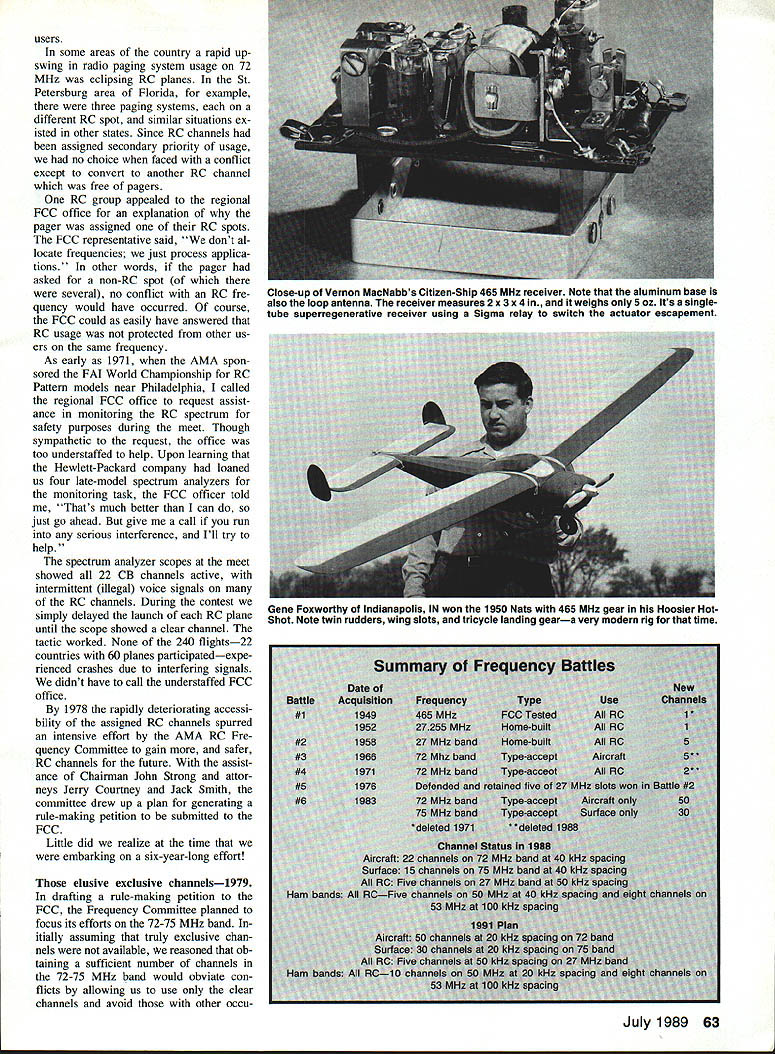
Following review of comments, the FCC assembled the final report and order and approved it in November 1982. The 1982 FCC legislation awarded RC aircraft 50 channels and RC boats and cars 30 channels — a total of 80 new RC channels that the FCC designated as exclusive for RC use. A phase‑in plan allowed manufacturers and users to adapt between 1983 and 1991. The first phase for aircraft was completed in December 1987, with the final phase scheduled for 1991.
The 80 new exclusive channels were expected to remove RCers’ vulnerability to co‑channel users. Adjacent non‑RC channels could be as close as 10 kHz and might cause issues, but the availability of alternate RC channels provided practical fallbacks. Technological advances made the required narrow‑band RC equipment feasible; German RC channels on 35 MHz, spaced at 10 kHz intervals, had been successful for nearly a decade, and several manufacturers were already offering equipment that met the 1991 specifications.
Harmonic and amateur‑coordination issues, while important in earlier years, are outside the detailed scope of this article. Over the years RC channels were coordinated with the Amateur Radio Relay League by Dick Jansson (WD4FAB) and other RC hams. Licensed ham channels related to RC operation are included in summary materials maintained by AMA.
Summary and comments (circa 1988): many RC frequency changes over the decades were caused by RCers’ lack of truly exclusive channels. As other users grew rapidly, RC needs were increasingly in conflict with rivals. The 80 exclusive channels granted by the FCC were a milestone intended to serve RC modelers for many years. The wide frequency separation between the RC aircraft and RC surface vehicle bands should prevent mutual interference between those classes.
We thank the many RC modelers, industry members, and national and international plane, boat, and auto organizations that supported AMA’s frequency acquisition efforts over four decades. We expect the RC‑only channels to be a workable system and hope that 40 years of RC frequency battles with the FCC have reached an end. In the meantime, we must value these hard‑earned frequencies and use them wisely so they serve us well for a long time.
AMA RC Frequency Committees — 1946–1988
- 1946–1962 — Walt Good, Chairman
Members: Willis Brown; Warren Bartlett; Clay Freese; E. Lorenz; Howard McEntee; Dick Schumacher; William Stelmack
- 1963–1971 — Ed Lorenz, Chairman
Members: Walt Good; Maynard Hill; Vernon MacNabb; Howard McEntee; John Phelps; Jack Port; Paul Runge
- 1972–1980 — John Strong, Chairman
Members: Bob Abele; Jack Albrecht; Walt Good; Dick Jansson; Fred Marks; C. Torrey Williams
- 1981–1982 — Bob Abele, Chairman
Members: Jack Albrecht; Dave Brown; Walt Good; Bill Herschberger; Dick Jansson
Acknowledgment: John Strong, with a longtime personal dedication to RC, contributed immeasurably to the RC frequency story through his executive work at AMA. His steady effort in organizing files and reporting the committee’s work has been a significant, if sometimes unseen, contribution to the frequency acquisition effort.
Transcribed from original scans by AI. Minor OCR errors may remain.

