
Beardmore Wee Bee
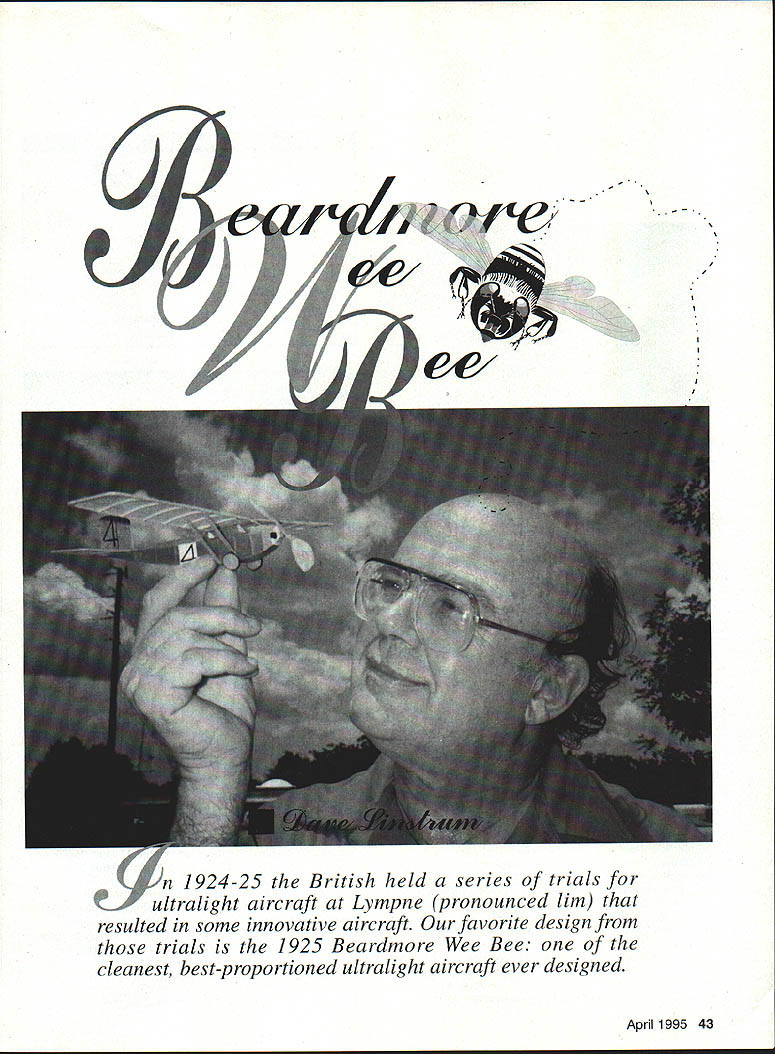
In 1924–25 the British held a series of trials for ultralight aircraft at Lympne (pronounced "lim") that resulted in some innovative designs. Our favorite from those trials is the 1925 Beardmore Wee Bee — one of the cleanest, best-proportioned ultralight aircraft ever designed.
Miami Indoor Aircraft Model Association fliers have built it in Pistachio (8-inch span) and Peanut (13-inch span) sizes. The Pistachio version won the MIAMA Internats with a top time of 57.8 seconds. Under a high ceiling it will do more than a minute — not bad for a model that will fit in a cigar box.
Construction
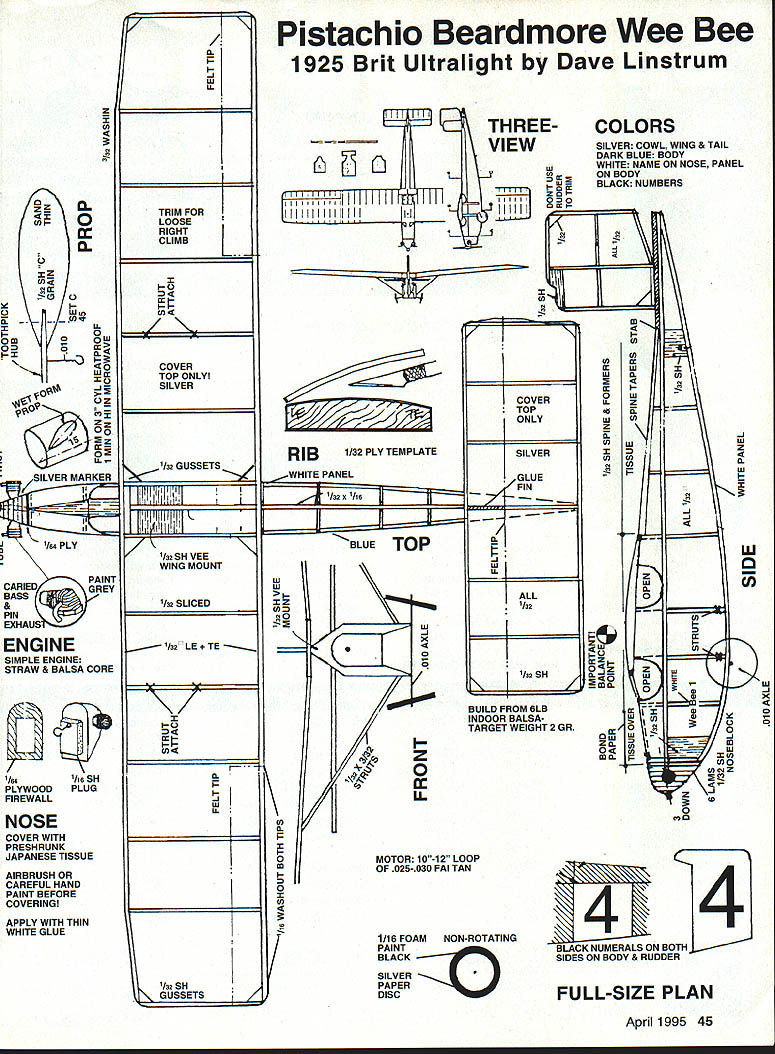
Note that the plans are presented full size. Make two photocopies of the plans (one to build on, and one to use for patterns, tracing ID numerals, etc.). Tape one copy to a soft surface like ceiling tile or foam core, and cover it with waxed paper.
Read the callouts on the plans and assemble the requisite tools, balsa, tissue, and paints. A minimal workshop inventory:
- X-Acto knife with #11 blade or a broken (non-stainless) double-edged razor blade
- Dressmaker pins
- Self-healing cutting board (use a scrap of artist's mat board if you are economy-minded)
- Glue applicator
- Artist's sable brush
- Needle-nose pliers
Be sure to build in an uncluttered work area with good light.
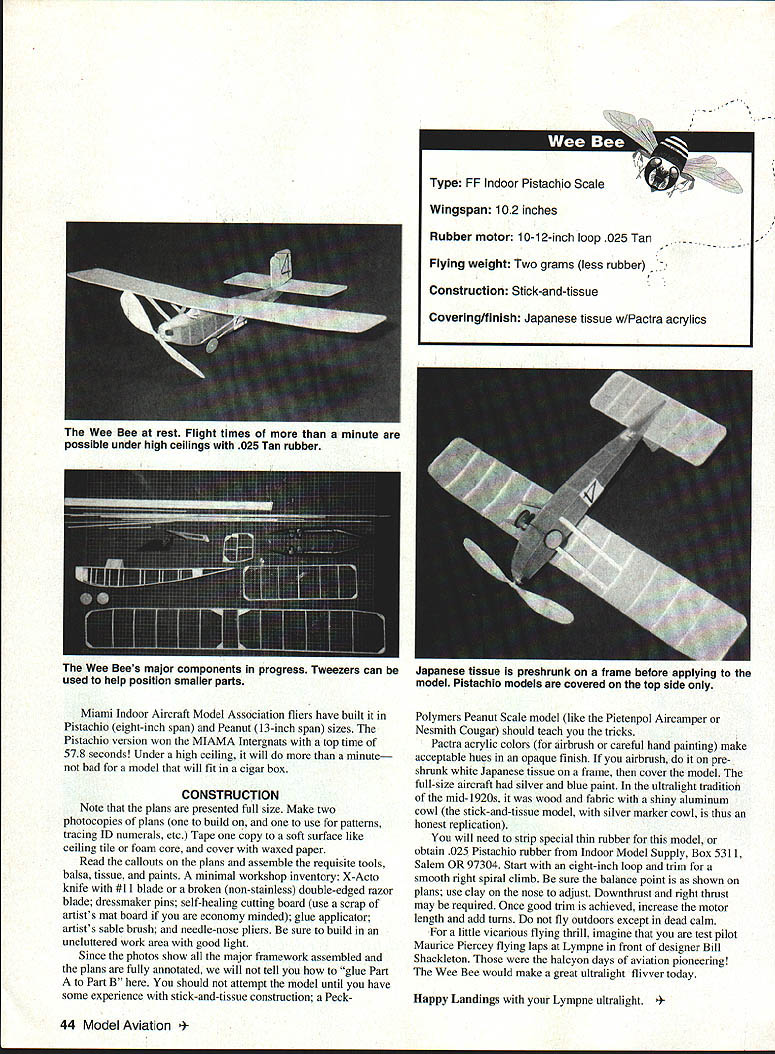
Since the photos show all the major framework assembled and the plans are fully annotated, the instructions do not spell out every "glue Part A to Part B" step. You should not attempt this model until you have some experience with stick-and-tissue construction; a Peck-Polymers Peanut Scale model (like the Pietenpol Aircamper or Nesmith Cougar) should teach you the necessary techniques.
Pactra acrylic colors (for airbrush or careful hand painting) make acceptable hues in an opaque finish. If you airbrush, do it on preshrunk white Japanese tissue on a frame, then cover the model. The full-size aircraft had silver and blue paint. In the ultralight tradition of the mid-1920s, it was wood and fabric with a shiny aluminum cowl. The stick-and-tissue model, with a silver-marker cowl, is an honest replication.
You will need to source special thin rubber for this model, or obtain .025 Pistachio rubber from Indoor Model Supply, Box 5311, Salem OR 97304. Start with an 8-inch loop and trim for a smooth right spiral climb. Be sure the balance point is as shown on the plans; use clay on the nose to adjust. Downthrust and right thrust may be required. Once good trim is achieved, increase the motor length and add turns. Do not fly outdoors except in dead calm.
For a little vicarious flying thrill, imagine that you are test pilot Maurice Piercey flying laps at Lympne in front of designer Bill Shackleton. The Wee Bee would make a great ultralight flivver today.
Happy landings with your Lympne ultralight.
Pistachio Beardmore Wee Bee
1925 Brit ultralight by Dave Linstrum
Three-view
(Full-size plan referenced)
Colors
- Silver: cowl, wing & tail
- Dark blue: body
- White: name on nose, panel on body
- Black: numbers
Plan notes and build details
Rib
- 1/32 ply template
- White panel
Top
- Blue: cover top only
- Silver: glue fin
- Felt-tip for markings
- Build from 6 lb indoor balsa
- Target weight: 2 g
Front
- 0.010" axle
Side
- White panel
- Tissue covering
- Spine and formers; spine tapers
- Open struts
- Wheel with 1/32" shock
- 1/32" shell; bond paper or tissue over
- Important: balance point as shown on plan
Prop
- Felt-tip finish
- Trim for a loose right climb
- Strut attachment
- Cover top only with silver
- 1/32" gussets
- Toothpick hub
- Wet-form propeller
- Silver marker finish
- 1/64" ply where noted
Engine
- Simple engine: straw and balsa core
- Paint grey
- Brass pin exhaust (carry or fabricate brass pin for exhaust)
Nose
- Cover with preshrunk Japanese tissue
- Airbrush or careful hand paint before covering
- Apply tissue with thin white glue
Motor
- 10"–12" loop of .025–.030 FAI tan rubber
- Use 1/16" foam non-rotating mount; paint black
- Silver paper disc for spinner
Markings
- Black numerals on both sides of the body and on the rudder
Full-size plan included in source materials.
Transcribed from original scans by AI. Minor OCR errors may remain.

