
Beautiful and Ugly Airplanes
Introduction
If it is true that "beauty is in the eye of the beholder," then the same must hold true for ugliness. Except that when it comes to airplanes, the eye is often overridden by the brain. Some airplanes, by their outstanding performance, become "beautiful" even though their contours may be awkward and their proportions so aesthetically unbalanced that an outsider must wonder how anyone in his right mind could see beauty in such a collection of confusing lines, angles, and shapes.
Labeling one airplane as "beautiful" and another as "ugly" depends on highly conflicting motivations. Anyone who spends hours looking at a wide variety of airplanes (either in person or in pictures) will develop standards. These standards may be based on artistic instincts or simply the result of practice and familiarity. To this must certainly be added personal bias—each of us has favorites, though the reasons for this are often vague.
Those with less-than-wide-eyed enthusiasm for airplanes must fall back on more radical ways of separating the extraordinary from the ordinary, such as artistic talent and objectivity. Extremists among them may even harbor suspicions that no airplane can be considered beautiful in the same way the Grand Canyon, a prize rose, or a properly implemented bikini can be. But who cares?
By now it should be clear that not everyone will agree which airplanes are beautiful and which are ugly. An unscientific poll conducted by the author at bars around Oshkosh, WI, during the early part of August—when that area seems to boast more airplanes than cars—pointed up the impossibility of ever achieving a consensus. A truly scientific poll might well result in a list of a thousand different airplanes, each with but a single vote.
There is always the possibility of dividing airplanes into categories, so there could be many winners (and losers). It would be easier to determine the most beautiful and the ugliest single-engined, fabric-covered 1920s biplanes, for instance. But pretty is pretty, and ugly is ugly; why should it matter how many wings an airplane has or when it was built? Of course, things like agricultural planes and ultralights are almost always ugly, and perhaps they shouldn't be forced to compete with categories having a much wider range of visual qualities.
In view of the total impracticality of formal efforts to choose the most pleasing and the most revolting airplanes of all time, a unilateral decision has been made to let a solitary individual do the chore. The author modestly presents himself as one of the few true authorities in this area and humbly offers the following choices. He is prepared to defend his selections—unless someone comes along with something better, or if the someone is bigger.
The most beautiful
We'll pick one grand champion, and then a bunch of runners-up listed in no particular order. Remember, this is a purely visual thing. No points will be given (or taken away) because of an airplane's flying qualities, its contributions to aviation history, the author's personal association with it, or even its suitability for modeling. The idea is to look at an airplane the way you would look at a painting or a piece of sculpture, and grade it accordingly.
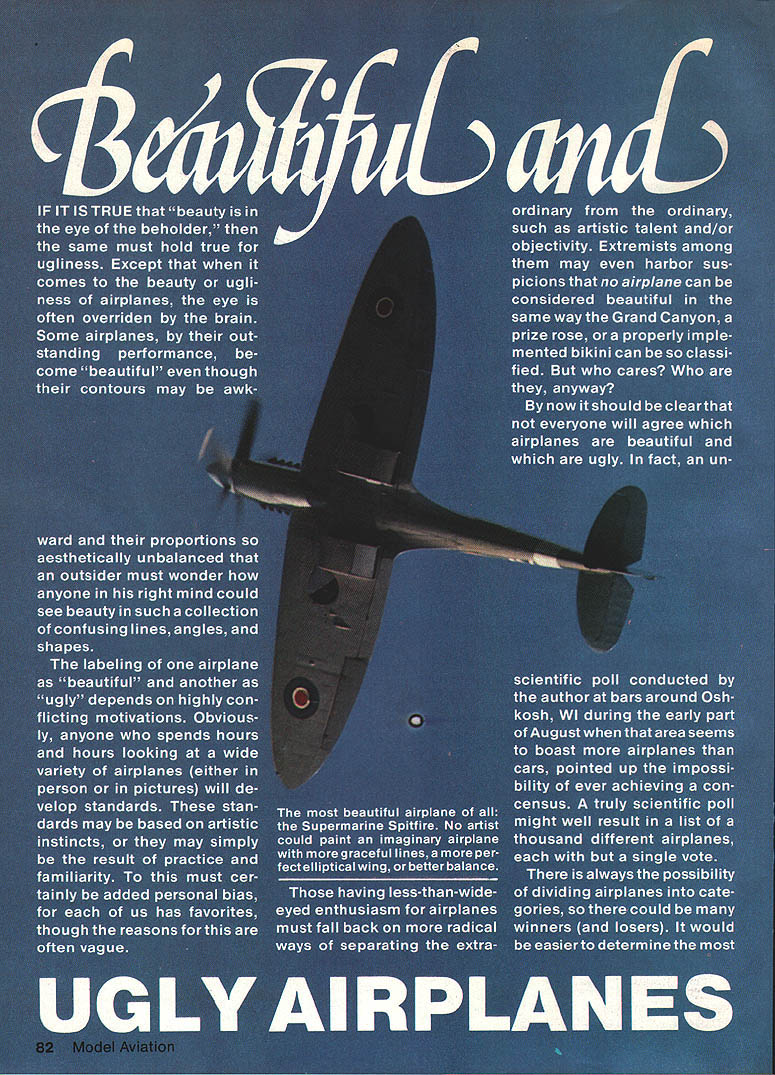
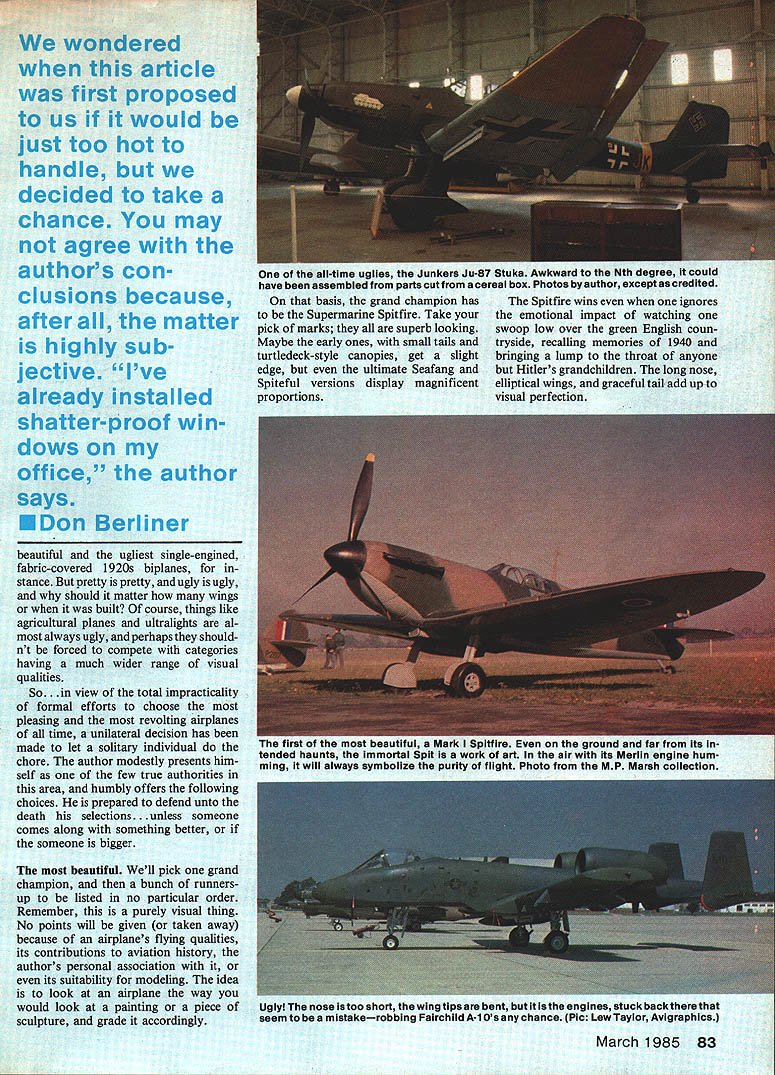
On that basis, the grand champion has to be the Supermarine Spitfire. Take your pick of marks; they all are superb looking. Maybe the early ones, with small tails and turtledeck-style canopies, get a slight edge, but even the ultimate Seafang and Spiteful versions display magnificent proportions.
The Spitfire wins even when one ignores the emotional impact of watching one swoop low over the green English countryside, recalling memories of 1940 and bringing a lump to the throat. The long nose, elliptical wings, and graceful tail add up to visual perfection.
The ugliest
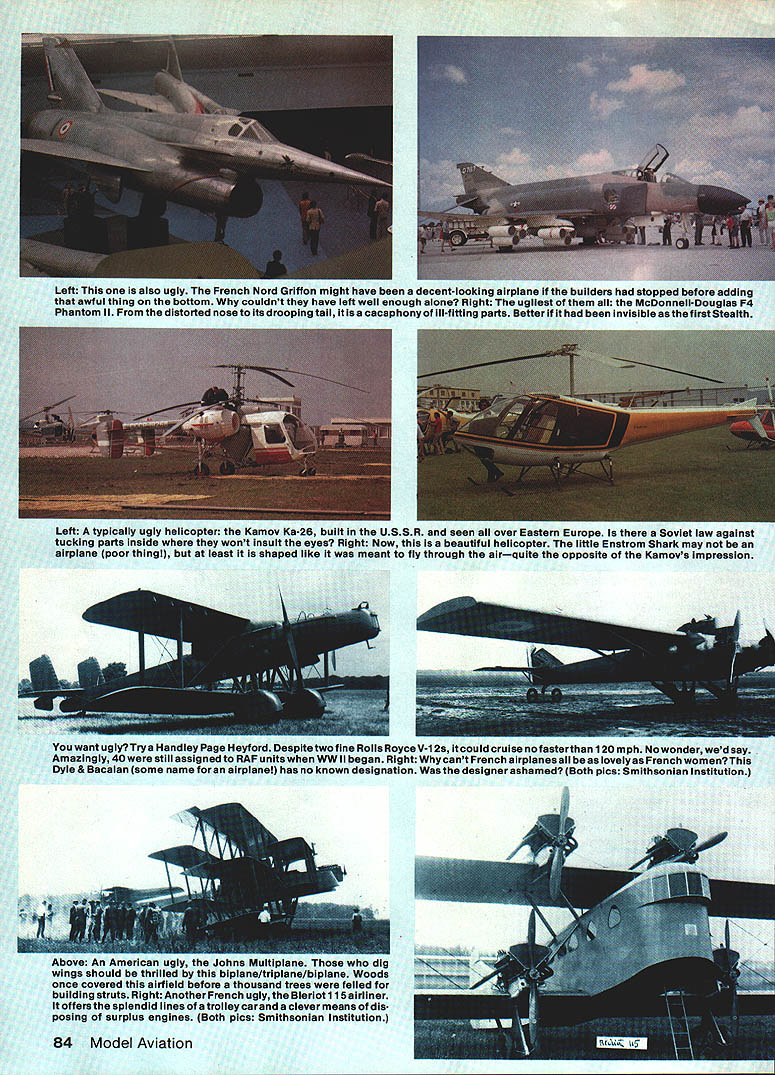
The grand champion for ugliness has to be the McDonnell-Douglas F-4 Phantom II. Its nose bulges, its wings appear crooked, and its tail droops. No two parts look like they belong on the same airplane. Don't waste your time insisting that it's beautiful because it was the greatest fighter plane of the 1960s—that doesn't count. Even with its wheels and flaps retracted, it has far too many funny-shaped pieces sticking out. And it's awfully noisy.
Moreover, the Phantom II violates one of aviation's most hallowed precepts: if an airplane looks right, it will fly right. What business does this misshapen collection of crudities have flying so well? If the airplane had any sense of its own position in life, it would fly as badly as it looks. Since it doesn't, we have no choice but to penalize it even more. But it would have won easily even without penalty points.
The other beauties
The following runners-up survived a brutal weeding-out process that left the author's office piled with slides and prints of rejected airplanes—and his circle of friends seriously depleted.
- Ryan STA
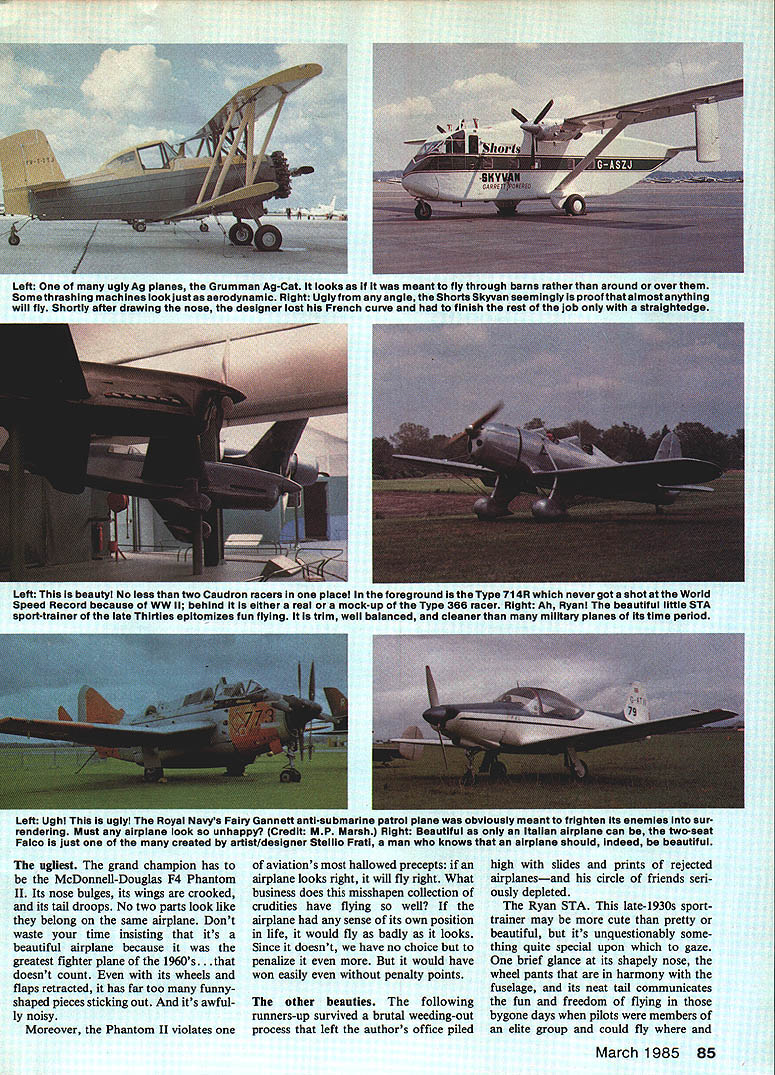
The late-1930s sport-trainer may be more cute than beautiful, but it's unquestionably something quite special to gaze upon. One brief glance at its shapely nose, the wheel pants harmonious with the fuselage, and its neat tail communicates the fun and freedom of flying in those bygone days when pilots were members of an elite group. The Ryan seems to fulfill the definition of "beautiful" for this exercise.
- Caudron C.460
The great French racer of the mid-1930s may have been the sleekest prop-driven airplane ever flown. It says "speed" as effectively as anything could. The long, slim nose, wonderfully tapered wings, and minimal tail put it in the same class as a greyhound or a dolphin.
- Falco F.8L
Designed by the brilliant Italian engineer Stelio Frati, this all-wood two-seater is a factory-built "Ferrari of the Air." Now available as an American home-built, the shape is still gloriously Italian.
- Long Midget Mustang
The inspiration of Piper engineer Dave Long, it so upset the bigwigs at North American Aviation that they insisted it not be called by the name of their beloved P-51. Thus, in ads it is the Long Midget. The example built by Lloyd Butler, complete with retractable landing gear and folding wings, has the purity of line that few airplanes can boast. The wings, tail, nose, and canopy all fit the theme of efficiency and grace.
- Cessna 195
The postwar version of the classic Airmaster, it was the last product of that prolific firm to look like a real airplane rather than some salesman's flying sample case. The powerfully rounded nose blends perfectly into the low-drag windshield. Not even the spindly Wittman spring-leaf landing gear compromises the craft's beauty.
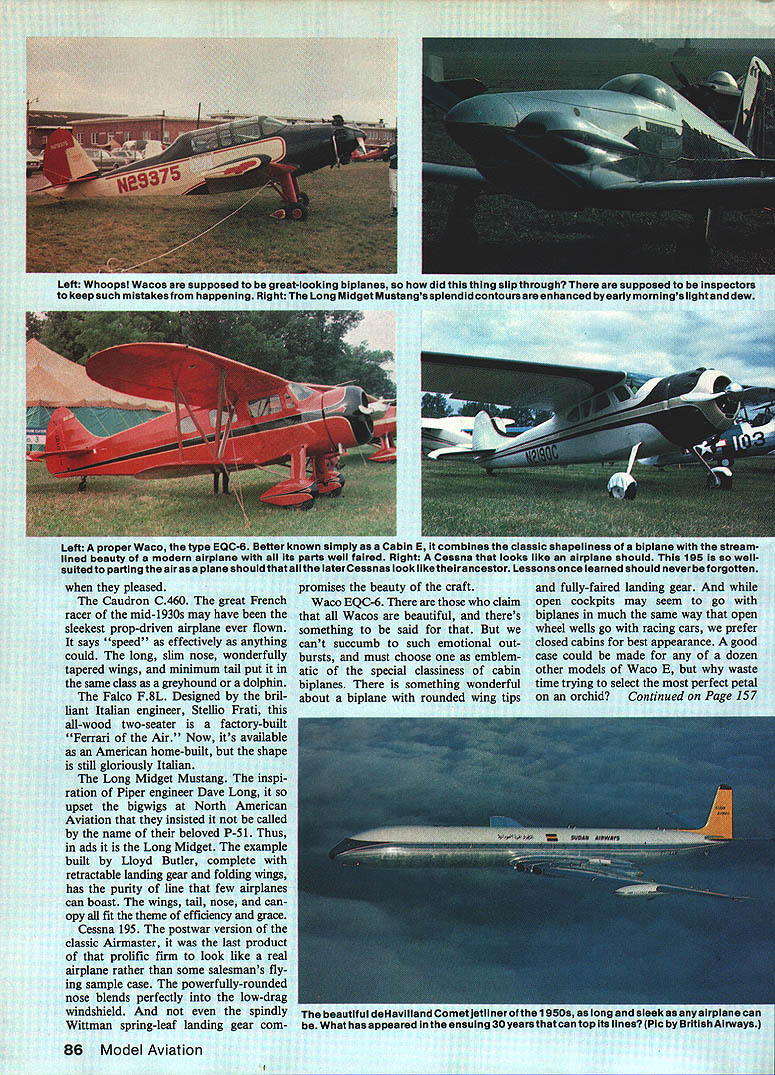
- Waco EQC-6
There are those who claim that all Wacos are beautiful, and there's something to be said for that. But we must choose one as emblematic of the special classicness of biplanes. There is something wonderful about a biplane with rounded wingtips and fully faired landing gear. While open cockpits may seem to go with biplanes, we prefer closed cabins for best appearance. A good case could be made for any of a dozen Waco E models, but why waste time selecting the most perfect petal on an orchid?
Beautiful & Ugly/Berliner
Continued from page 86
There are many who insist that jets are not really airplanes, but rather the products of impersonal computers. True enough, they hide all their interesting parts inside, but why blame a flying machine for the behavior of its designers? While aware of the risks involved in declaring jets among the most beautiful of airplanes, we shall charge ahead.
- de Havilland Comet
This is the airliner, not the magnificent twin-engined racer. It was the first true jet airliner to enter service, but it suffered from insufficient engineering and merely paved the way for the Boeing 707. Its simplicity of line and curves that don't look like they were drawn by machines make it one of the great shapes of the air. While its more profitable replacements have their engines hanging from wings or bolted to tails, the Comet's engines are modestly tucked inside its wings.
- BAC/Aérospatiale Concorde
It is the world's only successful supersonic airliner (the Soviet copy flopped). With its nose down for better visibility on takeoff and landing, it can look ungainly. But with the nose up and cruising at 1,300 mph, its gentle curves break up the stark leading-edge line of other delta-winged airplanes. It is a picture of effortless locomotion.
- Enstrom Shark
OK, so it's a helicopter and not an airplane. But there are those among us who claim to see beauty in these strange contraptions. If, indeed, there are beautiful helicopters, then the trim, shapely Shark must be one. Of course, it would look a lot better without the funny thin top and with a short pair of wings. But then a giraffe wouldn't look so silly if it resembled a collie.
- Douglas A-20 Havoc
This World War II light bomber has marvelously balanced proportions and truly lovely curves. Its beauty can even survive the addition of a gun turret on top. By contrast, the subsequent A-26 Invader, while just as well balanced, lost the special beauty of the A-20 by replacing curves with angles.
The other uglies
Choosing a few runners-up for the title of all-time ugliest proved more difficult than expected. In fact, there are so many ugly airplanes that certain categories must be considered as group entries.
- French multi-engined bombers and transports of the 1930s
Dozens qualify for ugly honors. It's almost like the head of the French Department of Aeronautics declared that aerodynamic drag was good! These ornate creations have glassed-in bombardier noses or cockpits so rococo and un-aeronautical they'd make good subjects for rock-album covers.
- Dyle & Bacalan
A typical example of the era's proliferation of shapes and parts. Like most of its ilk, it never progressed beyond testing—which was probably a good thing.
- Handley Page Heyford
The British may not have had the French flair for the dramatically outlandish, but they still managed to build airplanes that look like mistakes. The Heyford's lower wing is mounted on cabane struts instead of as an upper wing like sensible biplanes. The impressive wheel pants are spoiled by gawky struts, and the reasonably streamlined nose is topped by a crude open cockpit. Nothing quite makes sense, especially for an airplane still in use when World War II began in 1939.
- Johns Multiplane
An American answer to the European challenge to design the most foolish-looking bomber. Based on the premise that the more wings an airplane has, the better it will fly, the Johns combined positive and negative stagger into one great confusion of struts. It had more than enough wing panels to set some sort of record for interplane drag.
- Junkers Ju-87 Stuka
German airplanes of the World War II period often possessed a meanness that was more than a subjective response. The Ju-87 dive bomber was one of the meanest looking: awkwardly bent wings, a tail that seemed hurriedly sawed out of plywood, an ugly beak of a nose, and a wailing siren. It proved effective against unopposed ground targets but didn't stand much chance against fighters like the Hawker Hurricane.
- Fairchild A-10 Warthog
Purists call it the Thunderbolt II, but that's an insult to the original P-47. The A-10 certainly lacks any semblance of tasteful shape. Its rear-mounted turbofans look like they were quickly stuck on when someone realized the prototype didn't have engines.
- Nord Griffon
The French have made great strides since the 1930s, but they started out building some really weird jets. The Griffon had a turbojet engine mounted inside a ramjet engine. It looked like it had been designed during the third hour of the engineering department's annual office party. It once flew faster than the existing world speed record, but it nevertheless suggests a midair collision.
- Fairey Gannet
This anti-submarine patrol plane looks bad enough in flight with its huge spinner above a grimacing air intake and double-humped canopy. On the ground it truly stands out. The mildly cranked wings fold twice for convenient carrier storage, which only makes it look broken and pathetic.
- Short Skyvan
Short Brothers produced the majestic Sunderland, then later the Skyvan: a short-haul airliner and cargo plane that looks like a winged box. Ungraceful to the point of caricature, the Skyvan exemplifies the idea that function was chosen over beauty. Shorts eventually replaced it with the longer 3-30 (still boxy) and finally with the almost-streamlined 3-60 commuter airliner.
- Grumman Ag-Cat
Grumman produced many practical but homely airplanes. The Ag-Cat is big and bulky with a high canopy and deep fuselage common to agricultural planes. These shapes meet the special demands of crop dusting, but there's no good reason they couldn't be rounded off and smoothed.
- Waco monoplane
Near the end of its existence, Waco veered from its proud course and built a monoplane. The sole remaining Waco monoplane (not counting World War II troop gliders) was seen at an antique fly-in and attracted a deserved lack of attention, despite its rarity.
- Kamov Ka-26
A truly gruesome rotorcraft with a profusion of struts, blades, booms, and fins sticking out in all directions, with little concern for the niceties of aerodynamics. It looks as if it were built not from plans but from what was left over when someone stopped building flying boats.
So there it is, at least for now. We could have rambled on and on, adding many more deserving airplanes to both lists. But the goal was to make a point rather than to be all-inclusive. You may have nominations of your own—if so, why not let us know what they are and why.
Transcribed from original scans by AI. Minor OCR errors may remain.

