
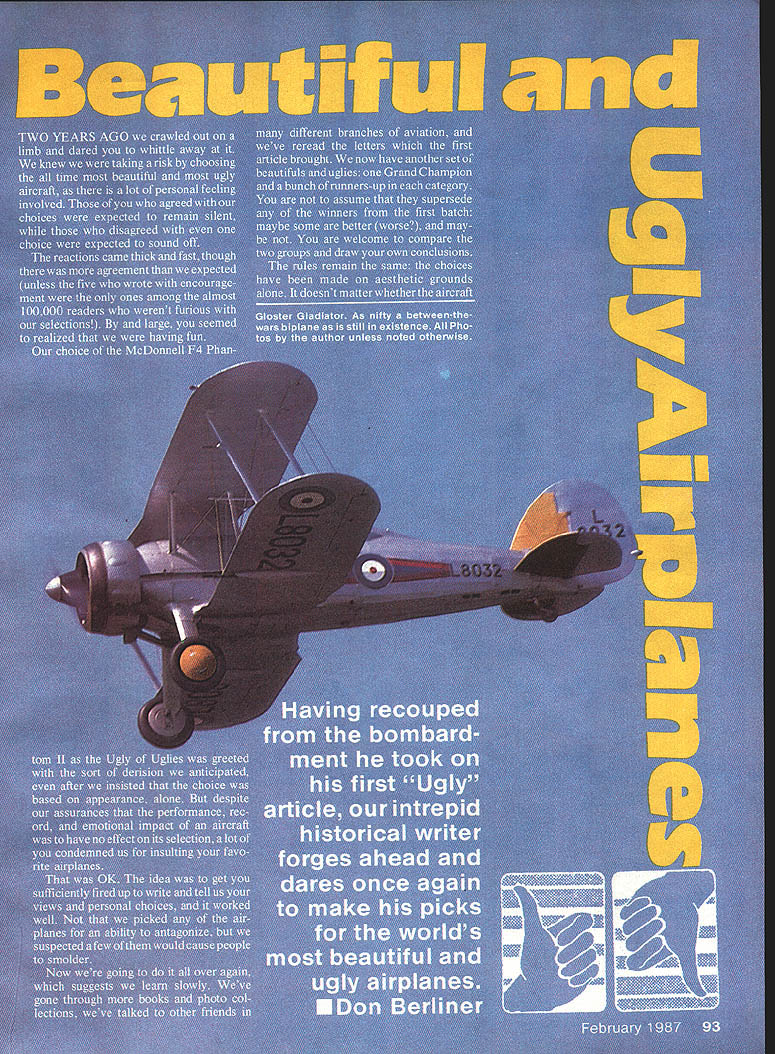
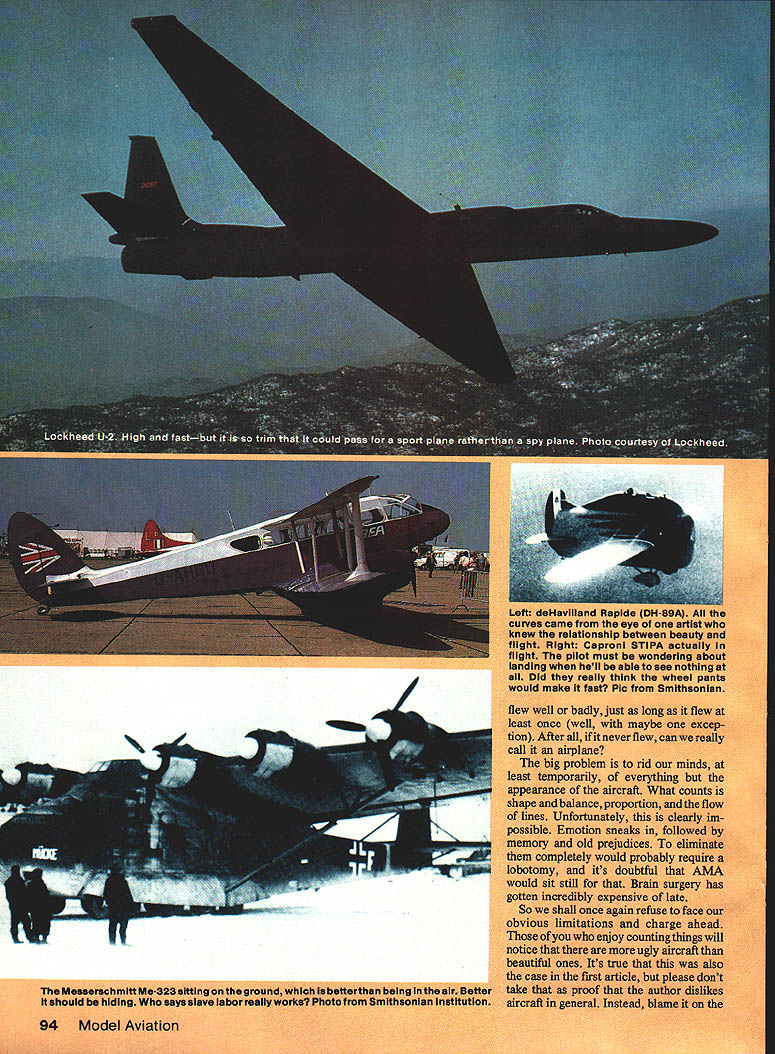
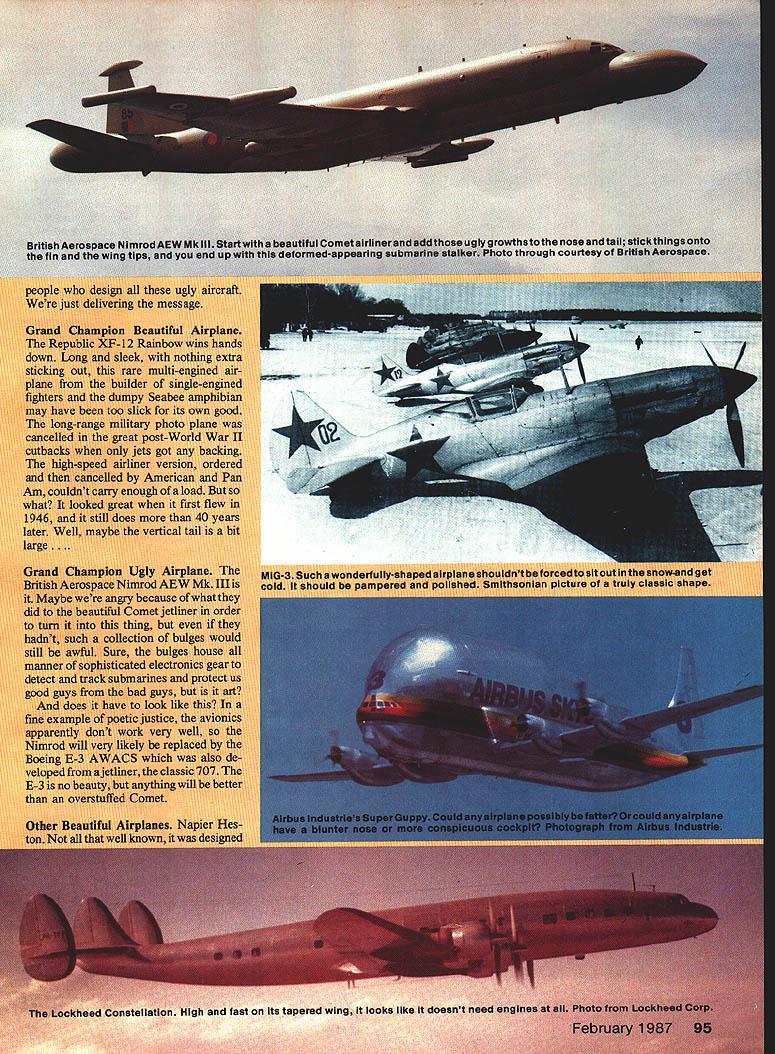
Beautiful and Ugly Airplanes
Two years ago we crawled out on a limb and dared you to whittle away at it. We knew we were taking a risk by choosing what we considered the most beautiful and most ugly aircraft, as there is a lot of personal feeling involved. Those of you who agreed with our choices were expected to remain silent, while those who disagreed with even one choice were expected to shout.
The reactions came thick and fast, though there was more agreement than we expected (unless the five who wrote with encouragement were the only ones among the almost 100,000 readers who weren't furious with our selections). By and large, you seemed to realize that we were having fun.
Our choice of the McDonnell F4 Phantom II as the Ugly of Uglies was greeted with the sort of derision we anticipated, even after we insisted that the choice was based on appearance alone. But despite our assurances that the performance, record, and emotional impact of an aircraft was to have no effect on its selection, a lot of you condemned us for insulting your favorite airplanes.
That was OK. The idea was to get you sufficiently fired up to write and tell us your views and personal choices, and it worked well. Not that we picked any of the airplanes for an ability to antagonize, but we suspected a few of them would cause people to smolder.
Now we're going to do it all over again, which suggests we learn slowly. We've gone through more books and photo collections, we've talked to other friends in many different branches of aviation, and we've reread the letters which the first article brought. We now have another set of beautiful and uglies: one Grand Champion and a bunch of runners-up in each category. You are not to assume that they supersede any of the winners from the first batch; maybe some are better (worse?), and maybe not. You are welcome to compare the two groups and draw your own conclusions.
The rules remain the same: the choices have been made on aesthetic grounds alone. It doesn't matter whether the aircraft flew well or badly, just as long as it flew at least once (well, with maybe one exception). After all, if it never flew, can we really call it an airplane?
The big problem is to rid our minds, at least temporarily, of everything but the appearance of the aircraft. What counts is shape and balance, proportion, and the flow of lines. Unfortunately, this is clearly impossible. Emotion sneaks in, followed by memory and old prejudices. To eliminate them completely would probably require a lobotomy, and it's doubtful that AMA would sit still for that. Brain surgery has gotten incredibly expensive of late.
So we shall once again refuse to face our obvious limitations and charge ahead. Those of you who enjoy counting things will notice that there are more ugly aircraft than beautiful ones. It's true that this was also the case in the first article, but please don't take that as proof that the author dislikes aircraft in general. Instead, blame it on the people who design all these ugly aircraft. We're just delivering the message.
Having recouped from the bombardment he took on his first "Ugly" article, our intrepid historical writer forges ahead and dares once again to make his picks for the world's most beautiful and ugly airplanes. — Don Berliner
Grand Champion Beautiful Airplane
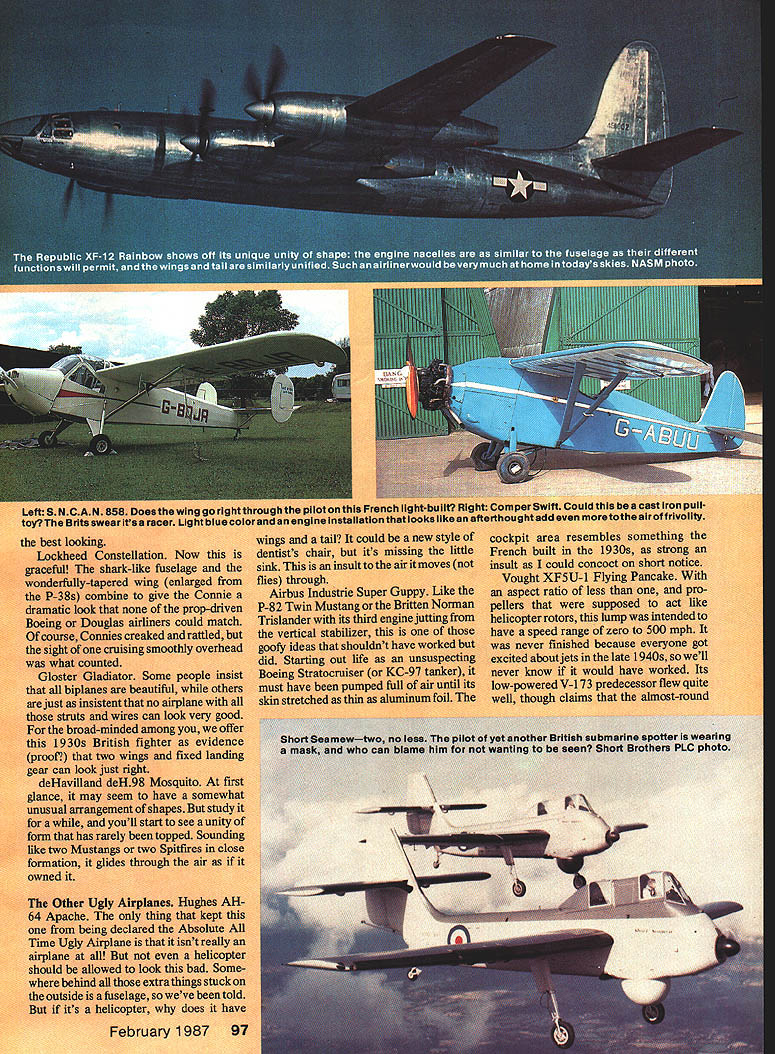
Republic XF-12 Rainbow
The Republic XF-12 Rainbow wins hands down. Long and sleek, with nothing extra sticking out, this rare multi-engined airplane from the builder of single-engined fighters and the dumpy Seabee amphibian may have been too slick for its own good. The long-range military photo plane was cancelled in the great post-World War II cutbacks when only jets got any backing. The high-speed airliner version, ordered and then cancelled by American and Pan Am, couldn't carry enough of a load. But so what? It looked great when it first flew in 1946, and it still does more than 40 years later. Well, maybe the vertical tail is a bit large.
Grand Champion Ugly Airplane
British Aerospace Nimrod AEW Mk. III
The British Aerospace Nimrod AEW Mk. III is it. Maybe we're angry because of what they did to the beautiful Comet jetliner in order to turn it into this thing, but even if they hadn't, such a collection of bulges would still be awful. Sure, the bulges house all manner of sophisticated electronics gear to detect and track submarines and protect us good guys from the bad guys, but is it art? And does it have to look like this? In a fine example of poetic justice, the avionics apparently don't work very well, so the Nimrod will very likely be replaced by the Boeing E-3 AWACS which was also developed from a jetliner, the classic 707. The E-3 is no beauty, but anything will be better than an overstuffed Comet.
Other Beautiful Airplanes
Napier-Heston Racer
Not all that well known, it was designed to break the world speed record of 469 mph set in 1939 by a nasty-looking (and nasty-flying) Messerschmitt Me 209 V. The Heston was powered by a 2,300 hp, 24-cylinder Napier Sabre engine and had an estimated top speed of 480 mph. It might well have broken the record, except that it crashed on its first flight in 1940; a second one was never completed. Still, it looks as fast as anything that ever used a propeller, and any airplane that looks that fast looks great.
Lockheed U-2
It looks sinister, and it is. It also looks a lot like a sailplane, most of which are beautiful. The simplicity of line and lack of protrusions (at least on the early versions) give it a certain elegance. At its cruising altitude around 100,000 feet, it reportedly is a real handful. But a beautiful airplane should be flown low where people can enjoy it. Then they could replace its terribly expensive high-altitude cameras by a couple of Instamatics and save a lot of money. One problem with this quite special airplane is that it doesn't have a name! If you have any suggestions, why not write to Lockheed with a carbon to Model Aviation?
de Havilland DH.89A Rapide
OK, this one will probably start some arguments, since its particular brand of beauty may not be evident to all. But remember, it's a twin-engined biplane airliner, which puts an extra burden on it. Others of this rare breed, such as the Curtiss Condor, are kinda dumb looking, and most bombers with two wings and two engines look really bad. The Rapide, however, retains a pleasing balance and charm.
Cessna Airmaster
This is the pre-World War II airplane that reappeared after the war (with spring landing gear) as the lovely Cessna 195. There are definite similarities to the Monocoupe, which is a point in its favor. Not many have survived, but those still flying are treasured, and even basket cases are valuable. This is what a fast lightplane should look like.
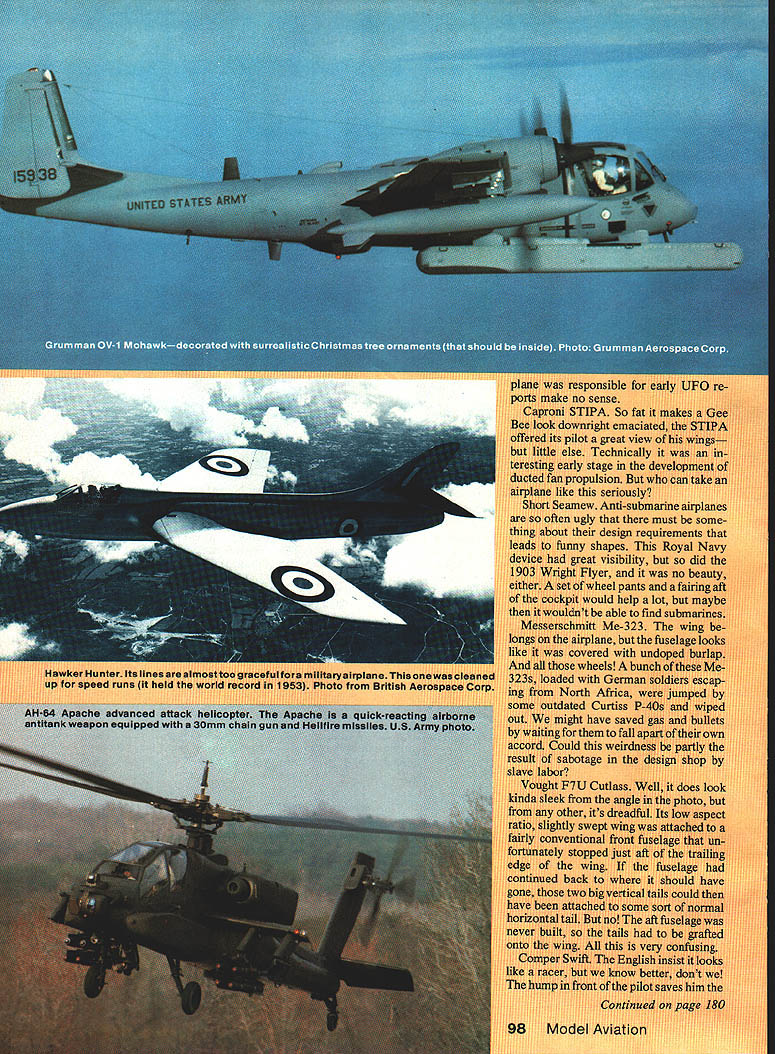
Hawker Hunter
Jet fighters have long ceased to be graceful and, well, airplane-looking. But the RAF standby of the 1950s is a true joy to observe. It didn't sacrifice any performance to achieve its looks, either. This particular Hunter held the World Speed Record in 1953. It must have been a ball to fly.
MiG-3
This looks suspiciously like thousands of sketches confiscated by annoyed geography teachers in the late 1930s and early 1940s. Except for the plain paint jobs and the snow on the field, this could be the pit area at some imaginary air race. The long nose and rear-set cockpit certainly make it look racy. It may not have been the best Soviet piston-engined fighter, having sacrificed armament for speed, but it was a handful to fly.
The Other Ugly Airplanes
Hughes AH-64 Apache
The only thing that kept this one from being declared the Absolute All Time Ugly Airplane is that it isn't really an airplane at all! But not even a helicopter should be allowed to look this bad. Somewhere behind all those extra things stuck on the outside is a fuselage, so we've been told. But if it's a helicopter, why does it have wings and a tail? It could be a new style of dentist's chair, but it's missing the little sink. This is an insult to the air it moves (not flies) through.
Airbus Industrie Super Guppy
Like the P-82 Twin Mustang or the Britten-Norman Trislander with its third engine jutting from the vertical stabilizer, this is one of those goofy ideas that shouldn't have worked but did. Starting out life as an unsuspecting Boeing Stratocruiser (or KC-97 tanker), it must have been pumped full of air until its skin stretched as thin as aluminum foil. The cockpit area resembles something the French built in the 1930s, as strong an insult as I could concoct on short notice.
Vought XF5U-1 Flying Pancake
With an aspect ratio of less than one, and propellers that were supposed to act like helicopter rotors, this lump was intended to have a speed range of zero to 500 mph. It was never finished because everyone got excited about jets in the late 1940s, so we'll never know if it would have worked. Its low-powered V-173 predecessor flew quite well, though. Claims that the plane was responsible for early UFO reports make no sense.
Caproni STIPA
So fat it makes a Gee Bee look downright emaciated, the STIPA offered its pilot a great view of his wings—but little else. Technically it was an interesting early stage in the development of ducted-fan propulsion. But who can take an airplane like this seriously?
Short Seamew
Anti-submarine airplanes are so often ugly that there must be something about their design requirements that leads to funny shapes. This Royal Navy device had great visibility, but so did the 1903 Wright Flyer, and it was no beauty, either. A set of wheel pants and a fairing aft of the cockpit would help a lot, but maybe then it wouldn't be able to find submarines.
Messerschmitt Me 323
The wing belongs on the airplane, but the fuselage looks like it was covered with undoped burlap. And all those wheels! A bunch of these Me 323s, loaded with German soldiers escaping from North Africa, were jumped by some outdated Curtiss P-40s and wiped out. We might have saved gas and bullets by waiting for them to fall apart of their own accord. Could this weirdness be partly the result of sabotage in the design shop by slave labor?
Vought F7U Cutlass
Well, it does look kinda sleek from the angle in the photo, but from any other, it's dreadful. Its low aspect ratio, slightly swept wing was attached to a fairly conventional front fuselage that unfortunately stopped just aft of the trailing edge of the wing. If the fuselage had continued back to where it should have gone, those two big vertical tails could then have been attached to some sort of normal horizontal tail. But no! The aft fuselage was never built, so the tails had to be grafted onto the wing. All this is very confusing.
Comper Swift
The English insist it looks like a racer, but we know better, don't we! The hump in front of the pilot saves him the discomfort of having to look at the silly little engine stuck onto the nose almost as an afterthought. Huge wheel pants might make it look less out of balance, and a nice round cowling would help too. But then it wouldn't be a Swift.
S.N.C.A.N. 858
This is a French idea of a lightplane. They seem to have stuck the front end of an Aeronca Champ (cute, but hardly beautiful) and the rear of an Ercoupe (not even cute) onto a pretty nondescript wing. The cockpit placing may give the pilot a good view of the world, but it makes the airplane look sort of unhappy.
Grumman OV-1 Mohawk
Why couldn't the customer (the U.S. Army) have told the designer that this thing was going to have to carry a lot of extra equipment so it could have been jammed inside? This lack of consideration resulted in an airplane with too much stuff hanging from it and a nose that belongs on a helicopter — a classic example of an airplane designed by committee.
All right, now it's your turn. Are there obviously beautiful and ugly airplanes we've missed? Have we called airplanes ugly that you are convinced are beautiful, or vice versa? Do you think our latest selections are brilliant or nonsensical? Think about it, and then do something about it (preferably with words). Who knows, we may even agree with you.
Transcribed from original scans by AI. Minor OCR errors may remain.

