
Beautiful and Ugly Airplanes
Here we go again! Two more years have passed, and your proudly humble reporter has another batch of ugly and beautiful airplanes for your consideration. An eclectic assortment, to be sure — they're at least as ugly or beautiful (one or the other, not both together) as those we've shown before. Some were suggested in your very well thought out letters; others are leftovers from prior deliberations; and still more came by way of lightning inspiration.
As before, we have based our selections purely on the visual content of the airplanes. No credit is allowed for historic significance, or for flight performance, or for any other emotional elements save the writer's brilliantly concealed prejudices. In order to keep things at least partially in perspective, you are referred to page 37 of the March 1987 issue of Model Aviation for a fine example of the writer's standard of true beauty. Airplanes can look great, but let's not get nutty about it!
As with the two previous installments of this open-ended (and possibly endless) series (March 1985 and February 1987), we shall pick a Grand Champion for both Beautiful and Ugly, followed by a large number of runners-up. Regardless of source, the choices are strictly those of the writer and almost certainly do not reflect the opinions of the Model Aviation staff or of AMA (none of whom were consulted, because who cares what they think?).
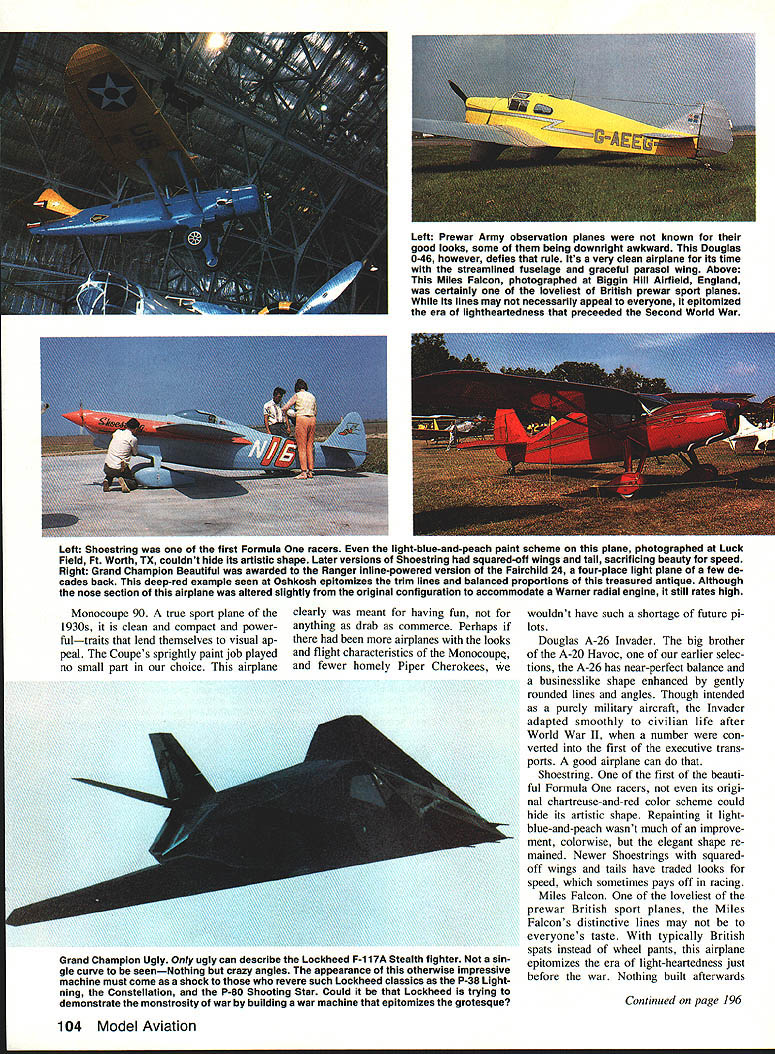
On to the serious stuff. To begin with, here's a scoop that you will not have read in Aviation Week or even the National Enquirer. It can now be revealed for the very first time in these pages that an airplane has been created expressly for the purpose of winning the title of Grand Champion Ugly. This unique (and appreciated) act was committed by none less than the venerable Lockheed Aircraft Company, in the form of its F-117A Stealth fighter. Why else would anyone create an airplane without a single curve? By comparison, Northrop's B-2 stealth bomber doesn't look bad at all, proving that it takes strong motivation and dedicated creativity to produce a really ugly stealth aircraft.
The appearance of this otherwise impressive little machine comes as a shock to those who revere such classic Lockheed beauties as the P-38 Lightning, the Constellation, and the P-80 Shooting Star. When queried about this sudden reversal of policy, the best that the Lockheed spokesman could manage was a kind of gurgle. (We probably caught him off-guard!)
Of course, there are those who offer a very different explanation for the ghastly lines of the F-117A. As these folks tell it, the airplane started life innocently enough as a conventional non-stealth design. Lockheed management realized what the creation looked like and decided to apply known stealth technique so people couldn't see it. Yet a third possibility comes to mind to explain the crude shape of the sneaky bird: could Lockheed actually be trying to demonstrate a monstrosity of warfare, building a machine that epitomizes the grotesque? Something that's especially suited to being beaten into a plowshare should war ever be renounced in favor of civilization. F-117A needs a tiller and a John Deere decal to look right at home behind a straw-hatted draft horse.
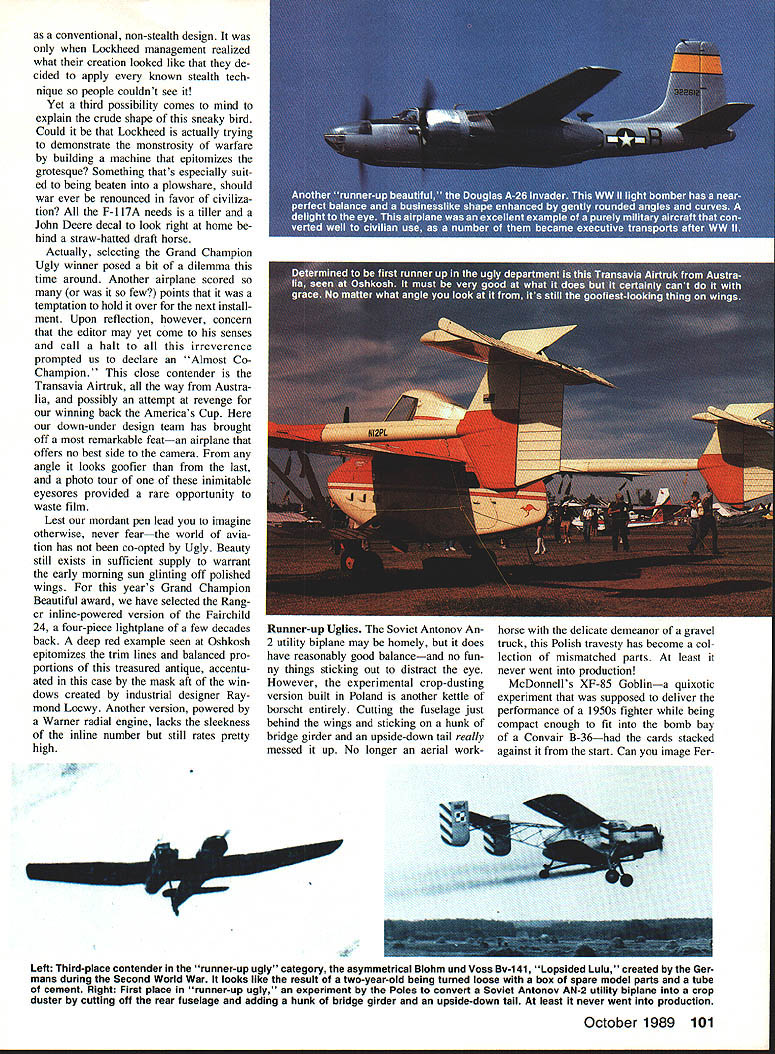
Actually selecting a Grand Champion Ugly winner posed a bit of a dilemma this time around. Another airplane scored a few points, and there was temptation to hold it over for the next installment. Upon reflection, however, our concern for the editor may yet come to his senses and call a halt to irreverence, which prompted us to declare an Almost Co-Champion. A close contender was the Transavia Airtruk of Australia — possibly attempting revenge for winning back the America's Cup down-under — whose design team has brought off a remarkable feat: an airplane that offers no best side; every camera angle looks goofier than the last. The inimitable eyesore provided a rare opportunity to waste film.
Lest the mordant pen lead you to imagine otherwise, never fear — the world of aviation has co-opted Beauty. Beauty still exists in sufficient supply; for the Grand Champion Beautiful award we have selected the Ranger inline-powered version of the Fairchild 24 four-place lightplane. A deep red example seen at Oshkosh epitomizes trim lines and balanced proportions, a treasured antique accentuated by the aft windows created by industrial designer Raymond Loewy. Another version powered by the Warner radial engine lacks the sleekness of the inline number but still rates pretty high.
Grand Champion Ugly
Lockheed F-117A Stealth fighter — an airplane apparently created to win the Grand Champion Ugly title: faceted, devoid of curves, and startlingly at odds with Lockheed's classic lines.
Almost Co-Champion Ugly
Transavia Airtruk — an Australian design that manages to look progressively goofier from every angle; a truly inimitable eyesore.
Grand Champion Beautiful
Fairchild 24 (Ranger, inline-powered version) — a deep-red example seen at Oshkosh epitomizes trim lines and balanced proportions, enhanced by Raymond Loewy's aft windows. The Warner-radial-powered version is less sleek but still highly attractive.
Runner-up Uglies
- Antonov An-2 — The Soviet utility biplane may be homely, but it has reasonably good balance and no funny things sticking out to distract the eye. However, an experimental crop-dusting version built in Poland is another kettle of borscht entirely: cutting the fuselage just behind the wings and attaching an upside-down bridge-girder tail really messed up the plane. No longer an aerial workhorse with a delicate demeanor, the gravel-truck Polish travesty became a collection of mismatched parts and, at least, never went into production.
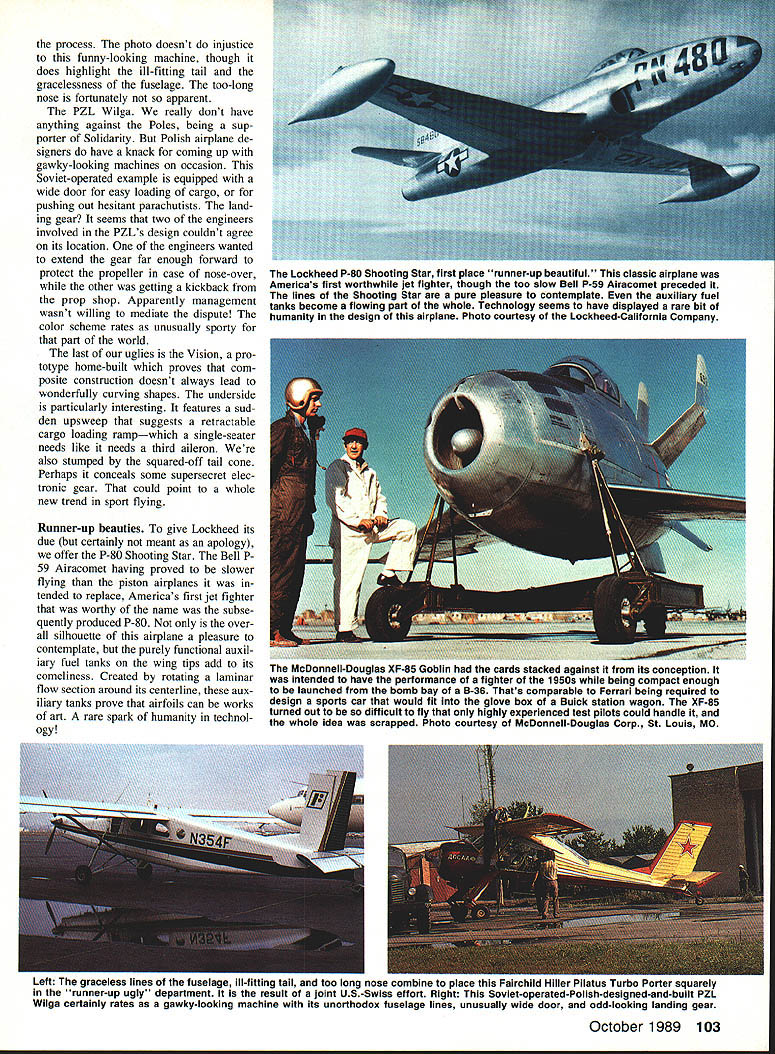
- McDonnell XF-85 Goblin — A quixotic experiment intended to deliver 1950s fighter performance while being compact enough to fit into the bomb bay of a Convair B-36. Can you imagine Ferrari building a sports car that had to fit into the glove compartment of a Buick station wagon? Still, did this have-your-cake-and-eat-it-too airplane have to look like a barrel with a bunch of feathers for a tail? The Goblin was so hard to operate with the carrier airplane that only a well-trained test pilot could manage it, and so the idea was scrapped. But the Air Force and the manufacturer deserve a Bronx cheer for trying.
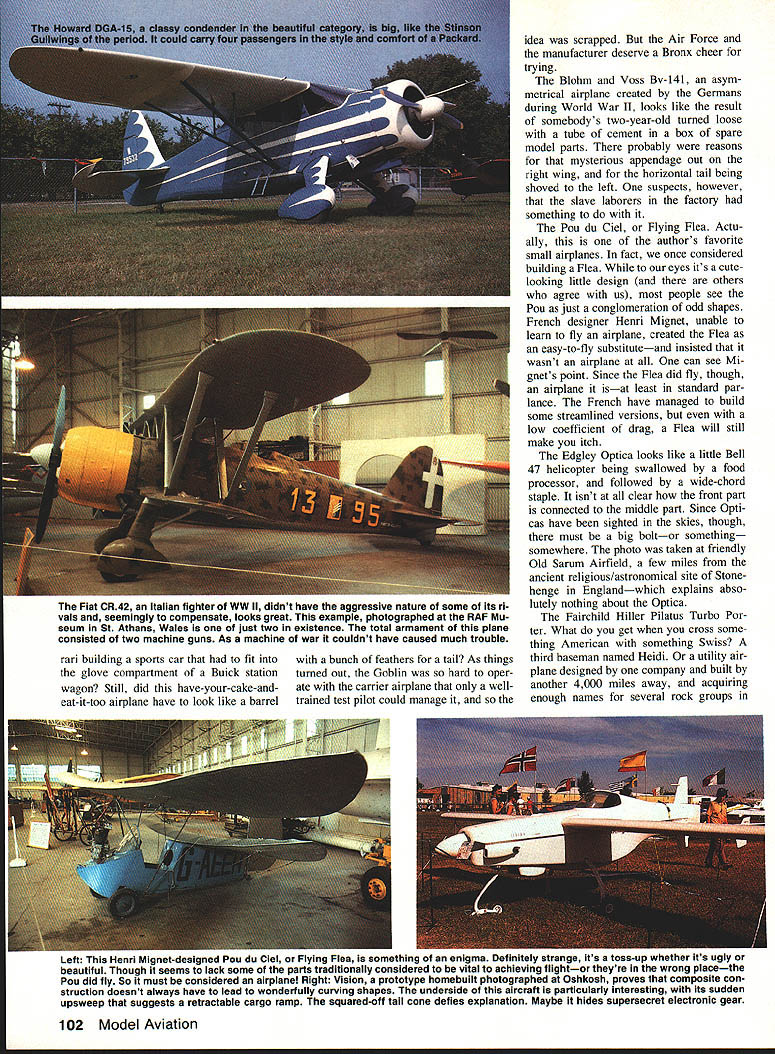
- Blohm & Voss BV 141 — An asymmetrical German World War II airplane that looks like the result of somebody's two-year-old turned loose with a tube of cement in a box of spare model parts. There probably were reasons for that mysterious cockpit pod out on the right and for the horizontal tail being shoved to the left, but one suspects factory conditions may have had something to do with it.
- Pou du Ciel (Flying Flea) — One of the author's favorite small airplanes and once considered for a personal build. While cute to some, most people see the Flea as a conglomeration of odd shapes. French designer Henri Mignet, unable to learn to fly conventional airplanes, created the Flea as an easy-to-fly substitute — and insisted that it wasn't an airplane at all. Since the Flea did fly, though, an airplane it is. Streamlined versions exist, but even with a low coefficient of drag, a Flea will still make you itch.
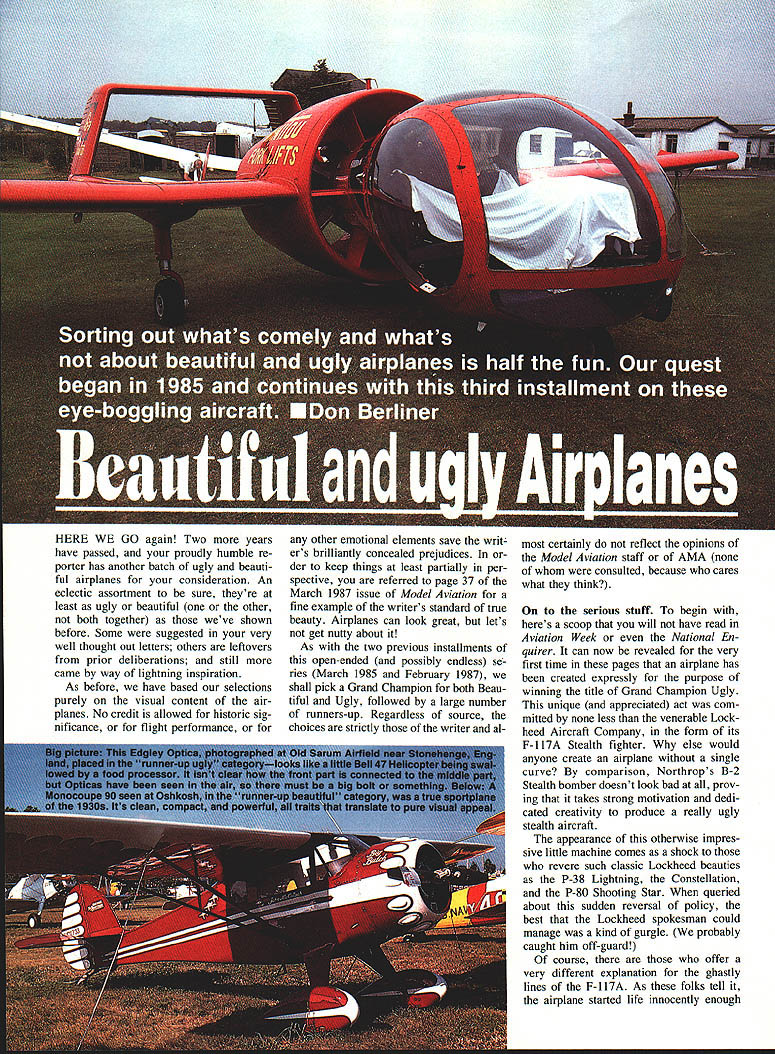
- Edgley Optica — Looks like a little Bell 47 helicopter being swallowed by a food processor and followed by a wide-chord staple. It isn't at all clear how the front part is connected to the middle part. Since Opticas have been sighted in the skies, though, there must be a big bolt—or something—somewhere. The photo was taken at friendly Old Sarum Airfield, a few miles from Stonehenge in England — which explains absolutely nothing about the Optica.
- Fairchild-Hiller Pilatus Turbo Porter — What do you get when you cross something American with something Swiss? A third baseman named Heidi. Or a utility airplane designed by one company and built by another 4,000 miles away, acquiring enough names for several rock groups in the process. The photo doesn't do this funny-looking machine injustice; it highlights the ill-fitting tail and the gracelessness of the fuselage. The too-long nose is fortunately not so apparent.
- PZL Wilga — Polish design tendencies occasionally produce gawky-looking machines. This Soviet-operated example is equipped with a wide door for easy cargo loading or for pushing out hesitant parachutists. The landing gear? It seems two of the engineers couldn't agree on its location: one wanted the gear far enough forward to protect the propeller in a nose-over, while the other was getting a kickback from the prop shop. Management apparently wasn't willing to mediate. The color scheme is unusually sporty for that part of the world.
- Vision (prototype home-built) — A prototype that proves composite construction doesn't always lead to wonderfully curving shapes. The underside features a sudden upsweep that suggests a retractable cargo loading ramp — which a single-seater needs like it needs a third aileron. The squared-off tail cone is puzzling; perhaps it conceals some supersecret electronic gear. That could point to a whole new trend in sport flying.
Runner-up Beauties
- Lockheed P-80 Shooting Star — America's first jet fighter worthy of the name after the P-59 Airacomet. The overall silhouette is a pleasure to contemplate, and the purely functional auxiliary fuel tanks on the wing tips, created by rotating a laminar-flow section around its centerline, add to its comeliness. A rare spark of humanity in technology.
- Monocoupe 90 — A true 1930s sport plane: clean, compact, and powerful. The Coupe's sprightly paint job played no small part in its appeal. This airplane was clearly meant for having fun, not for anything as drab as commerce. If there had been more airplanes with the looks and flight characteristics of the Monocoupe and fewer homely Piper Cherokees, perhaps we'd have a larger pool of future pilots.
- Douglas A-26 Invader — The big brother of the A-20 Havoc and a near-perfect example of balance and businesslike shape, enhanced by gently rounded lines and angles. Though intended as a purely military airplane, the Invader adapted smoothly to civilian life after World War II when some were converted into executive transports. A good airplane can do that.
- Shoestring — One of the first beautiful Formula One racers. Not even its original chartreuse-and-red color scheme could hide its artistic shape. Repainting it light-blue-and-peach wasn't much of an improvement colorwise, but the elegant shape remained. Newer Shoestrings with squared-off wings and tails have traded looks for speed, which sometimes pays off in racing.
- Miles Falcon — One of the loveliest prewar British sport planes, the Miles Falcon's distinctive lines may not be to everyone's taste. With typically British spats instead of wheel pants, this airplane epitomizes the era of light-heartedness just before the war. Nothing built afterwards succeeded in recapturing that spirit.
- Howard DGA-15 — The original Howard DGA-15 lineage began with the Monocoupe and then an enlarged version designed by Ben Howard dubbed "Mr. Mulligan," the only high-wing airplane to win a Thompson Trophy race. The little interwar production edition of that racer is the inspired DGA-15. Like the Stinson Gullwing of the same period, it is a big airplane capable of carrying four passengers in Packard-sedan comfort with plenty of headroom and foot room.
- Fiat CR.42 — Italian World War II fighters lacked the aggressive impact of their rivals, but some looked rather romantic, which arguably makes more sense than being militant. The surviving examples display novel interplane struts to good advantage. With only two machine guns, though, such an airplane could hardly have caused much trouble.
- Lancair — The introduction of composite construction into the home-built airplane hobby has led to some of the most striking designs ever seen and to quantum jumps in performance. Complex curves are as easy to form as flat sides, and builders with an artistic flair can produce trim little two-seaters like this Lancair. Equipped with only a 120-hp engine, a well-built Lancair 235 will cruise at better than 200 mph, putting many modern factory-built two-seaters to shame.
- Douglas O-46 — Prewar Army observation planes were not known for their good looks; some were downright awkward. This Douglas example was particularly clean for its time. That graceful parasol wing might have been designed by Bill Barnes, the fictional hero of the day.
Being a purist, the author resisted the temptation to include a sizeable assortment of other airplanes, each of which briefly claimed his attention. These also-ran designs are more cute than beautiful, or more dopey and dumb-looking than ugly. We'll stick to the straight and narrow, rather than modify our rules.
Providing we can count on our readers' help in replenishing our stock of beauties and uglies, we'll be back with still another assortment for your perusal.
If you should disagree strongly with any of these latest selections, please let us know — while offering some suggestions of your own. Who knows? If we do bring you a fourth installment of this series, it may include a contest to pick the All-Time Champions, with first prize being the winner's choice of either the title to the AMA headquarters building or a case of diet soda pop.
Transcribed from original scans by AI. Minor OCR errors may remain.

