


Beautiful & Ugly
Don Berliner
Once again, years have streaked by, and it's time to search the multifaceted world of aviation for flying machines whose appearance is either especially pleasing or especially displeasing. Note: appearance—not performance, technical significance, emotional appeal, or historical impact—is the operative word here.
It isn't easy, but occasionally someone has to take a calm, cool, purely intellectual look at a wide variety of flying machines and judge them solely on their aesthetic appeal.
In line with what have become almost hallowed traditions, I shall pick a Grand Champion Ugly and a Grand Champion Beautiful, as well as a bunch of runners-up—those that couldn't quite meet the standards (one way or the other) of this history-making competition.
In the past, we've found some truly outstanding examples deserving of Grand Champion status. Uglies: the McDonnell Douglas F-4 Phantom II, the BAe Nimrod AEW.3, and the Lockheed F-117 Stealth fighter. And we've found some truly outstanding Beautifuls: the Supermarine Spitfire I, the Republic XF-12 Rainbow, and the Fairchild F-24.
The final choices are strictly mine, with an appreciative tip of the cap to a lot of readers who have suggested particularly fine choices for stardom. This is very much a participation sport. Don't sit there and grumble and compose silent threats; take pen to paper, and let the editors know how you feel. But make your position clear: Do you want your large financial contribution (small ones will be ignored, but not returned) to go toward the purchase of blocks of granite for a statue of the author or for bags of cement to make him a new pair of custom-made shoes? This is no time to be shy.
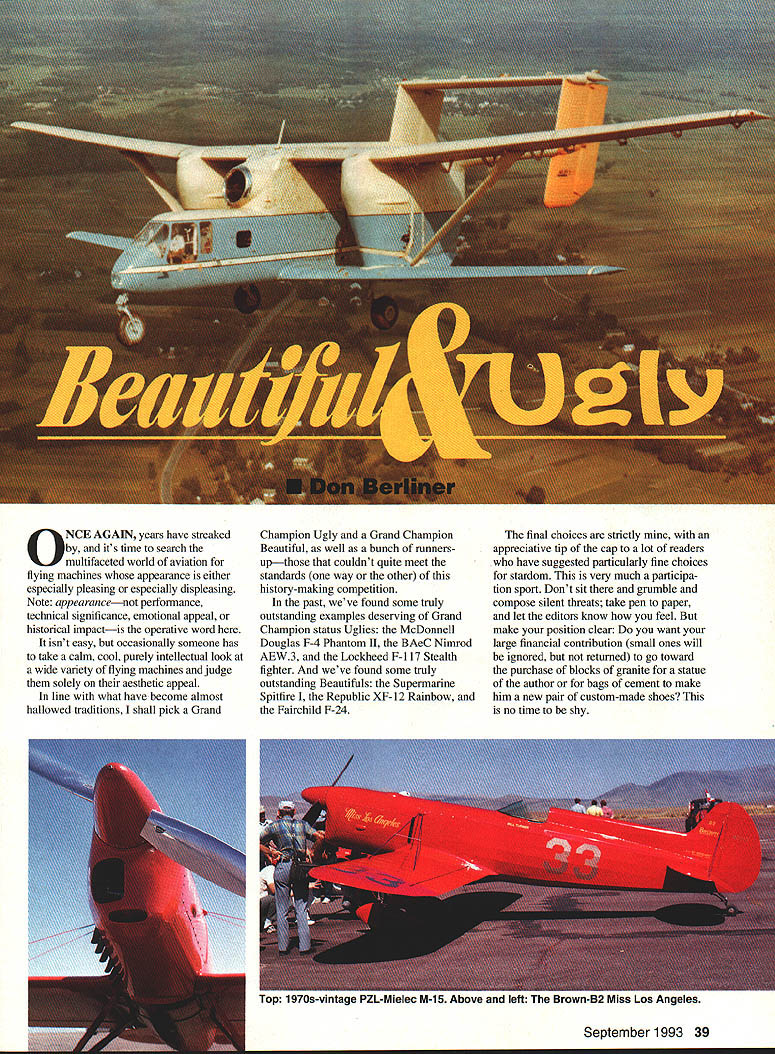
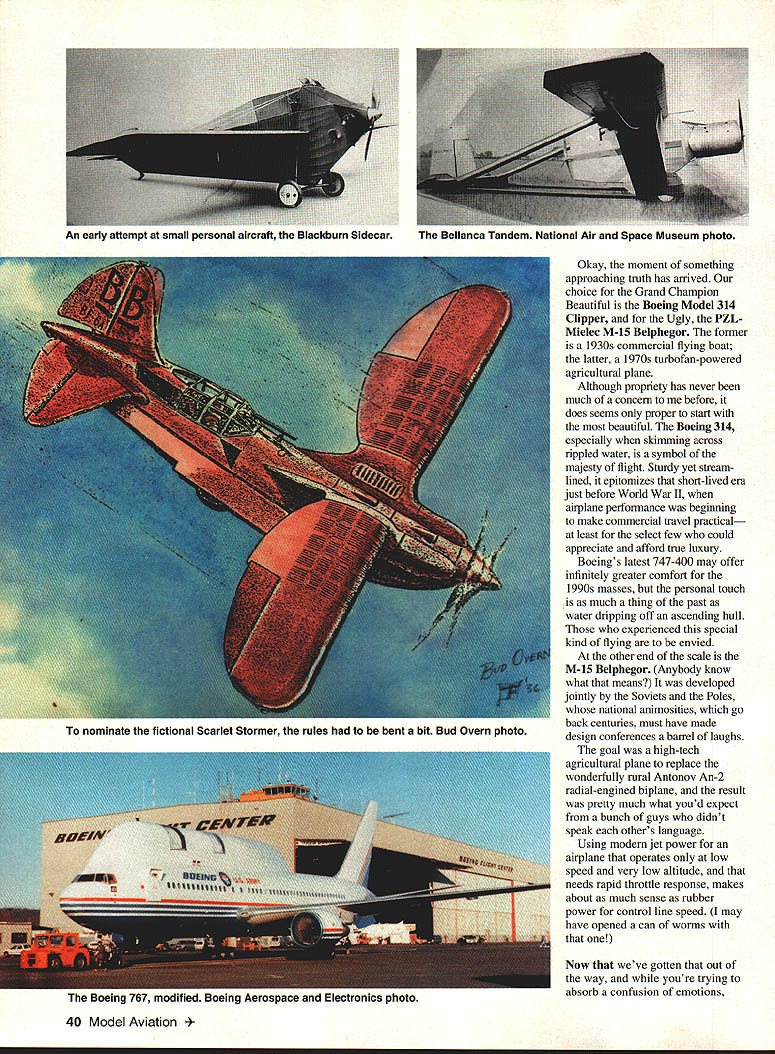
Okay, the moment of something approaching truth has arrived. Our choice for the Grand Champion Beautiful is the Boeing Model 314 Clipper, and for the Ugly, the PZL-Mielec M-15 Belphegor. The former is a 1930s commercial flying boat; the latter, a 1970s turbofan-powered agricultural plane.
Grand Champions
- Grand Champion Beautiful — Boeing Model 314 Clipper
The Boeing 314, especially when skimming across rippled water, is a symbol of the majesty of flight. Sturdy yet streamlined, it epitomizes that short-lived era just before World War II, when airplane performance was beginning to make commercial travel practical—at least for the select few who could appreciate and afford true luxury. Boeing's latest 747-400 may offer infinitely greater comfort for the 1990s masses, but the personal touch is as much a thing of the past as water dripping off an ascending hull. Those who experienced this special kind of flying are to be envied.
- Grand Champion Ugly — PZL-Mielec M-15 Belphegor
At the other end of the scale is the M-15 Belphegor. It was developed jointly by the Soviets and the Poles, whose national animosities, which go back centuries, must have made design conferences a barrel of laughs. The goal was a high-tech agricultural plane to replace the wonderfully rural Antonov An-2 radial-engined biplane, and the result was pretty much what you'd expect from a bunch of guys who didn't speak each other's language. Using modern jet power for an airplane that operates only at low speed and very low altitude, and that needs rapid throttle response, makes about as much sense as rubber power for control-line speed.
Now that we've gotten that out of the way, and while you're trying to absorb a confusion of emotions, we'll move along to the also-rans. There really should be a less insulting term for those that came so close to winning.
Almost-Champion Beautifuls
- Scarlet Stormer (mythical)
Nominated by Bud Overn of Santa Ana, California, this is Bill Barnes's BF-6A, an amphibious pursuit plane with a V-12 engine and contra-rotating propellers, circa 1936. Most conspicuous is the gracefully tapered gull wing, reminiscent of the Hall Bulldog—an unsuccessful but great-looking entrant in the 1932 Thompson Trophy race. Like a lot of pursuit planes of the early and mid-1930s, the Stormer was never required to demonstrate its ability to fight and survive.
- Lockheed P-38 Lightning
The P-38 was the first creation of the late Kelly Johnson, perhaps the finest designer of airplanes. Its sleek form was a major jump forward in the immediate pre-World War II era and showed how unprecedented power could be tucked neatly into a minimum airplane. A cross-country sprint by the prototype at 400 mph made the services sit up and take notice, yet they were never able to cobble up the classic lines of the best American twin-engined fighter of the day. Besides, a P-38 sounds even sweeter than a Spitfire, a Mustang, or a Mosquito.
- Johnson Rocket
One of a flood of new planes that appeared almost as soon as the smoke of World War II had cleared, the Rocket offered a very modern look and modern performance. Offering 160 mph cruising speed on just 185 hp, it was aimed at returning fighter pilots who craved something more exciting than 90 mph Piper Cubs and Aeroncas. It was a two-seat, personal version of a Mustang. Financial problems put an end to production after fewer than 20 had been built; today they are collectors' items, looking much younger than their 45 years.
- Dassault Falcon 20 (Mystère)
Some people still insist that there are airplanes and there are jets. For many categories, propellers just don't make much sense—one example is executive or business transports. Of the dozen or so bizjets produced, the French Falcon 20 is easily the best looking: simple, well balanced, and businesslike in form. Most are painted white with one or two horizontal color stripes to emphasize the speed of the craft.
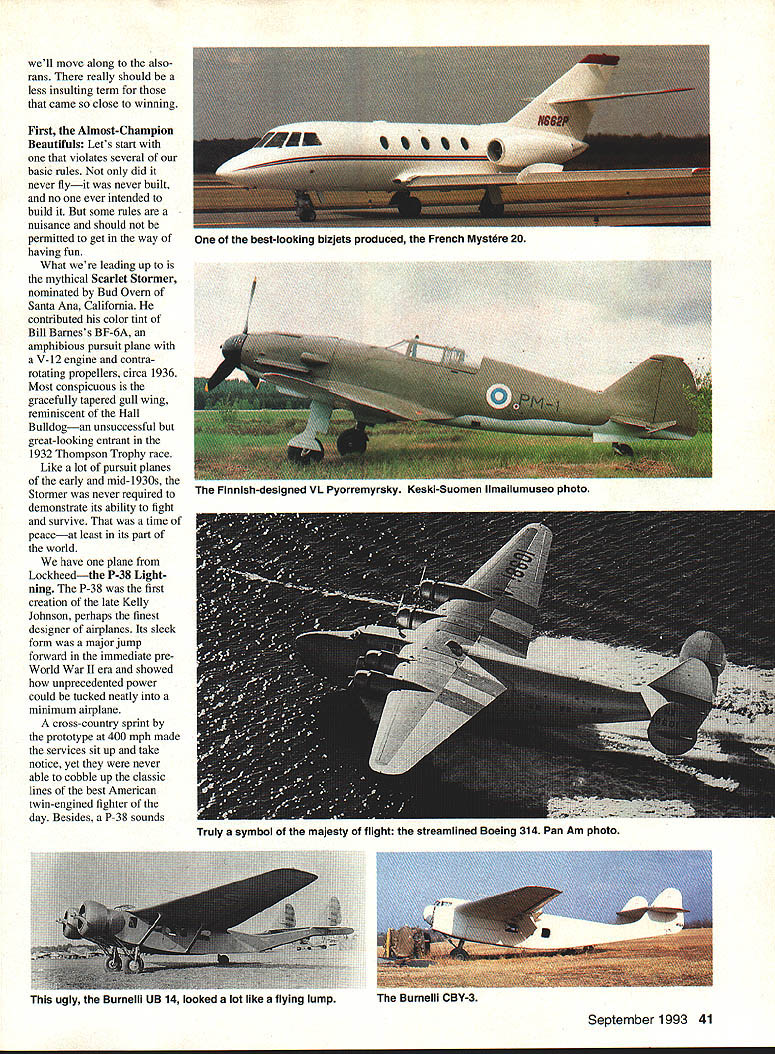
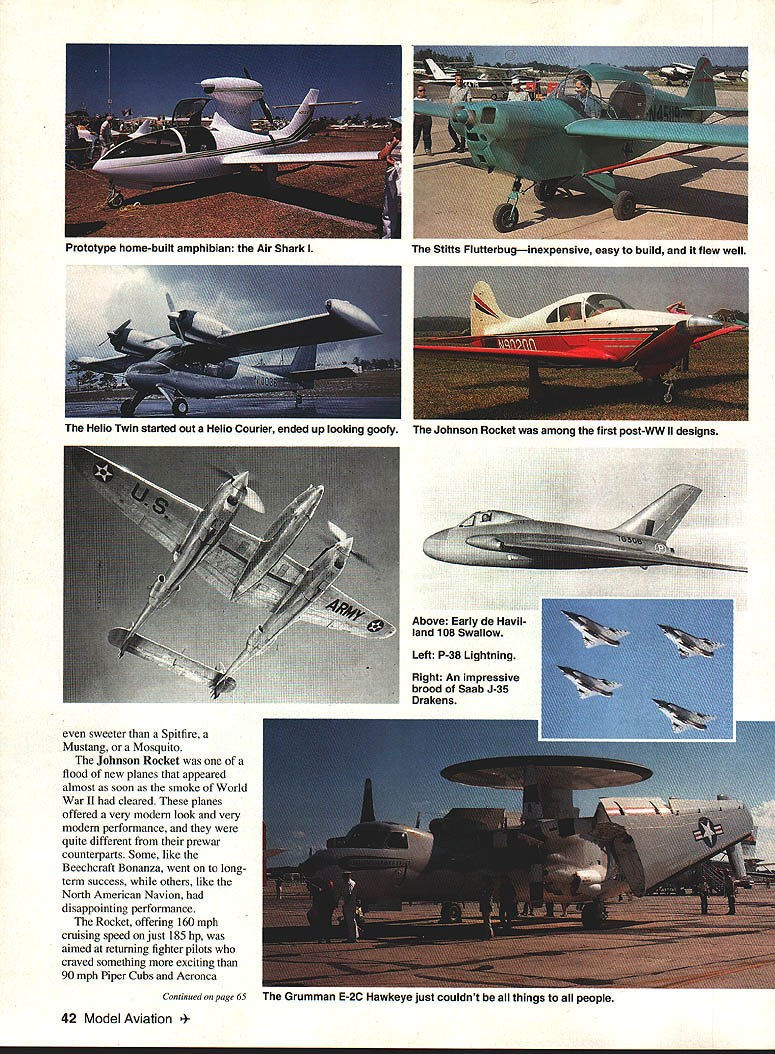
- Brown B-2 Miss Los Angeles
Long and slim with a tiny windshield, brilliant red paint, and exotic gold numbers and name, the Brown B-2 forced the pilot to wear that glamorous leather helmet (unless, of course, he was bald). The tight cowl completely enclosed a potent six-cylinder Menasco engine, while individual exhaust stacks gave the airplane both the look and the sound of power. Bill Turner’s reproduction preserves that racing elegance.
- Saab J-35 Draken
The Draken's double delta and triangular vertical tail fit the rest of the airplane. A quartet of them swooshing through the sky over southern Sweden looks dramatic without being overly aggressive.
- Air Shark I
A prototype home-built amphibian, the Air Shark I lacks many compromises forced on other small amphibious aircraft. Its hull is inconspicuous and the rest of its airframe is clean and devoid of protrusions. Though the old Constellation may have had a more sharklike fuselage, this new composite creation looks like it might—with a few minor adjustments—be able to serve as a submarine.
- VL Pyörremyrsky
A Finnish World War II-era design patterned after the Messerschmitt Bf-109, it lacks the harshness of line and some of the bulges that characterize the German fighter. The only Pyörremyrsky left is fully restored and on display in a Finnish museum, where it looks a lot better than the locally-built Brewster Buffalo housed in the same museum.
- de Havilland D.H.108 Swallow
One of the very first airplanes with swept wings and no horizontal tail, the D.H.108 was startling when it first appeared in 1946. While all three experimental prototypes were eventually lost in crashes, they produced data that led to successful swept-wing jets. The risky combination of a Vampire fuselage with a new wing and vertical tail worked well, producing a faster and racier-looking airplane.
Uglies
- Burnelli UB-14
Called a flying wing despite the presence of tails and a fuselage, the UB-14 was really an airplane with a broad, carefully shaped lifting fuselage that acted like part of the wings. Its manufacturer claimed superior load capacity, but visually it looks like a flying lump—many would prefer to be transported in something that looks more like a DC-3.
- Modified Boeing 767 (Airborne Optical Adjunct)
While current airliners tend to follow familiar design rules, somebody can always get playful. One example is a Boeing 767 reduced to the impersonal status of the Army Strategic Defense Command's "Airborne Optical Adjunct," complete with an 86-foot-long cupola housing infrared sensors and data processors. The odd big doors on top and the cupola upset the airplane's otherwise clean lines.
- Helio Twin
Based on the Helio Courier, which can take off and land almost as short as a BAE Harrier and can fly amazingly slowly, the Twin conversion stuck engines onto the wings and moved the landing gear so far forward that the proportions became goofy-looking. There has to be a better way to arrange those parts.
- Stitts Flutterbug
One of the first home-built designs to be available as commercial construction drawings, the Flutterbug was simple, inexpensive, and flew reasonably well. But it looks amateurish—home-builts should look good enough to fool naive people into thinking they were factory-built.
- Blackburn Sidecar
An early attempt at a small personal plane with side-by-side seating, the 1919 Sidecar had a ghastly appearance that might have doomed the light plane to instant oblivion. The six-foot-deep fuselage and five-inch-high windshield made it look like a nearsighted bug; the drastic taper on the cowl hid a 30 hp engine that couldn't get it off the ground.
- Bellanca Tandem
Bellanca built eccentric-looking airplanes that performed well, but the Tandem—with its overly long nose hiding two radial engines and a sponson-supported tail—is almost too much. The drive shaft for the rear prop exited the aft-facing rear engine and passed squarely through the cabin.
- Grumman E-2C Hawkeye
The E-2C shows what happens when you try to make one airplane do everything. The large gadget on top houses a radar dish, and carrier storage demands foldable wings, which hides much of the multiplicity of vertical tail pieces. The result is a functional but ungainly silhouette—if only someone had painted a funny face on the nose.
Well, there you have it: a mess of Beautiful and Ugly airplanes for you to think about when you have nothing productive to do. If any of these choices evoke a strong reaction, do something about it. If not, let us know, and we'll try harder next time. Oh, yes, there will definitely be a next time—you don't get off that easy!
Transcribed from original scans by AI. Minor OCR errors may remain.

