
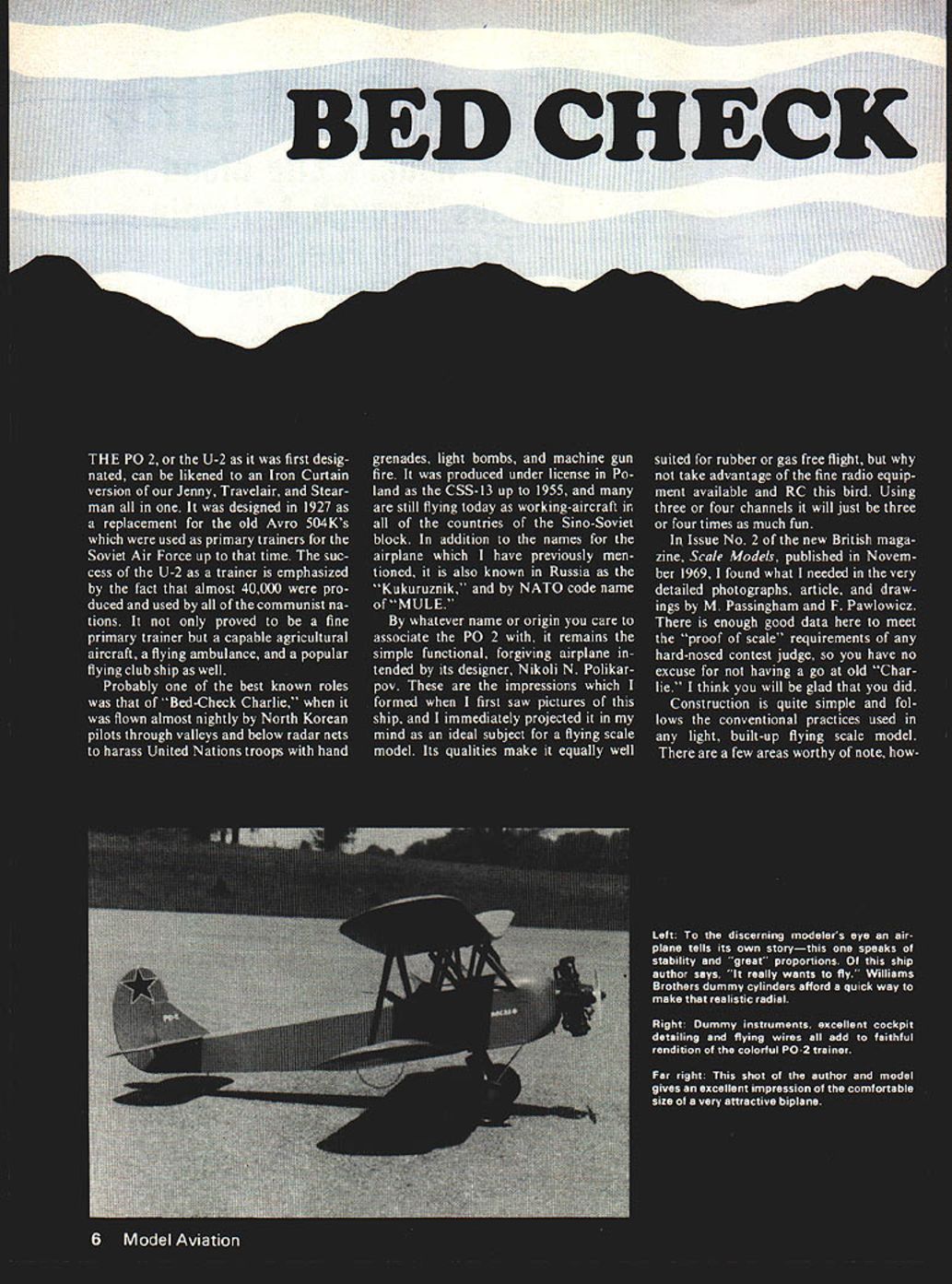
Bed Check Charlie
The Po-2, or the U-2 as it was first designated, can be likened to an Iron Curtain version of our Jenny, Travelair, and Stearman all in one. It was designed in 1927 as a replacement for the old Avro 504K's which were used as primary trainers for the Soviet Air Force up to that time. The success of the U-2 as a trainer is emphasized by the fact that almost 40,000 were produced and used by all of the communist nations. It not only proved to be a fine primary trainer but a capable agricultural aircraft, a flying ambulance, and a popular flying club ship as well.
Probably one of the best known roles was that of "Bed-Check Charlie," when it was flown almost nightly by North Korean pilots through valleys and below radar nets to harass United Nations troops with hand grenades, light bombs, and machine gun fire. It was produced under license in Poland as the CSS-13 up to 1955, and many are still flying today as working aircraft in all of the countries of the Sino-Soviet bloc. In addition to the names for the airplane which I have previously mentioned, it is also known in Russia as the "Kukuruznik," and by NATO code name of "MULE."
By whatever name or origin you care to associate the Po-2 with, it remains the simple, functional, forgiving airplane intended by its designer, Nikolai N. Polikarpov. These are the impressions which I formed when I first saw pictures of this ship, and I immediately projected it in my mind as an ideal subject for a flying scale model. Its qualities make it equally well suited for rubber or gas free flight, but why not take advantage of the fine radio equipment available and RC this bird. Using three or four channels it will just be three or four times as much fun.
In Issue No. 2 of the new British magazine, Scale Models, published in November, 1969, I found what I needed in the very detailed photographs, article, and drawings by M. Passingham and F. Pawlowicz. There is enough good data here to meet the "proof of scale" requirements of any hard-nosed contest judge, so you have no excuse for not having a go at old "Charlie." I think you will be glad that you did.
Construction is quite simple and follows the conventional practices used in any light, built-up flying scale model. There are a few areas worthy of note, how- however, which I would like to call your attention to. Note that after you construct the basic sides from 3/16" square balsa a 1/32" plywood inner-doubler is used back to the rear of the cockpits. Not only does this provide great strength and a cozy radio/servo/battery compartment, but it enables you to cover the model with fabric simulated material (silk, Silkspan, etc.) up to the cowling without sacrificing any strength and carrying out the scale effect to the maximum.
Join the sides and add the decking. 3/32" wire wing struts and 1/8" wire landing gear struts (faired with balsa), and set aside. That's all there is to it.
Next build the wings—this is easy since ailerons aren't necessary and all four panels are the same (left and right sides of course). The center section of the top wing should be quite sturdy as it mates to the struts for mounting. The center section of the bottom wing is the same width as the fuselage and, when removed, provides access to the radio/servo compartment. Laminate the tips from 1/16 X 1/4" balsa, using water thinned Titebond glue applied with a brush. A form outlining the tip (inside the tip bow) should be used for bending the laminations, and to hold them until the glue is dry. This makes a very strong tip which is light, accurate, and pleasing to the eye.
Use the same method for constructing the rudder and horizontal tailplane except construct the curved members from 1/16 X 3/16" balsa.
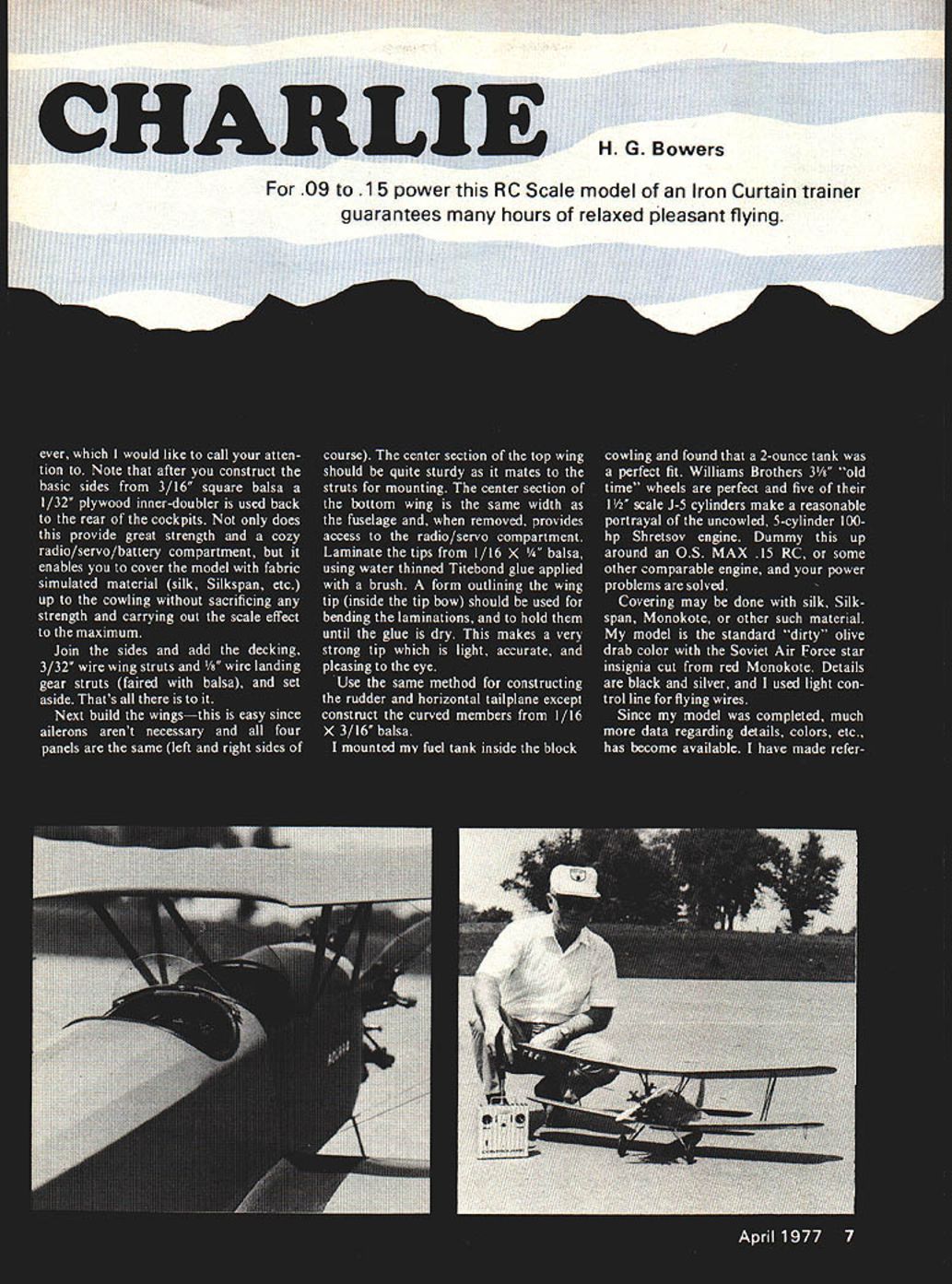
I mounted my fuel tank inside the block cowling and found that a 2-ounce tank was a perfect fit. Williams Brothers 3/8" "old time" wheels are perfect and five of their 1 1/2" scale J-5 cylinders make a reasonable portrayal of the uncowled, 5-cylinder 100-hp Shvetsov engine. Dummy this up around an O.S. MAX .15 RC, or some other comparable engine, and your power problems are solved.
Covering may be done with silk, Silkspan, Monokote, or other such material. My model is the standard "dirty" olive drab color with the Soviet Air Force star insignia cut from red Monokote. Details are black and silver, and I used light control line for flying wires.
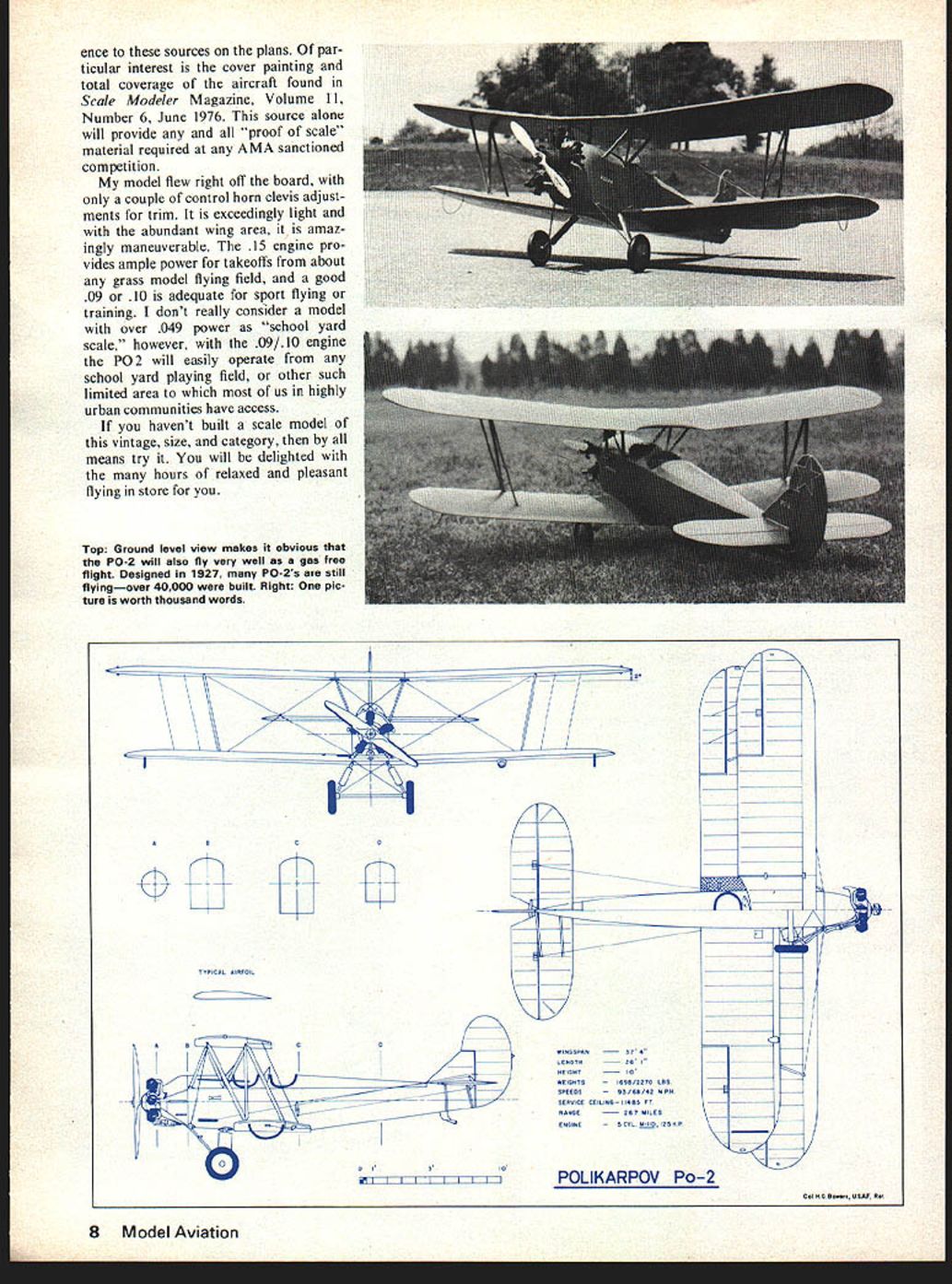
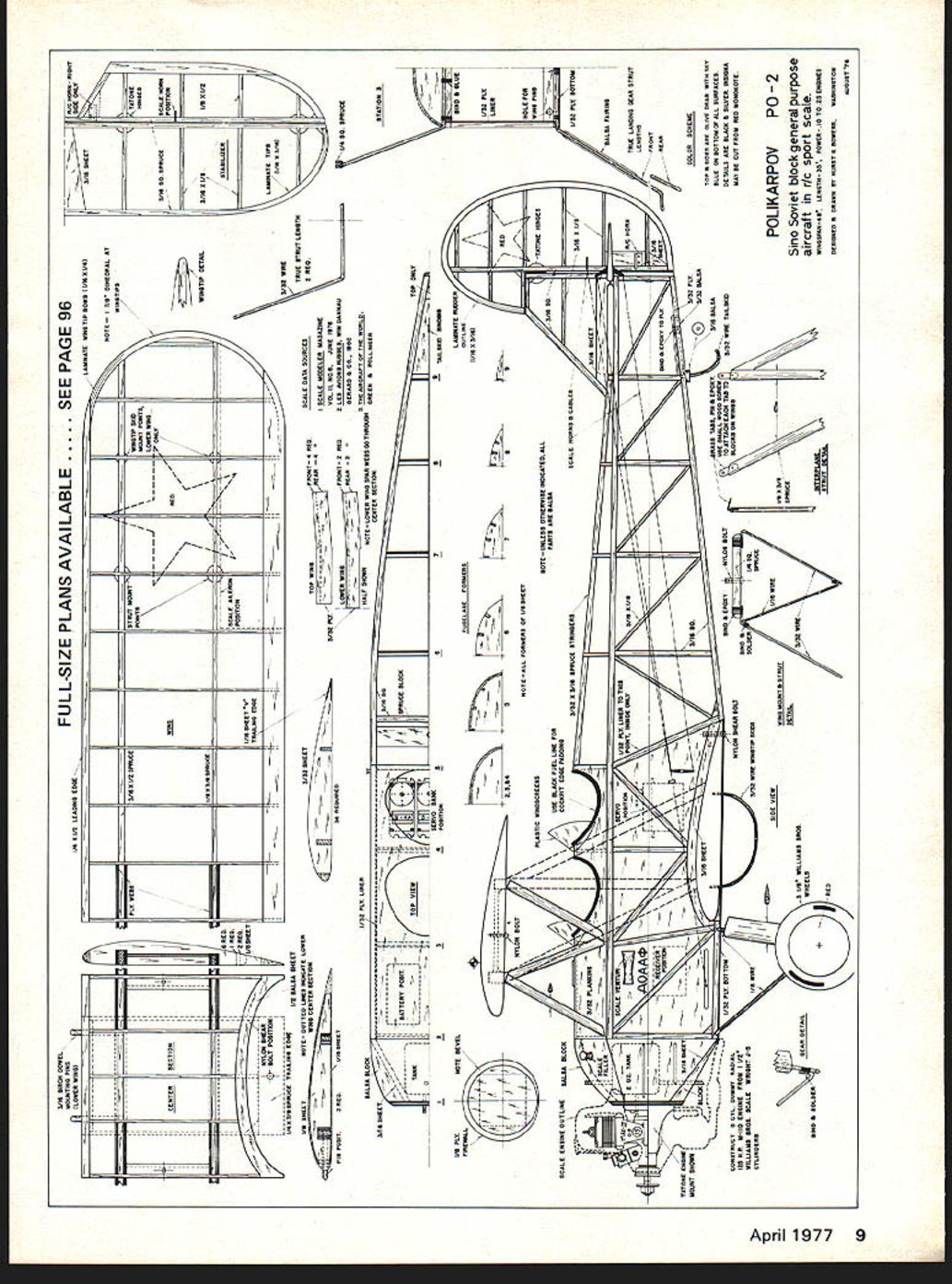
Since my model was completed, much more data regarding details, colors, etc., has become available. I have made refer- ence to these sources on the plans. Of particular interest is the cover painting and total coverage of the aircraft found in Scale Modeler Magazine, Volume 11, Number 6, June 1976. This source alone will provide any and all "proof of scale" material required at any AMA sanctioned competition.
My model flew right off the board, with only a couple of control horn clevis adjustments for trim. It is exceedingly light and with the abundant wing area, it is amazingly maneuverable. The .15 engine provides ample power for takeoffs from about any grass model flying field, and a good .09 or .10 is adequate for sport flying or training. I don't really consider a model with over .049 power as "school yard scale," however, with the .09/.10 engine the PO-2 will easily operate from any school yard playing field, or other such limited area to which most of us in highly urban communities have access.
If you haven't built a scale model of this vintage, size, and category, then by all means try it. You will be delighted with the many hours of relaxed and pleasant flying in store for you. Designed 1927, Po-2s are still flying — over 40,000 built.
Right picture is worth a thousand words.
Full-size plans available — see page 96.
Transcribed from original scans by AI. Minor OCR errors may remain.

